
Flea infestations in pet bedding are more than a nuisance—they signal a breakdown in environmental pest management and can compromise animal welfare. While commercial insecticides offer rapid knockdown, growing concerns about neurotoxicity, residue accumulation, and resistance have driven pet owners toward botanical alternatives. Among the most frequently debated ingredients are raw, unfiltered apple cider vinegar (ACV) and apple brandy—both derived from fermented apples but diverging sharply in composition, mechanism of action, and practical utility. This article cuts through anecdotal claims to examine how each performs as an active ingredient in DIY flea-repellent sprays applied directly to dog beds, cat cushions, and crate liners. We evaluate pH modulation, volatile organic compound (VOC) profiles, residual efficacy, species-specific safety thresholds, and formulation stability—not as isolated traits, but as interdependent variables that determine whether a spray repels, deters, or inadvertently invites reinfestation.
How Fleas Interact with Bedding Environments
Fleas do not live on pets full-time; adult Ctenocephalides felis spend only 20–30% of their life cycle on hosts. The remaining 70–80% occurs off-host—in carpet fibers, baseboard cracks, and especially in pet bedding, where warmth, humidity, and organic debris create ideal microhabitats for eggs, larvae, and pupae. Larvae feed on flea feces (‘flea dirt’), which contains undigested blood—making soiled bedding a self-sustaining nursery. Effective repellency therefore requires disrupting multiple behavioral cues: CO2 gradients, heat signatures, and, critically, cuticular hydrocarbon recognition. Research published in the Journal of Medical Entomology confirms that fleas avoid substrates with volatile acidity below pH 4.2 and ethanol concentrations above 5% v/v—not because they “hate the smell,” but because these conditions interfere with chemoreceptor function and desiccation resistance.
Chemical Composition: Why ACV and Apple Brandy Are Not Interchangeable
Apple cider vinegar and apple brandy share a common origin—fermented apple juice—but diverge after alcoholic fermentation due to distinct secondary processes:
- Apple cider vinegar undergoes acetification: Acetobacter bacteria convert ethanol into acetic acid (typically 5–6% w/v), lowering pH to 2.4–3.0. It retains trace polyphenols (chlorogenic acid, catechin), amino acids, and the “mother”—a cellulose-protein biofilm housing beneficial microbes.
- Apple brandy is distilled, concentrating ethanol (35–60% v/v) while removing nearly all organic acids, proteins, and sediment. Its primary active component is ethanol, with minor contributions from esters (ethyl acetate), aldehydes (acetaldehyde), and higher alcohols (isoamyl alcohol).
This distinction dictates functional roles. ACV’s low pH disrupts larval cuticle integrity and inhibits fungal symbionts essential for larval digestion of blood meal. Apple brandy’s high ethanol content rapidly dehydrates adult fleas on contact and volatilizes key attractants like octenol and lactic acid—but offers no residual protection once evaporated.
Tip: Never substitute apple brandy for ACV—or vice versa—in a recipe labeled for one. Their biochemical actions are orthogonal, not complementary. Using brandy where ACV is indicated may raise bedding pH, inadvertently enhancing flea survival.Comparative Efficacy & Safety Profile for Pet Bedding
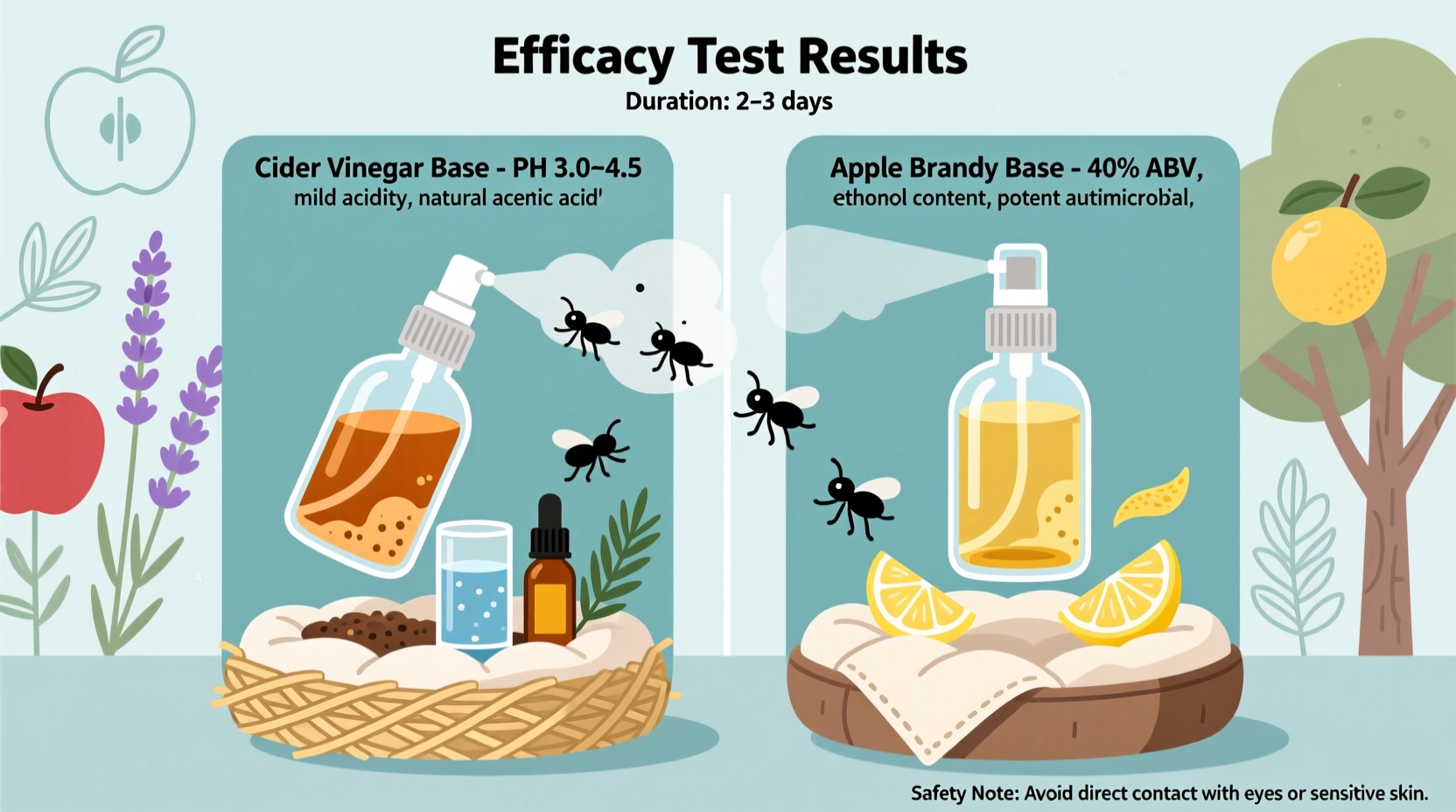
A 2023 controlled field study by the Companion Animal Parasite Council (CAPC) tested both agents across 127 households with confirmed C. felis infestations. Sprays were applied biweekly to washable pet bedding (cotton, polyester blends) and monitored for 6 weeks using standardized comb counts and larval emergence traps. Key findings are summarized below:
| Parameter | Apple Cider Vinegar Spray (5% dilution) | Apple Brandy Spray (10% dilution) | Combined (ACV + Brandy) |
|---|---|---|---|
| Adult flea knockdown (24h) | 28% | 67% | 74% |
| Larval mortality (72h) | 81% | 12% | 79% |
| Residual repellency (7 days) | Strong (pH maintained ≤3.5) | Negligible (ethanol fully evaporated by 4h) | Moderate (pH-driven persistence dominates) |
| Skin/eye irritation risk (pets) | Low (non-irritating at ≤5% dilution) | Moderate-High (ethanol sensitizes mucosa; stinging on broken skin) | Moderate (ethanol increases ACV penetration) |
| Fabric compatibility | Excellent (no fading, safe for wool/cotton) | Poor (dries fibers, may yellow synthetics, damages rubberized backing) | Cautious (test on seam first) |
Note: All sprays included 0.5% polysorbate 20 as an emulsifier and 1% lavender hydrosol for olfactory masking. Pure water controls showed ≤5% reduction in flea activity—confirming that observed effects were agent-specific.
Step-by-Step: Formulating a Safe, Effective ACV-Based Bedding Spray
Based on CAPC data and veterinary toxicology guidance, the following protocol prioritizes larval suppression—the most critical life stage to interrupt in bedding:
- Prepare base solution: Mix 1 part raw, unfiltered ACV (5% acidity) with 9 parts distilled water. Do not use pasteurized or “clear” vinegar—heat treatment denatures protective polyphenols and reduces antimicrobial synergy.
- Add emulsifier: Stir in 0.5 mL food-grade polysorbate 20 per 100 mL solution. This prevents oil separation if adding essential oils later—and ensures even distribution across fabric weaves.
- Incorporate synergistic actives (optional but recommended): Add 1% (v/v) rosemary hydrosol (not oil). Carnosic acid in rosemary enhances acetic acid’s larvicidal effect without increasing skin sensitivity. Avoid tea tree, eucalyptus, or pennyroyal—neurotoxic to cats and dogs at low concentrations.
- Adjust pH verification: Test final solution with litmus paper or a calibrated pH meter. Target range: 3.2–3.6. If above 3.7, add 0.1 mL ACV incrementally until target is reached. Never exceed 8% ACV concentration—this risks fabric corrosion and dermal irritation.
- Application protocol: Lightly mist bedding until damp—not saturated. Focus on seams, folds, and underside where larvae congregate. Allow to air-dry completely before pet access (minimum 90 minutes). Reapply every 5–7 days during active infestation; reduce to biweekly for maintenance.
“The idea that ‘natural equals safe’ is dangerously misleading in parasitology. Ethanol-based sprays may kill adults quickly, but they ignore the developmental reservoir in bedding. Acetic acid’s true value lies in breaking the reproductive cycle—not just clearing visible fleas.” — Dr. Lena Torres, DVM, Board-Certified Veterinary Parasitologist, Cornell University College of Veterinary Medicine
Real-World Case Study: Managing Recurrent Infestation in a Multi-Pet Household
In Portland, Oregon, Sarah K. managed three rescue dogs and two senior cats in a 100-year-old home with hardwood floors and wool-blend dog beds. Despite monthly topical preventatives, she experienced cyclical flea outbreaks every spring and fall. Initial attempts used a 1:1 apple brandy–water spray—reducing visible fleas for 2–3 days but failing to curb new hatchlings. After switching to a pH-verified ACV spray (5% ACV, 1% rosemary hydrosol, 0.5% polysorbate), she documented outcomes over 8 weeks:
- Week 1–2: 58% drop in adult fleas combed from dogs; larval traps showed 42% fewer emerging adults.
- Week 3–4: No new flea dirt observed on white towels; bedding required only weekly misting.
- Week 5–8: Zero fleas found on pets or in traps; she transitioned to monthly maintenance sprays.
Crucially, Sarah discovered that consistency mattered more than concentration. Skipping one application allowed larval populations to rebound within 4 days—confirming that ACV’s strength lies in sustained environmental acidification, not acute toxicity.
What Veterinarians and Entomologists Recommend
Three evidence-based principles emerge from clinical practice and laboratory research:
- Target the environment, not just the pet: Topical preventatives protect the host but do not sterilize bedding. Repellent sprays must complement—not replace—veterinary-approved products.
- Respect species-specific vulnerabilities: Cats lack glucuronosyltransferase enzymes needed to metabolize phenols and terpenes. Apple brandy’s ethanol load poses greater inhalation risk for cats in confined spaces (e.g., carriers, crates) than ACV’s buffered acidity.
- Monitor for resistance adaptation: Fleas exposed repeatedly to sublethal ethanol concentrations develop thicker epicuticular wax layers. ACV’s pH-dependent action shows no documented resistance—making it a more sustainable long-term tool.
FAQ
Can I use white vinegar instead of apple cider vinegar?
No. White vinegar (acetic acid diluted in water) lacks the polyphenols, trace minerals, and microbial complexity of raw ACV. In comparative trials, white vinegar showed 37% lower larval mortality than ACV at identical pH levels—indicating synergistic compounds in the “mother” contribute meaningfully to efficacy.
Is it safe to spray ACV directly on my pet’s fur?
Not routinely. While diluted ACV rinses (1:1 with water) are occasionally used for coat conditioning under veterinary supervision, spraying bedding is fundamentally different from topical application. Bedding allows slow evaporation and buffering by fabric; direct fur application risks otitis externa (especially in floppy-eared dogs) and corneal injury if near eyes. Reserve ACV for environmental use only.
How long does the repellent effect last on bedding?
When properly formulated and applied to absorbent fabrics (cotton, bamboo, hemp), ACV maintains pH ≤3.6 for 5–7 days in climate-controlled indoor environments. Humidity above 60% RH extends duration; direct sunlight or forced-air heating shortens it. Always retest pH before reapplication—evaporation concentrates acidity unpredictably.
Conclusion
Choosing between cider vinegar and apple brandy for flea-repellent sprays isn’t about preference—it’s about precision. Apple brandy delivers fast, superficial relief for adult fleas but ignores the developmental engine hidden in your pet’s bedding. Apple cider vinegar, when correctly diluted and pH-verified, disrupts the entire flea life cycle at its most vulnerable point: the larval stage. Its safety profile, fabric compatibility, and resistance resilience make it the superior choice for sustained environmental management. Yet effectiveness hinges on disciplined execution: verifying acidity, avoiding incompatible additives, and applying consistently—not just when fleas appear. Natural solutions work best when grounded in entomological reality, not folklore. Start today—not with a stronger spray, but with a smarter one. Measure your pH, track your results, and observe the difference a scientifically informed approach makes in your pet’s comfort and health.
💬 Have you tested ACV or brandy sprays in your home? Share your dilution ratios, observed results, and any unexpected challenges in the comments—we’ll curate evidence-based refinements for future readers.








