Searing a steak is more than just cooking—it’s about creating flavor through the Maillard reaction, that rich browning process that turns a simple cut of meat into something extraordinary. But achieving that perfect crust without filling your kitchen with smoke is a common challenge. Two of the most popular pans in modern kitchens—cast iron skillets and non-stick pans—are often pitted against each other in this battle. So which one truly delivers superior searing with minimal smoke? The answer isn’t as straightforward as it seems, and depends on material science, technique, and expectations.
The Science Behind Searing and Smoke
Searing occurs when high heat rapidly raises the surface temperature of meat past 300°F (149°C), triggering the Maillard reaction—a chemical process between amino acids and sugars that produces deep, savory flavors and an appetizing brown crust. However, when fats reach their smoke point, they begin to break down, releasing acrid smoke and potentially harmful compounds. This is where the choice of cookware becomes critical.
Different materials conduct and retain heat differently, which affects how quickly and evenly a steak browns—and whether that process stays under control or turns into a smoky disaster.
Tip: Always pat your steak dry before searing—moisture prevents browning and increases splatter, raising the risk of smoke.Cast Iron Skillet: The High-Heat Champion
Cast iron has long been hailed as the gold standard for searing steaks. Its dense structure allows it to absorb, store, and distribute heat exceptionally well. Once properly preheated, a cast iron skillet maintains a consistent surface temperature even when a cold steak hits the pan. This thermal stability is crucial for achieving an even sear without hot spots.
Moreover, seasoned cast iron develops a natural non-stick surface over time, enhancing its ability to release food cleanly after searing. Because of its high heat tolerance—often exceeding 500°F (260°C)—it can handle the temperatures needed for effective Maillard browning without degrading.
However, there’s a trade-off: while cast iron excels at heat retention, it also promotes more smoke during searing, especially if oil with a low smoke point (like extra virgin olive oil) is used. Even high-smoke-point oils like avocado or refined grapeseed can begin to smoke when pushed beyond 450°F. And since cast iron gets very hot, managing ventilation becomes essential.
“Cast iron gives you restaurant-level sear capability at home, but only if you respect its power. It’s not just a pan—it’s a heat engine.” — Chef Marcus Tran, Culinary Instructor at Pacific Kitchen Academy
Non-Stick Pan: The Low-Smoke Contender
Non-stick pans, typically made with aluminum cores coated in PTFE (Teflon) or ceramic, are designed for convenience and easy cleanup. They require little to no oil, reducing fat intake and minimizing smoke from burning fats. On paper, this makes them ideal for low-smoke cooking.
But here’s the catch: most traditional non-stick coatings start to degrade around 500°F (260°C). At temperatures above this threshold, the coating can emit fumes that are harmful to birds and potentially irritating to humans. More importantly, these pans cannot sustain the high heat required for proper steak searing without risking damage.
As a result, when you place a thick-cut ribeye in a non-stick pan, the surface rarely reaches optimal browning temperature. Instead of crisping, the steak tends to steam or gray out, producing a pale, uneven finish. Even thinner cuts struggle to develop deep color because lowering the heat to protect the coating sacrifices sear quality.
Ceramic non-stick pans fare slightly better, with some rated up to 850°F, but they still lack the thermal mass of cast iron. They heat quickly but cool down fast upon contact with cold food, making consistent searing difficult.
Head-to-Head Comparison: Performance Breakdown
| Feature | Cast Iron Skillet | Non-Stick Pan |
|---|---|---|
| Max Safe Temperature | 500–700°F (with seasoning) | 450–500°F (PTFE); up to 850°F (ceramic) |
| Heat Retention | Excellent | Poor to Moderate |
| Searing Capability | Superior (deep Maillard reaction) | Limited (shallow browning) |
| Smoke Production | Moderate to High (depends on oil and temp) | Low (if kept below 450°F) |
| Durability | Extremely Durable (with care) | Shorter lifespan (coating wears) |
| Cleanup Difficulty | Moderate (avoid soap; scrub gently) | Easy (dishwasher-safe models available) |
| Best For | Thick steaks, reverse sear, outdoor-style crusts | Eggs, fish, delicate proteins |
Step-by-Step Guide: How to Sear Steak Without Excessive Smoke
Whether you’re using cast iron or attempting the sear on a non-stick surface, technique plays a major role in minimizing smoke while maximizing flavor. Follow this proven method:
- Choose the right cut: Select a well-marbled, 1–1.5 inch thick steak such as ribeye, strip, or filet mignon. Thinner cuts cook too quickly and don’t build enough surface heat for proper searing.
- Dry the steak thoroughly: Use paper towels to remove all surface moisture. Water turns to steam, preventing direct contact between meat and pan—critical for browning.
- Preheat the pan for 5–7 minutes: Place the skillet over medium-high to high heat until it’s hot enough that a few drops of water sizzle and dance across the surface (Leidenfrost effect).
- Use high-smoke-point oil: Apply a thin layer of avocado oil (smoke point ~520°F), refined grapeseed oil (~420°F), or clarified butter (~450°F). Avoid butter, extra virgin olive oil, or unrefined coconut oil.
- Sear without moving: Lay the steak in the pan and let it sit untouched for 2–3 minutes per side. Moving it too soon disrupts crust formation.
- Baste for flavor (optional): Add garlic, thyme, and a spoonful of butter once the first side is browned. Tilt the pan and spoon the melted fat over the top.
- Finish to desired doneness: Transfer to oven if needed (reverse sear method), or continue stovetop cooking with reduced heat.
- Ventilate aggressively: Turn on your range hood, open windows, or use a portable air purifier to manage smoke.
Real-World Example: Home Cook Test
Jamie Rivera, a home cook from Portland, tested both pans side by side using identical 1.25-inch ribeyes, seasoned simply with salt and pepper. She preheated both pans on her gas stove over medium-high heat for six minutes, used avocado oil, and followed the same searing steps.
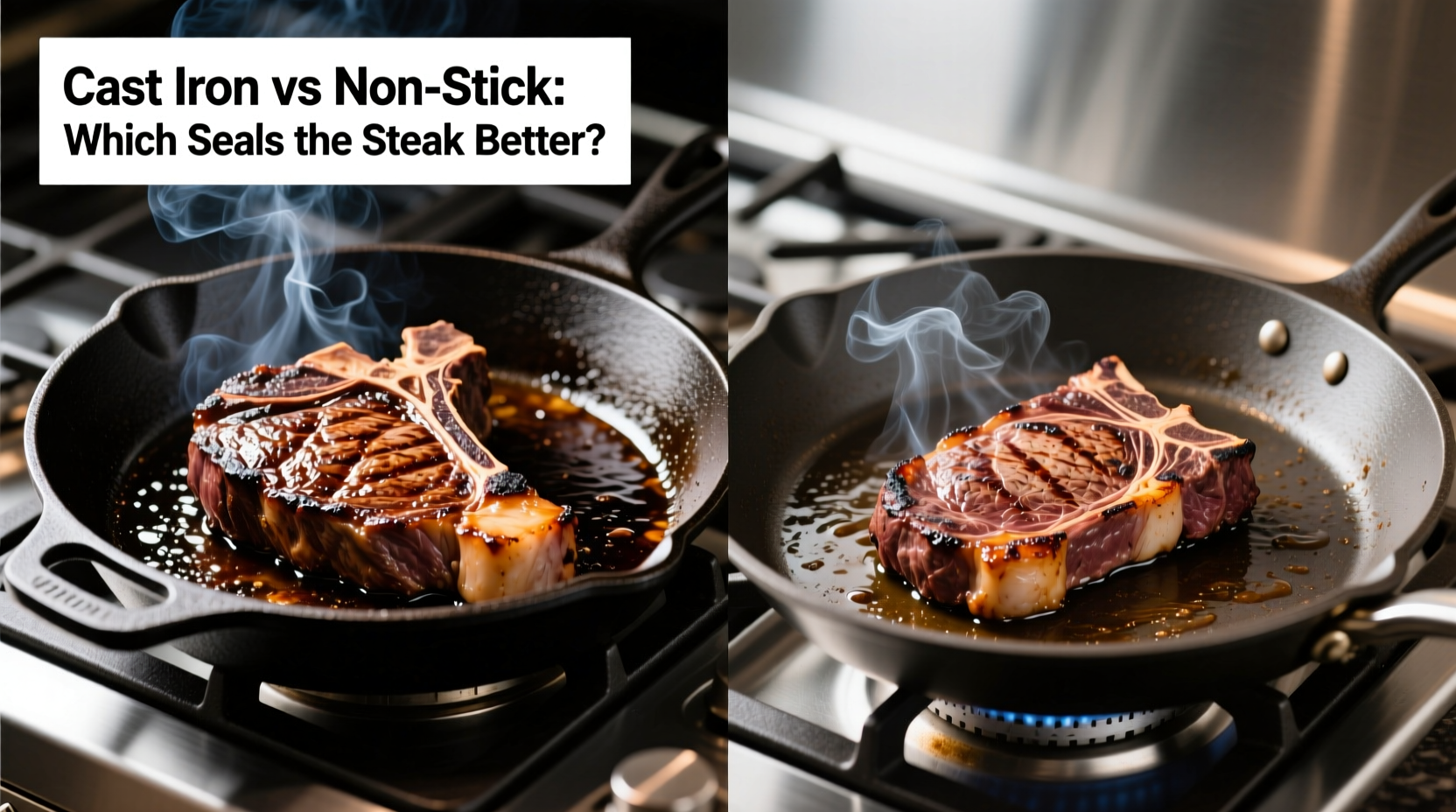
Results were telling. In the cast iron skillet, the steak developed a deep mahogany crust within three minutes. There was noticeable smoke, but with the exhaust fan running, it remained manageable. The internal temperature reached medium-rare evenly, and the flavor was robust, with clear caramelization.
In contrast, the non-stick pan produced a lighter, patchy brown surface after four minutes. The steak released easily, but lacked crispness and depth of flavor. Jamie noted that she had to lower the heat midway to avoid coating odor, which compromised the sear. “The cast iron steak tasted like it came from a steakhouse,” she said. “The other one felt safe—but not special.”
Expert Insight: What Professionals Recommend
Chefs overwhelmingly favor cast iron—or carbon steel—for searing tasks. While non-stick pans have a place in professional kitchens, they’re reserved for eggs, pancakes, and delicate fish—not high-heat applications.
“In a commercial kitchen, we never sear steak in non-stick. It’s a liability for flavor and safety. If you want a real sear, you need mass and heat—cast iron delivers both.” — Chef Lila Nguyen, Executive Chef at Oak & Ember
That said, advancements in cookware technology have introduced hybrid options. Some brands now offer “hard-anodized” non-stick pans with reinforced coatings that withstand higher temperatures. While these perform better than standard non-stick, they still fall short of cast iron’s thermal performance and longevity.
Checklist: Choosing the Right Pan for Smoke-Controlled Searing
- ✅ Prioritize heat tolerance: Choose pans rated above 500°F for true searing.
- ✅ Use high-smoke-point oils: Avocado, grapeseed, or clarified butter only.
- ✅ Preheat thoroughly: Cold pans lead to sticking and steaming.
- ✅ Keep steaks dry: Pat dry with paper towels before cooking.
- ✅ Control ventilation: Run exhaust fans, open windows, or cook near doors.
- ✅ Avoid overcrowding: One or two steaks max per batch to maintain pan temperature.
- ✅ Consider carbon steel: A lighter, smoother alternative to cast iron with similar performance.
Frequently Asked Questions
Can I safely sear steak in a non-stick pan?
You can, but it won’t produce a proper sear. Most non-stick pans cannot handle the sustained high heat needed for Maillard browning without risking coating degradation. The result is often a grayed, steamed surface rather than a flavorful crust.
Why does my cast iron pan smoke so much when searing?
Smoke comes from oil hitting its smoke point, not the pan itself. Using oils with low smoke thresholds (like butter or EVOO) will cause heavy smoke. Switch to avocado or refined grapeseed oil, and ensure your pan isn’t overheated beyond what’s necessary—medium-high is usually sufficient.
Is there a non-stick pan that can sear like cast iron?
Not currently. While some ceramic or hard-anodized pans claim high heat resistance, they lack the thermal mass to maintain searing temperatures after contact with cold meat. True searing requires both high heat and heat retention—qualities inherent to cast iron and carbon steel.
Conclusion: The Verdict on Searing Performance
When it comes to searing steak effectively without excessive smoke, the cast iron skillet is the clear winner—despite requiring more careful handling. Its unmatched heat retention and high thermal capacity enable deep, even browning that non-stick pans simply cannot replicate. Yes, it produces more smoke, but that can be managed with proper oil selection, ventilation, and technique.
Non-stick pans prioritize safety and ease over performance. They minimize smoke by limiting heat, but in doing so, sacrifice the very essence of a good sear: flavor development through controlled, high-temperature browning.
If your goal is restaurant-quality results at home, invest in a well-seasoned cast iron skillet and learn to work with it confidently. For everyday light cooking, keep your non-stick pan handy—but save the steak for cast iron.
💬 Have you tried searing steak in both types of pans? Share your experience, tips, or favorite oil blend in the comments below—we’d love to hear what works in your kitchen!








