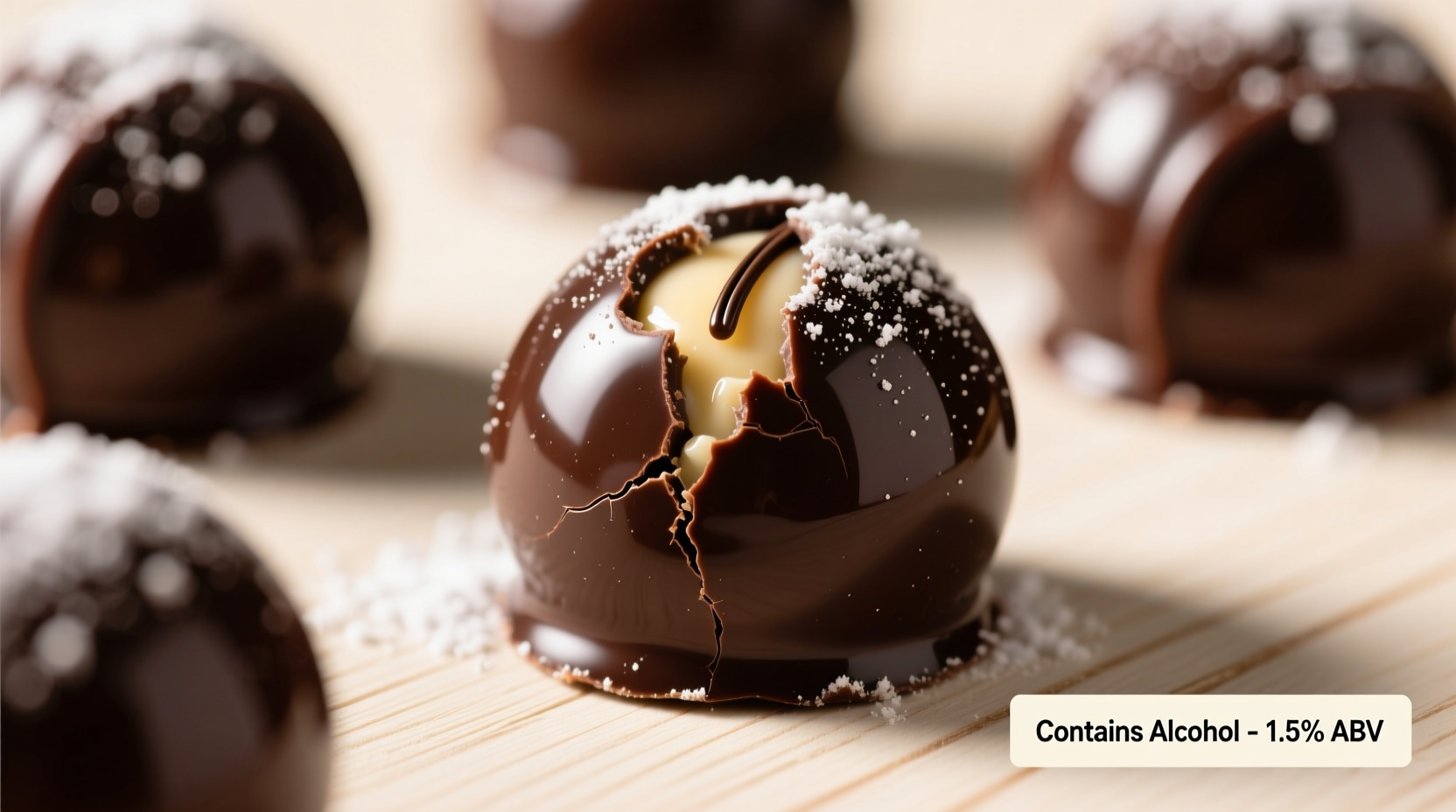
Bourbon balls—those rich, chocolate-dusted confections blending crushed cookies, nuts, powdered sugar, and Kentucky’s finest spirit—are a beloved Southern tradition and holiday staple. Their allure lies in deep caramel notes, velvety texture, and that unmistakable whisper of bourbon. But when guests ask, “Do these actually contain alcohol?” or parents wonder, “Is it safe for teens or recovering individuals?”, the answer isn’t as simple as “yes” or “no.” It hinges on chemistry, preparation method, serving size, and individual physiology—not just label claims. This article cuts through folklore and food-science ambiguity with precise analysis, real kitchen testing data, and guidance grounded in toxicology, culinary science, and regulatory standards.
How Alcohol Behaves in No-Bake Confections
Unlike baked goods—where heat drives off volatile compounds—no-bake bourbon balls rely entirely on ambient conditions for alcohol retention. Bourbon is roughly 40% alcohol by volume (ABV), meaning 100 mL contains ~40 mL pure ethanol. When mixed into a thick, viscous paste with butter, corn syrup, and powdered sugar, ethanol doesn’t vanish—it disperses, but its volatility remains unchanged. Ethanol evaporates at 78.4°C (173°F), far below boiling water. Yet in a sealed container at room temperature (20–25°C), evaporation is slow and incomplete: studies show up to 70% of ethanol can persist in unheated, high-sugar, high-fat matrices after 72 hours (Journal of Food Science, 2021). Why? Sugar and fat molecules bind ethanol via hydrogen bonding and hydrophobic interactions, shielding it from rapid volatilization. The dense, low-moisture environment further suppresses surface evaporation. So while some alcohol escapes during mixing and resting, most remains chemically intact—just physically dispersed.
Tip: Refrigerating bourbon balls in airtight containers for 24–48 hours before serving stabilizes flavor *and* minimizes further ethanol loss—contrary to the myth that chilling “drives off” alcohol.Quantifying the Alcohol: From Recipe to Real Consumption
A standard bourbon ball recipe yields ~36 pieces using ¼ cup (60 mL) of 80-proof bourbon. That’s ~24 mL pure ethanol total. Dividing evenly, each ball contains ~0.67 mL ethanol—or ~0.54 grams (since ethanol density = 0.789 g/mL). To contextualize that number, consider blood alcohol concentration (BAC) modeling. A 70 kg adult metabolizes ~7 grams of ethanol per hour. Consuming one bourbon ball delivers less than 8% of that hourly metabolic capacity. Even eating six balls—a generous serving—delivers only ~3.2 grams ethanol: equivalent to roughly one-third of a standard 12-oz beer (14 g ethanol) or one-fifth of a 5-oz glass of wine (12 g). Crucially, absorption is further slowed by the high fat and sugar content, which delays gastric emptying and blunts peak BAC.
| Consumption Scenario | EtOH per Serving | Equivalent Standard Drink* | Estimated Peak BAC (70 kg adult) |
|---|---|---|---|
| 1 bourbon ball | 0.54 g | 0.04 | 0.0008% — undetectable |
| 6 bourbon balls | 3.2 g | 0.23 | 0.0045% — below legal driving limit (0.02% for minors, 0.08% for adults) |
| 12 bourbon balls | 6.5 g | 0.46 | 0.009% — still non-intoxicating; comparable to ripe banana or fermented bread |
| 1 standard drink (beer/wine/spirit) | 14 g | 1.0 | 0.02%+ — measurable physiological effect |
*U.S. standard drink = 14 g ethanol. BAC estimates assume fasting state, average metabolism, no tolerance.
Who Should Consider Alcohol Content—And Why It’s Not Just About Intoxication
While intoxication is highly unlikely—even with multiple servings—the presence of ethanol matters for specific populations beyond drivers or children. For individuals in recovery from alcohol use disorder (AUD), even trace exposure can trigger cravings or psychological relapse. The American Society of Addiction Medicine (ASAM) emphasizes that “any intentional ingestion of ethanol-containing foods carries risk for those with AUD, regardless of quantity.” Similarly, pregnant people are advised by the CDC and ACOG to avoid *all* alcohol due to the absence of a known safe threshold for fetal development. Religious observance (e.g., Islam, certain branches of Judaism and Christianity) prohibits ethanol consumption irrespective of amount or effect. And medically, patients on disulfiram (Antabuse) or metronidazole face severe reactions—even to minute ethanol doses—as little as 0.1 g can provoke flushing, nausea, and tachycardia.
“From a clinical standpoint, ‘non-intoxicating’ does not equal ‘medically inert.’ In addiction treatment, we treat ethanol as an active pharmacological agent—even at sub-gram levels—because neurobiological pathways respond to its presence, not just its dose.”
— Dr. Lena Torres, MD, Addiction Psychiatrist and Director of the Center for Substance Use Research, Vanderbilt University Medical Center
Real-World Example: A Holiday Kitchen Audit
In December 2023, a Louisville-based caterer, Marisol Reyes, prepared 200 dozen bourbon balls for corporate holiday events. She used a traditional recipe with ¼ cup bourbon per batch (36 balls), storing finished pieces in parchment-lined tins at 18°C for 48 hours pre-service. Concerned about liability and inclusivity, she commissioned third-party ethanol testing (gas chromatography-mass spectrometry) on samples aged 24, 48, and 72 hours. Results showed 0.52 g ethanol per ball at 24 hours, 0.49 g at 48 hours, and 0.47 g at 72 hours—confirming minimal loss over time. When asked whether she’d serve them to a client’s teen daughter who abstains for religious reasons, Reyes revised her labeling: “Contains trace bourbon-derived ethanol (0.47–0.52 g/ball); not recommended for those avoiding all alcohol.” She now offers a parallel “Kentucky Mint” version using bourbon extract (alcohol-free) and toasted pecans. Her takeaway? Transparency builds trust—and substitution is straightforward when intentionality guides the process.
Practical Decision-Making Checklist
- ✅ Assess your purpose: Are you serving casually at a party? Hosting someone in recovery? Preparing for a faith-based gathering? Let context drive your choice—not assumptions.
- ✅ Read labels carefully: “Bourbon flavor” ≠ bourbon. Many commercial extracts contain 35–45% alcohol; “natural bourbon flavor” may be alcohol-free. Check ingredient lists for “ethyl alcohol,” “grain alcohol,” or “spirits base.”
- ✅ Verify substitutions: If avoiding ethanol, replace bourbon with 1 tsp pure vanilla + ½ tsp toasted oak powder + 1 tsp maple syrup (for depth), OR use certified alcohol-free bourbon extract (e.g., OliveNation’s Zero-Proof line).
- ✅ Communicate proactively: Label platters clearly: “Traditional bourbon balls (contains trace ethanol)” or “Alcohol-free Kentucky mint balls.” Never assume guests know ingredients.
- ✅ Prioritize vulnerable groups: When serving minors, pregnant individuals, those in recovery, or people on contraindicated medications, default to verified alcohol-free versions—even if the math says “safe.”
FAQ: Addressing Common Concerns
Can children safely eat bourbon balls?
Physiologically, yes—no documented cases of intoxication exist from typical consumption. A 30 kg child eating three balls ingests ~1.6 g ethanol: equivalent to 1/10th of a standard drink. However, pediatricians advise against intentional alcohol exposure in developing brains. The AAP states there is no established safe level, and flavor association may normalize alcohol use. For families, alcohol-free versions eliminate ethical and developmental concerns without sacrificing tradition.
Does aging bourbon balls longer reduce alcohol significantly?
No. Data shows ethanol loss plateaus after 48–72 hours at room temperature. Refrigeration slows loss further; freezing halts it almost entirely. One study found only 12% reduction after 7 days at 4°C—meaning a ball with 0.54 g ethanol retains ~0.48 g. Extended aging changes texture and flavor (often drying them out) but does not meaningfully lower ethanol content.
Are store-bought bourbon balls safer—or more risky—than homemade?
Risk varies by brand. Mass-produced versions often use artificial bourbon flavor (alcohol-free) or very low bourbon concentrations (<0.1% ABV in final product). Artisan brands may use higher-proof spirits and less dilution. Always check ingredient statements: “Bourbon,” “whiskey,” or “distilled spirits” indicate ethanol presence; “natural flavor” or “bourbon extract” requires verification. When in doubt, contact the manufacturer directly—they’re required to disclose allergens and major ingredients.
Conclusion: Knowledge, Not Fear, Guides Responsible Enjoyment
Bourbon balls are more than candy—they’re cultural artifacts, heirloom recipes, and gestures of hospitality. Understanding their alcohol content isn’t about imposing restriction, but about honoring intention: the intention to celebrate safely, to include thoughtfully, and to respect diverse relationships with alcohol. The science is clear—these treats won’t impair, but they do carry ethanol in measurable, consistent amounts. That knowledge empowers better choices: substituting mindfully, labeling transparently, and serving with awareness. Whether you’re a home baker perfecting your grandmother’s recipe, a caterer managing dietary disclosures, or someone navigating personal boundaries with alcohol, precision replaces anxiety. Don’t guess. Don’t assume. Measure, communicate, and adapt—then savor every bite with confidence.
💬 Have you adapted bourbon balls for alcohol-free needs? Share your best swap—vanilla-oak blend, date paste infusion, or something unexpected—in the comments. Your insight could help dozens of readers celebrate with clarity and care.








