
When people hear the word \"bobcat,\" many imagine a wild, oversized feline prowling through backyards—sometimes even mistaking them for small cougars or exaggerated house cats. But how large are bobcats, really? And how do they compare to the domestic cats we cuddle on our sofas? The truth lies somewhere between myth and measurement. While bobcats are indeed larger than house cats, the difference isn’t always as dramatic as folklore suggests. This article breaks down the real dimensions, behaviors, and ecological roles of both species to give you a clear picture of what sets them apart—and why accurate understanding matters for safety, wildlife conservation, and responsible pet ownership.
Size Comparison: Bobcat vs House Cat
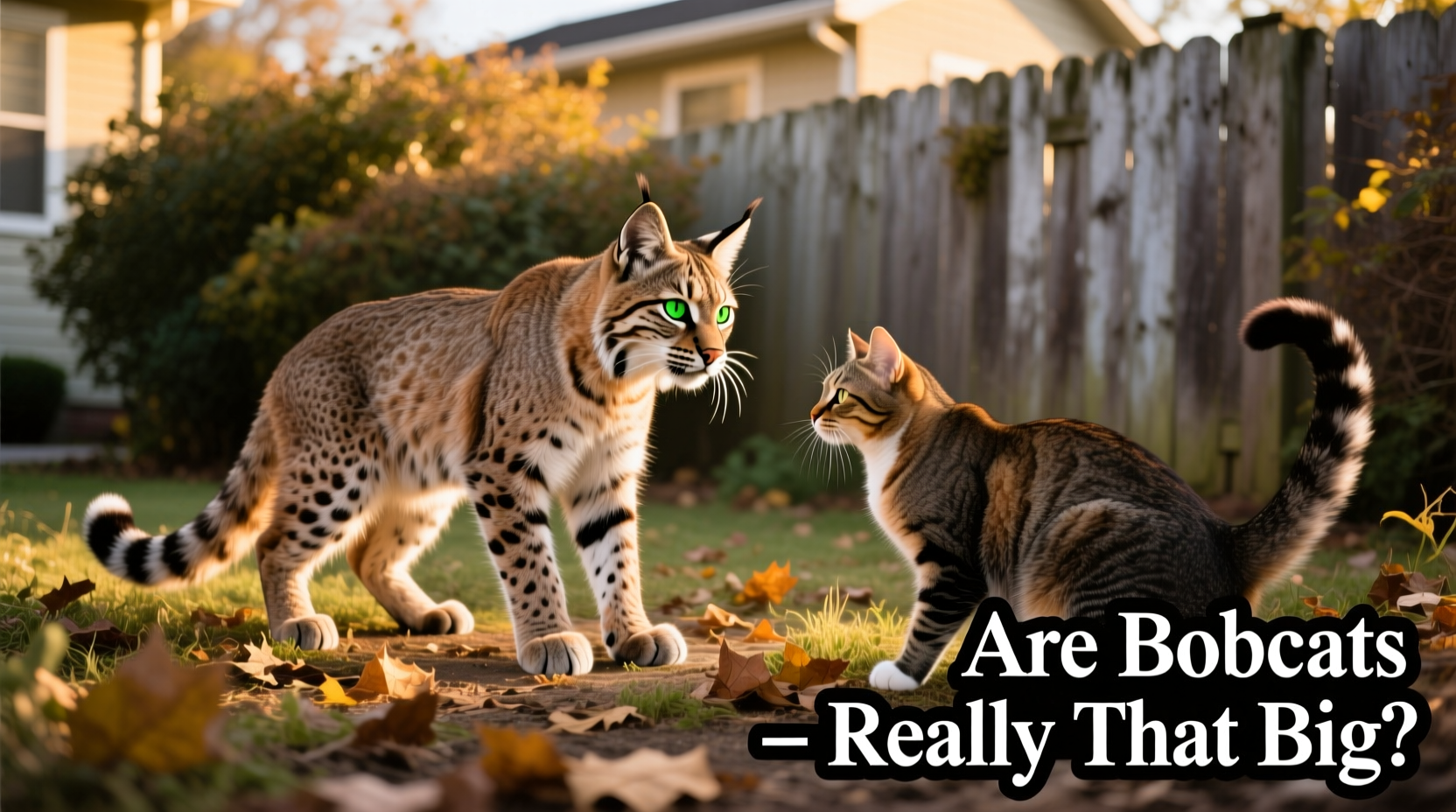
The most common misconception about bobcats is their size. Urban legends often describe them as being “as big as a German Shepherd” or “twice the size of a house cat.” In reality, while bobcats are significantly larger than domestic cats, they rarely reach such extreme proportions.
Adult bobcats typically weigh between 15 to 35 pounds (6.8–15.9 kg), with males on the higher end of that range. Their body length ranges from 24 to 40 inches (60–100 cm), not including the short, “bobbed” tail that gives them their name. Standing at the shoulder, they reach about 21 inches (53 cm) tall—roughly the height of a medium-sized dog.
In contrast, the average house cat weighs between 8 to 10 pounds (3.6–4.5 kg) and measures 18 to 20 inches (45–50 cm) in body length. Even large domestic breeds like Maine Coons rarely exceed 25 pounds and still fall within similar length parameters.
Tip: If you spot a wild cat and aren't sure if it's a bobcat or a large house cat, look at the tail: bobcats have short, black-tipped tails; domestic cats have long, slender tails.Detailed Size Breakdown
| Feature | Bobcat | House Cat |
|---|---|---|
| Average Weight | 15–35 lbs (6.8–15.9 kg) | 8–10 lbs (3.6–4.5 kg) |
| Body Length | 24–40 in (60–100 cm) | 18–20 in (45–50 cm) |
| Shoulder Height | ~21 in (53 cm) | ~9–10 in (23–25 cm) |
| Tail Length | 4–7 in (10–18 cm) | 9–12 in (23–30 cm) |
| Ears | Long, tufted tips | Short, rounded or pointed |
| Fur Pattern | Spotted or streaked, tawny to grayish | Varies widely by breed |
Physical and Behavioral Differences
Beyond size, several physical traits distinguish bobcats from domestic cats. Bobcats have muscular builds, powerful limbs built for pouncing, and distinctive ear tufts that enhance their hearing. Their eyes are adapted for low-light hunting, giving them superior night vision compared to house cats.
Behaviorally, bobcats are solitary, territorial predators. They maintain home ranges that can span up to 30 square miles, depending on prey availability. Unlike house cats, which may roam freely but rely on humans for food, bobcats hunt daily—targeting rabbits, rodents, birds, and occasionally deer fawns.
Domestic cats, while retaining some predatory instincts, are far less aggressive and lack the stamina and strength for sustained wild survival. Most house cats would struggle to survive a week in the wild without human support.
“Bobcats are efficient, stealthy hunters evolved for rugged terrain. They’re not oversized pets—they’re apex predators in their ecosystems.” — Dr. Lena Peterson, Wildlife Biologist, University of Montana
Real-Life Encounter: A Suburban Sighting
In 2021, residents of Asheville, North Carolina, reported seeing a “giant cat” near a neighborhood trail. One homeowner snapped a blurry photo and posted it online, sparking concern. Local wildlife officials responded and confirmed it was a male bobcat—estimated at 28 pounds—passing through during its nightly patrol.
What stood out wasn’t its monstrous size, but its calm demeanor. The bobcat avoided people, stayed on the forest edge, and disappeared within minutes. No aggression was shown. Officials used the event to educate the public: bobcats are naturally wary of humans, and sightings, while startling, are usually harmless.
This case illustrates how perception inflates reality. The animal was large for a cat, yes—but not unusually so for a healthy adult male bobcat. It was simply doing what bobcats do: moving through territory in search of food.
Can Bobcats Mate With House Cats?
A persistent myth suggests that so-called “bigs” seen around rural areas are hybrids of bobcats and house cats. There is no verified scientific evidence that bobcats and domestic cats can produce fertile offspring. While rare mating attempts may occur, successful hybridization is biologically improbable due to chromosomal differences.
Veterinarians and geneticists agree: any large, wild-looking cat seen near homes is either a pure bobcat, a feral house cat, or a large domestic breed like a Maine Coon—never a true hybrid.
Tip: Never attempt to feed or approach a bobcat. Doing so can habituate them to humans, increasing the risk of conflict.Safety and Coexistence: What You Need to Know
As human development expands into natural habitats, encounters with bobcats are becoming more common—especially in suburban fringes across the U.S. West, Southwest, and Southeast. Understanding how to coexist safely is essential.
Bobcats pose minimal threat to humans. Attacks are exceedingly rare. However, they may see small pets—especially outdoor cats and toy dogs—as prey. Protecting your animals means keeping them indoors or supervised outdoors.
If you live near wooded areas, consider these steps:
- Secure trash and compost bins to avoid attracting rodents, which in turn attract bobcats.
- Install motion-sensor lighting around entry points.
- Remove dense brush or woodpiles near your home that could serve as shelter.
- Keep small pets indoors at dawn and dusk, when bobcats are most active.
Checklist: Responding to a Bobcat Sighting
- Stay calm and keep your distance.
- Do not run—back away slowly.
- Make yourself appear larger and make loud noises.
- Never feed the animal.
- Report aggressive or sick-looking animals to local wildlife authorities.
Frequently Asked Questions
Are bobcats dangerous to humans?
No, bobcats are naturally reclusive and avoid people. Documented attacks on humans are extremely rare and usually involve animals that are sick, injured, or cornered.
Can a bobcat kill a house cat?
Yes. Bobcats view small animals as potential prey. Outdoor house cats are at risk, especially at night. Keeping cats indoors is the best protection.
How can I tell if a cat I saw is a bobcat?
Look for a short, black-tipped tail, ear tufts, a muscular build, and a tawny coat with dark spots or streaks. Bobcats don’t meow like house cats—they make growls, hisses, or high-pitched screeches.
Conclusion: Respecting the Wild
The idea that bobcats are “as big as people say” depends entirely on whose story you’re hearing. Exaggerated tales paint them as fearsome beasts, but the truth is more nuanced: they are capable predators, yes, but also relatively modest in size and deeply attuned to avoiding human contact. Comparing them fairly to house cats reveals significant differences in build, behavior, and ecological role—but not necessarily the dramatic size gap pop culture suggests.
Understanding these animals reduces fear and fosters respect. Whether you're a homeowner, pet guardian, or nature enthusiast, knowing the facts helps you make informed decisions and live harmoniously with native wildlife.
💬 Have you spotted a bobcat or confused one with a large house cat? Share your experience in the comments to help others recognize the signs and respond responsibly.








