In the world of sound healing and energy work, few tools have gained as much attention in recent years as singing bowls. Among them, two types stand out: traditional crystal quartz singing bowls and the increasingly popular cobalt blue \"rose\" bowls. With bold color, deep resonance, and a growing social media presence, blue rose bowls are being hailed by some as the next evolution in vibrational therapy. But how do they truly stack up against high-grade crystal bowls? Are the cobalt ones worth the hype, or is this just aesthetic appeal masquerading as function?
This article breaks down the science, sound, craftsmanship, and energetic properties behind both types to help you make an informed decision—whether you're a seasoned practitioner or someone exploring holistic wellness for the first time.
Understanding the Basics: What Are Blue Rose Bowls and Crystal Singing Bowls?
Crystal singing bowls are typically made from 99.9% pure crushed quartz that’s heated and spun into shape at extremely high temperatures. The resulting bowl amplifies specific frequencies based on its size and thickness, often tuned to Solfeggio or chakra-aligned notes. These bowls produce clear, ethereal tones that linger in the air and are widely used in meditation, sound baths, and energy alignment practices.
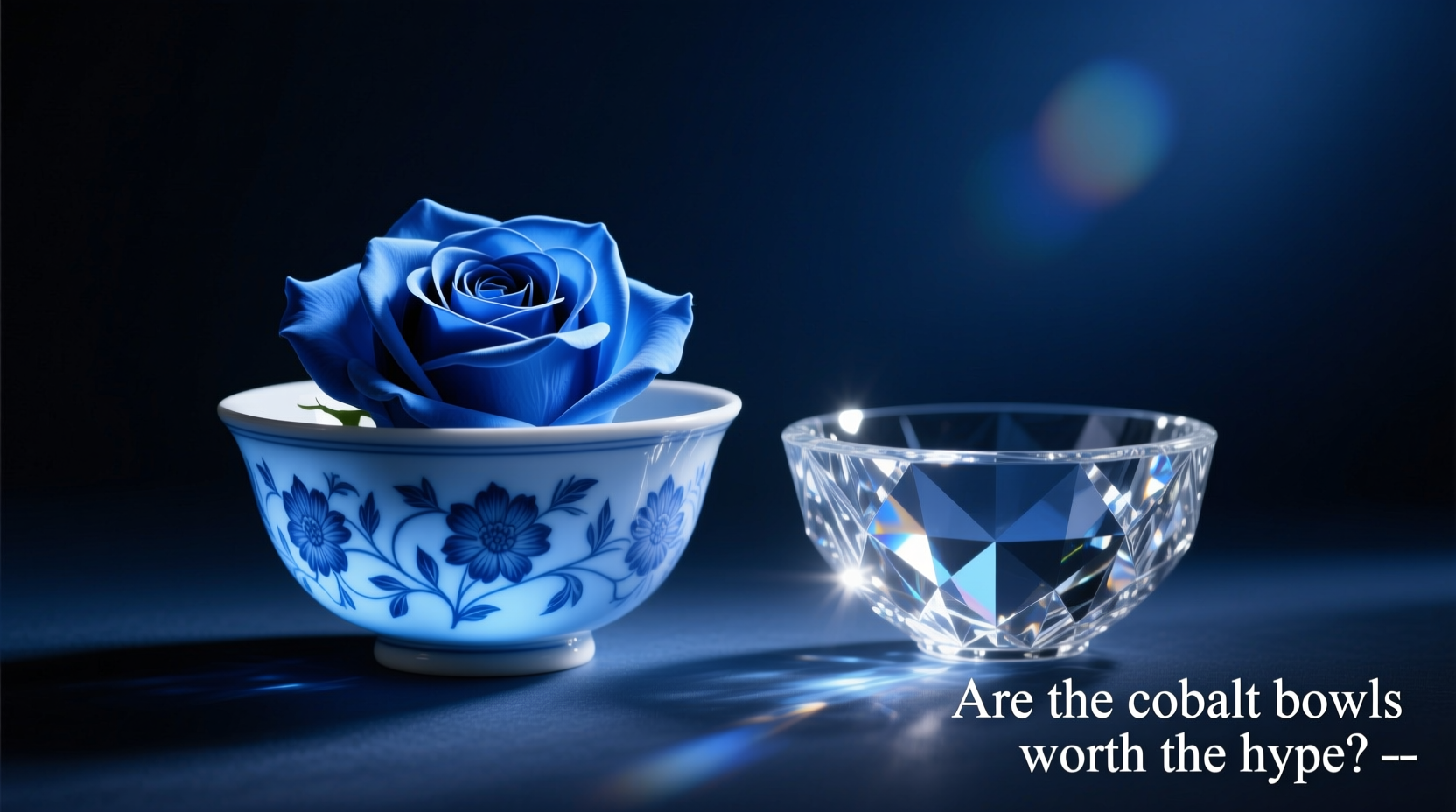
Blue rose bowls, on the other hand, are crafted from colored glass—specifically cobalt-infused soda-lime glass. Despite sometimes being marketed with terms like “healing crystal” or “vibrational vessel,” they are not made from quartz. Their name comes from their striking deep blue hue and floral-like design etched or molded into the base. They’re often associated with emotional healing, heart chakra activation, and spiritual awakening due to their color and visual symbolism.
Tip: Don��t be misled by branding—check material composition before purchasing. True crystal bowls are made of quartz; blue rose bowls are glass.Sound Quality and Resonance: A Side-by-Side Comparison
The primary function of any singing bowl is its ability to produce sustained, harmonious sound. Let's examine how each type performs acoustically.
| Feature | Crystal Singing Bowls | Blue Rose (Cobalt Glass) Bowls |
|---|---|---|
| Tonal Clarity | High – pure, bell-like overtones | Moderate – warmer but less precise pitch |
| Sustain Duration | Long – 30+ seconds depending on size | Medium – 15–25 seconds |
| Fundamental Frequency Accuracy | Precisely tunable (e.g., 528Hz) | Less consistent tuning between models |
| Vibration Transmission | Strong physical resonance felt through body contact | Milder tactile feedback |
| Harmonic Complexity | Rich layering of overtones | Simpler harmonic structure |
While crystal bowls excel in sonic precision and depth, blue rose bowls offer a mellower, more diffuse tone. This isn't inherently inferior—it may even be preferable for those sensitive to high-frequency sounds. However, if your practice relies on accurate frequency delivery (such as targeted chakra work or binaural entrainment), crystal remains the superior choice.
“Tuning accuracy matters when working with intentional sound. You can’t align the third eye with a misaligned C#.” — Dr. Lena Patel, Acoustic Therapist & Researcher at the Institute for Vibrational Medicine
Material Properties and Energetic Claims
Proponents of crystal bowls emphasize that quartz has piezoelectric properties—it generates an electric charge under mechanical stress—which allows it to store, amplify, and transmit energy. Many believe this makes quartz uniquely suited for holding intentions, charging with affirmations, or enhancing meditation focus.
Blue rose bowls lack these inherent energetic conductive properties. Cobalt glass does not possess piezoelectricity, nor does it naturally resonate at human-biocompatible frequencies. That said, intention plays a powerful role in energetic work. If a user feels deeply connected to the symbolism of the blue rose—the heart opening, transformation, mystery—then the psychological and emotional impact can still yield meaningful results.
Color psychology supports this idea. Blue is traditionally linked to calmness, communication, and the throat chakra. Deep cobalt shades evoke introspection and spiritual depth. So while the material may not vibrate like quartz, the visual and symbolic elements contribute to a holistic experience.
Real Example: A Practitioner’s Shift in Perspective
Sophie Tran, a sound healer based in Asheville, initially dismissed blue rose bowls as “decorative novelties.” She used only professional-grade crystal sets in her sessions. But after incorporating a cobalt bowl into a grief counseling session, she noticed something unexpected: clients opened up emotionally faster than usual.
“One woman started crying within minutes—not because of the sound, but because she said the bowl looked like ‘the sky after a storm.’ That visual metaphor unlocked something. I realized tools aren’t just about physics—they’re about meaning.”
Sophie now keeps one blue rose bowl in rotation specifically for heart-centered work, using it alongside her crystal set rather than instead of it.
Practical Guide: Choosing the Right Bowl for Your Needs
Selecting between blue rose and crystal bowls depends on your goals, budget, and practice style. Follow this step-by-step guide to determine which fits best:
- Define Your Purpose: Are you using the bowl for personal meditation, group sound baths, therapeutic work, or decorative display?
- Evaluate Sound Sensitivity: Do you prefer sharp, clear tones or softer, ambient vibrations?
- Assess Budget: High-quality crystal bowls range from $150–$500+. Blue rose bowls are typically $60–$120, making them accessible entry points.
- Check Material Transparency: Verify whether the seller discloses composition. Avoid brands that imply blue rose bowls are “crystal” when they’re glass.
- Test Before Buying (if possible): Attend a local sound circle or shop with demo access to hear both types live.
- Consider Layered Use: Some practitioners use both—a crystal bowl for tonal precision and a blue rose bowl for symbolic or visual anchoring.
Common Misconceptions and Marketing Myths
The rise of blue rose bowls has been accompanied by misleading claims. Here are three myths worth dispelling:
- Myth 1: “Blue rose bowls are made from rare crystals.”
Reality: They are manufactured glass, not mined minerals. There is no natural “blue rose crystal.” - Myth 2: “They emit higher vibrational energy than quartz.”
Reality: No scientific evidence supports this. Quartz has measurable energetic properties; colored glass does not. - Myth 3: “All singing bowls work the same way.”
Reality: Differences in material, shape, and manufacturing significantly affect sound, sustain, and application.
Transparency matters. Reputable sellers will clearly state materials and avoid pseudoscientific jargon. Be cautious of phrases like “quantum-infused” or “ancient Lemurian technology” without verifiable sourcing.
FAQ
Can I use a blue rose bowl for chakra balancing?
Yes, but with caveats. While the blue color aligns symbolically with the throat and third eye chakras, the bowl’s frequency may not match standard chakra pitches. For precise tuning, pair it with a verified crystal bowl or use it for visualization support rather than primary tonal work.
Do blue rose bowls break more easily than crystal?
Glass is generally more brittle than fused quartz. Cobalt bowls can crack under thermal shock (e.g., sudden temperature changes) or impact. Handle with care, avoid extreme heat, and never place in direct sunlight for long periods.
Are there ethical concerns with either type?
Some crystal bowls are sourced from regions with questionable mining practices. Look for suppliers who disclose origin and sustainability efforts. Blue rose bowls, being man-made, avoid mineral extraction issues but should still be evaluated for fair labor practices in production.
Final Verdict: Are Cobalt Blue Rose Bowls Worth It?
The answer depends on what you seek. If your priority is acoustic precision, energetic conductivity, and long-term durability, high-grade crystal singing bowls remain unmatched. They are instruments of measurable resonance and proven effectiveness in sound therapy.
However, blue rose bowls bring something different: emotional resonance through beauty, symbolism, and accessibility. They serve as powerful anchors in ritual, excellent tools for beginners, and compelling additions to intuitive or artistic practices. They’re not replacements for crystal—but they don’t need to be.
The hype around cobalt blue rose bowls isn't entirely justified in technical terms, but neither is it meaningless. In holistic wellness, where perception, emotion, and belief shape outcomes, a bowl that inspires deeper presence—even through its color—has value.
“We must honor both science and soul. One gives us data, the other gives us meaning.” — Rafael Singh, Author of *The Sound of Stillness*
Take Action: Build Your Intentional Sound Toolkit
Don’t choose between logic and feeling—integrate both. Start with a well-tuned crystal bowl for foundational practice. Then, consider adding a blue rose bowl not because it’s “better,” but because it speaks to you. Let your toolkit reflect both precision and poetry.
💬 Have experience with both types? Share your insights below—your story could help others find their perfect sound.








