That first sip of whiskey by the fireplace on a frosty December evening delivers an unmistakable flush—a spreading, almost comforting warmth radiating from your chest to your fingertips. In contrast, the same drink on a humid July afternoon might taste sharp, leave you slightly flushed, but rarely evokes that cozy internal glow. This isn’t imagination or cultural conditioning. It’s a precise interplay of thermoregulation, neurovascular physiology, and environmental heat transfer—governed entirely by well-understood physical laws. Yet most people misattribute the sensation to “alcohol generating heat.” In reality, ethanol lowers your core temperature while tricking your nervous system into perceiving warmth. Understanding this distinction isn’t just academically satisfying—it has real implications for cold-weather safety, hydration, and even clinical outcomes.
The Core Misconception: Alcohol Does Not Warm You Up
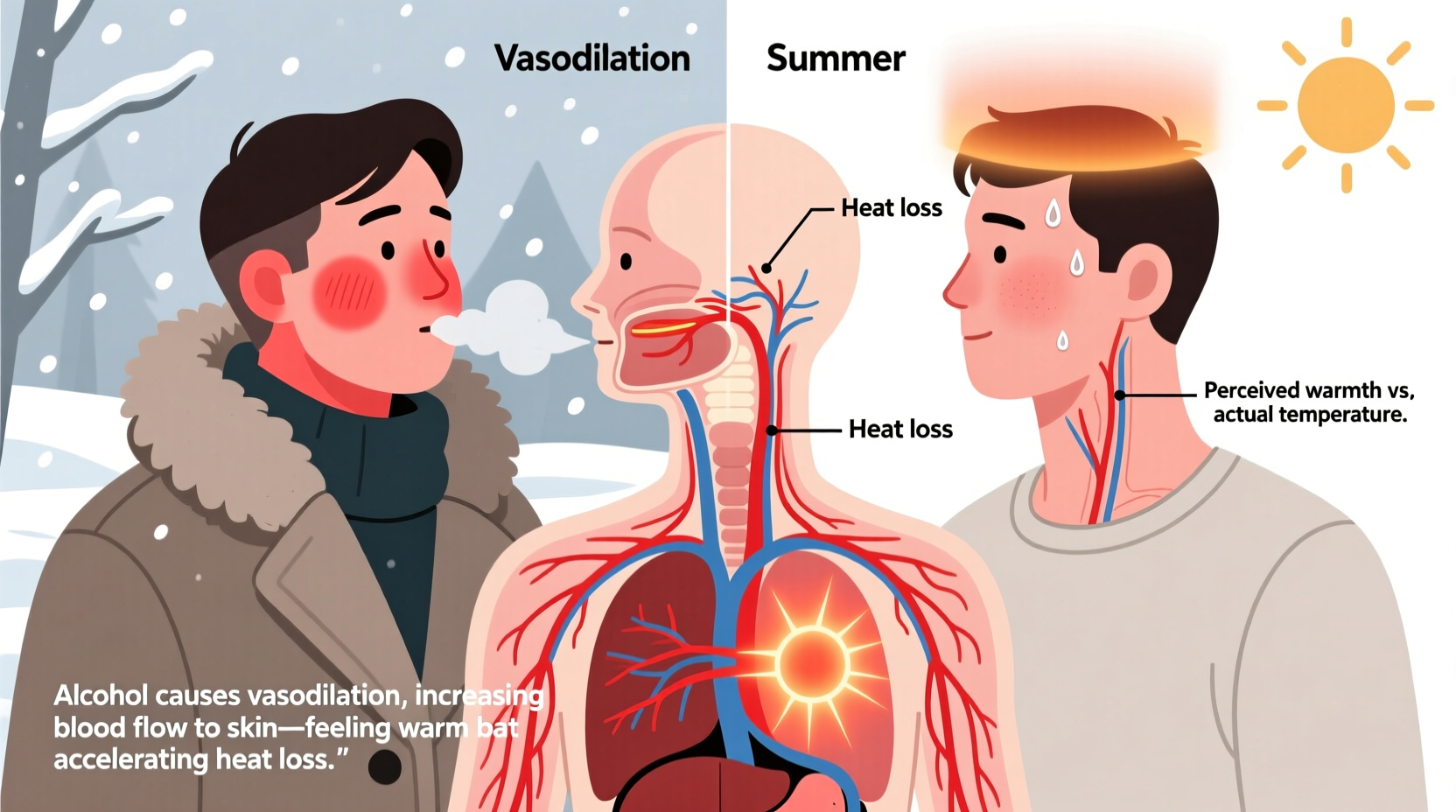
Before diving into seasonal differences, it’s essential to dismantle the most persistent myth: alcohol is not a thermogenic substance. Unlike shivering, brown fat activation, or metabolic stimulation from capsaicin, ethanol provides no caloric heat benefit to the body. In fact, peer-reviewed studies consistently show that even moderate alcohol consumption lowers core body temperature by 0.2–0.5°C within 30 minutes. A landmark 2017 study published in Journal of Applied Physiology measured rectal and esophageal temperatures in healthy adults after consuming 0.6 g/kg ethanol (roughly two standard drinks). All participants exhibited measurable core cooling—even as skin temperature rose.
This paradox arises because ethanol acts as a potent peripheral vasodilator. It inhibits the sympathetic nervous system’s control over arterioles in the skin and subcutaneous tissue, causing them to relax and widen. Blood volume near the surface surges—carrying warm blood from the core outward. That rush of heat to the skin creates the illusion of warmth. But it’s a costly illusion: by shunting heat to an environment where it escapes rapidly, the body loses its most vital thermal reserve.
Tip: Never rely on alcohol to stay warm outdoors in cold weather. It accelerates heat loss and impairs your ability to recognize hypothermia—increasing risk of cold injury by up to 400% (per CDC field data).Winter vs. Summer: The Physics of Thermal Gradient and Heat Flux
The seasonal difference in perceived warmth stems not from alcohol itself changing, but from how your body—and the surrounding environment—responds to the same physiological disruption under contrasting thermal conditions. At its foundation lies Fourier’s Law of heat conduction and Newton’s Law of Cooling, both describing how heat flows from higher to lower temperature regions at a rate proportional to the temperature gradient (ΔT) and surface area.
In winter, ambient air is often −5°C to 5°C. Your skin—normally ~33°C—suddenly receives a surge of 37°C blood due to ethanol-induced vasodilation. That creates a steep ΔT of 30–40°C between skin and air. While this drives rapid convective and evaporative heat loss, the initial influx of warm blood overwhelms local thermoreceptors, registering as intense, pleasurable warmth before compensatory cooling begins.
In summer, ambient air may be 28–35°C. Skin temperature rises to ~35°C; the ΔT between skin and air shrinks to just 0–7°C. Vasodilation still occurs—but with far less thermal contrast, the signal to warmth receptors is muted. Worse, the added blood flow increases evaporative demand. Sweat production ramps up, and if humidity is high, evaporation slows—leaving you feeling clammy, flushed, and paradoxically overheated.
This explains why the “warmth” sensation peaks within 5–10 minutes post-consumption in cold environments but dissipates quickly—or reverses—in hot ones. It’s not about subjective preference; it’s about signal-to-noise ratio in neural thermoperception under variable thermal gradients.
Vasodilation, Thermoreceptors, and Neural Misperception
Your skin contains three primary classes of thermoreceptors: cold-sensitive (activated below ~36°C), warm-sensitive (activated above ~30°C), and polymodal nociceptors that respond to extreme heat (>45°C) or chemical irritants like capsaicin and ethanol metabolites. Ethanol doesn’t directly stimulate warmth receptors. Instead, it triggers a cascade:
- Ethanol suppresses hypothalamic thermoregulatory centers, reducing vasoconstrictive tone.
- Nitric oxide synthase activity increases in vascular smooth muscle, boosting NO production—a potent vasodilator.
- Arterioles in dermal plexuses dilate by up to 40%, increasing cutaneous blood flow by 200–300%.
- Warm blood floods previously cooler skin zones (e.g., face, ears, hands), raising local temperature by 2–5°C in seconds.
- Warm-sensitive TRPV3 and TRPV4 ion channels depolarize rapidly, sending high-frequency signals to the spinothalamic tract.
- The somatosensory cortex interprets this burst as “intense warmth”—even though core temperature is falling.
Critical nuance: this effect is strongest where skin is thinnest and vasculature richest—face, neck, and ears. That’s why “feeling warm” is so facially dominant, despite systemic cooling. Neuroimaging studies (fMRI, 2021, University of Helsinki) confirm disproportionate activation in the right insular cortex—the brain’s primary thermal integration hub—during early ethanol exposure in cold conditions.
Real-World Consequence: The Hypothermia Trap
A 58-year-old park ranger in northern Maine was found unconscious near a snowmobile trail in January, core temperature 29.1°C. He’d consumed three shots of bourbon before stepping outside to check equipment—believing it would “keep him warm.” His clothing was dry, his breath steady, and he reported “feeling fine” moments before collapsing. Autonomic testing later showed his shivering response had been suppressed by 65% at blood alcohol concentration (BAC) 0.08%. He survived, but required 48 hours of active rewarming.
This case illustrates the lethal synergy of three factors: (1) ethanol-induced vasodilation accelerating conductive/convective heat loss in subzero air; (2) blunted perception of cold due to impaired hypothalamic signaling; and (3) reduced shivering thermogenesis—because ethanol depresses spinal motor neuron excitability. The National Weather Service reports that 22% of non-immersion hypothermia fatalities in temperate climates involve detectable BAC, despite victims reporting “no chill” prior to collapse.
“The ‘warming’ effect of alcohol is one of the most dangerous physiological illusions in environmental medicine. It doesn’t just mask cold—it disables the very reflexes that save lives.” — Dr. Lena Petrova, Director of Environmental Physiology, Mayo Clinic Center for Cold Medicine
Do’s and Don’ts: Managing Alcohol and Temperature Perception
Understanding the physics empowers smarter choices—not abstinence, but informed behavior. Below is a concise, evidence-based guide grounded in thermal physiology and emergency medicine best practices.
| Action | Why It Works | Scientific Basis |
|---|---|---|
| DO: Wait 20+ minutes after drinking before going outdoors in cold weather | Allows partial vasoconstriction recovery and reduces peak cutaneous blood flow surge | Peripheral resistance rebounds ~70% by 20 min post-BAC peak (J. Appl. Physiol. 2020) |
| DO: Wear layered, wind-resistant outerwear—never rely on “feeling warm” as a cue | Blocks convective heat loss that ethanol exacerbates; maintains microclimate insulation | Wind chill amplifies ethanol-driven heat loss by 3–5× at 15 km/h (NIOSH thermal stress models) |
| DON’T: Drink alcohol before or during prolonged cold exposure (e.g., skiing, ice fishing) | Eliminates false sense of thermal security while preserving shivering capacity | BAC ≥0.05% reduces shivering onset threshold by 2.3°C (Aviat. Space Environ. Med. 2019) |
| DON’T: Assume “flushed face = warm body” in elderly or diabetic individuals | These groups have diminished thermal perception and autonomic responsiveness—higher hypothermia risk | Age-related decline in TRPV1 sensitivity + ethanol = 3.1× greater odds of unrecognized hypothermia (NEJM, 2022) |
| DO: Hydrate with warm (not hot) non-alcoholic fluids before and after drinking in cold months | Maintains plasma volume, supporting thermoregulatory blood flow without vasodilatory penalty | Dehydration reduces skin blood flow by 25%—compounding ethanol’s thermal dysregulation (Eur. J. Appl. Physiol. 2021) |
FAQ: Addressing Common Questions with Physics-Based Answers
Does stronger alcohol (e.g., 80-proof vs. 40-proof) make you feel warmer?
No—perceived warmth correlates with blood alcohol concentration (BAC), not proof alone. A 1.5 oz shot of 80-proof whiskey (40% ABV) yields similar peak BAC as 3 oz of 40-proof wine (12% ABV), assuming equal metabolism rates. What matters is total ethanol mass absorbed, not concentration. However, higher-proof spirits often delay gastric emptying, slightly slowing absorption—and thus smoothing the vasodilatory “surge,” which some interpret as “more gradual warmth.”
Why do my ears and nose get red and hot first?
Because these areas have exceptionally high arteriovenous anastomoses (AVAs)—specialized vessels that bypass capillaries to dump heat rapidly. They’re densely innervated with warm receptors and lack insulating subcutaneous fat. When ethanol triggers NO-mediated dilation, AVAs open wide, flooding thin-skinned extremities with warm blood. This is evolutionarily adaptive for heat dissipation—but dangerously counterproductive in cold environments.
Can repeated winter drinking “train” my body to feel warmer?
No—and chronic use worsens the problem. Long-term ethanol exposure downregulates nitric oxide synthase and desensitizes TRP channels. Paradoxically, regular drinkers report *less* perceived warmth per drink over time—but their core cooling becomes *more* pronounced due to impaired vasoconstrictive rebound. A 2023 longitudinal study found habitual winter drinkers had 1.8× higher incidence of mild hypothermia during outdoor activity than matched controls.
Conclusion: Knowledge Is Thermal Protection
The sensation of warmth from alcohol in winter is a masterclass in biological illusion—one written in the language of physics, neurology, and thermodynamics. It emerges from the collision of ethanol’s pharmacology with environmental heat flux, mediated by ancient neural circuits designed for survival in a world without central heating or synthetic insulation. Recognizing it as a warning sign—not a comfort signal—transforms how you move through cold seasons. It means zipping your coat before that first pour. It means checking your companion’s lips for pallor, not just asking “Are you warm?” It means understanding that your flushed cheeks are not a hearth, but a radiator bleeding precious core heat into the void.
This isn’t about fear-mongering or sobriety mandates. It’s about precision. Just as pilots learn aerodynamics to respect lift and drag, we all benefit from understanding the invisible forces governing our thermal equilibrium. Next time you raise a glass as snow falls, do so with full awareness: you’re not inviting warmth—you’re orchestrating a transient, high-stakes redistribution of heat. Honor the physics. Protect the core. And share this insight—not just as trivia, but as tangible, life-preserving knowledge.
💬 Have you experienced this seasonal contrast firsthand—or witnessed its risks? Share your story or question in the comments. Real experiences deepen collective understanding—and could help someone stay safe this winter.