
Words do not exist in isolation. Whether in a novel, academic paper, or everyday conversation, meaning is shaped by surrounding language. Context clues—hints embedded in sentences or paragraphs that help define unfamiliar words—are foundational to reading comprehension and vocabulary development. They allow readers to infer meaning without relying solely on dictionaries or prior knowledge. For students, language learners, and even seasoned readers, mastering the use of context clues transforms reading from a passive activity into an active process of discovery.
In classrooms and real-world settings alike, the ability to interpret unknown words through context correlates strongly with overall literacy success. Rather than halting progress every time an unfamiliar term appears, skilled readers use syntactic, semantic, and structural cues to keep moving forward. This fluency supports deeper engagement with texts and accelerates vocabulary acquisition over time.
The Role of Context Clues in Vocabulary Development
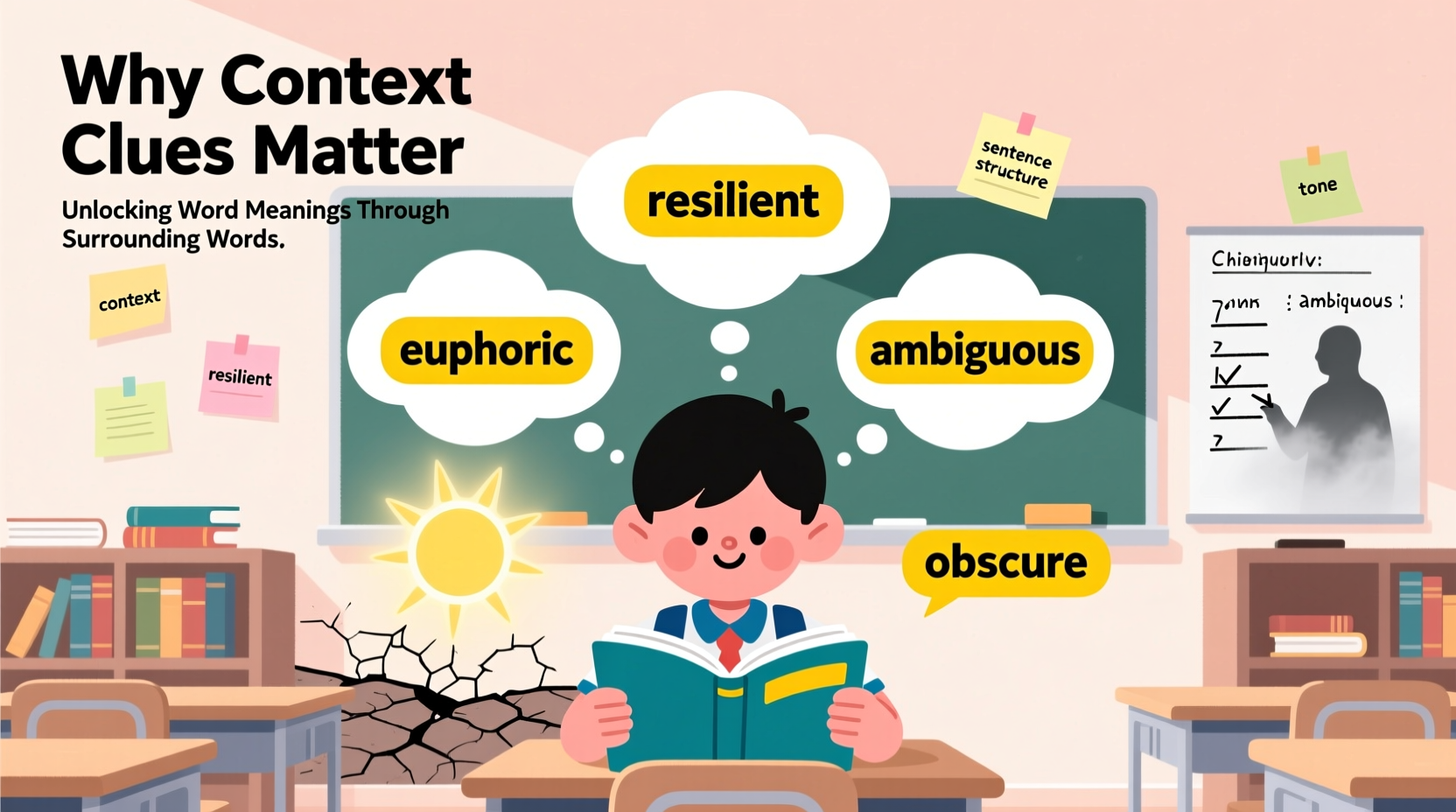
Every reader encounters new words. The average adult reads between 20,000 and 40,000 new word instances annually. Relying exclusively on definitions limits learning speed and practical application. Context clues bridge this gap by providing immediate, situational understanding.
When a reader sees a sentence like, “The frigid wind pierced through his jacket,” the phrase “pierced through his jacket” suggests discomfort and coldness. Even without knowing “frigid,” the surrounding details imply it means extremely cold. This kind of inference strengthens memory retention because the brain links the word to a meaningful experience within the text.
Research shows that repeated exposure to words in varied contexts leads to robust vocabulary growth. A study published in *Reading Research Quarterly* found that students who were taught to identify and use context clues demonstrated significantly greater gains in vocabulary than those who relied only on direct instruction.
Tip: When you encounter an unfamiliar word, pause and examine the surrounding sentences before reaching for a dictionary.Types of Context Clues and How They Work
Context clues come in several forms, each offering different kinds of support. Recognizing these types enables more accurate interpretation.
| Type | Description | Example |
|---|---|---|
| Definition/Explanation | The text directly defines the word. | “An archipelago, a group of islands, dotted the coastline.” |
| Synonym | A similar word is used nearby. | “She was lethargic, sluggish after the long flight.” |
| Antonym/Contrast | An opposite word highlights meaning. | “Unlike her gregarious brother, Maya was reserved and quiet.” |
| Example/Illustration | Examples clarify the word’s meaning. | “Carnivores, such as lions and wolves, eat meat.” |
| Appositive | A renaming phrase follows the word. | “Mount Everest, the tallest peak on Earth, attracts climbers worldwide.” |
| General Tone/Inference | Overall mood suggests meaning. | “He delivered the news with trepidation, hands trembling.” |
Understanding these categories helps readers systematically decode meaning. For instance, spotting an appositive or a contrastive conjunction like “unlike” or “however” signals that clarification is coming. These patterns become second nature with practice.
Step-by-Step Guide to Using Context Clues Effectively
Interpreting unfamiliar words using context is a skill that improves with deliberate practice. Follow this sequence to build confidence:
- Pause at the Unknown Word: Don’t skip it immediately. Mark it mentally or with a pencil.
- Read the Entire Sentence: Look for definition clues, synonyms, or examples.
- Examine Surrounding Sentences: Sometimes meaning extends beyond one line.
- Identify Clue Type: Is it a synonym? Contrast? Example? Labeling helps focus analysis.
- Make an Informed Guess: Formulate a definition based on evidence.
- Test Your Interpretation: Re-read the sentence with your guessed meaning. Does it make sense?
- Verify if Needed: Only after attempting inference, consult a dictionary to confirm.
This method promotes active reading and reduces dependency on external tools. Over time, steps two through six occur almost instantaneously.
Mini Case Study: Maria’s Reading Breakthrough
Maria, a ninth-grade English learner, struggled with standardized reading tests. She would stop at every unfamiliar word, losing track of main ideas. Her teacher introduced her to context clue strategies using short nonfiction passages. At first, Maria hesitated, fearing she’d guess wrong. But after practicing with guided exercises—highlighting contrast words like “but” and “although,” identifying examples after colons—she began making accurate inferences.
Within three months, Maria’s reading speed increased by 35%, and her comprehension scores rose significantly. On a passage about climate resilience, she encountered “mitigation” and used the sentence, “Steps to reduce emissions are key to mitigation,” to deduce it meant reducing harm. She later confirmed this with a dictionary. That moment marked a turning point: she realized she could navigate complex texts independently.
Expert Insight: Why Educators Emphasize Context Clues
Educational psychologists and literacy specialists consistently advocate for teaching context clue strategies early and often. Their reasoning goes beyond vocabulary building—it's about fostering independence and critical thinking.
“Students who can use context clues effectively aren’t just better readers—they’re better problem solvers. They learn to gather evidence, hypothesize, and test conclusions, skills that transfer across subjects.” — Dr. Linda Harper, Literacy Development Specialist, University of Michigan
Dr. Harper emphasizes that guessing isn’t random; it’s analytical. When students use context, they engage higher-order thinking processes akin to scientific reasoning. This cognitive engagement deepens understanding and makes learning more durable.
Common Pitfalls and How to Avoid Them
While powerful, context clues can mislead if misinterpreted. Some pitfalls include:
- Overreliance on partial clues: A single word like “but” doesn’t always signal contrast in meaning.
- Misreading tone: Sarcasm or irony can invert apparent meanings.
- Assuming all unfamiliar words need decoding: Some terms may be irrelevant to overall comprehension.
- Ignoring multiple meanings: Words like “light” or “bank” vary widely by context.
To avoid errors, readers should consider the broader passage, watch for signal words (e.g., “in contrast,” “for example”), and remain open to revising initial guesses as more information unfolds.
Tip: If your inferred meaning feels awkward when re-reading, double-check the context. You might have missed a subtle cue.Frequently Asked Questions
Can context clues replace dictionary use entirely?
No. While context clues are invaluable for quick comprehension and initial understanding, dictionaries provide precise definitions, etymologies, and usage examples. Use context first, then verify with a dictionary when accuracy matters—especially for academic or professional writing.
Are context clues equally effective in all types of texts?
Effectiveness varies. Narrative and expository texts often contain rich contextual support. However, technical, poetic, or highly abstract writing may offer fewer clear clues. In such cases, background knowledge becomes more critical.
How can parents help children develop context clue skills?
Ask questions during shared reading: “What do you think ‘enormous’ means here? How do you know?” Encourage prediction and evidence-based reasoning. Play word games where definitions must be guessed from sentences. These activities build awareness naturally.
Final Thoughts and Call to Action
Context clues are far more than a reading strategy—they are a gateway to autonomy in learning. Whether navigating a legal document, interpreting a poem, or reading a research article, the ability to derive meaning from context empowers individuals to engage confidently with any text. It fosters curiosity, reduces frustration, and accelerates vocabulary growth across languages and disciplines.
Start applying these techniques today. Challenge yourself to go ten minutes of reading without a dictionary. Highlight unfamiliar words, analyze their surroundings, and make educated guesses. Share your experiences with others—teachers, students, or fellow readers—and discuss how context transformed your understanding.
💬 Have a favorite example of a word you figured out using context? Share it in the comments and inspire others to sharpen their reading intuition!