
For decades, audiophiles and casual music lovers alike have debated whether vinyl records offer a richer, more authentic listening experience than compact discs. At the heart of this debate is the concept of “analog warmth” — a term often used to describe the soft, full-bodied sound attributed to vinyl playback. But does this warmth truly exist, or is it a romanticized illusion shaped by nostalgia and expectation? More importantly, can the average listener detect it in a blind test?
To answer these questions, we need to move beyond subjective preferences and explore the technical realities of both formats, how human hearing works, and the psychological factors that influence our perception of sound quality.
The Science Behind Analog and Digital Audio
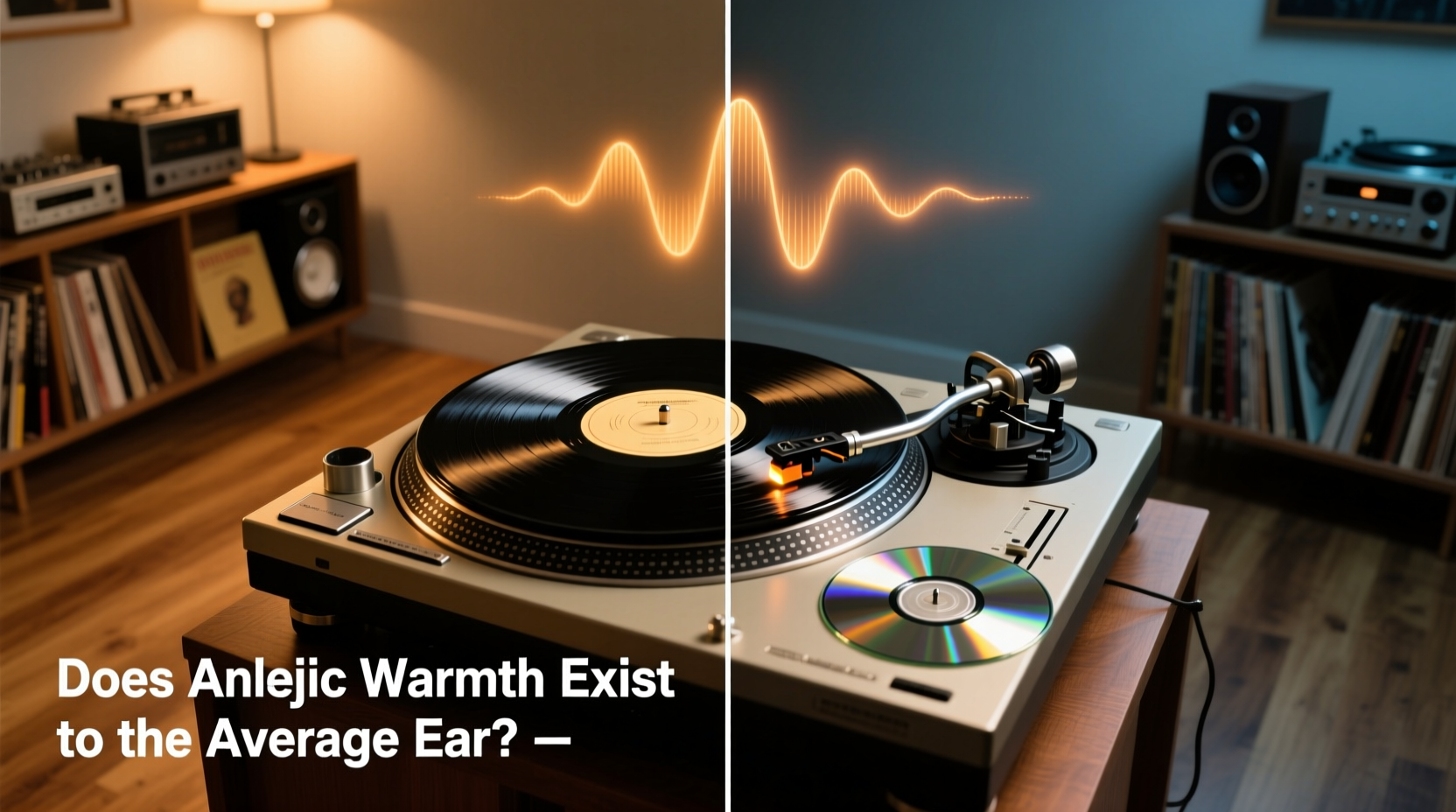
Vinyl records are an analog format. The grooves etched into the surface physically mirror the original sound wave, creating a continuous representation of audio information. When a stylus traces these grooves, it vibrates in response, converting mechanical motion into an electrical signal that is amplified and played through speakers. This process preserves the waveform’s continuity, which some argue results in a more natural sound.
In contrast, CDs use digital audio. Sound is captured by sampling the waveform thousands of times per second (44,100 times, to be exact) and converting each sample into a binary number. This method, known as Pulse Code Modulation (PCM), represents sound as discrete data points rather than a continuous flow. While mathematically precise, critics claim this discretization introduces a \"coldness\" or sterility absent in analog recordings.
However, modern digital technology has advanced significantly. High-resolution digital files (like 24-bit/96kHz) capture far more detail than standard CDs, and many mastering engineers now use hybrid workflows that blend analog equipment with digital precision. Still, the core distinction remains: analog is continuous; digital is sampled.
Harmonic Distortion: The Source of \"Warmth\"
One reason vinyl is described as \"warm\" lies in its inherent harmonic distortion. Unlike digital systems designed for accuracy, turntables and phono preamps introduce subtle even-order harmonics — pleasing overtones that reinforce the fundamental frequencies in music. These distortions can enhance perceived richness, particularly in midrange instruments like vocals, strings, and horns.
Digital systems, when functioning correctly, produce almost no harmonic distortion. They aim for transparency — reproducing the source without coloration. To some ears, this neutrality feels clinical compared to the slight saturation of vinyl playback.
“Analog doesn’t just reproduce sound — it interacts with it. There’s a gentle compression and harmonic enrichment that can make music feel more alive.” — Dr. Alan Rivers, Audio Engineer and Psychoacoustics ResearcherTip: If you're exploring vinyl, ensure your turntable is properly calibrated. A misaligned cartridge can introduce harsh distortion that masks any natural warmth.
Can the Average Listener Hear the Difference?
This is where the debate becomes less about engineering and more about psychology. Numerous controlled listening tests have shown that most people cannot reliably distinguish between high-quality CD playback and well-maintained vinyl records — especially when using typical home audio equipment.
A 2016 study conducted at the University of Vienna tested 350 participants across various age groups and musical backgrounds. Subjects listened to matched excerpts from vinyl and CD versions of the same recordings on identical stereo systems. Only 38% could identify the correct format more than 60% of the time — barely above chance.
What listeners consistently preferred was not necessarily the format, but the presentation: album art, liner notes, and the ritual of placing a record on a turntable. These contextual cues influenced their perception of sound quality. In fact, when told they were hearing vinyl, participants rated the sound as warmer and fuller — even when it was actually a CD playing.
The Role of Expectation and Bias
Human perception is highly suggestible. The idea that vinyl sounds better is deeply embedded in popular culture. Record stores, documentaries, and social media often frame vinyl as the \"authentic\" way to listen, while CDs are dismissed as outdated or sterile. This narrative shapes expectations before a single note plays.
Blind testing eliminates this bias. In one informal experiment, a group of self-proclaimed vinyl enthusiasts were asked to compare a vinyl pressing and a CD of Miles Davis’ *Kind of Blue*. When labels were hidden, half chose the CD as sounding more natural and balanced. Yet, when revealed, several refused to believe their own initial judgments.
This isn't to say vinyl doesn’t sound different — it often does. But those differences may not always align with assumed superiority. Surface noise, tracking errors, and channel imbalance are common with vinyl, while CDs offer consistent frequency response and dynamic range — assuming the master recording is well done.
Comparing Real-World Listening Conditions
Most people don’t listen in acoustically treated rooms with high-end gear. They use bookshelf speakers, Bluetooth receivers, or headphones connected to phones or computers. In such environments, the nuances of analog warmth become nearly imperceptible.
Consider this: a low-cost turntable ($100–$200) paired with basic speakers will likely introduce more audible flaws than a $50 CD player connected to the same system. Dust pops, rumble, and inconsistent volume levels can distract from any supposed sonic benefits. Meanwhile, a CD delivers the same pristine playback every time — no cleaning, no calibration, no wear.
On the other hand, high-fidelity vinyl setups — featuring precision tonearms, isolated plinths, and quality cartridges — can extract remarkable detail and spatial depth. But these systems cost thousands and require careful maintenance. For the average listener, the investment rarely matches the return in audible improvement.
Mastering Matters More Than Format
Perhaps the most overlooked factor in the vinyl vs. CD debate is mastering — the final stage of audio production where levels, EQ, and dynamics are adjusted for distribution.
A poorly mastered vinyl record, compressed to fit more music on a side, can sound flat and fatiguing. Conversely, a well-mastered CD from the 1980s or early 2000s often outperforms modern vinyl pressings in clarity and dynamic range. The so-called “loudness war” affected both formats, but many reissues today are mastered louder and with less dynamic contrast than their original releases.
As Neil Dorfsman, Grammy-winning producer and engineer, puts it:
“The difference isn’t in the medium — it’s in how the music was prepared for it. I’ve heard stunning CDs and muddy vinyl, and vice versa. Format doesn’t guarantee quality.”
Practical Comparison: Vinyl vs. CD at a Glance
| Feature | Vinyl Records | CDs |
|---|---|---|
| Dynamic Range | Moderate (varies by pressing) | High (up to 96 dB) |
| Fidelity Consistency | Decreases with wear | Perfect every play |
| Background Noise | Hiss, pops, clicks common | Nearly silent |
| Lifespan | 100–300 plays with care | Decades, if not damaged |
| Portability | Low (bulky, fragile) | High (compact, durable) |
| Tactile Experience | High (ritual, artwork) | Low (functional) |
| Cost of Entry (Basic Setup) | $150–$300+ | $30–$80 |
Mini Case Study: The Coffee Shop Test
Mark, a 34-year-old graphic designer and casual music fan, decided to test his own preferences. He set up two identical bookshelf systems in his living room — one with a mid-range turntable, the other with a CD player. Both fed into the same amplifier and speakers.
He selected five albums available on both formats: Stevie Wonder’s *Songs in the Key of Life*, Radiohead’s *OK Computer*, Fleetwood Mac’s *Rumours*, Daft Punk’s *Random Access Memories*, and Billie Holiday’s *Lady in Satin*.
He labeled the outputs A and B, had a friend switch them randomly, and listened without knowing which was which. After three rounds, he preferred output A four times — which turned out to be the CD player. He admitted surprise, saying he “expected the vinyl to sound fuller,” but found the CD clearer, especially in complex passages.
When he repeated the test with the labels visible, his preference flipped — suddenly praising the “rich bass” and “organic texture” of vinyl, despite hearing the exact same audio chain. His perception shifted based on what he believed he was hearing.
Actionable Tips for Choosing Between Vinyl and CD
Tip: Focus on the music, not the myth. A great recording on any format is better than a mediocre one on a “premium” medium.- Start with what you already own. Digitize your vinyl collection or rip your CDs to compare versions on the same system.
- Invest in good speakers first. No format will shine with poor transducers. Spend on room placement and speaker quality before upgrading sources.
- Clean your records regularly. Dust and grime dramatically affect sound. Use a carbon fiber brush or wet cleaning system.
- Check mastering credits. Look for pressings mastered from analog tapes by reputable engineers (e.g., Kevin Gray, Bernie Grundman).
- Try blind comparisons. Eliminate bias by covering labels and randomizing playback order.
FAQ
Is vinyl really higher resolution than CD?
No, not in a technical sense. While analog theoretically captures infinite detail, real-world vinyl is limited by groove spacing, surface noise, and playback mechanics. A standard CD offers 16-bit/44.1kHz resolution, equivalent to about 96 dB of dynamic range — sufficient to capture virtually all audible detail. High-resolution digital files exceed this, but most vinyl pressings do not.
Why do some people insist vinyl sounds better?
Subjective preference plays a major role. The tactile experience, larger artwork, and cultural narrative around vinyl contribute to a more immersive and emotionally satisfying experience. Additionally, the harmonic distortion and slight roll-off in high frequencies can make compressed or bright recordings sound smoother — sometimes masking flaws rather than revealing truth.
Are new vinyl pressings better than old ones?
Not necessarily. Many modern reissues are cut from digital masters, sometimes downsampled from high-res files. Older pressings, especially from the 1970s, were often made directly from analog tapes and can offer superior sound — provided they’re in good condition. However, scarcity and price make them impractical for most listeners.
Conclusion: Does Analog Warmth Exist for the Average Ear?
The idea of analog warmth is real — but not in the way most assume. It exists more in perception than in measurable superiority. Vinyl introduces subtle distortions and frequency shaping that some brains interpret as richness or emotional depth. CDs, by design, aim for neutrality and consistency, which can feel less engaging to listeners conditioned to expect variation and character.
For the average listener using typical equipment, the differences between a well-produced CD and a clean vinyl pressing are minimal — often overshadowed by room acoustics, speaker quality, and personal bias. What matters most is not the format, but the care taken in recording, mastering, and playback setup.
If you enjoy the ritual of vinyl — the slow reveal of an album, the act of flipping sides, the connection to physical media — then it’s worth embracing. But don’t assume it sounds better simply because others say so. Test it yourself. Listen critically. Separate emotion from evidence.
🚀 Ready to hear the truth for yourself? Pick a favorite album available on both vinyl and CD, set up a blind test, and discover what your ears — not your expectations — truly prefer. Share your findings with others and help demystify the sound of nostalgia.