Choosing your first Scotch can feel like stepping into a library where every book is written in a different dialect of smoke, oak, and sea salt. For newcomers, the distinction between single malt and blended Scotch isn’t just semantic—it’s pedagogical. One reveals the fingerprint of place and process; the other demonstrates the art of orchestration. If your goal is to learn *how* Scotch tastes—not just whether you like it—then clarity of flavor expression matters more than prestige or price. This article cuts through marketing noise to show why single malt Scotch, approached intentionally, serves as the superior foundational tool for flavor education. It’s not about declaring one “better” than the other. It’s about matching the right instrument to the student’s learning objective.
Why Flavor Clarity Matters More Than Preference at the Start
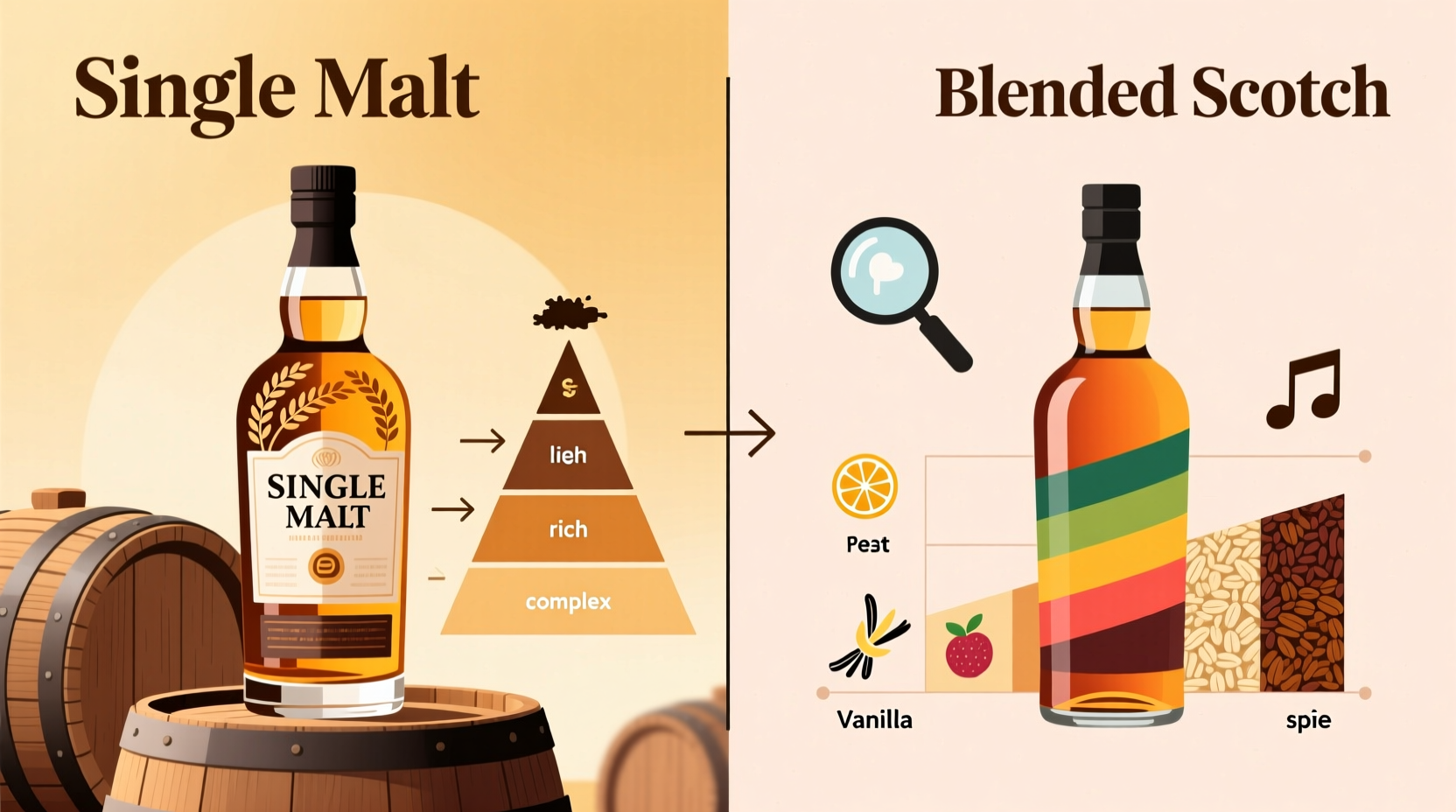
Beginners often assume that liking a whisky is the primary benchmark. But early exposure shapes neural pathways: repeated encounters with distinct, unmasked flavors train the palate to recognize patterns—peppery spice, dried apple, medicinal iodine, toasted almond. Blended Scotch deliberately smooths edges and harmonizes contrasts. That’s its strength—and its limitation for learners. A well-crafted blend may be more immediately approachable, but its complexity is distributed across dozens of malts and grains, diffused rather than spotlighted. Single malt, by definition, comes from one distillery, using malted barley only, fermented and distilled on-site. That constraint creates coherence: the same water source, local barley varieties (often), consistent still shape and cut points, and shared cask maturation conditions. The result? A transparent window into terroir, technique, and time.
Consider this analogy: learning music by ear begins with hearing individual notes before chords. You wouldn’t start with a symphony orchestra—you’d begin with a solo piano. Single malt is that piano. Its voice may be challenging at first—briny, peaty, austere—but each note rings true and unmuffled.
Tip: Skip the 12-year-old “entry-level” single malt labeled “smooth” or “mellow.” These are often heavily caramel-colored and chill-filtered, muting texture and nuance. Instead, choose an un-chill-filtered, natural-cask-strength (or near it) expression aged 8–12 years—like Glenmorangie Original, Aberlour A’Bunadh Batch Strength, or Benromach Traditional. They retain volatile esters and fatty acids essential for aroma development.How Blends Obscure—Not Just Balance—Flavor Origins
A typical premium blended Scotch contains 15–50 different whiskies. Grain whisky—distilled in continuous column stills—makes up 60–85% of most blends. It’s light, neutral, and high in ethanol yield, acting as a structural base. Malt whiskies provide character, but they’re selected not for individual distinction, but for functional contribution: one adds honeyed sweetness, another contributes citrus lift, a third delivers smoky depth. The blender’s skill lies in making these elements disappear into seamless unity.
This is craftsmanship—but it’s also obfuscation for the novice. When you taste Johnnie Walker Black Label, you experience a masterful, balanced dram. But you cannot isolate *why* it tastes of dark chocolate and dried fig. Is it the Caol Ila? The Talisker? The grain component? The answer requires access to proprietary blending logs and decades of sensory training. There’s no “flavor map” embedded in the bottle.
In contrast, a single malt’s profile is legible. Take Ardbeg 10 Year Old: its intense phenolic smoke, brine, and medicinal notes come directly from heavily peated barley, long fermentation, and slow distillation in tall, narrow stills on Islay. The casks—ex-bourbon and ex-sherry—add vanilla and stewed plum, but they don’t override the distillery’s signature. You taste *process*, not just product.
| Feature | Single Malt Scotch | Blended Scotch |
|---|---|---|
| Origin | One distillery, one production site | Mix of multiple distilleries (often 15–50+) |
| Grain Source | Malted barley only | Malted barley + unmalted cereals (corn, wheat) |
| Distillation | Pot stills only | Pot stills (malts) + column stills (grain) |
| Flavor Transparency | High: Distillery character dominates | Low to medium: Blending conceals origins |
| Learning Utility for Beginners | Excellent: Builds flavor vocabulary & recognition | Limited: Prioritizes harmony over articulation |
A Real Tasting Journey: How One Beginner Built Confidence in Six Weeks
Maya, a 32-year-old graphic designer in Portland, began her Scotch journey with a gift set of three miniatures: a blended Scotch (Chivas Regal 12), a Speyside single malt (Glenfiddich 12), and an Islay single malt (Lagavulin 16). She tasted them neat, then with a few drops of water, taking handwritten notes each time.
Week 1: She found the Chivas “easy” but vague—“tastes like… brown sugar and something woody?” Her notes were impressionistic, lacking anchors. Week 2: Glenfiddich revealed clear notes of pear, vanilla, and toasted oak. She recognized the vanilla from bourbon, the pear from white wine she drank regularly. Her confidence grew. Week 4: Lagavulin shocked her—“medicinal, like bandages and campfire”—but after reading about Islay’s peat bogs and coastal air, she understood *why*. She revisited Glenfiddich and noticed the subtle floral note she’d missed before. By Week 6, she could reliably distinguish unpeated Highland malts (honey, heather) from coastal ones (salt, kelp) and identify sherry cask influence (dried fruit, spice) versus bourbon cask (vanilla, coconut).
Crucially, Maya didn’t abandon blends. After six weeks, she returned to Chivas—and suddenly heard the underlying Speyside malt notes beneath the grain base. Her palate hadn’t just improved; it had gained a reference framework. That framework was built on single malts.
What to Taste—and in What Order—for Maximum Learning
Flavor education follows a logical progression: start simple and regional, then introduce contrast, then layer complexity. Avoid jumping from gentle Lowland to heavily peated Islay without preparation—that’s like learning French with Verlaine before mastering basic verbs. Follow this sequence over 4–6 sessions:
- Unpeated Speyside (e.g., Glen Moray Elgin Classic or Tomintoul 12): Light, fruity, floral. Establishes baseline malt character—apple, lemon zest, oatmeal, honey.
- Medium-peated Highland (e.g., Benriach Curiositas or Balvenie DoubleWood 12): Introduces smoke as a background note—campfire ash, roasted nuts—without overwhelming fruit or spice.
- Coastal Unpeated (e.g., Oban 14 or Old Pulteney 12): Adds salinity, brine, and maritime minerality—teaches how environment shapes spirit even without peat.
- Lightly Peated Islay (e.g., Bunnahabhain 12 or Caol Ila Unpeated/“Fruity” expressions): Demonstrates how identical geography can yield non-smoky profiles—citrus, seaweed, green herbs.
- Heavily Peated Islay (e.g., Ardbeg Wee Beastie or Laphroaig Triple Wood): The culmination—smoke as structure, not just seasoning. Teaches phenolic intensity, tar, iodine, and how cask type modulates fire.
Always taste with water—not soda, not ice. Add 1–2 drops at a time. Water breaks ester bonds, releasing volatile aromatics otherwise trapped in alcohol. Keep a clean glass for water, a notebook, and a neutral cracker (not bread—it’s too sweet) to reset your palate between drams.
“Single malts are the grammar of Scotch. Without understanding subject-verb-object—the distillery’s core expression—you can’t parse the complex sentences of blends. Teaching beginners with blends first is like teaching literature before phonics.” — Dr. Rachel McEwan, Master of Whisky Studies, University of Edinburgh
Myths Debunked: Why “Beginner-Friendly” Doesn’t Mean “Pedagogically Optimal”
Marketing often conflates accessibility with educational value. Let’s clarify common misconceptions:
- Myth: “Blends are smoother, so they’re better for new drinkers.”
Truth: Smoothness often comes from filtration, added caramel coloring, or excessive grain whisky dilution—masking flavor compounds essential for learning. A lightly peated, unfiltered single malt (e.g., Tobermory 12) offers more teachable texture than a filtered, caramel-colored blend. - Myth: “Single malts are too expensive or intimidating.”
Truth: Entry-level single malts like Auchentoshan Three Wood (£45–£55), Glengoyne 10, or even supermarket own-labels (Waitrose Highland Reserve) deliver remarkable transparency under £40. Intimidation fades with context—not price. - Myth: “You need to ‘graduate’ to single malts later.”
Truth: There’s no graduation. Many lifelong enthusiasts drink blends daily. But the foundational literacy—the ability to say “this tastes of wet stone because it’s from a coastal distillery using worm tub condensers”—is built on single malt exposure.
FAQ
Do I need to avoid blends entirely as a beginner?
No—and doing so would limit your appreciation of Scotch’s full spectrum. But treat blends as your “advanced listening practice,” not your first language lesson. Once you can reliably identify bourbon cask vanilla, sherry cask raisin, and peat smoke in single malts, return to a blend like Compass Box Glasgow Blend or Monkey Shoulder. You’ll hear the individual instruments clearly within the arrangement.
Is age statement the most important factor when choosing a learning malt?
No. A 12-year-old whisky aged in tired refill casks may be flatter and less expressive than an 8-year-old matured in first-fill sherry butts. Focus instead on production cues: “non-chill-filtered,” “natural color,” “cask strength” (or close to it), and distillery location. An 8-year-old Kilchoman Machir Bay tells you more about Islay than a 21-year-old Macallan with heavy sherry influence and filtration.
Can I learn flavor effectively from travel retail or duty-free bottles?
Proceed with caution. Many travel retail expressions are specially finished (e.g., “Port Wood Finish”) or higher-strength versions designed for novelty—not clarity. Stick to core range bottlings (the standard 10- or 12-year-old) from reputable retailers. If buying travel retail, verify it’s the exact same batch and label as the domestic release.
Conclusion
Flavor education isn’t passive consumption—it’s active decoding. Single malt Scotch provides the clearest, most consistent text for that work. Its constraints—single site, single grain, pot stills—create a controlled experiment in taste. Every variation in smoke level, cask type, or coastal humidity becomes legible. Blends, magnificent as they are, are the symphonies composed *after* the scales have been mastered. They reward deep listening, but they don’t teach the notes.
You don’t need rare bottles or a cellar to begin. You need curiosity, a clean glass, a few drops of water, and the willingness to taste slowly—not to judge, but to observe. Start with one unpeated Speyside. Note three things you smell before sipping. Then try one with light smoke. Compare. Repeat. In six weeks, you won’t just know what you like—you’ll understand *why*, and that understanding will transform every dram, every blend, every future tasting into a richer, more resonant experience.
💬 Your turn: Which single malt first made a flavor “click” for you? Share your breakthrough moment—and what you tasted—in the comments. Let’s build a living glossary of beginner epiphanies.