
The relationship between Russia and the United States has long been one of the most consequential and volatile in global politics. What began as a wartime alliance during World War II evolved into decades of ideological confrontation, military brinkmanship, and espionage. Today, despite the end of the Cold War, tensions persist—driven by competing interests in Europe, cyber warfare, election interference, and regional conflicts. Understanding why these two powers remain at odds requires a deep dive into historical turning points, shifting alliances, and the strategic calculations that continue to define their rivalry.
Cold War Origins: The Foundation of Distrust
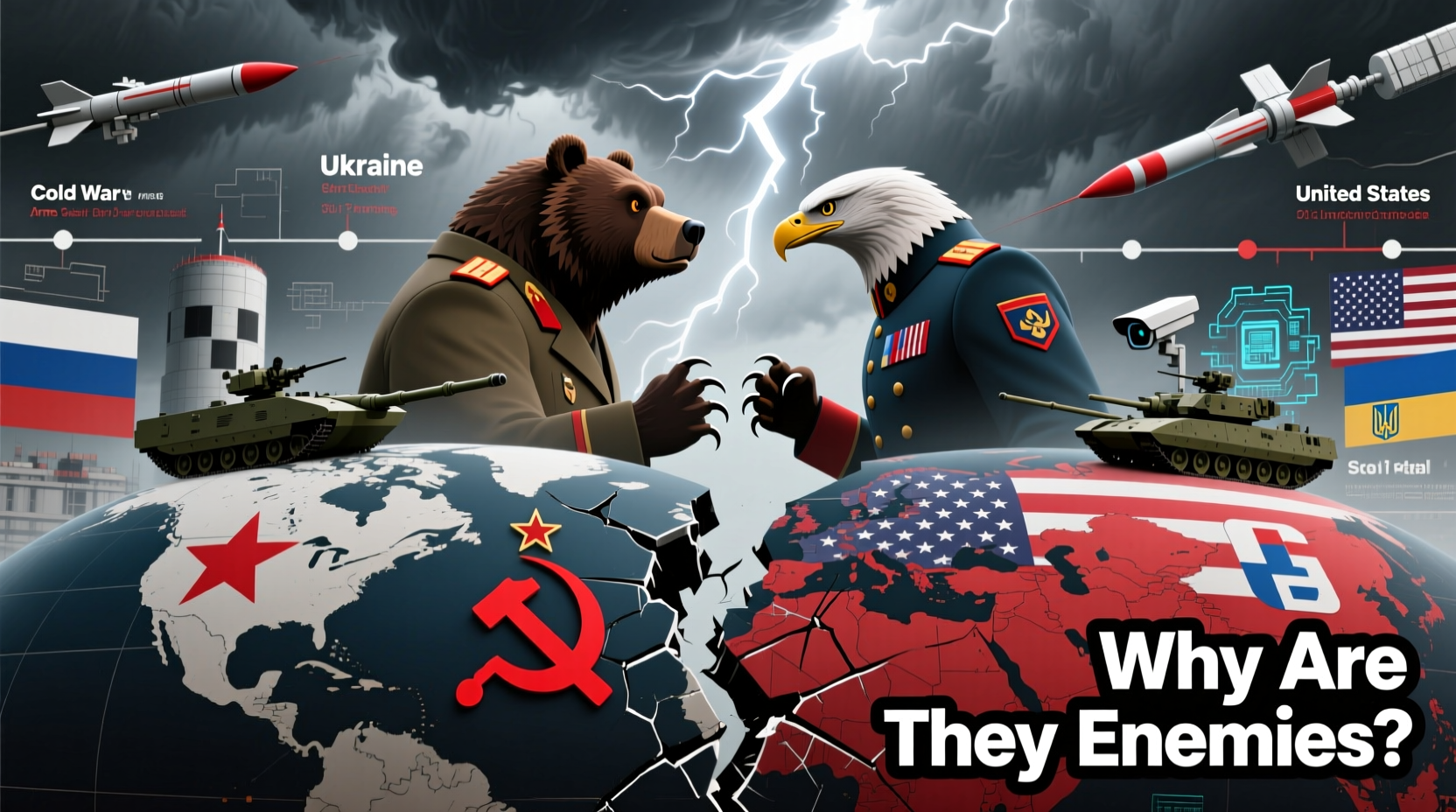
The roots of U.S.-Russia enmity stretch back to the aftermath of World War II. Though both nations were allies against Nazi Germany, their ideological differences—capitalist democracy versus communist authoritarianism—quickly surfaced. As the Soviet Union consolidated control over Eastern Europe, installing pro-Moscow regimes, American leaders saw this as imperial expansion. The Truman Doctrine (1947) formalized U.S. policy to contain communism, marking the beginning of the Cold War.
Key events intensified the divide:
- 1948–49 Berlin Blockade: The USSR cut off access to West Berlin; the U.S. responded with an airlift, demonstrating resolve.
- 1950s Arms Race: Both nations developed nuclear arsenals, leading to a dangerous doctrine of Mutually Assured Destruction (MAD).
- 1962 Cuban Missile Crisis: A 13-day standoff brought the world to the edge of nuclear war after Soviet missiles were discovered in Cuba.
This era cemented a pattern: competition masked by diplomacy, proxy wars in Korea, Vietnam, and Afghanistan, and constant surveillance through intelligence networks. Even moments of détente, such as Nixon’s visit to Moscow in 1972 or arms limitation talks (SALT I & II), never fully erased mutual suspicion.
Tip: When analyzing U.S.-Russia relations, consider how historical memory shapes current policy—Moscow remembers NATO expansion as betrayal; Washington recalls Soviet repression.The Post-Soviet Thaw and Its Collapse
The collapse of the Soviet Union in 1991 created hope for a new partnership. Russian President Boris Yeltsin cooperated with the West on arms reductions and economic reforms. The U.S., under Presidents George H.W. Bush and Bill Clinton, supported Russia’s transition—though often criticized for pushing shock therapy economics too aggressively.
However, several developments eroded trust:
- NATO Expansion: Starting in 1999, former Warsaw Pact countries like Poland, Hungary, and the Czech Republic joined NATO. Russia viewed this as a broken promise, despite no formal agreement barring expansion.
- Balkans Intervention: NATO’s 1999 bombing of Serbia (a Russian ally) without UN approval angered Moscow.
- Color Revolutions: U.S.-backed democratic uprisings in Georgia (2003) and Ukraine (2004) were seen by Russia as regime change operations.
By the time Vladimir Putin rose to power in 2000, he framed Russia’s weakness in the 1990s as national humiliation. His consolidation of power, crackdown on dissent, and reassertion of state control marked a departure from liberalization—and a return to great power ambition.
Modern Flashpoints: From Crimea to Cyberwarfare
The 2010s witnessed a sharp deterioration in relations. Several key crises transformed competition into open hostility:
1. Annexation of Crimea (2014)
Following Ukraine’s pro-Western revolution, Russia annexed Crimea and backed separatists in eastern Ukraine. The U.S. and EU imposed sanctions, calling it a violation of international law. This was the first time since WWII that a European state had absorbed territory by force.
2. Syria Conflict
Russia’s military intervention in 2015 to support Bashar al-Assad put it in direct opposition to U.S.-backed rebel groups. While both fought ISIS, their strategic goals diverged—Russia aimed to preserve Assad, the U.S. sought his removal.
3. Election Interference Allegations
U.S. intelligence agencies concluded that Russia conducted cyber operations to influence the 2016 presidential election, including hacking Democratic emails and spreading disinformation via social media. The findings led to indictments and deepened political polarization in America.
4. Nuclear Treaty Withdrawals
The U.S. withdrew from the Anti-Ballistic Missile (ABM) Treaty in 2002 and the Intermediate-Range Nuclear Forces (INF) Treaty in 2019, citing Russian violations. Russia suspended participation in the New START treaty in 2023, raising fears of a new arms race.
“We are not enemies, but our interests increasingly clash in a multipolar world where Russia demands respect.” — Sergey Lavrov, Russian Foreign Minister, 2022
Current Tensions: The Ukraine War and Global Repercussions
The full-scale invasion of Ukraine in February 2022 marked the lowest point in U.S.-Russia relations since the Cold War. The U.S. responded with unprecedented economic sanctions, military aid to Ukraine, and diplomatic isolation of Russia. Over $75 billion in U.S. aid has been sent to Kyiv as of 2024, including advanced weapons systems.
The conflict has reshaped global alliances:
- NATO has strengthened its eastern flank, adding Finland and Sweden.
- Russia has deepened ties with China, Iran, and North Korea.
- Energy markets have shifted, with Europe reducing reliance on Russian gas.
Despite attempts at backchannel diplomacy, dialogue remains minimal. High-level meetings between Biden and Putin are rare, and strategic stability talks are frozen. Cyberattacks, espionage, and disinformation campaigns continue beneath the surface.
| Issue | U.S. Position | Russia's Position |
|---|---|---|
| Ukraine Sovereignty | Full support for Ukrainian territorial integrity | Claims Ukraine is a puppet of the West; seeks “demilitarization” |
| NATO Expansion | All nations have right to choose alliances | Sees NATO near its borders as existential threat |
| Nuclear Weapons | Advocates arms control and transparency | Uses nuclear rhetoric as deterrent; suspends New START |
| Human Rights | Criticizes repression of dissent in Russia | Rejects Western interference; calls criticism “hypocritical” |
Pathways to De-escalation: Is Cooperation Possible?
While outright conflict remains unlikely due to nuclear deterrence, sustained hostility carries global risks—from disrupted supply chains to increased militarization. Some experts argue for limited cooperation in areas of mutual interest:
- Arms Control: Renewing or replacing New START could reduce accident risks.
- Climate Change: Both nations are major emitters and Arctic stakeholders.
- Counterterrorism: Shared threats from extremist groups could allow intelligence sharing.
- Diplomatic Channels: Reopening consulates and maintaining military-to-military communication prevents miscalculation.
Mini Case Study: The 2023 Detainee Swap
In a rare moment of cooperation, the U.S. and Russia conducted a high-profile prisoner exchange in August 2023, freeing journalist Evan Gershkovich and activist Paul Whelan in return for Russian prisoners held in the West. Conducted in Turkey, the swap showed that even amid deep hostility, backchannel diplomacy can yield results when both sides see value. It underscored that pragmatic engagement remains possible, even without broader reconciliation.
Frequently Asked Questions
Why does Russia see NATO as a threat?
Russia views NATO’s eastward expansion—especially into former Soviet republics like the Baltics—as a strategic encirclement. Despite NATO’s claim that membership is a sovereign choice, Moscow interprets it as a breach of informal understandings from the 1990s and a direct challenge to its sphere of influence.
Has the U.S. ever interfered in Russian elections?
There is little public evidence of direct U.S. interference in Russian elections. However, American funding for civil society groups, independent media, and NGOs in Russia has long been a point of contention. Moscow often labels such efforts as foreign meddling, mirroring accusations it faces regarding U.S. elections.
Could the U.S. and Russia go to war?
A direct military conflict remains highly unlikely due to the risk of nuclear escalation. However, the danger lies in indirect confrontations—through proxies, cyberattacks, or accidents in shared operational zones (e.g., Black Sea or Syria). Both sides maintain doctrines allowing for limited nuclear use, which increases the stakes of miscalculation.
Conclusion: Navigating a Fractured Relationship
The rivalry between Russia and the United States is not merely a product of individual leaders or isolated events—it is rooted in clashing worldviews, historical grievances, and the struggle for global influence. While cooperation on critical issues remains possible, the path forward requires realism, consistent communication, and a willingness to manage competition without sliding into conflict.
💬 What do you think is the biggest obstacle to U.S.-Russia peace? Share your thoughts in the comments below—whether it’s NATO, leadership, or historical mistrust, your perspective matters in understanding this pivotal global relationship.