In the evolving landscape of digital animation and game design, two distinct visual styles continue to command attention: retro pixel art and modern cel shading. While one draws inspiration from the technological constraints of the 1980s and '90s, the other leverages contemporary rendering techniques to mimic hand-drawn illustrations. As we move further into 2025, both styles have found renewed relevance—not just as nostalgic throwbacks or artistic experiments, but as viable choices for mainstream games, indie titles, and animated media. The question is no longer whether these styles belong in modern development, but which one resonates more deeply with today’s audiences, creators, and platforms.
The answer isn't straightforward. It depends on context—genre, target audience, technical requirements, and emotional intent. This article explores the strengths, limitations, and cultural significance of both retro pixel art and modern cel shading, analyzing their roles in shaping visual storytelling in 2025.
The Enduring Allure of Retro Pixel Art
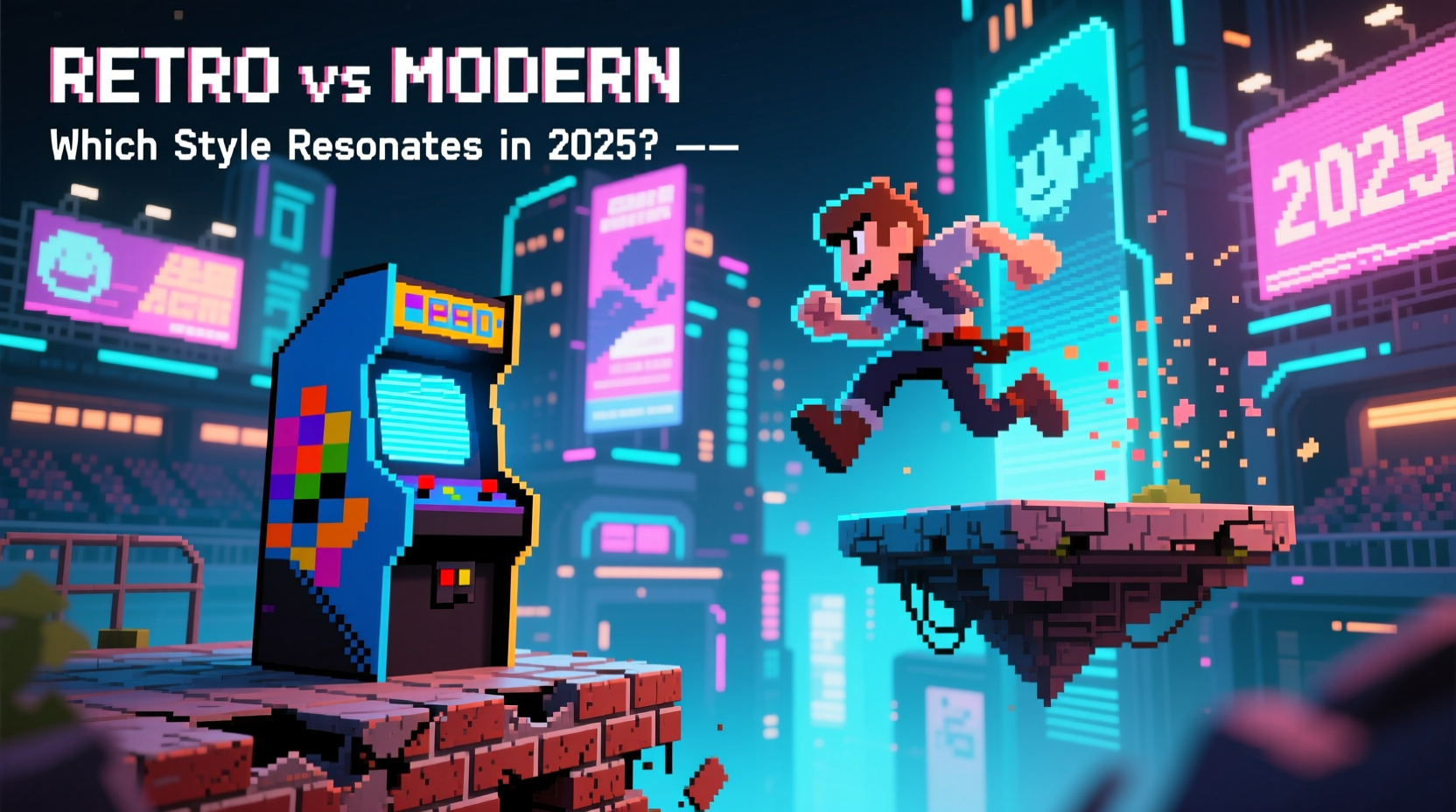
Retro pixel art originated from necessity. Early gaming consoles like the NES and Game Boy had limited processing power and memory, forcing developers to compress visuals into grids of colored pixels. What began as a technical limitation has evolved into a deliberate aesthetic choice—one that evokes nostalgia, minimalism, and creative constraint.
In 2025, pixel art thrives not despite its simplicity, but because of it. Indie developers, in particular, embrace pixel art for its low barrier to entry, strong community support, and timeless charm. Titles like *Celeste*, *Stardew Valley*, and *Undertale* have proven that pixel art can deliver emotionally rich experiences without relying on photorealistic graphics.
One of the key advantages of pixel art lies in its scalability and consistency. Because it relies on hand-crafted sprites rather than complex shaders or 3D models, it runs efficiently across devices—even on mobile or low-end hardware. This makes it ideal for cross-platform releases and experimental gameplay mechanics.
Tip: When designing pixel art, maintain consistent lighting direction and palette limits (e.g., 16–32 colors) to preserve visual cohesion.Cultural Resonance and Emotional Impact
Pixel art carries an emotional weight that transcends generations. For older players, it recalls childhood memories of playing *Super Mario Bros.* or *The Legend of Zelda*. For younger audiences, it represents a curated, intentional style—a reaction against the hyper-realism dominating AAA titles.
This duality allows developers to tap into universal themes: simplicity, clarity, and focus on gameplay over graphical fidelity. In an era where many feel overwhelmed by sensory overload in media, pixel art offers a form of digital minimalism.
“Pixel art isn’t about looking old—it’s about communicating clearly and emotionally through limitation.” — Lena Torres, Lead Artist at BitForge Studios
The Rise of Modern Cel Shading
Modern cel shading, also known as \"toon shading,\" emerged as a way to blend 3D modeling with 2D artistic expression. By applying flat colors, bold outlines, and stylized lighting, cel-shaded games simulate the look of cartoons, manga, or animated films. Notable examples include *The Legend of Zelda: The Wind Waker*, *Jet Set Radio*, *Okami*, and more recently, *Hi-Fi Rush* and *Genshin Impact*’s anime-inspired visuals.
By 2025, cel shading has matured into a sophisticated pipeline supported by real-time rendering engines like Unreal Engine 5 and Unity’s URP. Artists can now create dynamic, expressive characters and environments that retain a painterly or comic-book quality while benefiting from full 3D interactivity.
Unlike pixel art, cel shading doesn’t rely on nostalgia alone. Its appeal is rooted in visual identity and stylistic boldness. It enables creators to craft unique worlds that stand out in a crowded market. Moreover, cel shading aligns well with global trends in animation—particularly the rising popularity of anime and webcomics among Gen Z and Millennials.
Technical Advantages and Challenges
Cel shading performs exceptionally well in narrative-driven or action-oriented games where character expression and world vibrancy are paramount. Because it uses 3D assets, it supports camera freedom, physics interactions, and scalable resolution—features that are difficult to achieve with traditional pixel art.
However, it comes with higher production costs. Creating high-quality cel-shaded models requires skilled modelers, riggers, and shader programmers. Maintaining consistent line quality across different viewing angles remains a technical hurdle, especially when dealing with complex geometry or fast motion.
Despite these challenges, advancements in AI-assisted outlining and procedural texture generation are lowering the entry barrier. Tools like NVIDIA’s DLSS and Unity’s Shader Graph allow smaller studios to implement polished cel shading without massive teams.
Comparative Analysis: Key Differences in 2025
To understand which style resonates more today, it's essential to compare them across several dimensions. The table below summarizes critical factors influencing developer and audience preferences in 2025.
| Factor | Retro Pixel Art | Modern Cel Shading |
|---|---|---|
| Development Cost | Low to moderate; primarily 2D asset creation | Moderate to high; requires 3D modeling, rigging, custom shaders |
| Performance Efficiency | Excellent; lightweight, runs on most devices | Varies; optimized versions run well, but complex scenes strain hardware |
| Artistic Flexibility | Limited by grid constraints; excels in precision and detail at small scale | High; supports dynamic lighting, camera movement, and expressive animations |
| Nostalgia Factor | Strong; appeals to retro gamers and minimalist design lovers | Moderate; associated with early 2000s cult classics, less generational pull |
| Cross-Media Potential | Lower; harder to adapt directly to animation or print | Higher; naturally aligned with anime, comics, and streaming content |
| Trend Momentum (2025) | Stable; niche but growing in indie and mobile spaces | Increasing; boosted by anime culture and cinematic game storytelling |
Real-World Example: *Cuphead* vs *Hi-Fi Rush*
A telling comparison emerges when examining two critically acclaimed titles released within a few years of each other: *Cuphead* (2017) and *Hi-Fi Rush* (2023). Though separated by six years, both made significant impacts in 2025 due to lasting cultural influence and ongoing player engagement.
Cuphead, rendered entirely in hand-drawn animation mimicking 1930s cartoons, shares conceptual DNA with pixel art through its commitment to analog-style visuals. Despite being vector-based rather than pixelated, its success demonstrates a hunger for stylized, labor-intensive artistry. The game took seven years to develop, relying on frame-by-frame animation—a process reminiscent of classic Disney techniques.
Hi-Fi Rush, developed by Tango Gameworks, uses modern cel shading to create a vibrant, rhythm-based action experience. Inspired by anime and graphic novels, its visual language is dynamic, exaggerated, and perfectly synchronized with music. Released to widespread acclaim, it became a benchmark for how cel shading can enhance gameplay immersion.
Both games succeeded not because of their technology, but because their art styles served the core experience. *Cuphead*’s vintage aesthetic reinforced its challenging, old-school gameplay. *Hi-Fi Rush*’s energetic visuals amplified its musical combat system. These cases illustrate that resonance in 2025 depends less on the technique itself and more on alignment between style and substance.
Which Style Resonates More in 2025?
If resonance is measured by cultural reach, commercial viability, and future potential, modern cel shading holds a slight edge in 2025. Several macro-trends support this:
- Anime globalization: With anime surpassing $30 billion in global revenue in 2024, cel shading—which naturally complements anime aesthetics—is better positioned for mainstream adoption.
- Streaming and social media: Cel-shaded games tend to be more visually striking in short clips, making them highly shareable on TikTok, YouTube Shorts, and Twitch.
- AAA integration: Major franchises like *Spider-Man: Miles Morales* and *Xenoblade Chronicles 3* use hybrid cel shading to differentiate themselves from photorealistic competitors.
That said, retro pixel art remains deeply resonant within specific communities. Its resurgence in roguelikes, farming sims, and narrative adventures shows no signs of fading. Platforms like itch.io and Game Jolt continue to host thousands of pixel art projects annually, many funded successfully via Kickstarter or Patreon.
Ultimately, the “more resonant” style depends on the goal:
- For broad appeal, cinematic flair, and multimedia synergy → cel shading wins.
- For intimacy, accessibility, and nostalgic authenticity → pixel art excels.
Actionable Checklist: Choosing the Right Style for Your Project
Use this checklist to determine which animation style aligns best with your vision:
- ✅ Define your core audience: Are they fans of retro games or anime/streaming culture?
- ✅ Assess team size and skillset: Do you have 3D artists and shader experts, or are you working solo with 2D tools?
- ✅ Consider platform targets: Will the game run on mobile or low-spec devices? Pixel art may be more efficient.
- ✅ Evaluate narrative tone: Is your story whimsical and exaggerated (favor cel shading), or intimate and grounded (favor pixel art)?
- ✅ Plan long-term scalability: Do you envision spin-offs, animations, or merchandise? Cel shading integrates more easily with transmedia pipelines.
Looking Ahead: Convergence and Hybrid Approaches
An emerging trend in 2025 is the blending of both styles. Some developers are experimenting with “pixel-shaded” hybrids—using 3D models rendered with pixel-like textures or incorporating cel-shaded UI elements into otherwise pixel-based games.
For example, *Salt and Sacrifice* combines hand-painted 2D backgrounds with 3D character models using subtle cel shading, creating a layered, immersive world. Similarly, *Tunic* uses polygonal geometry masked under a deliberately retro presentation, blurring the line between old and new.
This convergence suggests that the future may not be about choosing one style over the other, but about leveraging the strengths of both. As tools become more flexible and audiences more visually literate, the distinction between “retro” and “modern” will continue to dissolve.
Frequently Asked Questions
Is pixel art still relevant in AAA game development?
While rare in large-scale AAA productions, pixel art influences design decisions even in high-budget games. Elements like inventory icons, map designs, and loading screens often use pixel-style assets for clarity and charm. Full pixel-art AAA titles remain uncommon due to market expectations around graphical fidelity, but indie-backed successes show there’s room for innovation.
Can cel shading work for horror or serious narratives?
Absolutely. Though often associated with lighthearted or comedic tones, cel shading can heighten emotional contrast. Games like *The Darkness II* and *Afro Samurai* prove that stylized visuals can coexist with mature themes. In 2025, developers are exploring darker palettes, distorted outlines, and shadow manipulation to expand cel shading’s expressive range.
Which style is easier to learn for beginners?
Pixel art generally has a gentler learning curve. Free tools like Aseprite, Piskel, and LibreSprite make it accessible, and countless tutorials exist online. Cel shading requires understanding 3D software (Blender, Maya), shader programming, and lighting principles, making it more complex for newcomers. However, beginner-friendly templates and asset stores are reducing this gap.
Final Thoughts: Style as Storytelling
In 2025, the debate between retro pixel art and modern cel shading is less about superiority and more about intentionality. Both styles offer powerful ways to communicate mood, theme, and identity. The most impactful projects aren’t those that simply adopt a trend, but those that use visual language to deepen player connection.
Retro pixel art reminds us that beauty can emerge from limitation. It champions craftsmanship, patience, and emotional nuance. Modern cel shading reflects our desire for bold self-expression, cinematic pacing, and cross-cultural storytelling. Together, they represent two poles of a creative spectrum—one rooted in memory, the other reaching toward the future.
Whether you're a developer, artist, or enthusiast, the takeaway is clear: choose the style that serves your story, not the one that follows the algorithm. Authenticity resonates louder than realism.
🚀 Ready to create your own visual masterpiece? Pick up a tool today—Aseprite for pixel art or Blender with Toon Shader setup—and start sketching. Share your progress online and join the global community redefining what animation means in 2025.