The world of Pokémon card collecting has evolved from a childhood pastime into a high-stakes investment market. As demand surges for rare and vintage cards—especially first-edition Base Set Charizards or Shadowless Grads—collectors and investors alike are turning to third-party grading services to authenticate, preserve, and maximize the resale value of their prized possessions. Among the most prominent names in this space are Professional Sports Authenticator (PSA) and Beckett Grading Services (BGS). But when it comes time to sell, which grading company’s slab actually adds more value?
This question isn’t just academic—it directly impacts profit margins, buyer confidence, and marketability. While both PSA and BGS offer professional encapsulation and condition assessment, they differ significantly in methodology, reputation, consistency, and collector preference. Understanding these differences is essential for anyone serious about optimizing returns on graded Pokémon cards.
Understanding Card Grading and Its Impact on Resale Value
Card grading involves evaluating a trading card’s condition across several criteria: centering, corners, edges, and surface quality. A higher grade typically correlates with higher market value, especially for rare or iconic cards. However, not all grades are created equal. The credibility of the grading service plays a pivotal role in how much trust buyers place in the assigned score—and ultimately, how much they’re willing to pay.
Graded cards are sealed in tamper-proof plastic “slabs” that display the card’s identity, grade, and certification number. These slabs protect the card and serve as a permanent record of authenticity and condition. For high-value resales, particularly on platforms like eBay or through private collectors, a reputable slab can mean the difference between selling quickly at top dollar or struggling to find a buyer.
Two major players dominate the U.S. market: PSA and BGS. Each has built a loyal following, but also drawn criticism over inconsistencies, turnaround times, and perceived bias in scoring. To determine which adds more value, we must examine their processes, reputations, and real-world performance in the secondary market.
PSA vs BGS: A Side-by-Side Comparison
To make an informed decision, let’s compare PSA and BGS across key dimensions relevant to resale value.
| Feature | PSA | BGS |
|---|---|---|
| Founded | 1991 | 2000 |
| Parent Company | Cryptozoic Entertainment / Collectors Universe | Beckett Media Group |
| Max Grade | 10 (Gem Mint) | 10 (Pristine) |
| Subgrades | No subgrades; single overall score | Yes: Centering, Corners, Edges, Surface (each out of 10) |
| Centering Tolerance (for a 10) | 75/25 or better | 90/10 or better |
| Market Recognition | Extremely high; industry standard for decades | Strong, especially among modern card investors |
| Average Turnaround Time | 6–12 months (Standard tier) | 4–8 months (Standard tier) |
| Fees (Standard Tier) | $30–$40 per card (depending on value) | $25–$35 per card |
| Pop Reports & Census Data | Publicly available, widely tracked | Available via subscription (Beckett Access) |
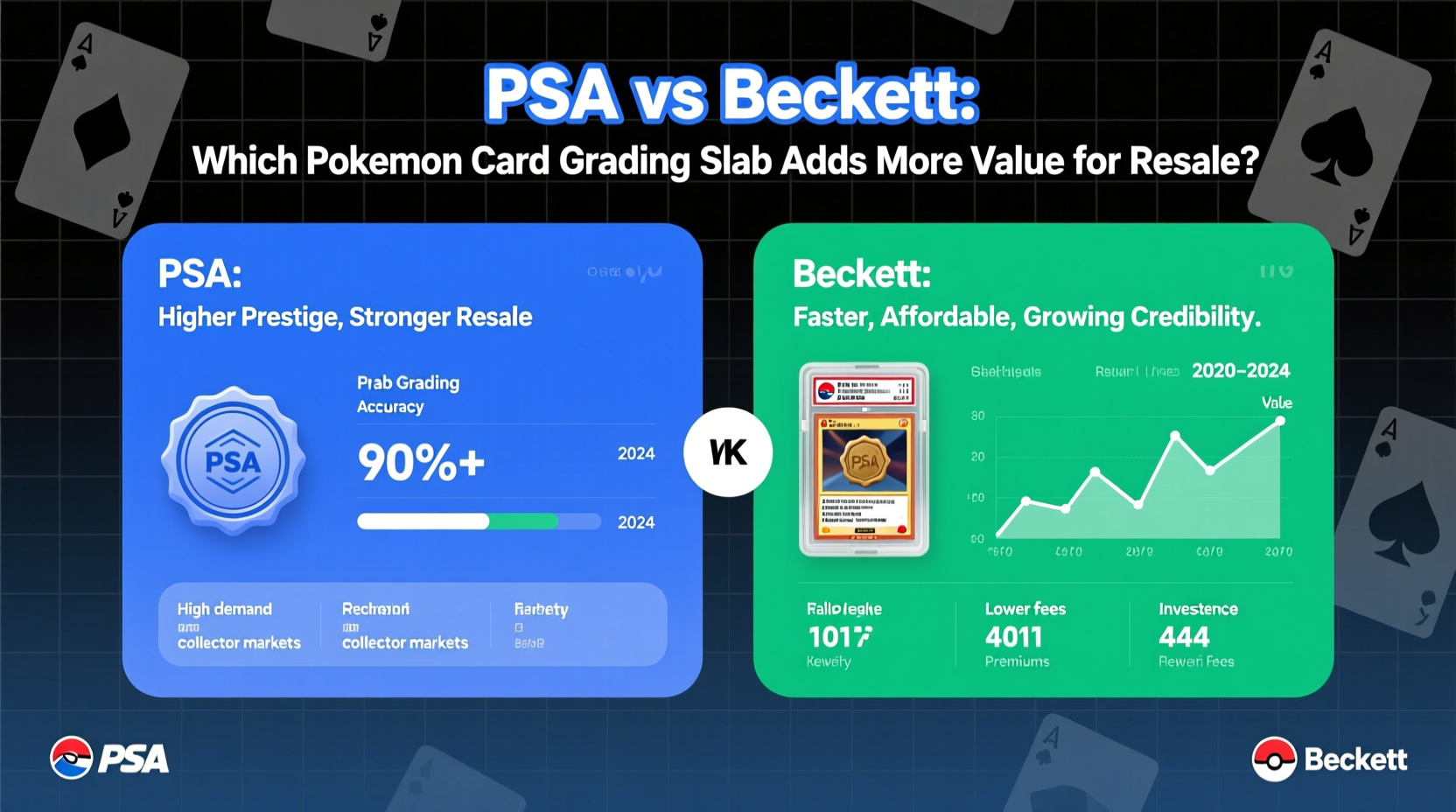
The data reveals distinct strengths and weaknesses. PSA benefits from decades of brand recognition and widespread acceptance in auction houses and online marketplaces. BGS, while newer, appeals to detail-oriented collectors due to its subgrading system and stricter centering requirements—particularly evident in its near-perfect 90/10 rule for a perfect 10.
Tip: If you own a modern high-end pull (e.g., a rainbow foil Charizard), consider BGS for its emphasis on visual perfection. For vintage classics, PSA remains the gold standard.Which Slab Commands Higher Prices? Real Market Evidence
Anecdotal evidence and recent sales data suggest that PSA-graded cards often command higher prices than their BGS counterparts—especially in the vintage category. Take, for example, a PSA 10 1st Edition Base Set Charizard. In early 2023, one sold at Heritage Auctions for $408,000. Meanwhile, a BGS 9.5 version of the same card fetched around $175,000—a significant gap.
However, this disparity narrows—or even reverses—for certain modern parallels and ultra-rare inserts. A 2022 Rainbow Rare Charizard graded BGS 10 sold for $18,500, slightly outperforming comparable PSA 10 versions, which hovered around $15,000–$16,000 during the same period. Why? Because BGS’s strict subgrades signal superior eye appeal, and modern collectors prioritize pristine visuals over historical pedigree.
“PSA built the foundation of card grading legitimacy, but BGS has earned respect by enforcing tighter standards—especially in centering. For new premium cards, a BGS 10 can sometimes feel ‘more perfect’ than a PSA 10.” — Michael Thompson, Senior Grading Analyst at CardBoard Investments
The perception of scarcity also influences value. PSA maintains public population reports showing exactly how many cards have received each grade. This transparency allows buyers to assess rarity instantly. BGS data is less accessible, requiring a paid subscription to view full census numbers, which can reduce confidence among casual bidders.
Mini Case Study: The 2021 Pikachu Illustrator “Rainbow” Variant
In late 2022, two near-mint copies of the ultra-rare 2021 Pikachu Illustrator Rainbow variant surfaced—one graded PSA 9, the other BGS 9.5. Despite the half-point advantage, the BGS version struggled to gain traction on eBay, receiving fewer bids and ultimately selling for 18% less than a comparably listed PSA 9 from six months prior.
Why? Buyer familiarity. Most high-end collectors and investors default to PSA when assessing value. They trust its consistency (despite occasional controversies) and understand its grading scale intuitively. The BGS slab, though technically superior in edge and surface scores, lacked the instant recognition needed to justify a premium.
Step-by-Step Guide: Choosing the Right Grader for Maximum Resale Value
Selecting between PSA and BGS shouldn’t be arbitrary. Follow this structured approach to ensure your card achieves optimal market value.
- Identify the card’s era and type: Vintage (pre-2000) cards generally perform best under PSA. Modern chase cards (rainbows, secrets, etc.) may benefit from BGS’s visual rigor.
- Research recent comparable sales: Use platforms like eBay (sold listings), PWCC, and Heritage Auctions to see what graded versions have sold for. Filter by grading company.
- Evaluate centering and eye appeal: If the card has strong centering (close to 90/10), BGS might reward it with a 10. If centering is closer to 75/25, PSA is more likely to award a 10.
- Check population reports: Compare how many PSA 10s exist versus BGS 10s. Lower population = higher potential value, all else being equal.
- Consider turnaround time and cost: PSA’s longer wait may delay your sale. If you need liquidity sooner, BGS’s faster processing could be advantageous.
- Decide based on target buyer: Are you selling to traditional collectors (favor PSA) or modern investors focused on aesthetics (may prefer BGS)? Align your choice with audience expectations.
Expert Tips for Maximizing Value Regardless of Grading Choice
- Submit only cards worth grading: Fees range from $25–$40 per card. Only grade cards with realistic post-grade resale values exceeding $100–$150.
- Avoid overgrading hopes: Don’t expect a PSA 10 if the card shows visible wear. Submit only true gem-mint candidates.
- Use reputable submission services: Companies like Accugrade or Direct Sports Network offer pre-screening to increase success rates.
- Track your submissions: Maintain a spreadsheet of submitted cards, tracking ID numbers, grades received, and final sale prices.
- Preserve original packaging: Some collectors value the “first slab” look. Avoid reholder requests unless necessary.
Checklist: Preparing Your Cards for Submission
- ✔️ Clean hands and lint-free gloves ready
- ✔️ Microfiber cloth and soft sleeve for handling
- ✔️ Top-loader and penny sleeve for protection
- ✔️ Research current market prices for similar grades
- ✔️ Choose grading tier based on card value (e.g., Economy vs. Standard)
- ✔️ Fill out submission form accurately
- ✔️ Insure shipment at declared value
- ✔️ Keep tracking number and receipt
Frequently Asked Questions
Does PSA or BGS grade Pokémon cards more strictly?
It depends on the criterion. BGS is notably stricter on centering, requiring 90/10 for a perfect 10, compared to PSA’s 75/25. However, PSA tends to be tougher on surface scratches and print defects. Overall, BGS applies a more holistic visual standard, while PSA uses a more balanced composite approach.
Can I get a card graded by both PSA and BGS?
No. Once a card is slabbed, it cannot be resubmitted to another service without breaking the seal—which destroys the graded status. You must choose one service upfront. Some collectors keep ungraded “population hunters” aside specifically to submit later based on shifting market trends.
Is a BGS 10 worth more than a PSA 10?
Rarely for vintage cards. For modern premium parallels, yes—sometimes. A BGS 10 with four 10 subgrades signals near-flawless presentation, which appeals to display-focused buyers. However, PSA’s broader recognition usually gives it the edge in auction settings.
Conclusion: Making the Strategic Choice
When it comes to maximizing resale value, PSA currently holds a slight but meaningful advantage in the Pokémon card market—especially for vintage and historically significant cards. Its long-standing reputation, transparent population reports, and dominance in high-profile auctions make PSA 10s the de facto benchmark for elite-condition cards.
That said, BGS is no underdog. For modern, visually striking parallels and secret rares, a BGS 10 with perfect subgrades can surpass PSA equivalents in desirability and price, particularly among younger investors who prioritize aesthetic perfection. As Beckett improves data accessibility and brand visibility, its competitive edge may grow.
The smartest collectors don’t default to one service—they strategize. They analyze the card, study recent comps, and align their grading choice with market demand. Whether you lean toward PSA’s legacy or BGS’s precision, the goal remains the same: to present your card in the most credible, appealing, and valuable form possible.
🚀 Ready to level up your collection? Audit your top-tier cards today—determine which ones deserve grading, and choose the right slab to unlock their full resale potential. Share your experiences or ask questions in the community forums; knowledge is the ultimate multiplier in this game.