
For users still relying on the iPhone 13 mini, the allure of Apple’s latest flagship—the iPhone 15 Pro—can be strong. But is the jump from a compact, efficient device to a premium titanium-powered powerhouse truly justified? The answer depends on your priorities: Are you chasing cutting-edge performance, better photography, or simply a longer software lifespan? This breakdown compares every key aspect—from design and display to camera, battery life, and real-world usability—to determine whether upgrading makes financial and functional sense.
Design and Build: Compact Charm vs Premium Powerhouse
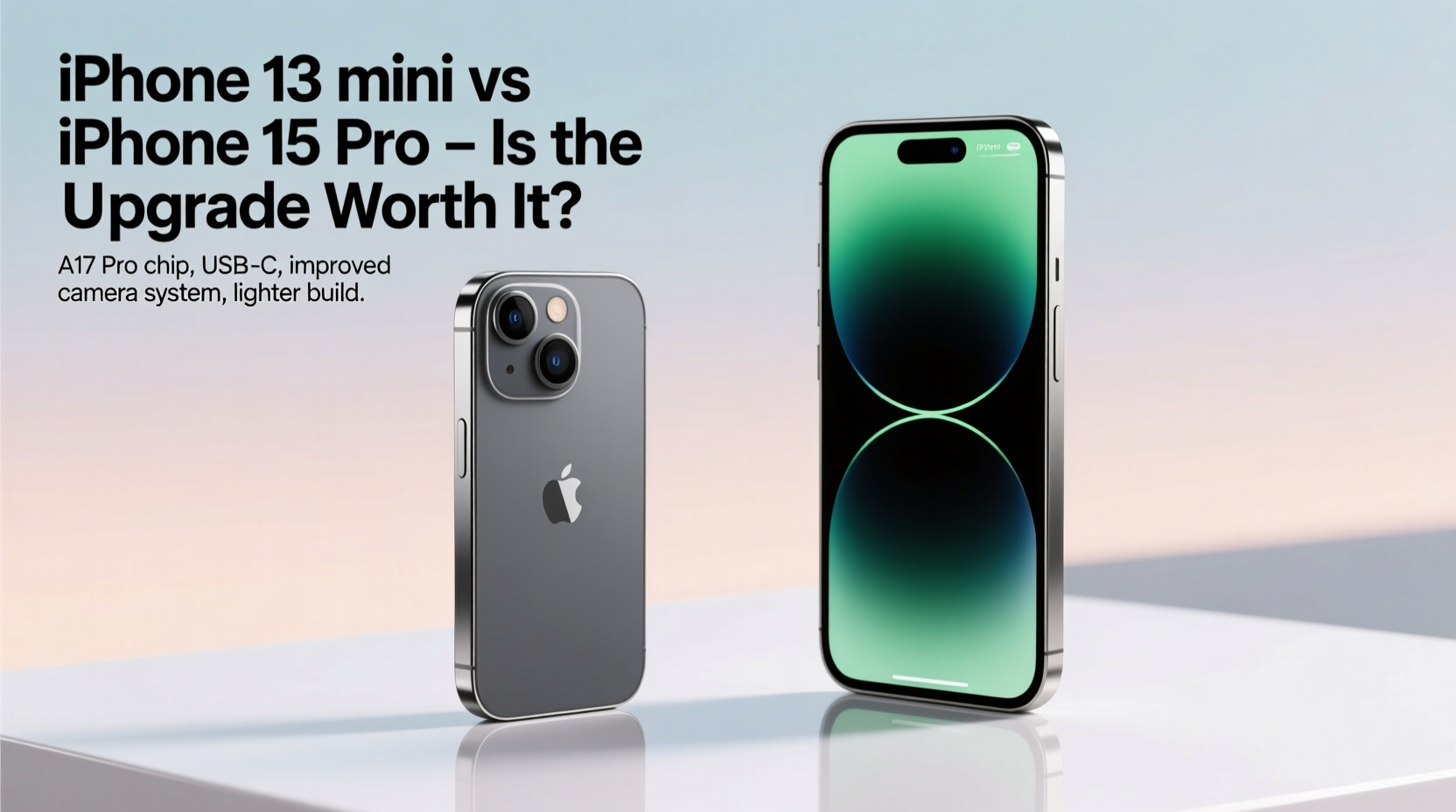
The iPhone 13 mini represents Apple’s last attempt at a true small smartphone. Measuring just 131.5 x 64.2 x 7.65 mm and weighing 140 grams, it fits comfortably in one hand and slips easily into tight pockets. Constructed with aluminum edges and glass back, it’s durable but lacks the elite feel of higher-end models.
In contrast, the iPhone 15 Pro redefines luxury in Apple’s lineup. Crafted from aerospace-grade titanium, it’s lighter than its predecessor despite being larger (146.6 x 70.6 x 8.2 mm, 187 grams). The chamfered edges return, offering a refined aesthetic reminiscent of the iPhone 4 and 5 era. The new Action button replaces the mute switch, allowing customizable shortcuts for camera, flashlight, or Focus modes—a feature power users appreciate.
Tip: If pocketability is non-negotiable, the 13 mini still wins. But if you value durability, premium materials, and long-term comfort during extended use, the 15 Pro’s build quality is a significant step up.Display and Usability: Size Matters More Than You Think
The 13 mini features a 5.4-inch Super Retina XDR OLED display with a resolution of 2340 x 1080 pixels. While sharp and vibrant, its smaller screen can feel cramped when multitasking, watching videos, or typing extensively.
The iPhone 15 Pro boasts a 6.1-inch Super Retina XDR display with ProMotion technology, supporting adaptive refresh rates from 1Hz to 120Hz. This means smoother scrolling, more responsive gaming, and improved power efficiency. True Tone, HDR support, and brighter peak brightness (up to 2000 nits outdoors) make viewing in sunlight far more comfortable.
More importantly, iOS has evolved to favor larger screens. Features like landscape app layouts, split-view multitasking on iPadOS-inspired workflows, and gesture navigation are better suited to the 15 Pro’s footprint. For users who spend hours on social media, reading, or video calls, the size difference becomes a usability advantage—not just a preference.
Performance and Software Longevity
Under the hood, the leap from the A15 Bionic chip (in the 13 mini) to the A17 Pro (in the 15 Pro) is substantial. The A15 remains capable for everyday tasks—messaging, browsing, streaming—but struggles with intensive applications like 4K video editing, AR experiences, or high-end mobile gaming.
The A17 Pro, built on a 3nm process, delivers up to 20% faster CPU performance and 2x faster GPU performance. It supports hardware-accelerated ray tracing, enabling console-quality games like Resident Evil Village and Assassin’s Creed Mirage on mobile. Machine learning tasks, such as photo enhancement and live text recognition, are also significantly quicker.
“With the A17 Pro, Apple isn’t just improving speed—it’s redefining what smartphones can do.” — Mark Soyer, Senior Mobile Analyst at TechInsight Group
Software support is another critical factor. The iPhone 13 mini will likely receive updates until 2026 or 2027. The iPhone 15 Pro, released in 2023, is expected to be supported through 2030–2031. That extra 3–4 years of iOS updates means longer security patches, compatibility with future apps, and resale value.
Camera Comparison: From Good to Professional Grade
The iPhone 13 mini’s dual-camera system includes a 12MP main sensor and a 12MP ultra-wide lens. It performs well in daylight and offers excellent Smart HDR and Deep Fusion processing. However, low-light performance lags behind current standards, and there’s no telephoto lens—only digital zoom.
The iPhone 15 Pro introduces a completely redesigned camera system:
- 48MP Main Sensor: Default 24MP output with pixel binning; enables superior detail and cropping flexibility.
- 12MP Ultra-Wide: Improved low-light performance and focus down to 2cm for macro shots.
- 12MP 3x Telephoto Lens: Optical zoom replaces digital cropping, ideal for portraits and distant subjects.
- Next-Gen Computational Photography: Photonic Engine, Smart HDR 5, and Night mode available across all lenses.
Video capabilities also see a major leap. The 15 Pro supports 4K Dolby Vision HDR recording at 120fps, Log encoding for professional color grading, and USB-C direct ProRes video output to external drives—features absent in the 13 mini.
Real-World Example: Travel Photographer’s Dilemma
Sophia, a travel blogger using her 13 mini for content creation, found herself frustrated during a trip to Iceland. Low-light shots of the Northern Lights lacked clarity, and she couldn’t capture distant waterfalls without losing detail. After upgrading to the 15 Pro, she used the 3x telephoto lens to frame dramatic landscapes and recorded cinematic 4K time-lapses via ProRes. Her content quality—and audience engagement—improved noticeably.
Battery Life and Charging: Efficiency vs Endurance
The 13 mini’s compact size comes at a cost: limited battery capacity. Apple rated it for up to 17 hours of video playback, but real-world usage often lands between 8–10 hours of screen time. Heavy users may need a midday charge.
The 15 Pro offers significantly better endurance—up to 23 hours of video playback and around 14–16 hours of mixed usage. It benefits from both a larger battery and the power-efficient A17 Pro chip. Additionally, it supports faster charging (up to 50% in 30 minutes with a 20W+ adapter) and USB-C, which replaces Lightning for universal compatibility.
While the 13 mini still charges via Lightning (with slower speeds), the shift to USB-C on the 15 Pro simplifies travel, reduces cable clutter, and allows faster data transfer—especially useful for photographers moving large files.
Detailed Feature Comparison Table
| Feature | iPhone 13 mini | iPhone 15 Pro |
|---|---|---|
| Release Year | 2021 | 2023 |
| Chipset | A15 Bionic | A17 Pro (3nm) |
| Display | 5.4\" OLED, 60Hz | 6.1\" OLED, 120Hz ProMotion |
| Rear Cameras | 12MP Wide + 12MP Ultra-Wide | 48MP Wide + 12MP Ultra-Wide + 12MP 3x Telephoto |
| Front Camera | 12MP | 12MP Dynamic Island with Autofocus |
| Video Recording | 4K HDR @ 60fps | 4K Dolby Vision @ 120fps, ProRes, Log Encoding |
| Battery Life (Video Playback) | Up to 17 hours | Up to 23 hours |
| Charging Port | Lightning | USB-C (faster data & charging) |
| Materials | Aluminum & Glass | Titanium Frame & Glass |
| Software Support (Estimated) | Until ~2026–2027 | Until ~2030–2031 |
Is the Upgrade Worth It? A Practical Checklist
Before making the move, consider these questions:
- Do you need better photos or videos? If yes, especially in low light or with zoom, the 15 Pro is transformative.
- Are you running out of battery by midday? The 15 Pro offers substantially longer endurance.
- Do you play graphics-intensive games or edit media on your phone? The A17 Pro handles these tasks with ease.
- Do you value future-proofing? Extra years of iOS updates make the 15 Pro a smarter long-term investment.
- Can you adapt to a larger phone? If one-handed use is essential, the 13 mini’s size remains unmatched.
Frequently Asked Questions
Can the iPhone 13 mini still handle daily tasks in 2024?
Yes. The A15 chip remains powerful enough for social media, email, messaging, streaming, and even moderate gaming. However, some newer apps may begin to optimize for A16+ chips, potentially slowing performance over time.
Does the iPhone 15 Pro justify its higher price?
At $999 starting, it’s a premium device. If you’re a power user, photographer, or plan to keep your phone for 4+ years, the investment pays off. Casual users may find the standard iPhone 15 or even a refurbished 14 Pro more cost-effective.
Will my accessories work with the iPhone 15 Pro?
Most cases won’t fit due to redesigned dimensions and the Action button. Lightning accessories require adapters, but USB-C compatibility opens doors to broader peripheral support.
Final Verdict: Who Should Upgrade?
For users deeply attached to the 13 mini’s compact form, the upgrade to the 15 Pro involves a trade-off in size and convenience. But objectively, the advancements in performance, camera, battery, and longevity are substantial. The 15 Pro isn’t just an incremental update—it’s a generational leap tailored for those who rely on their phones as creative tools, productivity hubs, or primary cameras.
If you’ve held onto your 13 mini for two years or more, and you're noticing slowdowns, storage limits, or frustration with photo quality, now is a reasonable time to move up. The iPhone 15 Pro offers not just better specs, but a more sustainable, future-ready experience.
🚀 Ready to make the switch? Evaluate your usage patterns, prioritize your needs, and consider selling your 13 mini to offset the upgrade cost. The right phone should enhance your life—not hold it back.