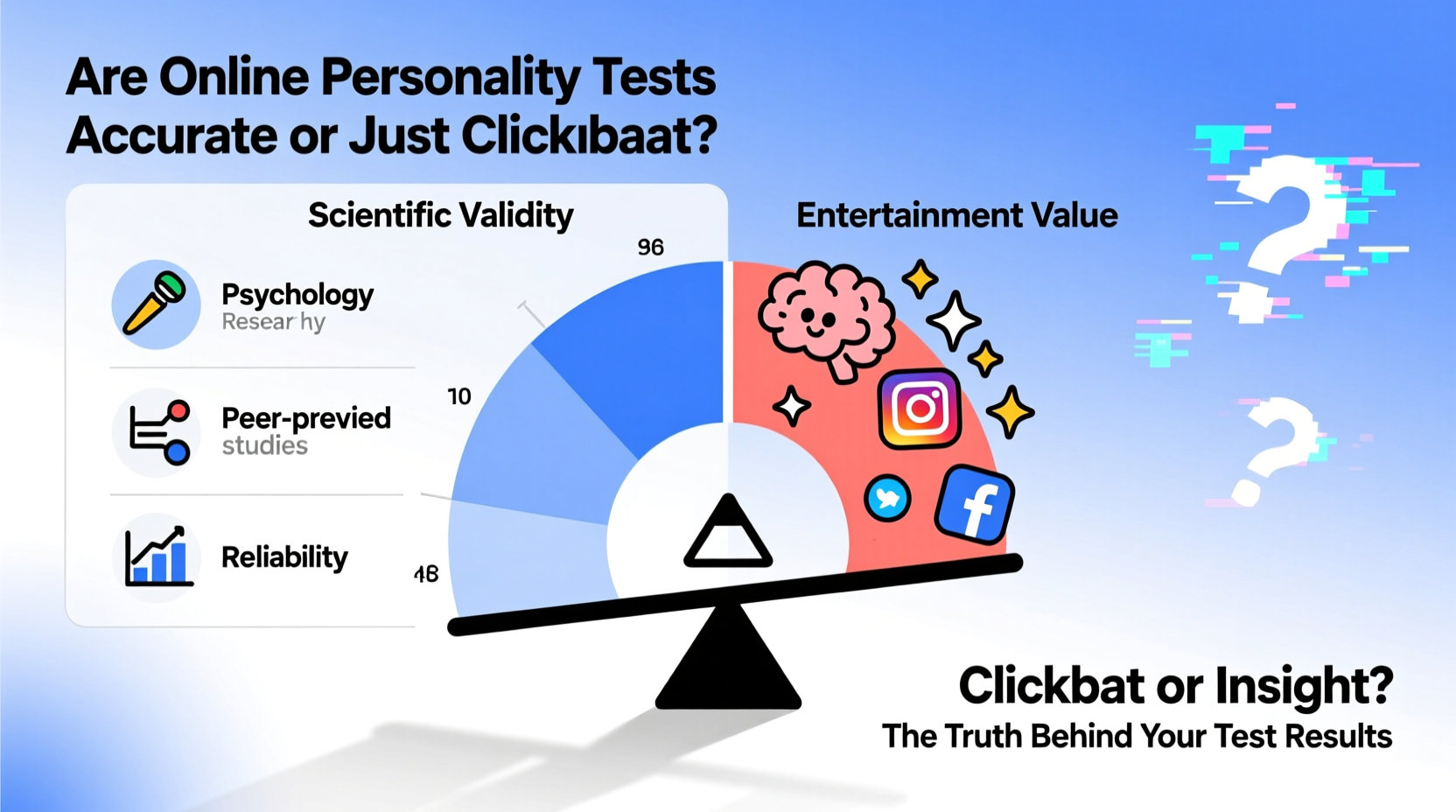
In an age of endless scrolling and instant gratification, few things capture attention like a quick “Which Type Are You?” quiz. From “What’s Your Inner Archetype?” to “Discover Your Career Soul Match,” online personality tests flood social media feeds, promising profound self-knowledge in under five minutes. But beneath the colorful graphics and shareable results lies a critical question: are these tools scientifically valid, or are they merely digital entertainment designed to go viral?
The answer isn’t binary. While some online assessments draw from decades of psychological research, many others prioritize engagement over accuracy. Understanding the difference requires unpacking what makes a personality test reliable, how legitimate models are applied (or misused) online, and why so many people still find value—even if the science is shaky.
The Science Behind Personality Assessment
Personality psychology has long sought to categorize and understand human behavior through structured frameworks. The most widely accepted model in academic circles is the **Big Five Personality Traits**, also known as the Five-Factor Model. It measures individuals across five broad dimensions:
- Openness to Experience – curiosity, creativity, preference for novelty
- Conscientiousness – organization, dependability, goal orientation
- Extraversion – sociability, energy levels, assertiveness
- Agreeableness – compassion, cooperation, trust
- Neuroticism – emotional instability, anxiety, mood swings
This model is backed by extensive peer-reviewed research and demonstrates strong reliability and validity across cultures. When administered properly—with sufficient questions, standardized scoring, and controlled conditions—it can predict behaviors such as job performance, relationship satisfaction, and mental health tendencies.
However, most viral online quizzes bear little resemblance to this rigorous approach. Instead, they often rely on simplified dichotomies (e.g., “Are you an introvert or extrovert?”) or fictional archetypes (e.g., “Which mythical creature matches your vibe?”), sacrificing scientific depth for accessibility and virality.
“While brief self-assessments can spark introspection, equating them with clinical tools is like confusing a weather app with meteorology.” — Dr. Lena Patel, Cognitive Psychologist at Columbia University
Where Real Psychology Ends and Clickbait Begins
The line between credible assessment and entertainment blurs quickly online. Consider the popularity of the Myers-Briggs Type Indicator (MBTI). Originally developed from Carl Jung’s theories, MBTI classifies people into 16 personality types based on four dichotomies: Introversion/Extraversion, Sensing/Intuition, Thinking/Feeling, Judging/Perceiving.
Despite its widespread use in corporate training and pop culture, MBTI faces significant criticism within the scientific community. Studies show it has low test-retest reliability—meaning people often get different results when retaking it weeks apart—and lacks predictive power compared to models like the Big Five.
Tip: If a personality quiz doesn't explain its methodology or cite research sources, treat it as entertainment—not insight.Yet MBTI endures because it offers something compelling: identity clarity. Being told you’re an “INFJ” or “ENTP” feels definitive, even if the label oversimplifies complex traits. Online versions amplify this appeal with instant results, personalized descriptions, and social sharing buttons—all optimized for clicks rather than truth.
Worse, many sites repurpose professional frameworks without proper licensing or validation. A free “official” MBTI clone may look authentic but could distort scoring algorithms or omit key validation steps, rendering results meaningless.
Comparing Legitimate Tools vs. Viral Quizzes
| Feature | Scientific Assessments (e.g., Big Five, HEXACO) | Viral Online Quizzes |
|---|---|---|
| Development Basis | Peer-reviewed research, longitudinal studies | Pop psychology, mythology, marketing trends |
| Reliability & Validity | High; tested across populations | Rarely measured or disclosed |
| Number of Questions | 50–100+ items | 5–20 questions |
| Scoring Method | Standardized scales, statistical analysis | Algorithmic shortcuts, arbitrary point systems |
| Primary Use Case | Clinical diagnosis, hiring, personal development | Social sharing, entertainment, lead generation |
| Cost & Access | Administered by professionals or licensed platforms | Free, ad-supported, monetized via data collection |
This contrast reveals a fundamental divide: credible tools aim for precision and consistency, while viral quizzes prioritize speed and shareability. That doesn’t mean the latter are useless—but their purpose is different.
A Real-World Example: The Office Team-Building Dilemma
Consider Sarah, an HR manager at a mid-sized tech firm. Wanting to improve team cohesion, she found a trending “Workplace Archetypes” quiz online that promised to reveal employees’ collaboration styles. She shared it during a virtual meeting, and staff eagerly took part, laughing at results like “The Catalyst,” “The Anchor,” and “The Navigator.”
Morale improved temporarily—people enjoyed discussing their types—but when conflicts arose later, Sarah realized the labels had oversimplified real dynamics. One employee labeled “The Peacemaker” was actually avoiding tough conversations due to anxiety, not innate harmony-seeking. Another, dubbed “The Maverick,” felt boxed in by the rebellious image and disengaged further.
She eventually replaced the quiz with a certified DiSC assessment—a behavioral model used in organizational psychology—which provided nuanced insights into communication preferences and stress triggers. Unlike the viral tool, DiSC offered actionable feedback, retesting options, and facilitator training.
Sarah’s experience illustrates a common pitfall: mistaking engaging content for effective intervention. Fun quizzes can open conversations, but lasting change requires deeper understanding.
When Online Tests Offer Genuine Value
Not all online personality tools are fluff. Some platforms blend scientific rigor with user-friendly design, offering meaningful self-reflection opportunities. For example:
- Truity and 16Personalities offer free versions of the Big Five and MBTI with transparent methodologies and educational resources.
- Hogwarts House quizzes based on validated traits (like openness predicting Gryffindor vs. Ravenclaw alignment) have been studied for their ability to engage users in thinking about values and decision-making.
- Career-focused assessments from reputable sites like Princeton Review or O*NET Interest Profiler use psychometric principles to guide vocational choices.
The key differentiator? Transparency. Reliable tools disclose their foundations, avoid absolute statements (“You will succeed in X career”), and encourage follow-up learning. They also respect cognitive biases—such as the Barnum Effect, where vague, positive statements feel personally accurate—by minimizing flattery and emphasizing nuance.
Checklist: Evaluating an Online Personality Test
Before trusting any result, ask yourself these questions:
- Does the site name the psychological model it uses (e.g., Big Five, Enneagram)?
- Is there a clear explanation of how scores are calculated?
- Are sources or research citations provided?
- Does it warn against using results for high-stakes decisions (e.g., hiring, therapy)?
- Does it allow you to retake the test to check consistency?
- Is personal data protected, or is it sold to third parties?
- Does it avoid deterministic language like “You are destined to…”?
If most answers are “no,” proceed with skepticism.
Why We Keep Clicking: The Psychology of Engagement
The enduring popularity of online personality tests speaks less to their accuracy and more to fundamental human needs. People crave self-understanding, belonging, and narrative coherence. A simple quiz delivers all three instantly: it gives you a label, connects you to others with the same result, and frames your life in a story (“I’m an Explorer—no wonder I hate routine!”).
Platforms exploit this through smart design:
- Progressive disclosure – questions start easy, building investment.
- Flattering interpretations – descriptions emphasize strengths and downplay flaws.
- Social proof – “9 million people got this result!” increases perceived legitimacy.
- Shareability – colorful graphics invite posting, reinforcing belief in the outcome.
These techniques aren’t inherently malicious—they mirror strategies used in education and therapy to boost engagement. But when divorced from accountability, they become persuasive tools for attention economies.
Frequently Asked Questions
Can online personality tests be harmful?
Direct harm is rare, but risks exist. Mislabeling someone as “toxic” or “unlovable” based on a quiz can damage self-esteem. In workplaces, relying on unvalidated tools for hiring or promotions may introduce bias. Always separate playful exploration from serious decision-making.
Are any online tests actually accurate?
Some are grounded in science. Free versions of the Big Five (like IPIP-NEO), the Enneagram (when administered with guidance), and career interest inventories (like Strong Interest Inventory derivatives) can offer useful insights—if taken seriously and interpreted cautiously. Accuracy improves with longer formats, retesting, and professional context.
Why do I keep getting different results on the same test?
This inconsistency highlights poor reliability. Mood, recent experiences, and even time of day influence responses. Scientific tests account for this with error margins and retesting protocols. If a quiz gives wildly different outcomes in a week, it’s likely measuring noise, not trait stability.
Conclusion: Use Wisely, Not Blindly
Online personality tests occupy a gray zone between science and spectacle. Dismissing them entirely ignores their potential to inspire reflection, spark dialogue, and make psychology accessible. Yet treating them as gospel risks reinforcing stereotypes and false certainties.
The most balanced approach is mindful engagement. Take a quiz for fun, discuss your result with friends, notice what resonates—and then dig deeper. Read about the underlying theory. Try a longer, validated version. Talk to a counselor or coach if you're exploring identity or career paths.
Self-knowledge isn’t delivered in a 10-question popup. It’s built through observation, experience, and honest inquiry. Let online tests be a starting point, not the final word.
🚀 Ready to explore your personality with integrity? Start with a scientifically backed assessment, reflect on your results, and share your journey—not just your type label.