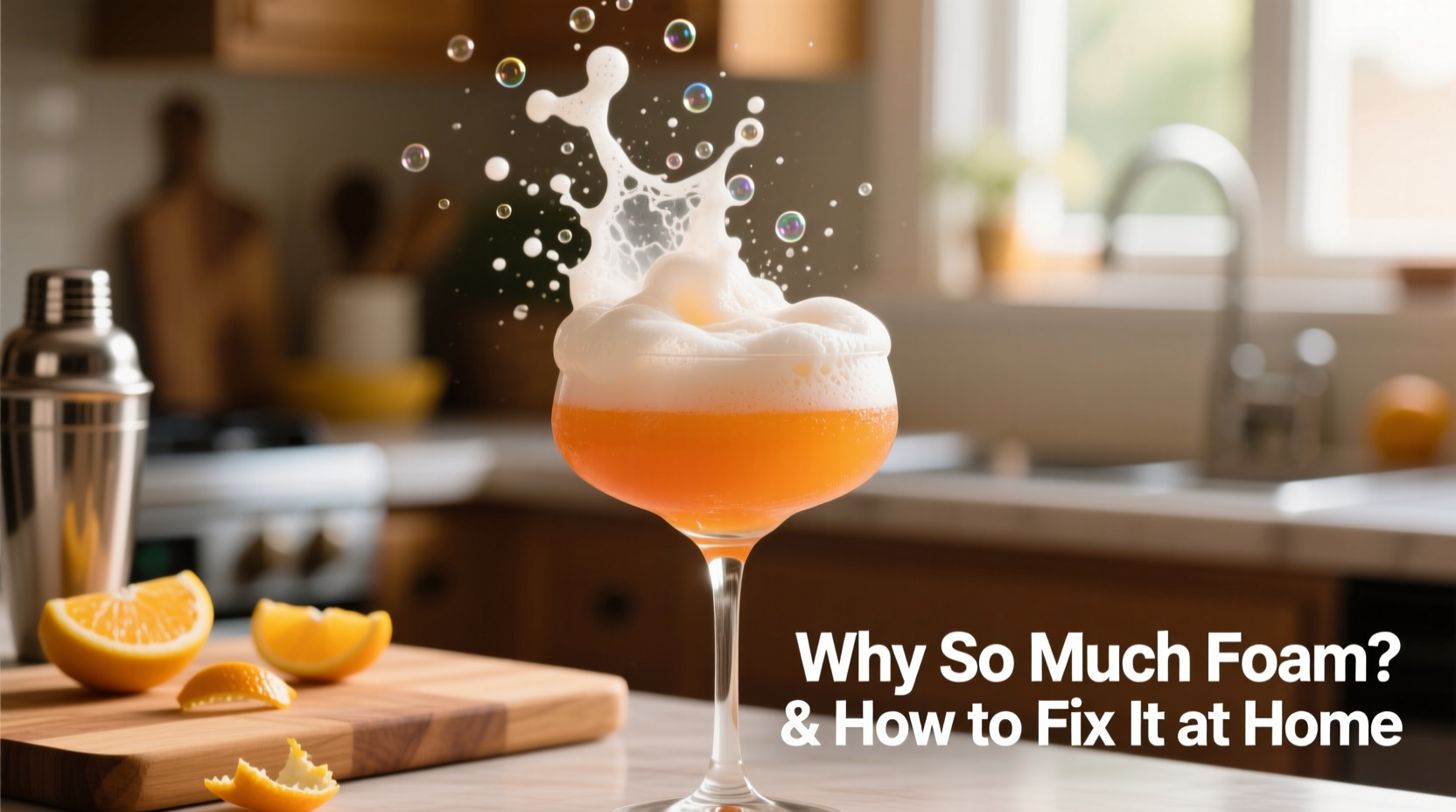
Excessive foam in cocktails isn’t just an aesthetic annoyance—it’s a signal. That thick, stubborn head clinging to the rim of your coupe or collapsing into a watery film before the first sip often means something’s off: wrong technique, unstable emulsifiers, over-aerated ingredients, or even subtle chemistry between components. Foam isn’t inherently bad—think of a well-textured Pisco Sour or a silky Ramos Gin Fizz—but when it’s uncontrolled, uneven, or disappears too fast, it compromises mouthfeel, aroma release, temperature retention, and balance. This isn’t about chasing Instagram-perfect froth; it’s about intentionality. Understanding *why* foam forms—and why it fails—is the first step toward mastering texture, one shaken drink at a time.
The Science Behind Cocktail Foam: It’s Not Just Air
Cocktail foam is a colloidal dispersion: tiny air bubbles suspended in liquid, stabilized by surface-active molecules—proteins, saponins, gums, or phospholipids—that reduce surface tension and form protective films around each bubble. In nature, egg whites contain ovalbumin and conalbumin; aquafaba (chickpea brine) delivers saponins and soluble proteins; coconut cream contributes lauric acid and natural emulsifiers; and even certain citrus juices—especially from underripe fruit—contain higher levels of pectin and limonene derivatives that aid stabilization.
But foam requires three precise conditions: agitation (to introduce air), a stabilizer (to coat bubbles), and viscosity (to slow drainage). When any element dominates—or is missing—you get either runaway froth or collapse. Over-shaking a drink with egg white doesn’t just add more air—it denatures proteins excessively, weakening their ability to form elastic networks. Likewise, using pasteurized egg whites (which are heat-treated and partially denatured) creates less resilient foam than fresh, raw yolks or whole eggs. And adding too much simple syrup or liqueur can thin the mixture, accelerating bubble coalescence.
“Foam isn’t decoration—it’s a functional layer that modulates volatility, carries aromatic compounds to the nose, and buffers acidity on the palate. A poorly structured foam doesn’t just look wrong; it tastes flat.” — Dr. Lucia Mendez, Food Scientist & Beverage Consultant, formerly of the Culinary Institute of America
5 Common Causes of Excessive or Unstable Foam (and What They Really Mean)
Before reaching for the strainer, diagnose the root cause. Here’s what each foam behavior reveals:
- Thick, dry, meringue-like foam that won’t integrate: Usually indicates over-dry shaking (no ice) or excessive protein use—especially with aged or frozen egg whites that have lost water-binding capacity.
- Foam that rises violently during shaking and overflows the tin: Often caused by carbonated ingredients (soda, tonic, sparkling wine) added pre-shake—or warm ingredients that expand rapidly under agitation and pressure.
- Foam that collapses within 10 seconds: Points to low-viscosity base (e.g., high-proof spirit + lemon juice only), insufficient stabilizer, or pH imbalance (too acidic destabilizes egg proteins below pH 4.0).
- Cloudy, grainy foam with visible particles: Suggests incomplete emulsification—often from using cold, thick dairy (like full-fat coconut milk straight from the fridge) or blending instead of proper dry shake technique.
- Foam that separates into distinct layers (clear liquid beneath foam): Indicates poor integration—usually due to skipping the wet shake after dry shaking, or using incompatible fats (e.g., olive oil–infused spirits without proper emulsifiers).
A Practical Fix Guide: Tools, Techniques, and Ingredient Swaps
You don’t need a centrifuge or lab-grade stabilizers to fix foam issues at home. Most solutions rely on precision, timing, and understanding your ingredients’ behavior.
Step-by-Step: The Two-Stage Shake Method (For Egg Whites & Aquafaba)
- Dry shake (no ice): Combine all ingredients—including egg white or aquafaba—in your shaker tin. Seal tightly and shake vigorously for 15–20 seconds. This incorporates air and begins protein unfolding.
- Add ice: Open the tin, add 4–5 large, dense cubes (not cracked or crushed ice—those melt too fast and dilute prematurely).
- Wet shake: Reseal and shake hard for exactly 10–12 seconds. This chills, dilutes, and tightens the foam structure without overworking it.
- Double-strain: Use a Hawthorne strainer + fine mesh strainer into your chilled glass. This removes any undissolved bits and refines texture.
This method works because dry shaking builds volume, while the wet shake sets the foam’s microstructure. Skipping either stage leads to instability—dry-only yields airy but fragile foam; wet-only gives minimal lift and poor integration.
Ingredient Substitutions That Actually Work
Not all stabilizers behave the same. Here’s how common options compare:
| Stabilizer | Foam Quality | Best For | Key Limitation |
|---|---|---|---|
| Fresh whole egg | Rich, creamy, long-lasting | Classic sours, creamy tiki drinks | Risk of salmonella; requires sourcing from reputable farms |
| Pasteurized egg white (liquid) | Light, airy, moderate stability | High-volume service, beginner-friendly | Lacks yolk lipids—less mouth-coating; degrades faster if over-shaken |
| Aquafaba (unsalted, room-temp) | Voluminous, vegan, neutral flavor | Vegan cocktails, citrus-forward drinks | Can taste beany if overused; sensitive to pH—add pinch of cream of tartar to stabilize |
| Coconut cream (full-fat, well-stirred) | Ultra-thick, tropical, luxurious | Tiki, rum-based, dessert cocktails | Separates if not chilled properly; avoid “lite” versions—they lack fat needed for emulsion |
| Gum arabic syrup (1:1 ratio) | Subtle lift, glossy sheen, no protein taste | Dry martinis, clarified milk punches, delicate floral drinks | Doesn’t replicate egg’s richness—best used in combination, not alone |
Real-World Case Study: The Overfoaming Whiskey Sour
Maya, a home bartender in Portland, spent months frustrated by her Whiskey Sour. She used fresh local eggs, organic lemon juice, and small-batch bourbon—but every shake produced a foam so thick it overflowed the tin, then collapsed into a sad, bubbly slurry in the glass. Her guests joked it looked like “a shaken soda gone rogue.”
She tracked variables: same egg source, same juicer, same shaker. Then she noticed her lemons were consistently underripe—green-tinged, lower in juice yield, and significantly more acidic (pH ~2.7 vs. ideal 3.2–3.5). That extreme acidity was denaturing the egg proteins before they could form stable networks. She also realized she’d been shaking for 30+ seconds dry—far beyond optimal.
Her fix? She switched to fully ripe, golden lemons (pH ~3.3), reduced dry shake to 18 seconds, added a pinch of baking soda (0.5g per drink) to gently buffer acidity without altering flavor, and began chilling her egg whites to 40°F before use. Result: a velvety, integrated foam that clung to the glass for 90 seconds—rich, aromatic, and perfectly balanced.
Essential Do’s and Don’ts for Foam Control
Do:- Use room-temperature aquafaba and chilled egg whites (cold helps proteins bind tighter during initial aeration)
- Weigh ingredients—not just measure—especially syrups and stabilizers (a gram matters in foam physics)
- Pre-chill your shaker tin in the freezer for 5 minutes before building
- Add stabilizers *before* citrus—if using both egg and acid, combine them first to allow partial buffering
- Shake carbonated ingredients—build them last and stir or top gently
- Use aged egg whites unless specifically trained in safe handling (they’re more fragile and prone to bacterial growth)
- Substitute lime for lemon without adjusting sweetener—limes are ~20% more acidic and destabilize foam faster
- Store aquafaba in the fridge longer than 5 days—it loses saponin activity and develops off-notes
FAQ: Your Foam Questions, Answered
Why does my foam disappear as soon as I pour—even when it looks perfect in the shaker?
Two likely culprits: warm glassware or residual detergent. Even trace soap film breaks surface tension instantly. Always rinse glasses thoroughly with hot water (no dish soap) and chill for at least 10 minutes before serving. Also check for oils—citrus oils expressed over the foam help anchor it, but oils from fingers or unclean bars will destroy it.
Can I fix overfoamed drinks, or is it ruined?
Yes—you can rescue it. If foam is overly voluminous but still cohesive, let the drink rest 20–30 seconds post-pour. The foam will naturally settle into a dense, elegant cap. If it’s weeping or separating, gently swirl the glass once—this reintegrates the liquid phase without collapsing structure. Never stir or agitate vigorously.
Is there a way to make foam without eggs or dairy—for allergies or dietary restrictions?
Absolutely. Aquafaba remains the gold standard, but newer options work well: psyllium husk powder (0.2g per drink, dissolved in 1 tsp water first), or a blend of gum arabic (0.3g) + xanthan gum (0.05g) in simple syrup. Both create stable, neutral foams ideal for clear cocktails. Avoid agar or gelatin—they require heat activation and produce gummy textures unsuited to cold drinks.
Conclusion: Foam Is Intention, Not Accident
Foam isn’t magic—it’s measurable, repeatable, and deeply responsive to your choices. Every time you reach for that lemon, crack that egg, or twist that citrus peel, you’re engaging in applied food science. The excess foam overwhelming your coupe isn’t a flaw in your technique; it’s data. It tells you your acid level is off, your shake time is misaligned, or your ingredients need recalibration. Fixing it isn’t about suppressing texture—it’s about honoring it. When foam holds its shape, releases aroma cleanly, and dissolves slowly across the palate, it transforms a drink from functional to resonant. You don’t need a professional bar or expensive gear. You need observation, patience, and the willingness to treat each shake like a quiet experiment. So next time your cocktail foams too much, pause—not to frown, but to listen. Then adjust, refine, and pour again. Your perfect foam isn’t hiding. It’s waiting for your attention.
💬 Have you cracked the code on a stubborn foam issue? Share your breakthrough—whether it’s a pH hack, a forgotten stabilizer, or a shaker-tin trick—in the comments. Let’s build a smarter, more intentional home bar—together.








