When investing in a timepiece meant to last for decades, the choice between mechanical and quartz movements isn't just about aesthetics or prestige—it's fundamentally about long-term care, reliability, and how much effort you're willing to commit to keeping your watch running. While mechanical watches are often celebrated for their craftsmanship and heritage, quartz watches have quietly dominated the market with their precision and practicality. But when it comes to decades-long ownership, which type truly demands less maintenance?
This question matters not only to collectors but also to everyday wearers who want a reliable companion on the wrist without constant trips to the watchmaker. The answer involves understanding how each movement functions, what can go wrong over time, and what kind of upkeep is realistically required.
How Mechanical and Quartz Watches Work
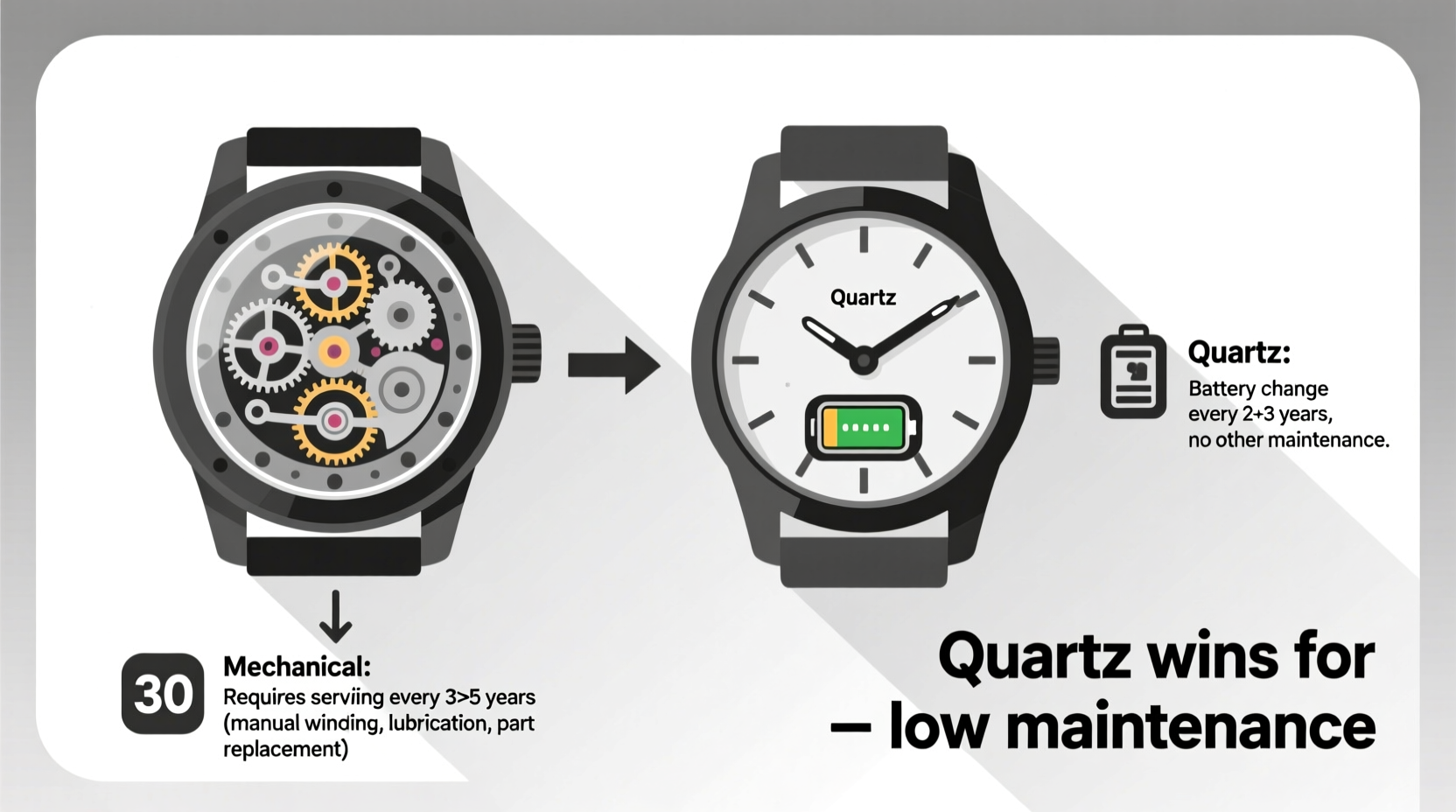
At the heart of the maintenance debate lies a fundamental difference in operation. Mechanical watches rely entirely on physical mechanics—springs, gears, levers, and balance wheels—to keep time. They are powered by either manual winding (hand-wound) or an automatic rotor that winds the mainspring through motion. These intricate systems require precise calibration and lubrication to function correctly.
In contrast, quartz watches use a battery-powered electronic oscillator regulated by a tiny quartz crystal. When electricity passes through the crystal, it vibrates at a consistent frequency (32,768 times per second), which the circuitry converts into one pulse per second to drive the motor that moves the hands. This system is inherently more stable and less prone to environmental interference than mechanical regulation.
The simplicity of the quartz mechanism translates directly into lower maintenance requirements. There are no oils to degrade, no hundreds of moving parts to misalign, and no need for regular cleaning due to internal friction buildup. Over decades, this becomes a significant advantage.
Tip: If you're seeking a \"set-and-forget\" timepiece for daily wear over many years, quartz models typically offer superior convenience and reliability.Maintenance Requirements Over Time
Over a 20- to 50-year ownership period, both types of watches will require some level of service—but the frequency, cost, and complexity differ dramatically.
Mechanical Watch Servicing Cycle
A well-maintained mechanical watch should be serviced every 5 to 7 years. During a full service, the movement is disassembled, cleaned, re-lubricated, reassembled, and adjusted for accuracy. Seals are replaced to maintain water resistance, and worn components may need replacement.
Failure to service regularly leads to oil drying out, increased friction, wear on pivots and gears, and eventually failure. Even if stored properly, old oil can gum up and damage the movement. Some vintage mechanical watches from the mid-20th century now suffer from “service neglect syndrome”—movement corrosion and part degradation due to lack of care.
Each service typically costs between $200 and $800 depending on brand and complexity. For high-complication pieces (chronographs, perpetual calendars), prices can exceed $1,500. Over 40 years, that adds up to thousands of dollars in cumulative maintenance.
Quartz Watch Longevity and Service Needs
Quartz watches require far fewer interventions. The primary recurring task is battery replacement, usually needed every 1 to 3 years depending on the model and battery type. A standard battery change costs $10–$30 and takes minutes.
Beyond that, most quartz movements do not require periodic overhaul unless they malfunction. Many modern quartz movements, especially those from brands like Seiko, Citizen, and Casio, are designed to run reliably for 20+ years with minimal intervention. Some older quartz watches from the 1970s and 1980s still function today with only occasional battery swaps.
Occasionally, seals degrade and moisture enters the case, leading to circuit corrosion or condensation. In such cases, a simple cleaning and gasket replacement may suffice. Unlike mechanical watches, there’s no need for routine disassembly and re-oiling.
“Quartz technology was revolutionary not just for accuracy, but for reducing user burden. A watch that keeps near-perfect time and doesn’t demand expert attention every few years—that’s real progress.” — Dr. Lars Bengtsson, Horological Historian, Swiss Institute of Time Studies
Comparative Maintenance Timeline Over 40 Years
To illustrate the difference clearly, consider a side-by-side scenario of owning a mechanical and a quartz watch over four decades.
| Task | Mechanical Watch (Every 6 Years) | Quartz Watch (As Needed) |
|---|---|---|
| Full Movement Service | 6–7 times (every 6 years) | 0–1 times (only if faulty) |
| Battery Replacement | N/A | 15–30 times (every 1.5–2.5 years) |
| Gasket/Water Resistance Check | Included in service | Recommended every 2–3 years (~13 times) |
| Cumulative Cost Estimate | $1,800 – $5,600 | $200 – $600 |
| Total Downtime | 6–8 weeks total (weeks per service) | Less than 1 week total |
The disparity in both cost and effort is substantial. While the mechanical watch owner must plan ahead for services, budget for unexpected repairs, and accept periods without their watch, the quartz owner enjoys near-continuous uptime with minimal planning.
Real-World Example: Two Watches, Four Decades
Consider two individuals who bought watches in 1985: Mark purchased a vintage Omega Seamaster 300 (automatic mechanical), while Jane opted for a Seiko 5 Quartz Oyster (a mid-tier quartz diver).
Mark wore his Omega frequently but didn’t service it until 2000—15 years later. By then, the oil had dried, the mainspring weakened, and the movement showed signs of wear. He spent $450 on a full service. Another service followed in 2007, 2013, and 2019. Each time, he faced delays and rising costs. In 2023, a gear failed due to long-term stress, requiring a rare part order.
Jane replaced her Seiko’s battery every two years. In 2005, she noticed fog inside the crystal and took it in; the technician replaced the gaskets ($25). In 2018, the circuit failed, but rather than repair it, she bought a new identical model for $180. Her total spending over 38 years: under $300.
Both watches kept good time. Both were cherished. But Jane’s experience required less time, money, and emotional investment. Her watch remained functional with almost zero downtime.
Long-Term Risks and Failure Points
No watch lasts forever without issues, but the nature of potential failures differs.
- Mechanical watches face cumulative wear: pivot holes elongate, jewels crack, springs fatigue, and lubricants break down. Even with perfect storage, aging oils can turn acidic and corrode metal parts. Vintage mechanical watches often need restoration, not just servicing.
- Quartz watches are vulnerable to circuit board corrosion, capacitor leakage, and stepper motor wear. However, because most quartz movements are modular and replaceable, fixing them often means swapping the entire movement for $50–$100—a fraction of mechanical repair costs.
Another factor is part availability. Luxury mechanical brands like Patek Philippe or Vacheron Constantin maintain archives and can often source vintage components. But for discontinued mid-range mechanical watches, finding original parts becomes difficult after 30+ years. In contrast, generic quartz movements (e.g., Miyota, ETA, Ronda) are mass-produced and widely available globally.
Tip: If future repairability matters, choose a quartz watch with a standard movement or a mechanical brand known for long-term support.What Experts Recommend for Decades-Long Ownership
Horologists and veteran watchmakers agree: if low maintenance is the priority, quartz wins decisively.
“For someone looking for a durable, accurate watch they can pass down without demanding technical knowledge or deep pockets, I always recommend a quality quartz—especially solar-powered ones like Citizen Eco-Drive. They’re engineered for longevity and ease.” — Thomas Reed, Master Watchmaker, Boston Clock & Watch Co.
That said, mechanical watches hold emotional and collectible value that quartz rarely matches. A Rolex or Jaeger-LeCoultre passed through generations carries narrative weight. But that legacy comes with responsibility: consistent care, documentation, and financial commitment.
Some modern hybrids blur the line. Seiko’s Spring Drive combines mechanical power with quartz-level accuracy, but still requires mechanical servicing. Similarly, Bulova’s Precisionist offers high-frequency quartz accuracy but uses proprietary tech that may complicate future repairs.
Step-by-Step Guide: Choosing Based on Long-Term Maintenance
Follow this decision framework to pick the right watch for decades of ownership with minimal upkeep:
- Define your priorities: Is accuracy and convenience key, or do you value craftsmanship and tradition?
- Assess your willingness to service: Can you commit to professional servicing every 5–7 years?
- Research brand support: Does the manufacturer provide parts and service for older models?
- Consider movement type: Opt for quartz if low maintenance is essential. Choose mechanical only if you enjoy the ritual of ownership.
- Budget for the long term: Factor in 40 years of potential costs—not just purchase price.
- Test reliability: Look for models with proven track records (e.g., Casio G-Shock, Seiko Kinetic, Longines quartz).
- Plan for storage: Store unused watches in dry, temperature-stable environments with batteries removed (for quartz).
Frequently Asked Questions
Can a quartz watch last 50 years?
Yes. With periodic battery changes and gasket replacements, many quartz watches from the 1970s still function today. Circuit longevity depends on protection from moisture and extreme temperatures. Solar-powered quartz watches (like Citizen Eco-Drive) eliminate battery replacement needs entirely and can operate for decades with minimal care.
Do mechanical watches degrade if not worn?
Yes. Even in storage, lubricants can dry out or become sticky over time, leading to increased wear upon restart. It’s recommended to wind and run manual watches occasionally or store them in a winder if automatic. After long storage, a mechanical watch should be inspected before regular use.
Are expensive quartz watches worth it for low maintenance?
High-end quartz watches (e.g., Grand Seiko 9F, Breitling SuperQuartz) offer superior build quality, better sealing, longer battery life, and temperature compensation for improved accuracy. While more costly upfront, they often outlast cheaper quartz models and require even fewer interventions, making them excellent long-term choices.
Final Verdict: Which Requires Less Maintenance?
Over decades, quartz watches undeniably require less maintenance than mechanical ones. They don’t need regular overhauls, are less sensitive to positional variance, and suffer fewer wear-related issues. Their electronic hearts are simpler, more robust, and easier to replace than intricate mechanical calibers.
While mechanical watches captivate with artistry and history, they demand ongoing stewardship. To own one for generations is to embrace a role as a caretaker—one who schedules services, monitors performance, and invests time and money into preservation.
If your goal is a reliable, accurate, and enduring timepiece that won’t burden you with upkeep, quartz is the rational choice. It delivers exceptional performance with minimal input, making it ideal for heirs, travelers, professionals, and anyone who values function over formality.
🚀 Ready to choose a watch that lasts decades with minimal effort? Start by exploring durable quartz models from Seiko, Citizen, or Casio—and enjoy peace of mind with every tick.








