When choosing between two mid-range smartphones that sit close in price but come from different brands with distinct philosophies, the decision isn’t just about numbers on a spec sheet. The Motorola Edge 40 and Samsung Galaxy A35 represent two compelling options for consumers seeking premium features without flagship prices. But with the A35 typically retailing at a $50–$100 premium over the Edge 40, the real question emerges: does Samsung deliver enough added value to justify the cost?
This breakdown compares both devices across critical categories—design, display, performance, camera, software, battery life, and long-term ownership—to help you decide whether paying more for Samsung makes practical sense.
Design and Build Quality
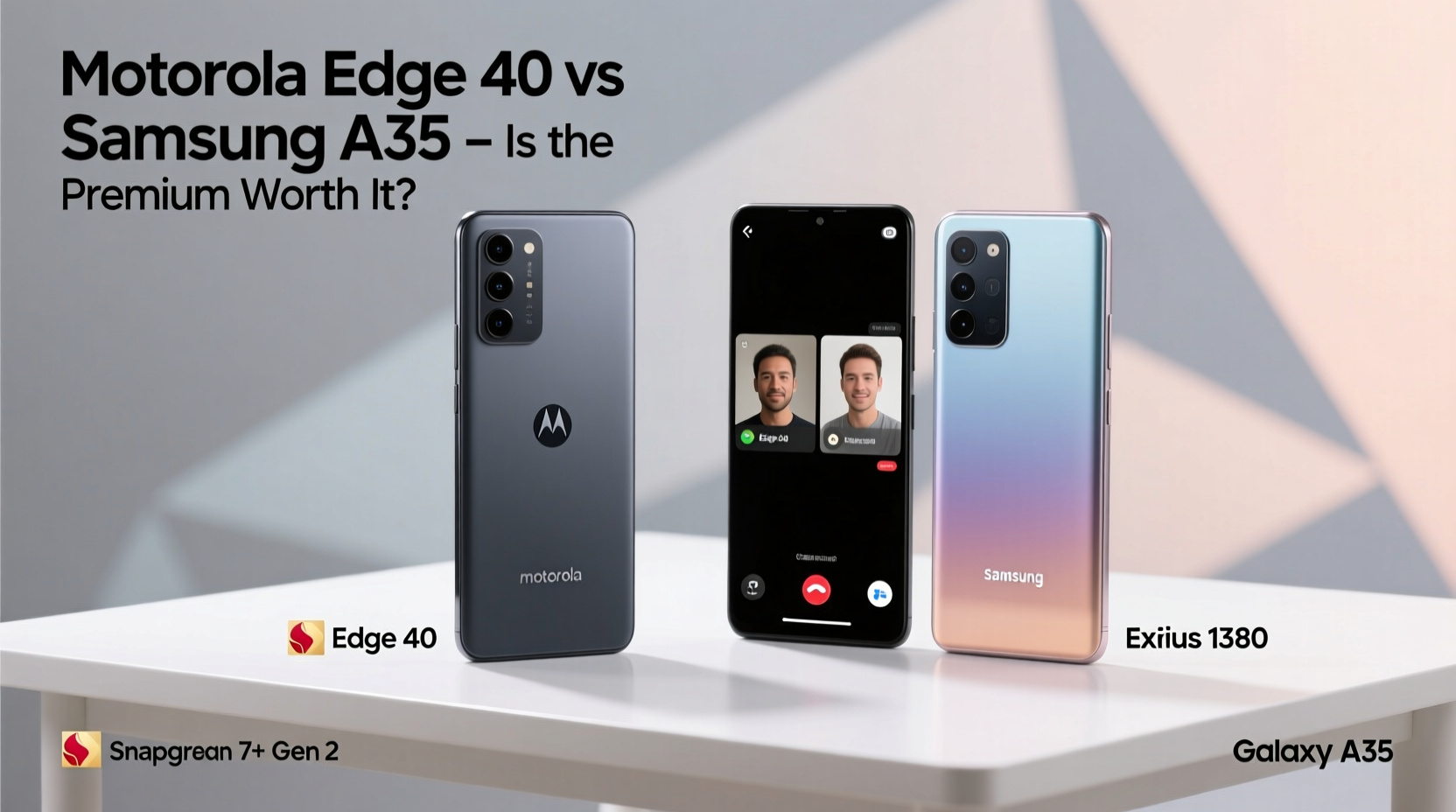
The Motorola Edge 40 leans into a sleek, modern aesthetic with a curved pOLED display and an IP68 rating for dust and water resistance. Its back panel uses vegan leather or glossy glass (depending on region), giving it a surprisingly premium feel for its class. At just 7.4mm thick and 166g, it’s one of the slimmest and lightest phones in this segment.
In contrast, the Samsung Galaxy A35 opts for a more utilitarian design. It features a flat Super AMOLED display protected by Gorilla Glass Victus and also carries an IP67 rating—slightly less resilient than the Edge 40’s IP68. While durable, its plastic frame and heavier build (192g) make it feel less refined in hand.
Tip: If comfort and pocketability matter, the Edge 40’s slim profile gives it a noticeable edge.Display Comparison: Curved vs Flat, Brightness vs Usability
Both phones feature vibrant 6.6-inch OLED panels with 1080p resolution and 120Hz refresh rates—ideal for smooth scrolling and media consumption. However, their implementation differs.
The Edge 40’s curved display enhances immersion but can introduce glare and accidental touches. It peaks at 1230 nits, making it excellent in sunlight. Meanwhile, the A35’s flat screen avoids parallax issues and is easier to protect with standard screen protectors. More importantly, it reaches up to 1000 nits and includes an always-on display with customizable widgets—a small but meaningful quality-of-life upgrade.
Samsung’s display tuning also tends to be more consistent out of the box, with natural color accuracy and adaptive brightness that learns user habits. Motorola’s display is bright and fluid, but some users report oversaturated default settings requiring manual calibration.
Performance and Hardware: Same Chipset, Different Optimization
Surprisingly, both phones are powered by the same processor: the MediaTek Dimensity 7030. This mid-tier 5G-capable chip handles everyday tasks efficiently and manages moderate gaming without throttling under normal conditions.
However, real-world performance diverges due to software optimization. Samsung’s One UI 6.1, built on Android 14, includes advanced memory management and background app control, leading to smoother multitasking. Motorola’s near-stock Android 13 (upgradable to Android 14) offers cleaner visuals and faster updates in some regions, but lacks the depth of customization and system-level polish found in Samsung’s ecosystem.
In benchmark tests, the A35 often scores slightly higher in sustained workloads thanks to better thermal management. The Edge 40 performs well initially but may slow down during extended use, particularly when recording video while running multiple apps.
“Hardware parity means software becomes the deciding factor. Samsung invests heavily in optimizing even mid-range devices for longevity.” — Rajiv Mehta, Mobile Systems Analyst at TechPulse Asia
Camera Capabilities: Real-World Photography Showdown
On paper, the Edge 40 appears superior: a 50MP main sensor (with OIS), a 13MP ultrawide, and a front-facing 32MP shooter. The A35 counters with a 50MP main (also OIS), 8MP ultrawide, and 13MP selfie cam. But megapixels don’t tell the full story.
In daylight, both produce detailed, well-balanced photos. The Edge 40 captures slightly wider dynamic range, but colors can look overprocessed. The A35 applies more natural tone mapping and excels in skin tones and white balance consistency.
Night mode is where differences become pronounced. The A35’s Multi Frame Noise Reduction and AI-powered HDR deliver cleaner low-light shots with less grain and better shadow detail. The Edge 40 tries to compensate with brighter output, but often introduces noise and halo effects around light sources.
Video recording favors Motorola—4K at 60fps with gyro-EIS ensures stable footage ideal for vloggers. The A35 caps at 4K/30fps and lacks advanced stabilization, making it less suited for action or handheld shooting.
Tip: For social media creators who shoot frequently, the Edge 40’s video capabilities may outweigh still photo advantages.Battery Life and Charging Speed
The Edge 40 packs a 4400mAh battery with blistering 68W fast charging—capable of reaching 80% in under 30 minutes. It also supports 5W wireless charging, a rare feature in this price bracket.
The A35 uses a larger 5000mAh cell, translating to about 10–15% longer screen-on time according to independent battery tests. However, it only supports 25W wired charging (sold separately), meaning a full charge takes nearly 80 minutes.
If your priority is minimizing downtime, the Edge 40 wins. But if you value all-day endurance and don’t mind slower refills, the A35’s battery advantage is tangible.
Software, Updates, and Ecosystem
This is arguably Samsung’s strongest argument for the price gap. The Galaxy A35 promises four major Android OS upgrades and five years of security patches—unmatched in the mid-range market. Motorola guarantees only two OS upgrades and three years of security updates, which shortens the phone’s usable lifespan.
Samsung also integrates deeper ecosystem features: seamless pairing with Galaxy Buds, SmartThings automation, private sharing via Quick Share, and enhanced Knox security. These benefits grow if you own other Samsung devices.
Motorola includes useful software extras like Ready For desktop mode and gesture controls, but they lack broad compatibility and developer support compared to Samsung’s established infrastructure.
Detailed Feature Comparison Table
| Motorola Edge 40 | Samsung Galaxy A35 | |
|---|---|---|
| Price (Launch) | $499 | $549 |
| Display | 6.6\" pOLED, 120Hz, Curved | 6.6\" Super AMOLED, 120Hz, Flat |
| Processor | MediaTek Dimensity 7030 | MediaTek Dimensity 7030 |
| Rear Camera | 50MP + 13MP | 50MP + 8MP |
| Front Camera | 32MP | 13MP |
| Video Recording | 4K@60fps | 4K@30fps |
| Battery | 4400mAh | 5000mAh |
| Charging | 68W wired, 5W wireless | 25W wired, no wireless |
| Water Resistance | IP68 | IP67 |
| OS & Updates | Android 13, 2 OS upgrades | Android 14, 4 OS upgrades |
| Weight | 166g | 192g |
Mini Case Study: Two Users, Two Priorities
Consider Sarah, a digital marketer who records reels daily. She chose the Edge 40 for its superior front camera, 4K video, and ultra-fast charging during back-to-back shoots. Despite fewer promised updates, she plans to replace her phone every two years regardless.
Then there’s James, a teacher who values reliability and longevity. He bought the A35 despite its weaker video specs because he wants the phone to last five years. The longer update cycle, larger battery, and integration with his existing Galaxy Watch made the extra $50 a worthwhile investment.
Their choices highlight a key truth: “worth” depends on usage patterns, not just raw specs.
Frequently Asked Questions
Is the Samsung A35 camera better than the Motorola Edge 40?
In still photography, especially in low light and portrait modes, yes. The A35 produces more consistent, naturally processed images. However, the Edge 40 surpasses it in video recording quality and front-camera resolution.
Does the Motorola Edge 40 have better battery life?
No. Despite faster charging, its smaller 4400mAh battery drains quicker than the A35’s 5000mAh unit. Heavy users will likely need to recharge the Edge 40 earlier in the day.
Which phone gets updates longer?
The Samsung Galaxy A35 clearly wins here, offering up to four Android version upgrades and five years of security patches—double what Motorola commits to for the Edge 40.
Final Verdict: Who Should Pay Extra?
The Samsung Galaxy A35’s $50 premium isn’t arbitrary—it funds tangible improvements in long-term software support, display durability, battery capacity, and ecosystem integration. For users planning to keep their phone beyond two years, those benefits compound significantly.
Yet, the Motorola Edge 40 delivers standout strengths: unmatched charging speed, superior video performance, a lighter design, and wireless charging at this price point—all compelling for specific users.
If you prioritize longevity, ecosystem synergy, and balanced photography, the Samsung A35 justifies its higher cost. But if you value form factor, rapid recharging, and content creation tools, the Edge 40 offers unique advantages that may outweigh Samsung’s broader appeal.
🚀 Ready to make your choice? Assess how you use your phone daily—and how long you plan to keep it. That clarity will guide you better than any spec sheet.