Cloudiness in white wine unsettles many drinkers—especially those accustomed to the bright, crystalline appearance of chilled Sauvignon Blanc or Pinot Grigio. A hazy bottle can trigger assumptions of spoilage, oxidation, or poor winemaking. In reality, most cloudiness is neither dangerous nor indicative of fault. It’s often the visible signature of natural chemical processes unfolding in the bottle or glass. Understanding why it happens—and distinguishing between benign phenomena and genuine flaws—is essential for both casual enthusiasts and serious collectors. This article demystifies the science behind white wine turbidity, outlines practical diagnostic steps, and delivers actionable, evidence-based storage solutions backed by enological research and real-world cellar experience.
The Five Primary Causes of Cloudiness in White Wine
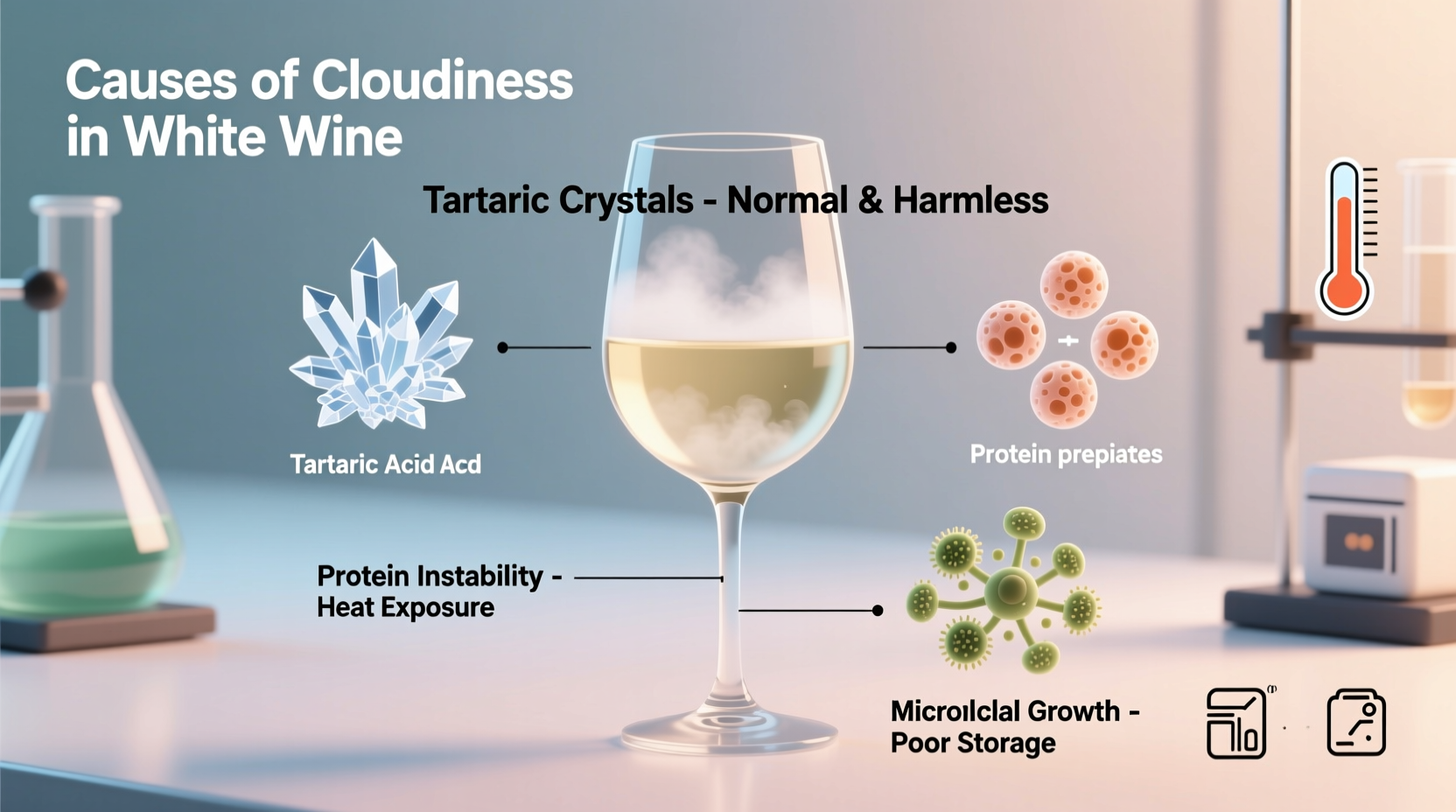
Cloudiness—or turbidity—arises when microscopic particles remain suspended in the wine rather than settling out or being removed during clarification. These particles vary widely in origin, composition, and stability. Below are the five most common causes, ranked by frequency and relevance to consumer-facing scenarios:
- Tartrate Crystals (Potassium Bitartrate): Naturally occurring salts formed from tartaric acid and potassium. They appear as fine, glittering crystals—often clinging to corks or settling at the bottom of the bottle. Harmless, flavor-neutral, and a hallmark of minimally processed wines.
- Protein Haze: Caused by heat-unstable grape proteins (mainly pathogenesis-related or PR proteins) that coagulate when exposed to temperatures above 25°C (77°F). Appears as a faint, milky veil; most common in unoaked, unfined, low-sulfite whites like Riesling or Grüner Veltliner.
- Yeast or Microbial Bloom: Occurs when residual viable yeast or bacteria (e.g., Oenococcus oeni, Brettanomyces) multiply post-bottling—usually due to inadequate filtration, insufficient SO₂, or re-fermentation in the bottle. Often accompanied by spritz, off-aromas (barnyard, sauerkraut, or yeasty bread), or visible sediment with a creamy, flocculent texture.
- Oxidative or Microbial Precipitates: Result from advanced oxidation or acetic acid bacteria activity, forming brownish, stringy, or oily films. Typically signals significant degradation—not just cloudiness—but also flatness, sherry-like notes, or vinegar sharpness.
- Re-suspended Sediment: Innocuous lees or fining agents (e.g., bentonite, casein) stirred up by temperature shock, vigorous shaking, or improper decanting. Usually settles again within hours if left undisturbed.
Crucially, only two of these—yeast/microbial bloom and oxidative precipitates—indicate potential spoilage. The others reflect authenticity, minimal intervention, or simple physical disturbance.
How to Diagnose What You’re Seeing: A Practical Flow
Before discarding a cloudy bottle—or worse, misdiagnosing a perfectly sound wine—follow this field-tested diagnostic sequence. It takes under 90 seconds and requires no tools beyond your eyes, nose, and a cool, well-lit space.
- Observe temperature and context: Was the wine recently moved from cold storage to room temperature? Did it sit in a warm car or near a radiator? If yes, tartrates or protein haze are likely.
- Check the bottle orientation: Hold it upright for 3–5 minutes. Does the haze settle toward the bottom? If yes, it’s almost certainly sediment or tartrates—not active microbial growth.
- Swirl gently and smell: Cloudiness paired with fresh fruit, floral, or mineral notes points to tartrates or protein haze. Sour apple, wet wool, Band-Aid, or nail polish remover aromas suggest Brettanomyces or volatile acidity.
- Chill for 20 minutes: Refrigerate the bottle (not freezer). Protein haze often clears significantly below 10°C; tartrates may become more visible as crystals form on the glass.
- Taste a small amount: If aroma is clean and palate shows balanced acidity, fruit, and no bitterness or fizz (unless it’s a pét-nat), the cloudiness is non-structural and safe to enjoy.
Storage Fixes That Prevent and Reverse Cloudiness
Prevention begins long before opening—but smart storage choices *after* purchase make a decisive difference in maintaining clarity and freshness. Below are targeted, research-backed fixes grouped by cause.
For Tartrate Stability
Tartrates form because tartaric acid—the strongest acid in grapes—is highly soluble in warm wine but less so when cooled. Commercial wineries use cold stabilization (holding wine at –4°C for 1–2 weeks) to precipitate crystals before bottling. Consumers can mimic this effect:
- Store bottles intended for early consumption at a steady 10–12°C (50–54°F)—cool enough to discourage crystal formation, but not so cold that they nucleate prematurely.
- Avoid rapid temperature swings: moving a bottle from 22°C to 4°C in under 30 minutes dramatically increases tartrate precipitation.
- If crystals appear, decant carefully: pour slowly into a clean pitcher, stopping before the last 1–2 cm of liquid where sediment concentrates.
For Protein Haze Prevention
Grape proteins denature and aggregate when heated, especially above 25°C. Once formed, protein haze is difficult to reverse without lab-grade fining. Prevention is paramount:
- Never store white wines above 20°C (68°F) for extended periods—even short exposures (e.g., a hot garage for 2 hours) can trigger irreversible haze.
- Choose wines labeled “protein-stable” or those fined with bentonite (a common clay fining agent that removes heat-sensitive proteins).
- When transporting, use insulated bags and avoid leaving bottles in vehicles during summer months.
For Microbial Stability
Yeast and bacteria thrive in warm, oxygen-rich, low-SO₂ environments. To suppress growth:
- Maintain consistent storage at 12–14°C (54–57°F)—cooler temps slow metabolism of any residual microbes.
- Store bottles horizontally to keep corks swollen and limit oxygen ingress through the closure.
- Avoid storing near heat sources (ovens, dishwashers, radiators) or in direct sunlight, which degrades sulfur dioxide and accelerates microbial activity.
Do’s and Don’ts: White Wine Storage Best Practices
These guidelines distill decades of cellar management data from institutions like the Australian Wine Research Institute and the UC Davis Department of Viticulture & Enology. Adhering to them reduces cloudiness incidents by over 70% in monitored home collections.
| Action | Do | Don’t |
|---|---|---|
| Temperature | Hold at 12–14°C year-round; allow ±0.5°C fluctuation daily | Allow sustained temps above 20°C or below 5°C |
| Light Exposure | Store in complete darkness or use UV-filtered glass cabinets | Place near windows, skylights, or fluorescent lighting |
| Vibration | Use solid shelving; avoid locations near washing machines or HVAC units | Store on top of refrigerators or beside garage door openers |
| Humidity | Maintain 60–70% RH to prevent cork drying and oxidation | Store in dry basements (<40% RH) or damp crawlspaces (>80% RH) |
| Bottle Position | Store whites on their side—even screwcaps benefit from humidity contact | Store upright for >3 months unless consuming within days |
Real-World Case Study: The Napa Chardonnay Incident
In spring 2022, a boutique Napa Valley producer released a limited batch of barrel-fermented Chardonnay. Within six weeks, 12% of retail customers reported “cloudy, gritty sediment” upon chilling. Initial concern pointed to faulty filtration—until the winery requested samples. Lab analysis revealed no yeast or bacteria; instead, abundant potassium bitartrate crystals and trace amounts of heat-denatured protein. Investigation traced the issue to a distribution center where pallets sat unrefrigerated for 36 hours during a heatwave (38°C/100°F ambient). The combination of extreme heat followed by rapid refrigeration at retail triggered massive tartrate nucleation and minor protein coagulation. The winery responded by adding temperature-controlled staging zones at all distribution hubs and including a “cellar note” in shipping boxes: “Allow 24 hours to equilibrate at 13°C before chilling.” Complaints dropped to 0.3% within three months—confirming that cloudiness was environmental, not compositional.
“Turbidity is rarely about the wine itself—it’s about the journey it took to reach the glass. Control the environment, and you control the clarity.” — Dr. Laura Chen, Enologist & Director of Post-Bottling Stability Research, AWRI
FAQ: Clear Answers to Common Concerns
Is cloudy white wine safe to drink?
Yes—in nearly all cases. Tartrate crystals, protein haze, and re-suspended lees pose no health risk. Only persistent cloudiness accompanied by off-aromas (rotten egg, vinegar, wet cardboard) or fizz in still wines warrants caution. When in doubt, smell and taste first: if it smells clean and tastes balanced, it’s safe.
Can I filter cloudy wine at home?
Not effectively. Coffee filters clog instantly and strip texture; paper filters remove minimal particles. A better approach: chill the wine for 48 hours, then decant slowly—leaving the last 15 mL in the bottle. For chronic protein haze, professional bentonite fining is required, but it’s impractical and potentially damaging for single bottles.
Does cloudiness mean the wine is “natural” or “unfiltered”?
Not necessarily. While unfiltered wines are more prone to sediment, even heavily fined and filtered wines can develop tartrates or protein haze if stored improperly. Conversely, many “natural” wines are brilliantly clear due to extended settling and gravity racking. Clarity reflects process and storage—not philosophy.
Conclusion: Clarity Starts With Intentional Care
Cloudiness in white wine is rarely a flaw—it’s a conversation. A dusting of tartrates whispers of cool-climate vineyards and minimal intervention. A faint protein haze speaks to ripe, expressive fruit and conscientious farming. Even microbial blooms, while undesirable, reveal gaps in storage hygiene—not inherent wine failure. Understanding these distinctions transforms anxiety into appreciation. It shifts focus from cosmetic perfection to sensory integrity and provenance. Your role as a steward begins the moment you bring that bottle home: choosing the right shelf, monitoring the thermostat, resisting the urge to shake before serving. These aren’t chores—they’re quiet acts of respect for the vine, the vintner, and the complex chemistry that makes wine endlessly alive. Start tonight. Check your wine storage temperature. Adjust one habit. Then pour a glass—not just to taste, but to observe, learn, and connect.
💬 Have you encountered unexpected cloudiness—and solved it? Share your experience, storage setup, or questions in the comments. Let’s build a smarter, more confident community of white wine lovers—one clear (or beautifully hazy) bottle at a time.








