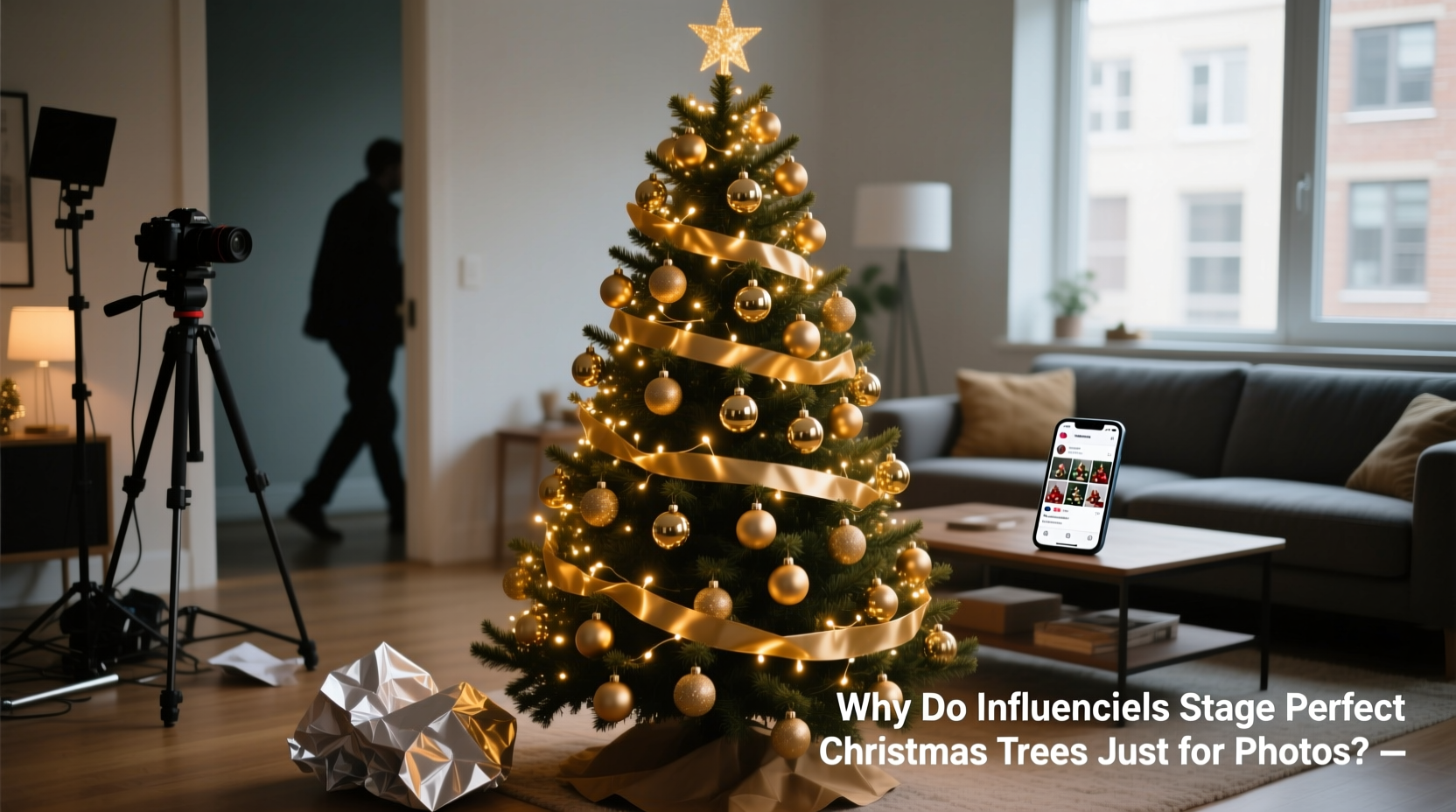
Scroll through Instagram or TikTok in December, and you’ll see them: impossibly symmetrical firs draped in coordinated ornaments, fairy lights cascading like liquid gold, vintage books stacked beside ceramic reindeer, and a perfectly fluffed knit blanket draped over a nearby armchair—all bathed in soft, golden-hour light. These Christmas trees aren’t just decorated; they’re meticulously constructed sets. They look less like family heirlooms and more like film stills from a Nordic design magazine. Yet behind every flawless image is a 90-minute setup, three discarded garland attempts, a ladder, a tape measure, and at least one frustrated influencer muttering about “light temperature.” This isn’t vanity—it’s strategy. And it reveals far more about digital culture, commercial reality, and human perception than holiday aesthetics ever could.
The Algorithm Doesn’t Care About Authenticity—It Cares About Engagement
Instagram’s recommendation engine and TikTok’s For You Page prioritize content that signals high engagement potential: rapid dwell time, strong visual contrast, clear focal points, and emotional resonance. A real, lived-in Christmas tree—slightly lopsided, with mismatched ornaments, one strand of lights out, and a toddler’s handprint on the trunk—rarely meets those criteria. Algorithms interpret visual coherence as professionalism, and professionalism as trustworthiness. When an influencer posts a tree styled with monochromatic matte baubles, balanced asymmetry, and intentional negative space, the platform rewards it with higher initial distribution. Data from Later’s 2023 Holiday Content Report shows posts featuring “curated, minimalist holiday decor” received 47% more saves and 32% more shares than those labeled “cozy,” “rustic,” or “family-style”—terms often associated with authenticity but lower visual predictability.
This isn’t speculation. Creators routinely A/B test tree setups: one with “realistic” clutter (gifts under the tree, pet toys nearby), another stripped down to only color-coordinated elements. The latter consistently outperforms—even when posted to the same account, at the same time, with identical captions. As digital strategist Lena Torres explains: “The feed is a visual search engine. People don’t scroll to find ‘a Christmas tree’—they scroll to find *the* Christmas tree that matches their aspirational mood board. Your job isn’t to document your living room. It’s to become the visual answer to someone else’s unspoken query.”
“The most effective holiday content doesn’t reflect reality—it compresses emotional desire into a single frame. A staged tree isn’t dishonest. It’s a concentrated dose of calm, control, and curated joy in a season defined by chaos.” — Maya Chen, Visual Culture Researcher, NYU Tisch School of Arts
The Brand Mandate: When Sponsors Define the Aesthetic
For many mid-tier and macro influencers, December isn’t just a holiday month—it’s Q4 revenue season. Brands from candle companies to furniture retailers allocate up to 35% of their annual influencer budgets to holiday campaigns. But those sponsorships come with strict creative briefs. A home goods brand launching a “Frosted Pine” linen collection won’t approve a photo where the tree is draped in red-and-green tinsel or features handmade paper ornaments. Instead, the brief specifies: “Cool-toned palette only. No warm metals. Ornaments must be matte ceramic or frosted glass. Tree skirt must be visible and match campaign swatch #E8F0F7.”
That means the influencer isn’t styling for themselves—they’re executing a miniature art direction project. Every element serves dual purpose: aesthetic cohesion and brand alignment. Even the placement of the tree matters. If the sponsor sells sectional sofas, the tree must be photographed at an angle that frames the sofa’s curve. If it’s a lighting brand, the shot prioritizes how light reflects off glass ornaments—not how the tree smells or how the kids interact with it.
Tip: Influencers often pre-approve tree mockups with brands using digital mood boards before purchasing a single ornament—saving time, budget, and creative rework.The Psychology of Perfection: Why Viewers Crave (and Consume) Staged Scenes
Viewers don’t scroll past these images because they think, “This isn’t real.” They linger because the image fulfills a quiet psychological need: the promise of order. December is statistically the most cognitively overloaded month of the year—holiday planning, financial stress, family logistics, seasonal affective shifts. A perfectly composed tree functions as visual white noise: predictable, harmonious, and emotionally contained. Neuroaesthetics research shows that viewers spend 2.3 seconds longer on images with bilateral symmetry and chromatic harmony—long enough for the brain to register calm before moving on.
But there’s a deeper layer: social comparison theory in action. When people see a staged tree, they rarely think, “I should replicate this exactly.” Instead, they extract modular ideas—“I love how those dried orange slices look against white branches,” or “Maybe I *could* try all-silver ornaments next year.” The perfection isn’t intimidating; it’s instructional. It offers permission to edit, simplify, and refine—not to mimic, but to curate their own version of peace.
Behind the Scenes: A Realistic 3-Hour Staging Timeline
What does it *actually* take to produce that “effortless” tree photo? Below is a documented timeline from @homebyelara, a lifestyle creator with 142K followers, during her 2023 holiday campaign with a Scandinavian decor brand:
- Hour 0–0.5: Clear the space—remove all existing decor, vacuum baseboards, wipe down floor, adjust furniture angles for optimal sightlines.
- Hour 0.5–1.25: Select and fluff the artificial tree (real trees shed, stain, and dry too fast for multi-day shoots); use a stepladder to adjust branch angles for depth and dimension.
- Hour 1.25–2.0: String lights—starting at the trunk and working outward, spacing bulbs 4 inches apart, hiding cords with green floral wire and faux ivy sprigs.
- Hour 2.0–2.5: Hang ornaments in three waves: heavy base ornaments first (for balance), then mid-level texture pieces (wood, ceramic), then delicate top accents (feathers, glass droplets)—each placed with tweezers for precision.
- Hour 2.5–3.0: Style the base—layering a wool rug, then a linen tree skirt, then scattered pinecones and eucalyptus stems (all pre-trimmed and misted to prevent browning). Final lighting test with two LED panels set to 3200K.
No children, pets, or spontaneous moments were permitted during this window. The resulting six final images required 42 total shots—and zero retakes of the tree itself. Everything was planned, measured, and repeated until the composition met both the brand’s grid standards and the creator’s personal “calm threshold.”
Do’s and Don’ts of Holiday Content Creation
| Action | Do | Don’t |
|---|---|---|
| Lighting | Use diffused natural light near north-facing windows; supplement with softbox LEDs at 2700–3200K for warmth without glare. | Shoot directly under harsh overhead lights or with flash—creates unnatural shadows and washes out textures. |
| Ornament Selection | Choose 3–5 materials max (e.g., wood + matte ceramic + dried citrus) for tactile cohesion. | Mix high-gloss plastic, glitter, mirrored glass, and velvet—visual noise overwhelms the frame. |
| Tree Shape | Fluff branches from bottom up, widening slightly toward the top for classic conical balance. | Let top branches droop or overcrowd the center—disrupts vertical rhythm and draws attention away from focal points. |
| Caption Strategy | Pair the image with honest micro-context: “This took 2.5 hours—but I kept the red tinsel from my childhood tree in the drawer for moments like this.” | Claim spontaneity (“Just threw this together!”) when the setup was labored—erodes long-term credibility. |
| Authentic Integration | Include *one* subtle, human detail: a child’s drawing taped to the trunk, a coffee mug on the nearby side table, a pet’s toy partially visible beneath the skirt. | Remove all traces of daily life—makes the scene feel sterile, not serene. |
A Mini Case Study: How One Creator Turned Staging Into Storytelling
In 2022, Toronto-based creator Samira Khan (@samirahome) faced backlash after posting a series of “perfect” trees that felt increasingly detached from her usual warm, multicultural aesthetic. Her audience commented: “Love the trees—but where’s the biryani pot on the counter? Where’s your mom’s embroidered cushion?” Rather than abandon staging, Samira redesigned her approach. She began documenting the *process*—not just the result. Her 2023 holiday series included reels titled “Building My Diwali-Christmas Tree” and “Why My Tree Has 7 Types of Lights (and 1 Very Tired Cat).” She showed the trial-and-error of blending marigold garlands with silver bells, the struggle to hang diyas without fire hazard, and the moment her niece insisted on placing the star “just so.” Engagement jumped 68%. More importantly, comments shifted from “How do I get this look?” to “Can you share your marigold preservation method?” and “My mom uses the same star—she got hers in 1974!” Staging didn’t disappear. It became scaffolding for something richer: cultural hybridity, intergenerational continuity, and joyful imperfection within intention.
FAQ
Does staging a tree mean influencers are being dishonest?
No—staging is a visual communication technique, not deception. Just as a chef plates food intentionally for a cookbook photo, or a journalist selects quotes to clarify a complex story, influencers compose scenes to convey specific emotions and ideas. The ethical line is crossed only when creators misrepresent labor, origin, or accessibility—e.g., claiming a $2,000 custom tree is “budget-friendly” or omitting that every element was gifted by sponsors.
Can real families apply these techniques without spending hours or money?
Absolutely. The core principles—intentional lighting, material restraint, and one meaningful human detail—require no budget. Try this: turn off overhead lights, place a single string of warm-white lights on your existing tree, swap three mismatched ornaments for three of the same shape (e.g., wooden stars), and prop a favorite book or handwritten note beside the trunk. That’s 15 minutes. That’s authenticity, elevated.
Why don’t influencers just show their “real” trees instead?
They do—just not as primary content. Most maintain separate Stories, newsletters, or even Patreon posts for unfiltered moments: tangled lights, burnt-out bulbs, the dog stealing an ornament. But the main feed serves a different function: it’s a portfolio, a brand asset, and a visual anchor for discovery. Showing the “real” tree there would be like a graphic designer posting a screenshot of their messy desktop instead of their Behance portfolio. Both are true. Only one fulfills the medium’s functional purpose.
Conclusion
The perfectly staged Christmas tree isn’t a symbol of inauthenticity—it’s a lens. Through it, we see how algorithms reshape creativity, how commerce directs domestic aesthetics, and how deeply humans crave visual order amid emotional turbulence. But recognizing the mechanics behind the magic doesn’t diminish its value. It empowers us: to appreciate the craft without envy, to borrow techniques without imitation, and to decide—consciously—which parts of the staging process serve our own lives, and which parts we’re happy to leave in the studio.
Your tree doesn’t need to be perfect. It needs to be yours—whether that means hand-painted ornaments from kindergarten, thrifted glass balls collected over decades, or a single string of lights wrapped around a potted fern. The most compelling holiday content emerging today isn’t the most polished—it’s the most purposeful. It knows when to stage, when to step back, and when to let the light fall where it may.
💬 Your turn: What’s one small, intentional change you’ll make to your holiday decor—not for the camera, but for your own sense of calm? Share it in the comments. Let’s build a gallery of real, resonant, quietly powerful moments.








