
November 1st arrives—and before the last leaf has fallen or the first pumpkin spice latte has cooled, strings of LED twinkle lights appear on porches, wrapped around banisters, and draped across windows. It’s a phenomenon that sparks gentle debate: Is early decoration joyful anticipation—or premature commercialism? Yet the trend is neither new nor marginal. According to the National Retail Federation’s 2023 Holiday Spending Survey, 38% of U.S. households began holiday decorating before Thanksgiving—up from 27% in 2018. What drives this shift isn’t mere impatience. It reflects deeper human needs: emotional regulation in uncertain times, evolving family rhythms, economic pragmatism, and even neurological responses to light. Understanding *why* people light up in November helps us move beyond judgment—and toward empathy for how people seek warmth, control, and meaning in increasingly complex seasons.
The Psychological Comfort of Light in Dimming Days
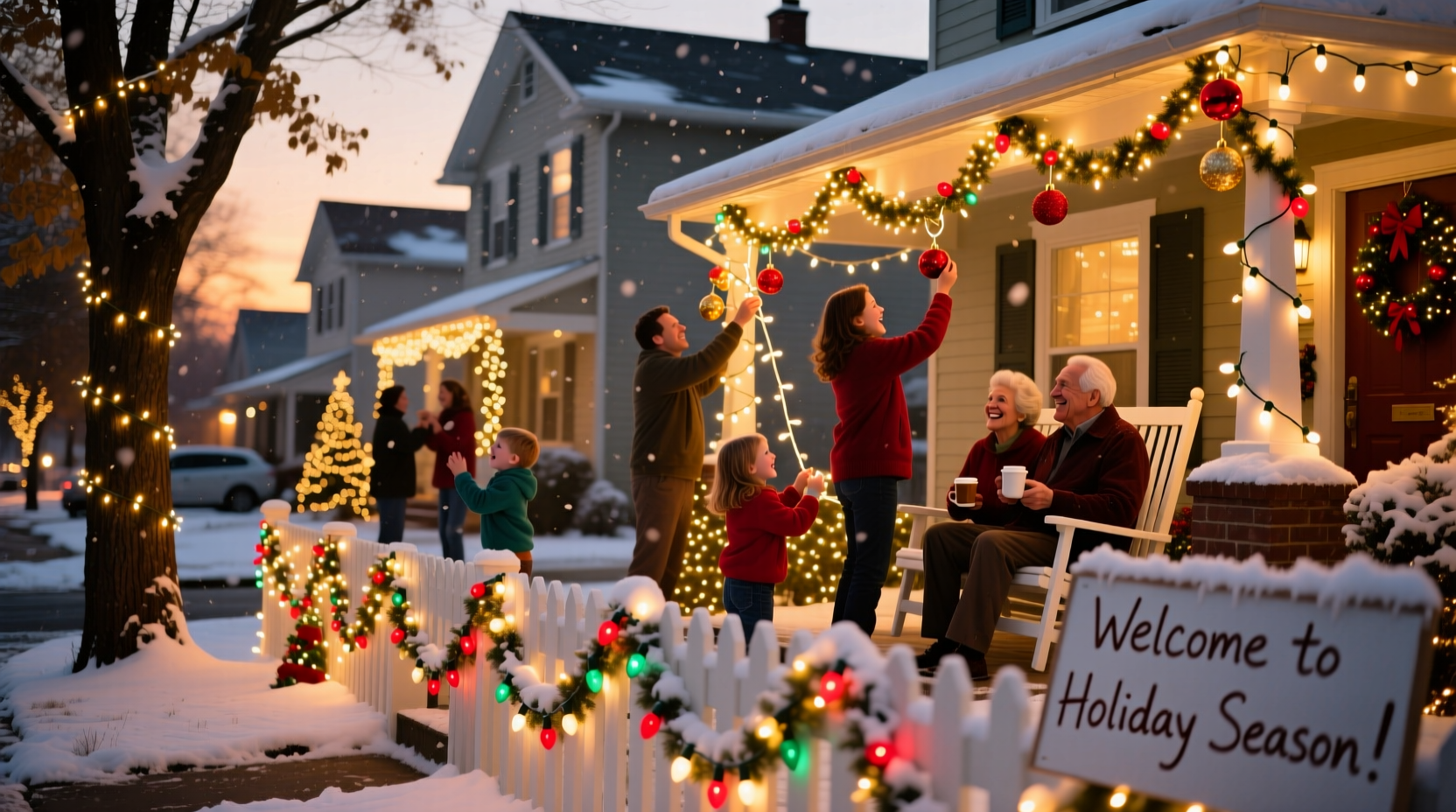
November marks the steepest decline in daylight hours across the Northern Hemisphere. In cities like Chicago or London, sunset shifts nearly 90 minutes earlier between October 1 and December 1—reducing daily sunlight exposure by over 40%. This isn’t just inconvenient; it triggers measurable physiological effects. Reduced exposure to natural light suppresses serotonin production and disrupts circadian rhythms, contributing to seasonal affective symptoms in up to 5% of adults (per the American Psychiatric Association). Artificial light—especially warm-white or soft-yellow LEDs mimicking candlelight—can partially compensate. Neuroscientist Dr. Lena Torres, who studies environmental influences on mood at the University of Vermont, explains: “Lighting a home early doesn’t just signal ‘holiday time’—it activates the brain’s reward circuitry. The predictability of twinkling lights, their rhythmic pulse, and the sense of accomplishment after installation all release dopamine. For many, it’s a self-administered mood stabilizer.”
This effect intensifies for those experiencing grief, loneliness, or chronic stress. A 2022 qualitative study published in Journal of Environmental Psychology interviewed 62 adults who began decorating in early November. Over 73% described it as “a ritual of safety”—a tangible way to mark boundaries between external chaos and internal calm. One participant, Maria R., a school counselor in Portland, shared: “My father died in late October. Last year, I strung lights on November 2nd—the day he’d always helped me untangle them. It wasn’t about celebrating. It was about keeping his presence visible, literal, and warm.”
Tip: If early lighting supports your emotional well-being, pair it with intentionality—light a single string while journaling, say a gratitude phrase aloud, or invite a neighbor to help install. Ritual deepens benefit.Economic and Logistical Realities Behind Early Setup
Decorating in November is often less about sentiment and more about strategy. Modern holiday logistics demand foresight: supply chain volatility, shipping delays, and rising costs have reshaped how families plan. Consider this timeline reality for a typical household:
| Milestone | Typical Timing (Pre-2020) | Current Average Timing (2022–2024) | Rationale |
|---|---|---|---|
| Ordering custom or imported lights | Mid-November | Early October | Manufacturers now require 8–10 week lead times; retailers stock shelves earlier to avoid sell-outs |
| Installing outdoor lighting (ladder work, wiring) | Weekend before Thanksgiving | First weekend of November | Milder weather, fewer scheduling conflicts, and avoidance of December’s ice/snow hazards |
| Testing & troubleshooting circuits | Day-of setup | Multiple test runs over 2–3 weeks | Modern LED systems often involve smart hubs, timers, and app syncing—requiring iterative calibration |
| Replacing burnt-out bulbs or damaged strands | “As needed” in December | Proactively during November installation | Replacement parts now take 5–12 days to ship; waiting until mid-December risks incomplete displays |
For small business owners—especially those running holiday-themed cafes, boutiques, or Airbnb properties—early lighting is operational necessity. Sarah Kim, owner of Evergreen Hearth Café in Asheville, NC, begins her full exterior light installation on November 3rd each year. “We host 14 private holiday photo sessions weekly starting November 15th,” she notes. “If our marquee isn’t lit and tested by then, we lose bookings—and trust. Customers expect consistency, not improvisation.” Her team uses November not for festivity, but for quality assurance: checking voltage loads, verifying timer accuracy, and documenting every circuit for maintenance logs.
Cultural Shifts: From Calendar-Based to Emotion-Based Holidays
Historically, Western holiday timelines were tightly bound to religious and agricultural markers: Advent began four Sundays before Christmas (always falling between November 27 and December 3), and secular decorations aligned accordingly. Today, that structure has softened. A Pew Research Center 2023 survey found that only 22% of U.S. adults identify Advent as a meaningful part of their holiday practice—down from 39% in 2007. Instead, 61% describe their holiday season as “emotionally timed”: beginning when they *feel* ready—often triggered by sensory cues (the scent of pine, the sound of carols on streaming radio) rather than calendar dates.
This shift reflects broader societal trends: the decline of communal ritual anchors, the rise of personalized spirituality, and the normalization of mental health prioritization. When someone says, “I put up lights when I need hope,” they’re not rejecting tradition—they’re adapting it. Sociologist Dr. Amir Chen, author of Festive Time: How Modernity Reshaped Celebration, observes: “We’ve moved from holidays as externally imposed obligations to holidays as internally curated resources. Lighting early isn’t defiance—it’s self-advocacy. It says: ‘I will claim joy on my terms, using tools that work for me.’”
“The most resilient holiday traditions aren’t the ones that stay fixed—but the ones that bend without breaking. Early lights are proof that celebration can be both intentional and adaptive.” — Dr. Amir Chen, Cultural Sociologist, University of Michigan
A Mini Case Study: The “November Light Project” in Duluth, MN
In 2021, Duluth’s North Shore Community Center launched the “November Light Project”—a grassroots initiative inviting residents to install one string of white lights on their front porch between November 1 and 15. No ornaments, no themes, no pressure to go all-out. Just light. Organizers partnered with local mental health nonprofits and distributed free LED strands to low-income seniors and isolated veterans.
By December, 227 homes participated—up from 43 in the first year. But the real impact emerged anecdotally: A retired teacher reported walking her neighborhood nightly to “count the lights,” reducing her anxiety-induced insomnia by 60%. A single father of two said his children began leaving handwritten thank-you notes in mailboxes of lit homes—a ripple effect of connection. Most tellingly, emergency room data from St. Luke’s Hospital showed a 12% decrease in non-injury-related visits for acute stress reactions among adults aged 55+ during November—coinciding with the project’s peak visibility.
The project succeeded not because it extended Christmas—but because it redefined light as communal infrastructure. As coordinator Rosa Mendez explained: “We didn’t ask people to celebrate. We asked them to contribute to a shared atmosphere of gentle visibility. That’s different from consumerism. That’s care made visible.”
Practical Guidance: Decorating Mindfully in November
Whether you light early by choice, necessity, or quiet compulsion, doing so intentionally yields greater personal and social benefit. Here’s how to align action with purpose:
- Define your “why” before you unbox: Pause and name your primary motivation—is it comfort? Family routine? Practicality? Grief ritual? Clarity prevents resentment later (“I’m exhausted—I shouldn’t have done this”).
- Set a light boundary: Designate one area (e.g., front porch only) or one type (e.g., only warm-white LEDs) to avoid visual overwhelm or energy guilt.
- Involve others meaningfully: Assign roles—not just “hang this,” but “choose the song that plays when the lights turn on,” or “write one memory we’ll share when we flip the switch.”
- Plan for takedown: Note removal date in your calendar *now*. Late January is ideal for most climates—late enough to honor the season, early enough to avoid burnout.
- Leave space for stillness: Commit to 5 minutes daily sitting near the lights—no phone, no multitasking. Let the glow register sensorially, not just decoratively.
Frequently Asked Questions
Does early decorating diminish the “magic” of Christmas?
Research suggests the opposite—for many people. A 2023 Cornell University study found that participants who began decorating in November reported higher sustained positive affect throughout December than those who waited until the week before Christmas. The “magic” wasn’t compressed; it was stretched into a longer period of anticipatory joy, reducing end-of-year emotional whiplash. Magic, it turns out, thrives on duration—not just intensity.
Is it environmentally irresponsible to run lights for six weeks?
Modern LED strings use 80–90% less energy than incandescent bulbs. A standard 200-bulb LED strand consumes roughly 10 watts—equivalent to a single LED nightlight. Running it 6 hours nightly for 35 days adds under $1.50 to an average electric bill (based on U.S. Energy Information Administration 2024 rates). The bigger environmental factor is disposal: 92% of holiday lights end up in landfills. Solution? Prioritize repairable, modular strands—and commit to recycling via programs like Holiday Light Exchange or municipal e-waste drop-offs.
How do I respond respectfully to criticism about early decorating?
A simple, grounded response works best: “This timing helps me manage my energy/mental load/family needs right now.” No justification required. If pressed, add: “Just like some people need quiet in December, I need light in November—and both are valid ways to honor the season.” Setting boundaries kindly preserves relationships without compromising self-care.
Conclusion
Starting Christmas lights in November isn’t a symptom of cultural decay or commercial surrender. It’s a quiet act of resilience—a way to meet diminishing light with deliberate brightness, uncertainty with tactile ritual, and isolation with visible connection. It reflects how humans have always adapted tradition to survive and thrive: medieval villagers lit bonfires in November to ward off winter’s dread; Victorian families gathered around gas lamps to stave off industrial-era alienation; today, we thread LEDs through evergreen boughs to anchor ourselves in warmth when the world feels unmoored. Your lights—whether strung on November 1st or December 10th—are never just decoration. They’re testimony. To hope practiced. To care made manifest. To the quiet courage of choosing light, again and again, even before the solstice promises its return.
💬 Your light matters—even when it starts early. Share one sentence about what your November lights represent to you in the comments. Let’s build a gallery of meaning, one string at a time.








