As winter descends and city squares transform into festive wonderlands, one element remains constant across nearly every Christmas market in Europe and beyond: the warm, inviting glow of string lights. Whether strung above cobblestone alleys or wrapped around wooden stalls, these delicate strands of light define the mood far more than any spotlight could. But why do organizers consistently choose soft strings over powerful beams? The answer lies not just in aesthetics, but in psychology, tradition, and a deep understanding of human perception during the holiday season.
Unlike commercial lighting setups designed for visibility or security, Christmas markets aim to evoke emotion—nostalgia, warmth, joy. String lights play a pivotal role in crafting this emotional landscape. This article explores the deliberate design choices behind festive illumination, revealing how something as simple as a strand of bulbs can shape an entire sensory experience.
The Psychology of Light in Festive Spaces
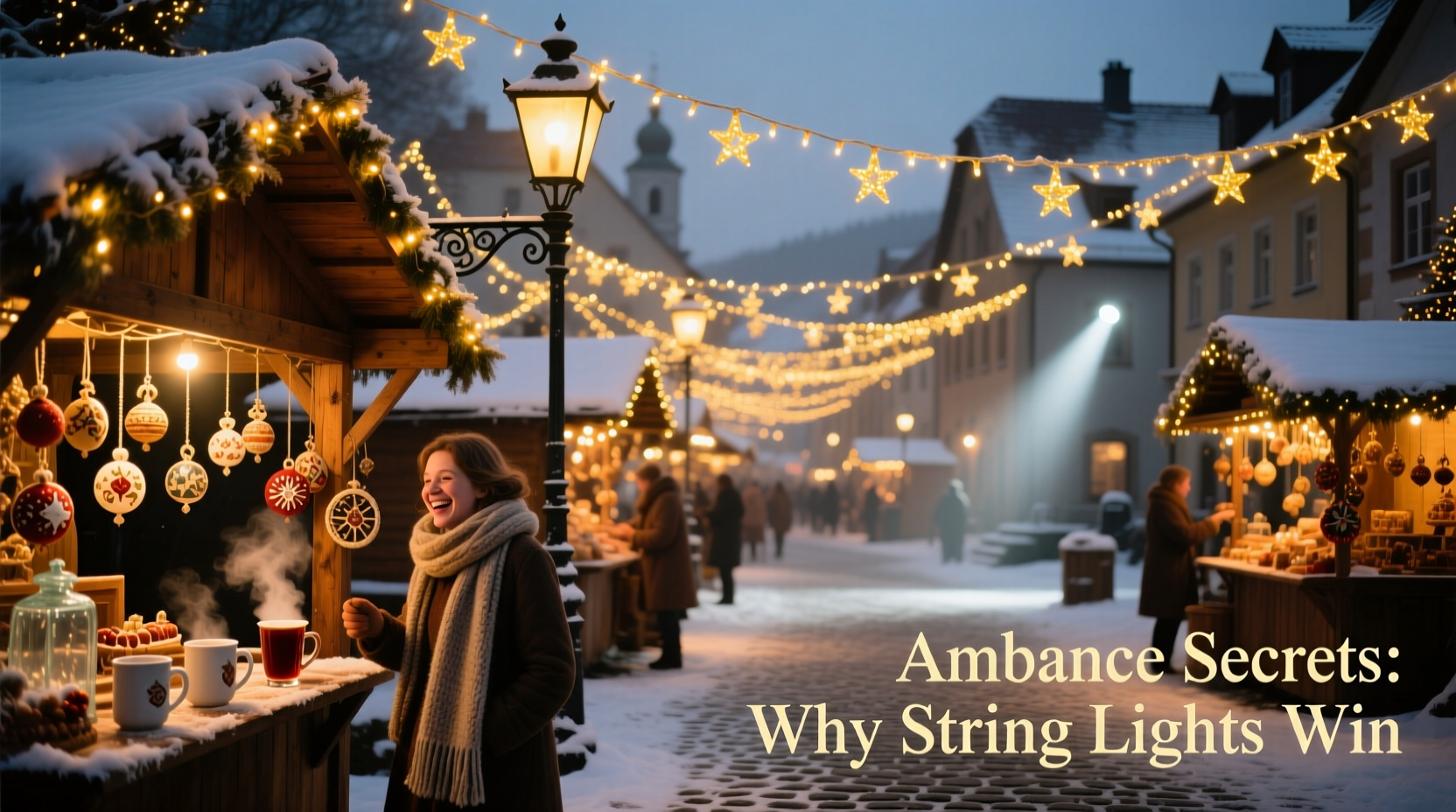
Lighting does more than illuminate—it influences mood, behavior, and memory. In the context of Christmas markets, lighting is carefully curated to trigger positive emotional responses. Studies in environmental psychology show that warm-toned, low-intensity lighting promotes feelings of comfort, safety, and intimacy. These are precisely the emotions associated with holiday traditions: family gatherings, hot drinks by the fire, and quiet moments under falling snow.
Spotlights, by contrast, serve functional purposes—highlighting architecture, ensuring safety, or drawing attention to specific displays. They are directional, intense, and often create sharp contrasts between light and shadow. While effective for retail signage or stage performances, such lighting feels clinical in a space meant to feel cozy and personal.
String lights, especially those with warm white or amber tones (typically 2200K–2700K color temperature), emit diffused, ambient light. This soft glow minimizes harsh shadows and wraps the environment in a gentle radiance. The result? A perceptual \"halo effect\" where the space itself feels welcoming, almost dreamlike.
“People don’t remember what they saw under bright lights—they remember how they felt in the glow.” — Dr. Lena Hofmann, Environmental Psychologist, University of Vienna
Tradition Meets Modern Design: The Evolution of Market Lighting
The use of string lights in Christmas markets isn’t merely a modern trend; it’s rooted in historical practice. Early German Weihnachtsmärkte of the 14th and 15th centuries relied on candlelight to illuminate stalls after dusk. Candles were placed in glass holders to protect against wind and fire, creating flickering points of warmth along narrow lanes. Though dangerous and short-lived, these flames established a visual language of intimacy and craftsmanship.
With the advent of electric lighting in the late 19th century, cities began replacing candles with small incandescent bulbs. These early electric strings mimicked the size and spacing of traditional candles, preserving the original aesthetic while improving safety and longevity. By the mid-20th century, mass-produced miniature bulb sets became standard across European markets—from Nuremberg to Strasbourg.
Today’s LED string lights maintain this legacy while offering energy efficiency and durability. Yet designers deliberately avoid mimicking daylight or fluorescent tones. Instead, they prioritize filament-style LEDs that replicate the soft, slightly uneven glow of vintage bulbs—sometimes even incorporating subtle flicker effects to echo candlelight.
Tip: When designing festive spaces, match bulb spacing to human eye-level perception—strings spaced 6–8 inches apart create continuous visual flow without appearing cluttered.Ambiance Engineering: Why Spotlights Fall Short
To understand why spotlights are rarely used in core market areas, consider their inherent characteristics:
- Directionality: Spotlights focus on objects, not environments. They isolate rather than envelop.
- Intensity: High-lumen output overwhelms peripheral vision and reduces night adaptation.
- Cold Tones: Many spotlights use neutral or cool white LEDs (4000K+), which feel sterile next to mulled wine and hand-carved ornaments.
- Shadow Contrast: Sharp edges and deep shadows disrupt the sense of unity within a market layout.
In contrast, string lights function as ambient layering tools. They are typically installed overhead in crisscrossing patterns or gently arcing lines, forming a canopy of light that covers wide areas evenly. This top-down diffusion ensures that faces remain softly lit—a crucial factor when visitors are interacting, shopping, or taking photos.
Moreover, string lights contribute to vertical illumination. Unlike ground-mounted spotlights that only reach upward a few feet, suspended strings light both the upper structure of stalls and the space beneath them. This creates depth and dimension, making narrow alleys feel expansive and inviting.
Comparison: String Lights vs. Spotlights in Market Settings
| Feature | String Lights | Spotlights |
|---|---|---|
| Light Quality | Soft, diffused, warm | Hard, focused, often cool |
| Coverage Area | Wide, continuous spread | Narrow, targeted zones |
| Emotional Impact | Cozy, nostalgic, romantic | Alert, formal, transactional |
| Installation Flexibility | Adaptable to irregular layouts | Requires fixed mounting points |
| Energy Efficiency (LED) | High (low wattage per bulb) | Moderate to high (depends on beam) |
| Best Use Case | Overall ambiance, pedestrian zones | Highlighting signs, stages, art pieces |
Note that spotlights aren't entirely absent from Christmas markets—they're used strategically. For example, a large nativity scene might be illuminated with recessed spotlights to draw attention, or a central tree may have uplighting for dramatic effect. But these are accents within a broader ambient framework dominated by strings.
The Role of Rhythm and Repetition in Visual Comfort
Another reason string lights dominate market design lies in the principle of rhythmic repetition. Human eyes are naturally drawn to patterns, especially predictable ones. The evenly spaced bulbs along a wire create a visual rhythm that guides movement and provides subconscious reassurance.
This is particularly important in crowded environments. When thousands of people navigate tight pathways, consistent lighting helps maintain orientation. A repeating pattern of lights overhead acts like a luminous pathway, reducing cognitive load and preventing disorientation.
Additionally, the rhythmic quality enhances photogenic appeal. Social media has amplified the importance of \"shareable\" moments in modern Christmas markets. Visitors expect picturesque scenes—steam rising from mugs, wreaths glowing in the background, lovers walking under twinkling arches. String lights provide the ideal backdrop: uniform enough to feel harmonious, yet dynamic enough to feel magical.
Mini Case Study: Dresden Striezelmarkt
Dresden’s Striezelmarkt, one of Germany’s oldest Christmas markets dating back to 1434, underwent a major lighting redesign in 2016. Previously, a mix of floodlights and older incandescent strings created uneven brightness and high energy costs. The new system replaced most fixtures with custom-warm LED string lights, installed in overlapping diamond patterns above the main promenade.
The results were immediate. Visitor surveys showed a 38% increase in perceived \"coziness,\" and nighttime attendance rose by 22% compared to the previous year. Vendors reported longer dwell times—shoppers lingered an average of 14 minutes longer per visit. Notably, social media mentions using hashtags like #DresdenGlow increased tenfold.
City planners attributed much of this success to the emotional resonance of the lighting. “We didn’t just improve visibility,” said urban designer Anja Weber. “We rebuilt the feeling of being inside a living snow globe.”
Design Checklist: Creating Authentic Market Ambiance
Whether you’re organizing a local holiday event or enhancing your storefront for the season, here’s a practical checklist based on proven market-lighting principles:
- Use warm-white string lights (2200K–2700K) exclusively for ambient coverage.
- Install lights overhead in overlapping grids or zigzag patterns for even diffusion.
- Ensure bulb spacing is no more than 8 inches apart to avoid visual gaps.
- Combine string lights with natural materials like wood, pine, and fabric banners to enhance warmth.
- Limited use of spotlights only for focal points (e.g., trees, sculptures).
- Test lighting at eye level—adjust height so faces appear softly lit, not shadowed.
- Use timers or smart controls to activate lights at dusk, reinforcing seasonal rhythm.
Step-by-Step: Building a Mini Market Canopy
Want to replicate the magic on a smaller scale? Follow this sequence to install an authentic-feeling string light canopy:
- Measure the area: Determine width and length of the zone to be covered.
- Select appropriate lights: Choose commercial-grade, weather-resistant LED strings with shatterproof bulbs.
- Plan suspension points: Install hooks or cables at least 8–10 feet high, spaced every 6–8 feet.
- Create a crisscross grid: Run parallel lines first, then add diagonal strings to form diamonds.
- Connect with low-voltage transformers: Avoid daisy-chaining too many sets; use splitters for reliability.
- Test before finalizing: Turn on the system at twilight to assess coverage and warmth.
- Add complementary elements: Hang small lanterns or greenery bundles from intersection points for added texture.
This method mirrors techniques used in real markets across Bavaria and Alsace, where layered lighting creates immersive experiences without relying on brightness alone.
Frequently Asked Questions
Can I use colored lights instead of white?
While white or amber tones dominate traditional markets for their authenticity, limited use of color—such as red or green accents on stall awnings—is acceptable. However, full-color strings can shift the mood from elegant to carnival-like. For a classic feel, stick to warm whites and use color sparingly as decoration.
Are LED string lights safe for outdoor use?
Yes, provided they are rated for outdoor conditions (look for IP44 or higher). Modern LEDs run cooler than incandescents, consume less power, and last significantly longer—making them ideal for multi-week events. Always inspect cords for damage before installation.
Why not use fairy lights instead of larger bulbs?
\"Fairy lights\" typically refer to ultra-miniature, densely packed strands. While charming, they lack the visual weight needed to define large spaces. Traditional market strings use slightly larger bulbs (T12 or G25 size) because they’re visible from a distance and contribute meaningfully to ambient brightness without glare.
Conclusion: The Art of Emotional Illumination
Christmas markets don’t rely on string lights simply because they’ve always done so. There’s a deliberate, research-backed logic behind every glowing strand. From psychological comfort to cultural continuity, these lights serve as silent storytellers—inviting people not just to see the market, but to feel part of it.
Spotlights inform. String lights enchant. And in the world of seasonal celebration, enchantment wins every time.
💬 Have you experienced a Christmas market with unforgettable lighting? Share your story in the comments—we’d love to hear what made it magical.








