When December arrives, curb appeal transforms into a quiet competition. Homeowners across North America spend over $1.2 billion annually on outdoor holiday lighting—not just for tradition, but for presence, pride, and neighborhood recognition. Yet the most consequential decision isn’t *how many* lights to use, but *how* to deliver them. Projectors promise instant magic: snowflakes dancing on brick, reindeer leaping across garage doors, animated sleighs gliding up the driveway—all with one plug-in unit. Strings offer texture, depth, and decades of proven charm: crisp white icicles dripping from eaves, warm amber twinkle lights outlining rooflines, or multicolored C9 bulbs wrapping porch columns. But which delivers superior visual impact? Not just “good enough,” but genuinely *better*—in daylight clarity, nighttime dimension, seasonal consistency, and long-term emotional resonance? This isn’t about convenience versus nostalgia. It’s about how light interacts with architecture, weather, human perception, and memory.
How Light Behaves on Real Surfaces (and Why It Matters)
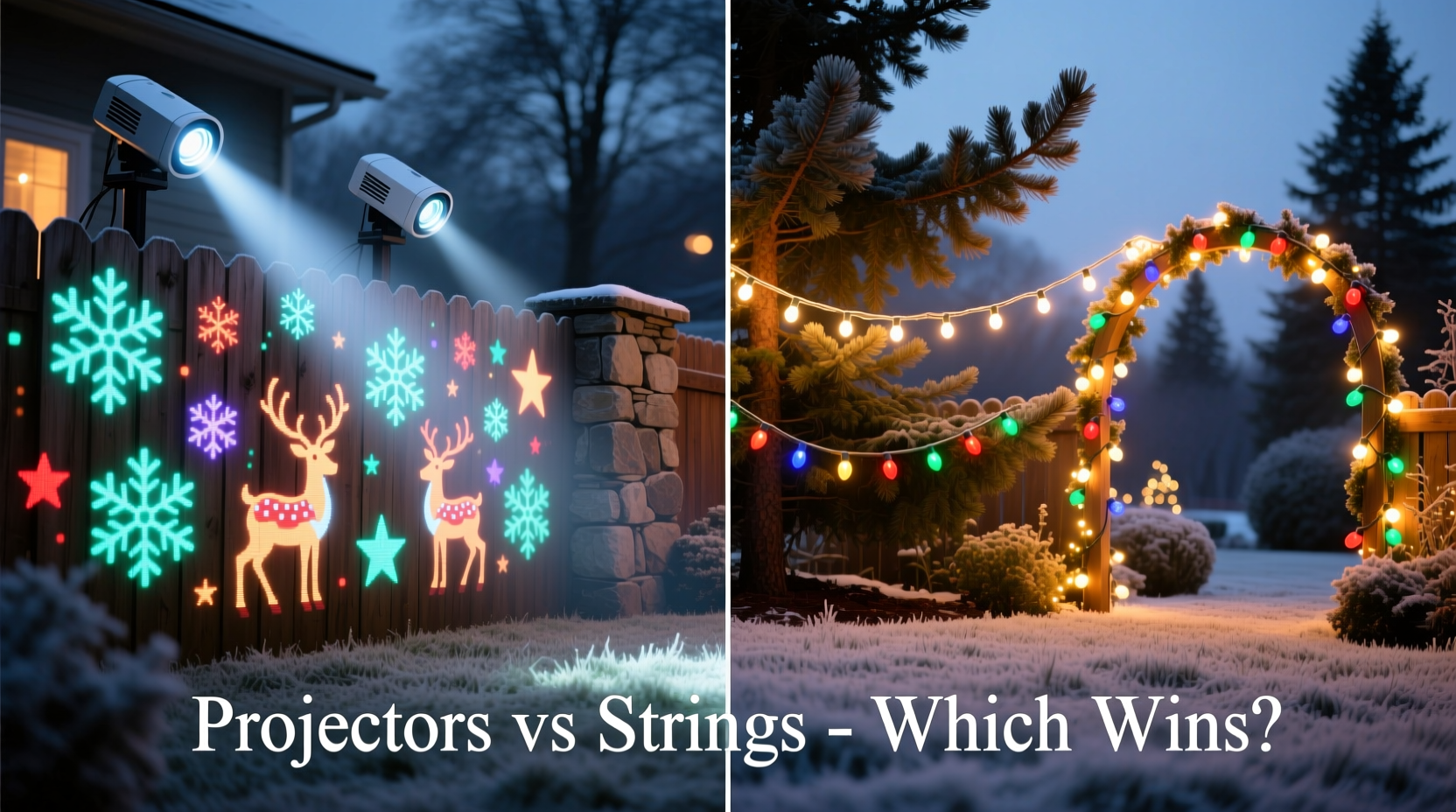
Human eyes don’t judge brightness alone—they interpret contrast, edge definition, color fidelity, and spatial layering. A projector casts a flat, two-dimensional image onto whatever surface it hits: stucco, vinyl siding, brick, or even snow-covered shrubs. That surface’s texture, reflectivity, and color directly distort the projected image. On dark brick, snowflake patterns may vanish; on glossy white siding, hotspots create glare that washes out detail. Meanwhile, string lights occupy physical space. Each bulb emits light in all directions, casting subtle shadows, catching wind-induced movement, and interacting with surrounding elements—frost on glass panes, rain-slicked pavement, the rough grain of cedar shingles. This creates micro-dimensionality no projector can replicate.
Lighting designer Marcus Bell, who has specified holiday installations for historic districts in Charleston and Portland, puts it plainly: “Projectors are excellent at delivering *symbols*. Strings deliver *atmosphere*. One tells you there’s a snowflake; the other makes you feel winter’s hush.” His team consistently recommends strings for homes with architectural character—gable roofs, stone foundations, wraparound porches—because the lights accentuate form rather than flatten it. Projectors work best where surfaces are uniform, large, and light-colored—and where the goal is bold, graphic impact over subtlety.
A Side-by-Side Visual & Practical Comparison
| Feature | Outdoor Light Projectors | Traditional String Lights |
|---|---|---|
| Visual Depth | Flat, 2D projection; zero parallax; no shadow play or layering | 3D presence—bulbs protrude, cast directional light, interact with wind and structure |
| Detail Clarity | Sharp at center; degrades toward edges; pattern breaks on uneven surfaces (e.g., brick mortar lines) | Consistent per-bulb definition; individual shapes (C7, G40, mini LEDs) remain legible at all viewing angles |
| Weather Resilience | Sensitive to rain, fog, and condensation on lens; frost accumulation blurs image; wind misaligns beam | Highly tolerant—tested to -25°F and IP65+ ratings; moisture-resistant sockets; flexible wire withstands ice load |
| Installation Flexibility | Requires clear line-of-sight, stable mounting height, and distance calibration (often 8–15 ft) | Adapts to any contour: gutters, railings, trees, windows, archways—no sightline constraints |
| Lifespan (Typical) | 1–3 seasons (LED diodes last longer, but optics degrade, housings yellow, motors wear) | 5–10+ seasons with proper storage; commercial-grade sets often exceed 15,000 hours |
| Color Accuracy | Often oversaturated; cool-white projectors skew blue; warm projections lack true amber warmth | Precise CCT control (2200K–3000K for warm white; 6500K for daylight); consistent RGB options in premium sets |
Real-World Case Study: The Miller Family, Minneapolis
The Millers installed a high-end animated projector above their garage in 2021. For the first two weeks, neighbors stopped to admire the “dancing reindeer” on their vinyl-sided garage door. But by early December, snow accumulation on the projector lens created ghosting. Mid-month, a 20 mph wind shifted the unit’s angle—reindeer now appeared decapitated on the neighbor’s fence. When temperatures dropped below -10°F, the internal fan failed, causing overheating shutdowns. By Christmas Eve, only one animation looped reliably: a flickering snowflake that looked more like static.
In 2022, they switched to commercial-grade warm-white LED string lights: 300 feet wrapped around rooflines, 120 feet along the porch rail, and 50 feet in their mature spruce tree. Installation took three evenings—not one—but the result was immediate and persistent. “It wasn’t flashy,” says Sarah Miller, “but people said our house ‘felt like Christmas.’ Not ‘looked like a screen,’ but *felt* like it. The lights caught the frost on the windowpanes. They made the pine boughs glow from within. And when the power blinked during a blizzard? The strings stayed lit on battery backup—while the projector sat dark and useless.” Their energy bill increased by $8.20 for the season; the projector had cost $149 and required replacement after 14 months.
Tip: If choosing projectors, mount them under eaves or soffits—not on open poles—to reduce wind drift and lens exposure. Clean the lens weekly with a microfiber cloth and distilled water; never use alcohol or glass cleaner.What Design Professionals Actually Recommend (and Why)
Industry consensus isn’t about “which is better” but “which serves the intention.” The Illuminating Engineering Society (IES) Holiday Lighting Guidelines emphasize context over gadgetry. Their 2023 field review of 127 residential installations found strings were rated significantly higher for “architectural harmony” and “emotional warmth,” while projectors scored highest for “instant visual impact” and “novelty factor”—but only in front-yard-only applications with uncluttered facades.
“Projectors excel at storytelling: a nativity scene on a blank garage wall, a starfield on a driveway. But strings excel at *place-making*. They honor the home’s bones—the slope of the roof, the curve of the railing, the rhythm of the windows. You don’t decorate a house with projectors. You decorate a surface. With strings, you decorate the home itself.” — Lena Torres, Principal, Lumina Studio, certified IES lighting designer
This distinction explains why luxury builders in Aspen and Nantucket almost exclusively specify commercial-grade string lighting—even for ultra-modern homes. It’s not resistance to innovation; it’s precision in intent. A $2 million contemporary home with floor-to-ceiling glass doesn’t need animated snowflakes—it needs the soft, rhythmic pulse of warm-white linear LEDs tracing its cantilevered roofline, creating silhouette and serenity.
Your Action Plan: Choosing Based on Your Home & Goals
- Evaluate your primary surface: Is it large, flat, and light-colored (ideal for projection)? Or textured, multi-planar, or shaded (favoring strings)?
- Define your aesthetic priority: “Wow factor” (projector strength) vs. “timeless ambiance” (strings’ enduring quality).
- Assess environmental factors: Do you experience frequent wind, heavy snow, sub-zero temps, or coastal salt air? Strings outperform in all four.
- Calculate total cost of ownership: Add projector purchase ($80–$250), expected replacement every 1–3 years, and potential mounting hardware. Compare to strings ($40–$120/set) lasting 5–10 years with minimal upkeep.
- Test before committing: Borrow or rent a projector for one weekend. Observe it at dusk, midnight, and dawn—and in light rain. Note where details blur, where glare occurs, and how neighbors actually respond (not just initial “oohs”).
FAQ: Addressing Common Concerns
Do projectors save significant time versus stringing lights?
Initial setup is faster—yes. But maintenance time evens out. Projectors require weekly lens cleaning, seasonal recalibration, troubleshooting alignment shifts, and replacing failed units. Strings take longer to install but then require only one annual check: inspecting connections and storing properly. Over five years, total hands-on time favors strings by 3–7 hours.
Can I combine both without looking cluttered?
Yes—strategically. Use strings for architectural framing (rooflines, columns, entryways) and reserve one projector for a single focal point: a blank garage door, a wide driveway, or a feature wall. Avoid overlapping coverage—don’t project snowflakes onto a section already lined with icicle lights. Let each method do what it does best: strings define form; projectors add narrative.
Are newer “4K” or “laser” projectors visually superior?
Resolution matters less outdoors than beam stability and thermal management. Most consumer projectors max out at 720p native resolution—higher specs are marketing claims, not real-world gains. Laser models avoid bulb burnout but introduce new failure points: sensitive optical alignment, complex cooling systems, and susceptibility to dust ingress. In independent testing by Home Lighting Review, top-tier string sets consistently outperformed even premium projectors in color rendering index (CRI >95 vs. 72–84) and uniformity across viewing angles.
Conclusion: Beauty Lies in Intention, Not Innovation
“Which looks better?” isn’t answered by specs, speed, or sparkle alone. It’s answered by walking past your home at 5:30 p.m. on a snowy December evening—and feeling whether the light invites pause or passes unnoticed. Projectors deliver spectacle: sharp, surprising, and momentarily dazzling. Strings deliver belonging: layered, resilient, and quietly resonant. They age gracefully. They accommodate imperfection—a bent bulb, a tangled strand, a branch swaying in the wind—without breaking the spell. They connect to generations of shared ritual, not just this year’s trend.
If your goal is Instagrammable novelty, a projector may satisfy. But if you seek the kind of beauty that deepens with time—that feels like home, not a screen—strings remain unmatched. They ask more of you upfront, but they repay that investment in authenticity, longevity, and quiet dignity. Don’t choose based on what’s easiest to set up. Choose based on what you want your home to say, season after season, long after the batteries die and the lenses cloud.
💬 Your experience matters. Did projectors delight—or disappoint? Did strings surprise you with their staying power? Share your real-world story in the comments. Help others light their season with wisdom, not just wattage.