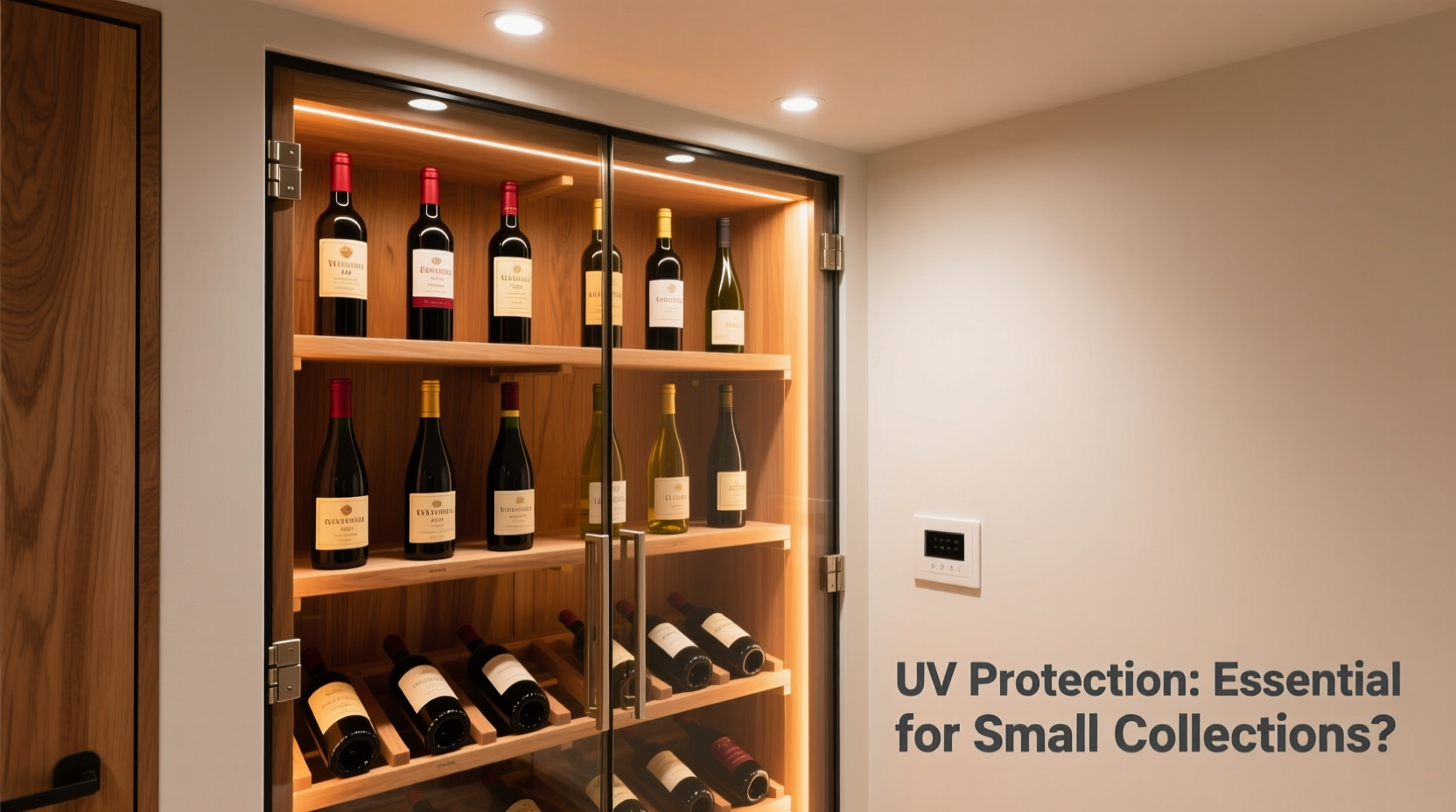
For many wine enthusiasts, building a personal collection begins modestly: a dozen bottles tucked under the stairs, six Bordeaux in a closet corner, or a temperature-stable nook beneath the kitchen island. As that collection grows—and as curiosity deepens—questions about preservation inevitably surface. One of the most frequently debated upgrades is UV-protected storage: cabinets, racks, or even custom-built wine fridges with UV-blocking glass or coatings. But does a household with 20–60 bottles truly need it? Or is this a luxury feature better suited to commercial cellars and serious investors?
The answer isn’t binary. It hinges on three interlocking realities: how light actually damages wine, what your environment looks like, and how long you intend to hold each bottle. This article cuts through marketing hype and anecdotal advice to deliver a practical, evidence-based assessment—grounded in oenology, materials science, and real-world experience from sommeliers, cellar managers, and home collectors who’ve tested both approaches.
How UV Light Actually Damages Wine (It’s Not Just About Heat)
Most people assume wine storage is primarily about temperature control—and rightly so. But ultraviolet (UV) radiation operates independently of heat and poses a distinct, insidious threat. Unlike infrared energy (which raises ambient temperature), UV photons carry enough energy to break molecular bonds in key wine compounds—especially in phenolics and aromatic precursors.
Research from the University of California, Davis’ Department of Viticulture and Enology confirms that exposure to UV-A (315–400 nm) and UV-B (280–315 nm) wavelengths triggers photochemical oxidation. This process degrades delicate esters and terpenes responsible for floral, citrus, and herbal notes—while simultaneously accelerating the formation of hydrogen sulfide and mercaptans, which yield “wet cardboard,” “skunk,” or “burnt rubber” aromas. Crucially, these changes occur *even at cellar temperatures* and *without visible browning* of the wine. A bottle stored at 13°C (55°F) but bathed in indirect daylight through a nearby window can develop detectable faults in as little as four weeks.
White and rosé wines are especially vulnerable due to lower tannin and pigment content—natural UV buffers found in reds. But don’t assume darker bottles offer full protection. Standard green glass blocks only ~30–40% of UV-B and ~70% of UV-A; amber glass performs better (~90% UV-B blocked), yet still transmits significant UV-A. Clear glass? Nearly transparent across the entire UV spectrum. And cork integrity matters less than commonly believed—light penetrates cork pores and interacts directly with wine near the ullage (the air gap at the top).
“Lightstrike isn’t theoretical—it’s one of the top three preventable causes of premature wine spoilage in domestic settings. I’ve tasted dozens of ‘freshly opened’ bottles from well-intentioned collectors that showed textbook light damage: muted fruit, flat acidity, and a persistent bruised apple note. All were stored in bright living areas or near windows.” — Dr. Lena Torres, Master of Wine and Senior Researcher, Australian Wine Research Institute
When UV Protection Delivers Real Value for Small Collections
UV-protected storage becomes more than an aesthetic upgrade when one or more of the following conditions apply:
- Your storage location receives any natural light—even filtered or reflected. North-facing rooms, interior shelves near skylights, or cabinets adjacent to sliding glass doors all qualify.
- You regularly store white, rosé, sparkling, or lighter reds (e.g., Pinot Noir, Gamay) for longer than 3–6 months. These styles lack the structural resilience of high-tannin, high-pigment wines like Cabernet Sauvignon or Syrah.
- You use clear or green-glass bottles—common among New World producers, natural wine labels, and many Champagnes.
- Your collection includes investment-grade or sentimental bottles intended for aging beyond two years, where subtle aromatic evolution matters.
- You live in a high-sunlight region (e.g., Arizona, Southern California, Mediterranean climates) where UV intensity remains elevated year-round—even on overcast days.
In these scenarios, UV protection isn’t precautionary—it’s preservative. It preserves not just drinkability, but intentionality: the ability to taste a wine as the winemaker envisioned it, at the moment you choose to open it.
Tip: If you’re unsure whether your current spot gets harmful light, conduct a simple test: place a UV-sensitive indicator card (available online for under $15) inside your storage area for 48 hours. If it darkens significantly, UV exposure is occurring—even without direct sun.UV Protection Options: What Works, What Doesn’t, and What’s Overkill
Not all UV-protected solutions deliver equal performance—or value—for a small collection. Below is a comparative analysis based on efficacy, cost, scalability, and practicality:
| Solution | UV Blocking Efficacy | Cost Range (USD) | Best For | Key Limitation |
|---|---|---|---|---|
| UV-filtering acrylic cabinet doors (e.g., polycarbonate with UV inhibitors) | 99%+ across UV-A/UV-B | $120–$450 (retrofit or built-in) | Wall-mounted racks, modular cabinets, DIY builds | Requires precise installation; scratches easily if uncoated |
| Dedicated wine fridge with UV-shielded glass | 95–98% (varies by brand & seal quality) | $800–$2,200 | Active collectors holding 30–100 bottles; multi-zone needs | Over-engineered for short-term storage; high energy use |
| Opaque, non-reflective storage boxes (corrugated fiberboard + matte black lining) | 100% (if fully sealed) | $15–$40 per box (holds 6–12 bottles) | Small rotating collections, seasonal storage, rentals | Reduces accessibility; no temperature regulation |
| Standard wooden cabinet with solid back panel + closed doors | ~90–95% (blocks ambient light, but not direct beam penetration) | $200–$600 (custom or premium ready-made) | Stable environments, mixed collections, aesthetic integration | Zero protection if doors are left open or poorly fitted |
| UV-blocking film applied to existing glass doors | 85–92% (depends on film grade & application) | $40–$120 (DIY) / $150–$300 (professional) | Retrofitting vintage cabinets or rental-friendly setups | Film degrades after 5–7 years; may yellow or bubble if low-grade |
Note: “UV-protected” claims on mass-market furniture often refer only to UV resistance of the cabinet’s *finish*, not its light-blocking capability for contents. Always verify technical specifications—not marketing language.
A Real-World Example: The Portland Collector’s Turnaround
Maya R., a graphic designer in Portland, Oregon, built a 42-bottle collection over five years—mostly Oregon Pinots, Alsatian Rieslings, and local sparkling wines. She stored them in a repurposed oak bookshelf beside a large north-facing window. Though the space stayed cool (12–15°C / 54–59°F year-round), she noticed a pattern: bottles opened after 8–12 months consistently lacked vibrancy. Her 2020 Willamette Valley Pinot showed muted strawberry notes and a faint vegetal tang—uncharacteristic for the producer. A local sommelier suggested a light exposure test. Using a UV meter, they confirmed 18 µW/cm² of UV-A radiation at bottle level during afternoon hours—well above the 5 µW/cm² threshold linked to measurable sensory change in sensitive whites and rosés.
Maya installed UV-filtering acrylic panels ($210) over her shelf’s front opening and added opaque black fabric liners behind bottles. Within three months, newly acquired bottles showed markedly brighter aromatics at 6 months. She also switched to storing all whites/rosés in matte-black cardboard boxes (reused shipping containers)—a zero-cost solution that delivered full opacity. Her conclusion: “I didn’t need a $1,500 fridge. I needed to stop treating my wine like books—something that just sits quietly. It needs darkness, like sleep.”
What You Can Do Right Now (A 4-Step Action Plan)
You don’t need to buy anything today to begin protecting your collection. Follow this sequence to assess risk and implement meaningful safeguards:
- Map your light exposure: Use your phone’s camera in manual mode (or a free light meter app) to record brightness levels at bottle height at 9 a.m., 1 p.m., and 5 p.m. for two consecutive days. Note reflections off walls, floors, or countertops.
- Identify your most vulnerable bottles: Prioritize whites, rosés, sparkling wines, and lighter reds aged beyond 6 months. Flag any in clear or green glass.
- Apply immediate low-cost barriers: Drape opaque fabric (black cotton, blackout curtain lining) over exposed racks. Slide bottles deeper into cabinets so labels face inward. Store vulnerable bottles horizontally inside sturdy cardboard boxes lined with matte black paper.
- Evaluate long-term fit: After 30 days, reassess. If you’ve eliminated noticeable light exposure and improved consistency in aroma/taste, your low-cost approach works. If you still see degradation—or plan to expand into age-worthy reds or fine Champagne—then invest in verified UV-blocking hardware.
FAQ: Addressing Common Concerns
Does LED lighting in my wine cabinet pose a UV risk?
Quality LED fixtures designed for wine storage emit negligible UV—typically less than 0.1 µW/cm² at 10 cm distance. However, cheap, unbranded LEDs (especially cool-white variants) may emit trace UV-A. When retrofitting, choose LEDs labeled “UV-free” or “wine-safe” and avoid spotlight-style bulbs focused directly on bottles.
Can I rely on keeping bottles in their original cardboard cases?
Yes—if the cases are intact, undamaged, and fully enclosed. Corrugated cardboard blocks >99% of ambient light. But avoid stacking cases in ways that compress flaps or create gaps. Also, never store cases directly on concrete floors (risk of moisture wicking) or in humid basements without vapor barriers.
Do screwcaps eliminate UV concerns compared to cork?
No. While screwcaps provide superior oxygen barrier properties, they do not shield against UV penetration. Light enters through the glass itself and interacts with wine molecules regardless of closure type. In fact, some studies suggest screwcapped wines may be *more* susceptible to lightstrike due to greater headspace consistency and absence of cork’s minor UV-absorbing lignins.
Conclusion: Clarity Over Cost, Intention Over Impulse
UV-protected wine storage isn’t about status—it’s about stewardship. For a small home collection, the question isn’t “Can I afford it?” but “Can I afford *not* to protect what I’ve chosen to keep?” The answer depends entirely on your environment, your wines, and your intentions. A $30 black box offers perfect protection for a case of summer rosé. A $400 UV-acrylic retrofit delivers precision control for a growing library of age-worthy bottles. Neither is universally “right”; both are rational when matched to need.
What matters most is moving beyond guesswork. Measure your light. Observe your wines. Taste critically—not just for pleasure, but for fidelity. That shift—from passive storage to active preservation—is where true value begins. Your collection reflects your taste, your travels, your memories. It deserves the same thoughtful attention you give to selecting each bottle in the first place.
💬 Have you experienced lightstrike—or solved it creatively? Share your setup, your lessons, and your favorite low-cost fix in the comments. Let’s build a smarter, more intentional community of home collectors—one bottle at a time.