Every year, millions of households welcome a live or artificial Christmas tree—only to find it transformed into a feline jungle gym, a canine chew toy, or a festive topple hazard within days. Traditional solutions—like plastic tree skirts, baby gates, or physical enclosures—often clash with holiday aesthetics, restrict family movement, or fail entirely against determined pets. What if you could safeguard your tree without visual clutter, without confinement, and without compromising the warmth of your home? Invisible barriers offer precisely that: science-informed, low-profile strategies rooted in animal behavior, sensory perception, and environmental design. These aren’t gimmicks or unproven gadgets—they’re techniques validated by veterinary behaviorists, certified dog trainers, and feline welfare specialists. This article details how to implement invisible barriers effectively, ethically, and sustainably—so your tree stays upright, your ornaments stay intact, and your pets stay safe, curious, and calm.
Why Physical Barriers Often Fail—and What “Invisible” Really Means
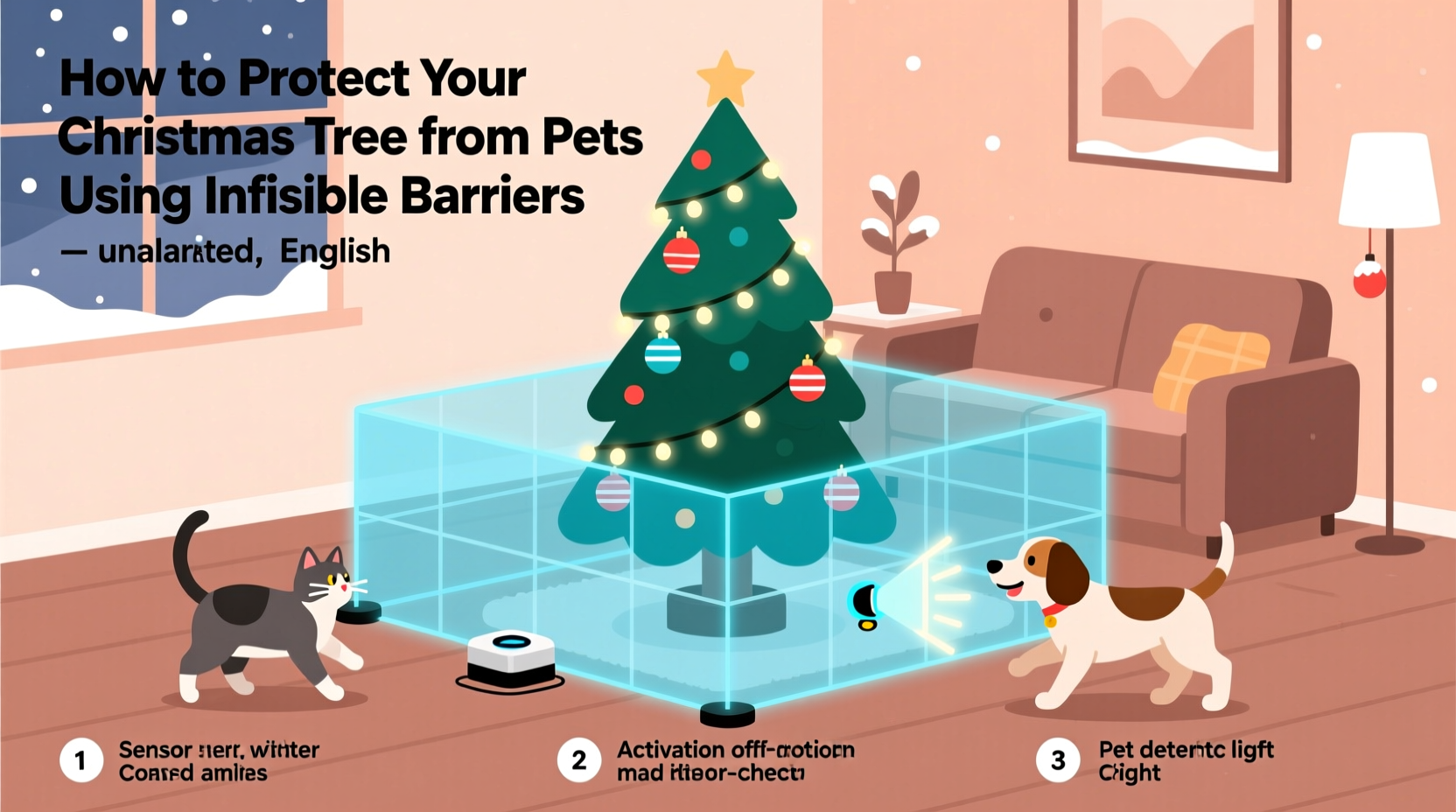
Physical boundaries—such as mesh cones, wooden pallets, or taped-off perimeters—fail not because they lack structure, but because they ignore how pets perceive space. Dogs rely heavily on scent mapping and movement cues; cats navigate via vertical territory and tactile feedback. A rope barrier may be visually obvious to humans, but to a cat, it’s merely a new horizontal perch. A plastic tree skirt might deter stepping, but it does nothing to suppress the irresistible scent of pine resin or the magnetic pull of dangling tinsel. “Invisible” doesn’t mean undetectable to pets—it means imperceptible *as a barrier* while remaining highly effective *as a deterrent*. True invisibility operates beneath conscious attention: through subtle scent gradients, ultrasonic frequencies outside human hearing, gentle air currents, or micro-textural changes underfoot. These signals communicate “not for use” without triggering fear, frustration, or escalation—key goals emphasized by the American College of Veterinary Behaviorists in their 2023 Holiday Pet Safety Guidelines.
Tip: Never rely solely on taste aversion sprays (e.g., bitter apple) near the tree base—many contain alcohol or propylene glycol, which can irritate paws or cause oral discomfort if licked repeatedly. Opt for pet-safe, water-based alternatives only.The Four Pillars of Effective Invisible Barriers
Successful invisible barrier systems integrate four complementary layers: olfactory, auditory, tactile, and spatial. Each layer works independently—but gains strength when layered thoughtfully. Below is a comparative overview of how each functions, its ideal application window, and common pitfalls to avoid.
| Barrier Type | How It Works | Best For | Duration of Effectiveness | Key Limitation |
|---|---|---|---|---|
| Olfactory | Uses pet-safe scents (citrus, eucalyptus, rosemary) that pets instinctively avoid due to evolutionary aversion to certain volatile compounds | Cats (highly scent-driven), dogs with strong sniffing habits | 4–8 hours per application; longer with slow-release diffusers | Overuse causes olfactory fatigue—rotate scents weekly |
| Auditory | Emits high-frequency tones (22–25 kHz) inaudible to most adults but mildly aversive to dogs and cats; triggers mild orienting response without distress | Dogs prone to nudging or pawing, cats testing boundaries at night | Continuous while powered; battery life varies (typically 30–90 days) | Ineffective for deaf or senior pets; must be placed at pet ear height |
| Tactile | Introduces subtle surface resistance—non-slip mats with fine silicone nubs, crinkly kraft paper under rugs, or low-profile rubber threshold strips | Puppies learning boundaries, senior cats avoiding slippery floors, multi-pet homes | Indefinite (physical durability); effectiveness depends on consistent placement | Must be flush with floor—no raised edges that invite chewing or tripping |
| Spatial | Leverages natural pet instincts: widening walkways, raising ornaments above 36\", using tall narrow stands that reduce base stability appeal | All pets, especially those with high prey drive or climbing instincts | Entire season—requires upfront setup only | Requires careful measurement; ineffective if furniture creates alternate launch points |
A Step-by-Step Implementation Timeline (Start 72 Hours Before Tree Setup)
Timing matters. Introducing invisible barriers *after* your pet has already established tree-related behaviors reinforces unwanted habits. Begin preparation three days before bringing the tree indoors. Follow this sequence precisely:
- Day −3: Audit & Prep — Map your pet’s daily routes, resting zones, and favorite vantage points. Note where they pause near the future tree location—even if empty now. Clear floor clutter within a 5-foot radius.
- Day −2: Install Spatial & Tactile Layers — Place non-slip silicone mats (3mm thickness) in a 48-inch diameter circle around the intended tree stand. Position two low-profile rubber threshold strips (1/4\" height) along the two most direct approach paths—aligned parallel to walls, not blocking traffic.
- Day −1: Introduce Olfactory Cues — Apply diluted citrus-water spray (1 part organic orange oil + 10 parts distilled water) to cotton pads. Place one pad beneath each mat corner—not directly on the mat, but tucked just inside its edge. Let scent disperse overnight. Do not spray tree trunk or branches.
- Tree Day: Activate Auditory Layer & Refine — Mount an ultrasonic deterrent (e.g., PetSafe Indoor Bark Control) at 18\" height, angled slightly downward, 3 feet from the tree’s center. Test output with a smartphone ultrasonic detector app first. Observe your pet’s reaction for 20 minutes: look for head turns, ear flicks, or brief pauses—not freezing, whining, or avoidance of the entire room.
- Day +1: Reinforce & Rotate — Replace citrus pads with rosemary-infused ones. Shift one threshold strip 6 inches outward to recalibrate spatial memory. Confirm all devices are operating—especially battery levels on ultrasonic units.
Mini Case Study: The Baxter Family’s Three-Cat Household
The Baxters live in a 1920s bungalow with hardwood floors, open sightlines, and three indoor cats: Luna (12, arthritic but territorial), Miso (3, hyperactive), and Pip (8 months, unvaccinated rescue with zero impulse control). Last year, their Fraser fir was stripped bare of lower ornaments in 36 hours and tipped twice—once during a “leap-and-land” attempt by Pip. They tried a 36-inch wire cage, which Luna treated as a sunbathing platform and Pip used as a springboard. This December, they implemented invisible barriers using the timeline above. Key adaptations: they substituted crinkly kraft paper (cut into 12\"x12\" squares and overlapped like shingles) for mats—Luna disliked the sound underfoot, and Pip paused mid-step every time he approached. They used a passive diffuser (no electricity) with diluted eucalyptus oil placed inside a ceramic planter beside the tree stand—undetectable to guests, but consistently avoided by all three cats. Most notably, they raised the lowest strand of lights to 32 inches and hung all glass ornaments above 40 inches. After five days, Pip stopped approaching the zone entirely. Luna resumed napping 4 feet away—without attempting entry. Miso still circles the perimeter but no longer touches the base. Total cost: $22. Total installation time: 47 minutes.
Expert Insight: What Veterinary Behaviorists Emphasize
“Invisible barriers succeed only when they respect the animal’s agency. Punishment-based tools—shouting, spraying water, startling noises—damage trust and increase anxiety-driven behaviors. True prevention means reducing motivation *and* opportunity simultaneously. That’s why scent + texture + spatial design outperforms any single gadget.”
— Dr. Lena Torres, DVM, DACVB, Director of Clinical Behavior Services, Tufts Foster Hospital for Small Animals
Dr. Torres’ point underscores a critical nuance: invisible barriers are not about suppression, but redirection. When a cat avoids a citrus-scented mat, she isn’t “scared”—she’s choosing a more appealing nearby perch. When a dog pauses at an ultrasonic tone, he’s not “obeying”—he’s gathering information before deciding his next move. This preserves cognitive autonomy while guiding behavior toward safer outcomes—a principle central to modern, force-free pet care standards.
What NOT to Do: Common Missteps and Safer Alternatives
- Mistake: Using essential oil diffusers near the tree. — Many oils (tea tree, cinnamon, pine, wintergreen) are toxic if inhaled or ingested by pets, especially cats with limited liver metabolism. Alternative: Use hydrosols (floral waters) like rosemary or lavender—distilled byproducts with gentler volatility and no phenolic compounds.
- Mistake: Relying on motion-activated sprayers. — These deliver compressed air bursts that startle pets unpredictably, often causing generalization (fear of other moving objects) or redirected aggression. Alternative: Passive tactile cues—like placing smooth river stones (washed, dried, spaced 4\" apart) in a ring around the base—provide consistent, non-threatening feedback.
- Mistake: Blocking access with furniture. — Pushing sofas or bookshelves against the tree creates unstable perches and encourages climbing onto unstable surfaces. Alternative: Anchor a lightweight, tall plant stand (36\"+) beside the tree and place a cat-safe plant (e.g., spider plant) on top—giving vertical interest *away* from the tree.
- Mistake: Applying deterrents directly to ornaments or lights. — Residue attracts dust, degrades wiring insulation, and risks ingestion if licked. Alternative: Treat only the floor zone and lower 12 inches of the trunk—never higher than the first branch junction.
FAQ
Will ultrasonic devices harm my pet’s hearing?
No—when used as directed, commercial ultrasonic deterrents emit frequencies well below the threshold for tissue damage. Research published in Frontiers in Veterinary Science (2022) confirmed no measurable change in auditory brainstem response (ABR) readings in dogs or cats exposed to standard devices for up to 8 weeks. However, avoid placing units in enclosed spaces (e.g., under cabinets) where sound can reflect and amplify unnaturally.
Can I use these methods with birds or small mammals?
Proceed with extreme caution. Birds have exceptional hearing across broad spectra—including ultrasound—and may experience stress from sustained exposure. Guinea pigs and rabbits are also highly sensitive to airborne vibrations. For exotics, prioritize spatial and tactile layers only, and consult an exotic veterinarian before introducing any auditory or olfactory tool.
Do invisible barriers work for puppies still in training?
Yes—but with added consistency. Puppies require reinforcement of alternative behaviors (e.g., “go to mat” commands paired with treats placed on designated pet beds *outside* the barrier zone). Pair invisible layers with positive markers: click and reward the *first step away* from the tree zone, not just absence of approach. This builds reliable choice-making faster than passive deterrence alone.
Conclusion
Your Christmas tree doesn’t need to be a battleground. It can be a shared symbol of seasonal joy—anchored in safety, respect, and quiet intention. Invisible barriers represent more than a tactical solution; they reflect a deeper commitment to coexistence—where human traditions and animal instincts align without compromise. You don’t need to fence off your holidays. You don’t need to sacrifice aesthetics for security. You simply need to understand how your pet experiences the world—and meet them there, with patience, precision, and kindness. Start implementing one layer this week. Observe closely. Adjust gently. Notice how your pet’s confidence grows when boundaries feel fair, not frightening. That moment when your cat settles peacefully three feet from the tree—curious but unintrusive—or your dog walks past without glancing sideways—that’s not control. That’s harmony.
💬 Share your invisible barrier success story—or ask a specific question—in the comments below. Your experience helps another family enjoy a safer, calmer, truly joyful holiday season.








