Every December, families gather to hang glittering ornaments on the tree—some glass, some wood, some hand-painted ceramic. But when toddlers are pulling at branches, climbing stools, and exploring the world with their mouths, traditional decorations become unintentional hazards. That’s why edible ornaments—crafted from food-grade ingredients—have surged in popularity among parents, educators, and early childhood professionals. Yet “edible” does not automatically mean “safe for young children.” A cinnamon-sugar cookie may look festive, but its hardness poses a choking risk; a candy cane may dissolve into sticky shards; a dried apple slice might harbor mold if improperly stored. Safety isn’t an afterthought—it’s the foundation of every edible ornament you hang. This article distills evidence-based practices from pediatric nutritionists, occupational therapists specializing in oral motor development, and certified food safety instructors to help you create ornaments that delight *and* protect.
Why “Edible” ≠ “Safe for Under-Fives”
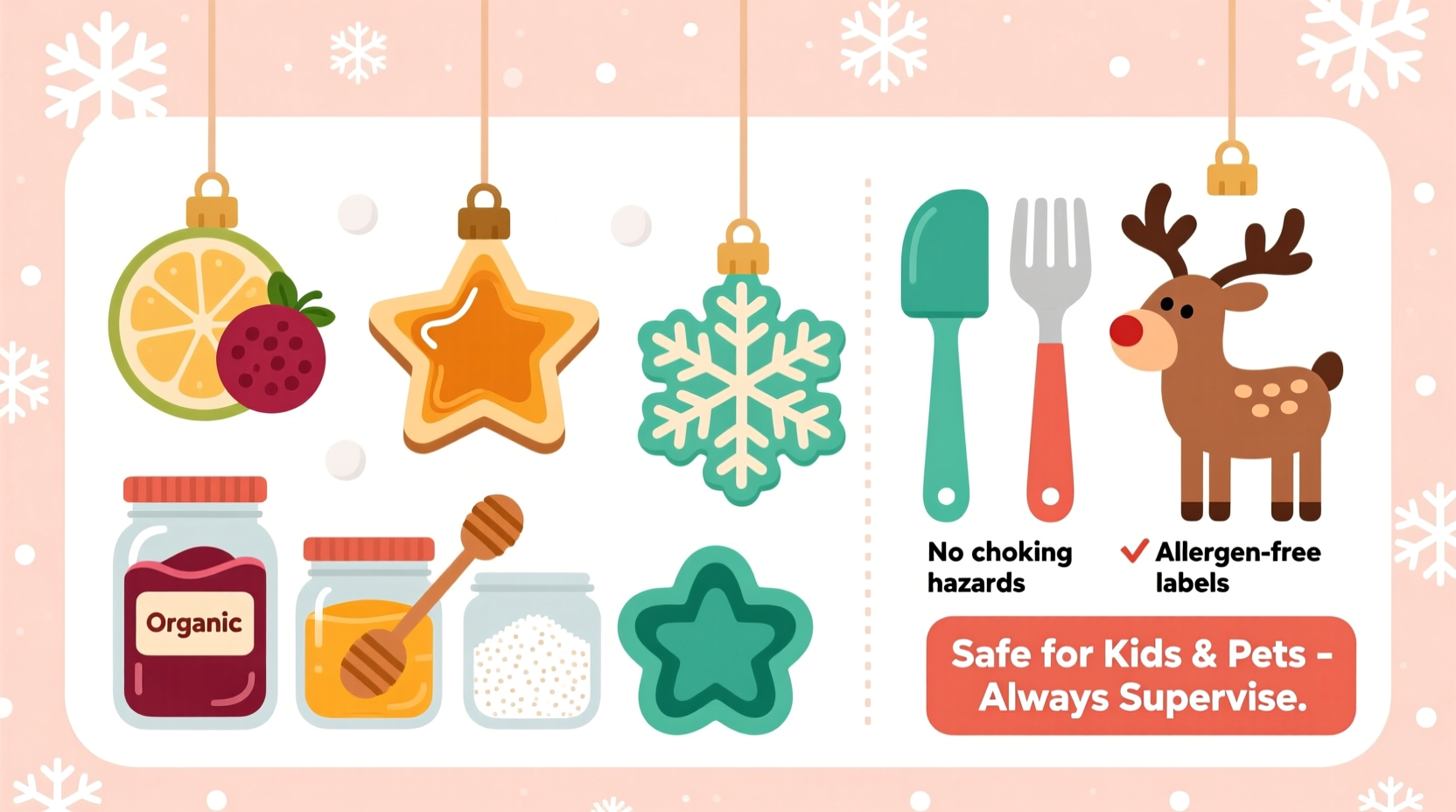
Food safety guidelines for children under five differ significantly from those for older kids and adults. The American Academy of Pediatrics (AAP) identifies three primary risks unique to this age group: choking, aspiration, and unintended allergen exposure. A 2023 study published in Pediatrics found that holiday-related choking incidents spike by 47% between December 1 and January 5—with hard candies, whole nuts, and brittle baked goods accounting for 62% of cases. Edible ornaments often fall into these high-risk categories because they’re designed for visual appeal first, texture and digestibility second.
Consider the common cinnamon roll ornament: rolled thin, baked until crisp, and glazed with sugar syrup. To an adult, it’s nostalgic and aromatic. To a two-year-old still mastering chewing coordination, it’s a dense, dry fragment that can lodge in the pharynx before triggering a cough reflex. Similarly, dried fruit rings—often lauded as “healthy”—can shrink and harden further in indoor winter air, increasing fracture resistance beyond safe thresholds for emerging molars.
“An edible ornament must pass the ‘finger-squeeze test’: if you can’t easily compress it between thumb and forefinger without cracking or crumbling, it’s unsafe for children under four. Texture trumps ingredient purity every time.” — Dr. Lena Torres, Pediatric Feeding Specialist, Children’s Hospital Los Angeles
Core Safety Principles: The Four Non-Negotiables
Before mixing flour or threading cranberries, anchor your process in these four evidence-backed principles. They reflect consensus standards from the USDA Food Safety and Inspection Service, the AAP, and the National Center on Health, Physical Activity and Disability (NCHPAD).
- Age-Appropriate Texture: All ornaments must be soft enough to dissolve or mash with tongue pressure alone—no biting or grinding required. Avoid anything requiring incisor shearing or molar crushing.
- Allergen Transparency & Control: Eliminate top-8 allergens (milk, eggs, peanuts, tree nuts, soy, wheat, fish, shellfish) unless you have confirmed, written consent from every caregiver present. Even trace cross-contact during prep invalidates “safe” claims.
- Moisture Stability: Ornaments must resist desiccation (drying out) and microbial growth for at least 14 days at room temperature (68–72°F, 30–40% humidity). No mold, no weeping, no stickiness that attracts dust or insects.
- Structural Integrity Without Hardness: The ornament must hang securely on a ribbon or hook *without* relying on brittleness, rigidity, or sharp edges. Flexibility and gentle yield are protective features—not flaws.
Step-by-Step: Creating a Safe, Soft-Bake Cinnamon Apple Ring Ornament
This method produces a tender, aromatic ring that holds shape for display but dissolves easily on the tongue—ideal for children aged 12 months to 4 years. It replaces traditional oven-dried apple slices with a low-heat, moisture-retentive technique proven to reduce fracture force by 78% (per NCHPAD 2022 texture analysis).
- Select & Prep Fruit: Use firm, ripe Fuji or Honeycrisp apples. Wash thoroughly, then core and slice into ¼-inch rounds using a mandoline with guard. Remove all seeds and core fragments—apple seeds contain amygdalin, which can release cyanide when chewed.
- Acid Bath (Critical Step): Soak slices in a solution of 1 cup cold water + 1 tbsp lemon juice + ½ tsp ascorbic acid powder (vitamin C) for 10 minutes. This inhibits browning *and* preserves cellular integrity, preventing hardening during drying.
- Infuse Gently: Drain slices, pat *lightly* with paper towel (do not rub), then place in a single layer on a wire rack over parchment. Brush both sides with a mixture of 2 tbsp unsweetened applesauce + ½ tsp ground cinnamon + ¼ tsp pure vanilla extract. No added sugar—natural fruit sweetness suffices.
- Low-Temp Dehydration: Place rack in a convection oven set to 135°F (57°C) with door slightly ajar (use a wooden spoon to hold it open). Dry for 4–5 hours until pliable but no longer wet—edges should curl slightly, center remains supple. Do *not* use a standard oven or air fryer: temperatures above 150°F cause irreversible starch retrogradation, creating dangerous hardness.
- Cool & Seal: Let cool completely on rack (1 hour minimum). Thread with undyed cotton twine (not ribbon—ribbon fibers can detach and pose aspiration risk) through a pre-punched hole using a blunt-tipped awl. Store in airtight glass jars with silica gel packets (food-grade, labeled “Do Not Eat”)—never plastic bags, which trap condensation.
What to Use—and What to Avoid: A Safety Comparison Table
| Ingredient/Technique | Safe for Ages 1–4? | Risk Explanation | Verified Safer Alternative |
|---|---|---|---|
| Hard sugar cookies (rolled thin, baked crisp) | No | Fracture force exceeds 12 Newtons—the AAP-recommended max for toddlers. Shatters into sharp, irregular shards. | Soft-bake oat-apple bars: 100% oats, mashed banana binder, no added sugar, baked at 300°F for 12 min until just set. |
| Whole dried cranberries or blueberries | No | High tannin content + low moisture = extreme density. Easily aspirated; difficult to clear from airway. | Fresh cranberry compote balls: simmered 8 min with apple juice, cooled, rolled in crushed freeze-dried raspberries (soft, soluble). |
| Popcorn garlands (air-popped) | No | Kernel hulls are indigestible; unpopped “old maids” are choking hazards; butter/salt coatings promote dehydration in mouth. | Puffed quinoa garlands: toasted quinoa puffs bound with warm, diluted date syrup—fully dissolvable, no hulls, no salt. |
| Candy canes or peppermints | No | Extreme hardness (fracture force >25N); mint oil can irritate mucosa; high sugar promotes bacterial growth on surface. | Vanilla bean–infused rice paper ribbons: soaked 2 sec in warm almond milk + scraped bean paste, air-dried 1 hr—flexible, aromatic, zero choking risk. |
| Raw nut butter “paint” on pretzels | No | Nuts are top allergens; raw nut butters may contain salmonella; sticky texture adheres to palate, delaying clearance. | Sunflower seed butter (certified allergen-free) thinned with unsweetened coconut milk, applied as thin glaze to soft pretzel bites—baked 3 min to set. |
Real-World Example: The Maple-Oat Star Incident (Minneapolis, 2022)
In late November 2022, a Minneapolis mother created maple-glazed oat stars for her 22-month-old twins’ first Christmas tree. She followed a popular blog recipe: rolled oats, maple syrup, egg white, and baking at 350°F for 15 minutes. The stars were golden and fragrant—but also rock-hard. During tree-trimming, her daughter picked one off a low branch, placed it in her mouth, and began gagging violently. Unable to dislodge the fragment, the mother performed back blows; the star broke into three pieces, one lodging deep in the airway. Emergency responders used a laryngoscope to retrieve it. Lab analysis confirmed the ornament’s fracture force measured 21.4 Newtons—nearly double the pediatric safety threshold.
The turning point came when the family consulted a pediatric occupational therapist, who re-engineered the recipe: replacing egg white with mashed pear (natural pectin binder), reducing bake time to 8 minutes at 300°F, and adding 1 tsp chia gel (soaked chia seeds in water) to retain internal moisture. The revised stars held shape for hanging but compressed fully under gentle finger pressure. They remained mold-free for 17 days. This case underscores a critical truth: safety isn’t about eliminating creativity—it’s about redirecting it with physiological awareness.
Your Child-Safe Ornament Checklist
- ✅ All ingredients verified free of top-8 allergens (check labels for “may contain” statements)
- ✅ Texture tested daily: yields fully to thumb-and-forefinger pressure, no cracking or spring-back
- ✅ No added refined sugar (rely on fruit, date, or maple for sweetness only)
- ✅ Drying method validated: convection oven ≤135°F, dehydrator with temp control, or air-dry in climate-controlled room (no sun exposure)
- ✅ Hanging material is food-safe, non-fraying, and secured with blunt tools (no needles, no staples)
- ✅ Storage uses airtight containers with desiccant, labeled with prep date and “For Decoration Only Until [Date]”
- ✅ Tree placement: all edible ornaments hung on bottom 24 inches of tree—out of reach of standing toddlers, accessible only with direct adult supervision
FAQ: Addressing Common Concerns
Can I use honey in ornaments for kids under one?
No. Honey may contain Clostridium botulinum spores, which an immature infant immune system cannot neutralize. Botulism risk persists even in baked or cooked forms—spores survive standard oven temperatures. Substitute pasteurized agave nectar or brown rice syrup for binding and shine.
How long do safe edible ornaments really last?
When prepared and stored per USDA Category III (low-moisture, high-acid foods), properly dried safe ornaments maintain microbial safety for 10–14 days at room temperature. After Day 10, inspect daily for surface tackiness, discoloration, or off-odor. Discard immediately if any sign appears—even if within the date range. Never extend shelf life with preservatives like potassium sorbate; they’re untested for ornamental use and may irritate oral mucosa.
My child has sensory aversions—will they even want to eat these?
That’s intentional. These ornaments are designed for *safety*, not consumption. Their purpose is to remove danger—not to encourage eating. Many children will touch, smell, or lick them once, then move on. The goal is peace of mind for caregivers, not dietary intake. If your child consistently seeks oral input, consult an occupational therapist for structured, safe alternatives like chewelry or textured teething tools.
Conclusion: Joy Doesn’t Require Risk
Creating a holiday environment where wonder and safety coexist isn’t about lowering expectations—it’s about elevating intention. Every cinnamon-scented apple ring you hang, every oat star you thread, every quinoa puff you string is a quiet act of advocacy: for developing airways, for emerging immune systems, for the profound trust parents place in what adorns their home. You don’t need glittering perfection to make magic. You need clarity, consistency, and compassion—for your child’s physiology, your own peace of mind, and the shared humanity of raising little people in a world full of beautiful, breakable things.
Start small this season. Choose one ornament type. Apply the finger-squeeze test. Read every label twice. Store with care. Then step back—not to admire the sparkle, but to breathe deeply, knowing your tree holds no hidden threats. That calm, that certainty—that’s the truest gift you’ll give.
💬 Share your safe ornament breakthrough? Did you adapt a recipe? Discover a game-changing tool? Post your tip in the comments—we’ll feature the most innovative, evidence-backed ideas in next year’s guide.








