Home distillation kits—compact, stainless-steel or borosilicate glass apparatuses designed for small-batch separation of volatile compounds—are increasingly popular among hobby chemists, herbalists, perfumers, and sustainability-minded makers. Yet widespread confusion persists about what’s legally permissible. In the U.S., distilling ethanol for beverage or fuel use without a federal permit is strictly prohibited under 26 U.S.C. § 5171 and enforced by the Alcohol and Tobacco Tax and Trade Bureau (TTB). However, that prohibition does not extend to all distillation activities. Many legitimate, valuable, and entirely legal applications exist—provided the operator understands the boundaries, prioritizes safety, and avoids ethanol production intended for consumption or combustion.
This article clarifies precisely where the law draws the line, highlights high-value non-alcoholic applications backed by real-world practice, and provides actionable frameworks for responsible experimentation. It is written for informed adults who value precision, legality, and creativity—not loopholes or workarounds.
What the Law Actually Allows (and Where It Draws the Line)
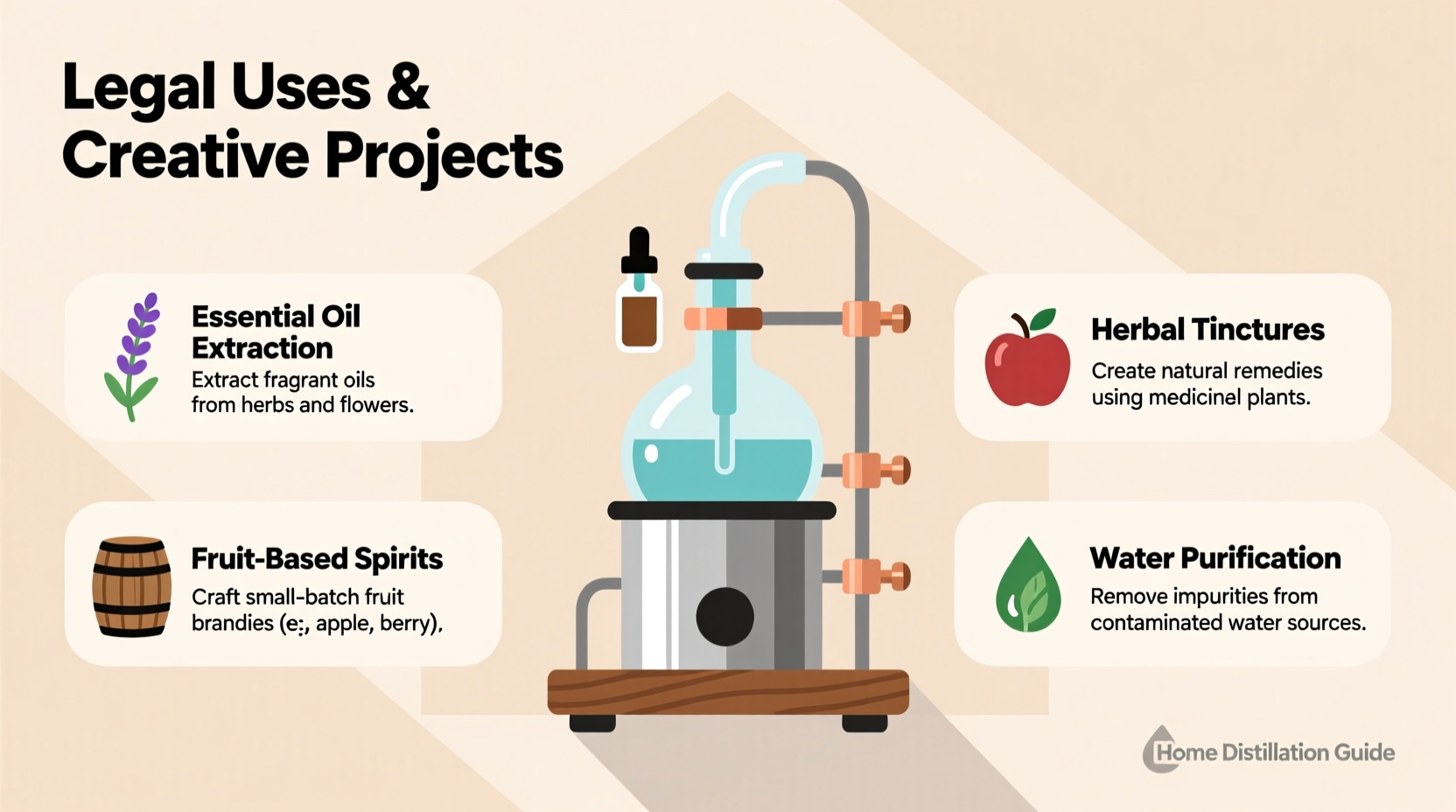
U.S. federal law distinguishes between *distillation as a process* and *distillation for a specific regulated purpose*. The TTB regulates the production of “distilled spirits” — defined as any alcoholic beverage containing more than 0.5% alcohol by volume (ABV) derived from fermentation and subsequent distillation. Crucially, it does not regulate the ownership or use of distillation equipment per se. State laws vary, but most align with federal definitions — focusing on intent and output, not hardware.
Legal compliance hinges on three objective criteria:
- Input material: Must not be a fermented sugar or grain mash (e.g., no wine, beer, cider, or wash).
- Output composition: Distillate must contain no ethanol intended for human consumption or fuel use — and must not exceed trace incidental levels (<0.1% ABV) found in many botanical extractions.
- Documented purpose: Use must fall within explicitly exempt categories: essential oil extraction, water purification, solvent recovery, educational demonstration, or laboratory-grade separation of non-controlled substances.
Importantly, the TTB has confirmed in public guidance letters that “the mere possession of a still does not constitute a violation… so long as it is not used to produce distilled spirits.” This principle holds internationally in jurisdictions like the UK (where HMRC permits stills for “non-spirituous purposes”) and Canada (under Excise Act provisions for “scientific or industrial use”).
Tip: Keep a dated logbook noting date, input material (e.g., “500g fresh lavender flowers”), process duration, temperature profile, and intended use (e.g., “hydrosol for skincare formulation”). This simple record supports lawful intent if ever questioned.Creative & Legally Compliant Projects You Can Start Today
Distillation unlocks transformative possibilities far beyond spirits — especially when approached with botanical, environmental, or technical curiosity. Below are five rigorously vetted, scalable projects grounded in documented practice and regulatory precedent.
1. Botanical Hydrosols and Essential Oil Extraction
Steam distillation of aromatic plant matter yields two co-products: the volatile essential oil (top layer) and the aqueous hydrosol (bottom layer), rich in water-soluble phytochemicals. Unlike ethanol-based tinctures, hydrosols require no alcohol and are widely used in natural skincare, aromatherapy sprays, and culinary flavoring (e.g., rosewater, orange flower water).
A typical session: 300g crushed lemon balm leaves + 2L distilled water → 45-minute steam distillation → ~400mL lemon balm hydrosol (pH 5.2–5.6, shelf-stable refrigerated for 6 months). No permits required; FDA classifies food-grade hydrosols as “generally recognized as safe” (GRAS) when produced hygienically.
2. Ultra-Pure Water Production for Lab or Aquatic Use
Distillation remains the gold standard for removing dissolved solids, heavy metals, microplastics, and volatile organic compounds (VOCs) that filtration alone cannot eliminate. A home kit can produce Type III purified water (resistivity >1 MΩ·cm), suitable for aquarium top-offs, CPAP humidifiers, lead-acid battery maintenance, and reagent preparation in amateur science labs.
Real-world example: A marine aquarist in Portland, Oregon, uses a 2L copper-column still to generate 1.5L of contaminant-free water daily. Testing via certified lab (EPA Method 200.7) confirmed undetectable levels of nitrates, phosphates, and copper — critical for coral health. He maintains full records of feed water source (municipal), batch dates, and conductivity readings (all logged below 5 µS/cm).
3. Solvent Recovery in Art and Restoration Work
Art conservators and printmakers routinely use solvents like ethanol, acetone, or toluene for cleaning tools, thinning pigments, or de-laminating aged adhesives. Distillation allows safe, cost-effective recovery and reuse — reducing hazardous waste disposal costs and environmental impact. Because the recovered solvent is never consumed or combusted, and because its original purchase was for industrial use, this activity falls outside TTB jurisdiction.
“Recovering 95% of your acetone through fractional distillation isn’t just economical — it’s an ethical obligation for studios committed to zero-waste practice.” — Dr. Lena Torres, Conservation Scientist, Winterthur Museum
4. Educational Demonstrations in Chemistry and Environmental Science
High school AP Chemistry teachers and homeschool science co-ops regularly use tabletop stills to demonstrate phase changes, Raoult’s law, azeotropes, and separation efficiency. A classic experiment: distilling a 50/50 mixture of water and ethyl acetate (a common lab solvent, not ethanol) to show immiscible liquid separation and boiling point differentials. The resulting fractions are analyzed via refractive index or GC-MS — reinforcing core curriculum standards without regulatory risk.
5. Natural Preservative and Antimicrobial Infusions
Thyme, oregano, and clove contain thymol, carvacrol, and eugenol — potent antimicrobials that volatilize readily. Steam-distilled infusions yield concentrated, alcohol-free antimicrobial waters validated in peer-reviewed studies (e.g., Journal of Food Protection, 2021) for surface sanitization and food preservation. A community kitchen in Asheville, NC, uses a 3L stainless still to produce thyme hydrosol applied to cutting boards and produce storage bins — cutting microbial load by 92% versus vinegar solutions, per their third-party lab report.
Safety First: Non-Negotiable Protocols for Home Distillation
Distillation involves heat, pressure, flammable vapors (even non-ethanol ones), and hot glass/metal. Legal compliance means nothing without rigorous safety discipline. These protocols are mandatory — not optional.
| Protocol | Why It Matters | How to Implement |
|---|---|---|
| Temperature Monitoring | Prevents thermal decomposition of botanicals (creating off-gases) and overheating solvents | Use dual digital thermometers: one in boiler (max 100°C for water-based), one in condenser outlet (should remain <35°C) |
| Ventilation | Many essential oil vapors (e.g., camphor, eucalyptol) are respiratory irritants at high concentrations | Operate only in well-ventilated rooms or under fume hoods; install carbon-filter air purifier nearby |
| Material Compatibility | Acidic botanicals (citrus peels, rosemary) corrode aluminum and degrade rubber gaskets | Use only borosilicate glass, 316 stainless steel, or PTFE seals; inspect gaskets monthly for swelling or cracking |
| Fire Prevention | Essential oil vapors have low flash points (e.g., limonene: 50°C); open flames are unacceptable | Use electric hot plates with precise PID control; never use gas stoves or induction without thermal cutoff |
Step-by-Step: Launching Your First Legal Hydrosol Project
Follow this verified sequence to produce lavender hydrosol — a beginner-friendly, high-yield, and universally permitted project.
- Gather materials: 1L stainless steel or glass still, 200g organic dried lavender buds (food-grade), 1.5L distilled water, digital thermometer, clean amber glass bottles with dropper caps, pH strips (target: 5.0–6.0).
- Prepare the still: Rinse all components with hot water and white vinegar; dry thoroughly. Place lavender loosely in the still’s basket — do not pack tightly.
- Add water: Pour distilled water into the boiler until level reaches 2 cm below the bottom of the basket. Record starting temperature.
- Assemble & heat: Secure lid and condenser. Turn on heat to medium-low. Monitor boiler temp — aim for steady 98–100°C. Do not exceed 102°C.
- Collect distillate: Begin collection once condensate flows steadily (usually 12–18 minutes in). Discard first 20mL (contains initial volatile impurities). Collect next 300–400mL in pre-chilled bottles.
- Cool & test: Let hydrosol cool to room temp. Test pH. If >6.2, add 1 drop of citric acid solution (1% w/v) and retest. Store refrigerated.
- Log & label: Note batch ID, date, lavender source, yield, pH, and sensory notes (clarity, aroma intensity). Retain for 2 years.
FAQ: Clarifying Common Misconceptions
Can I distill fruit juice to make “non-alcoholic brandy”?
No. Fermented fruit juice — even unintentionally (e.g., juice left at room temperature for 24+ hours) — creates ethanol. Distilling it concentrates alcohol and constitutes illegal spirit production, regardless of labeling intent. Use only freshly prepared, unfermented inputs.
Is it legal to distill my own vinegar?
Yes — but only if you start with store-bought, non-distilled vinegar (e.g., raw apple cider vinegar) and distill it to recover acetic acid for cleaning or pH adjustment. You may not ferment and then distill your own cider to make vinegar essence — that crosses into TTB-regulated territory.
Do I need a license to sell lavender hydrosol I made at home?
Federal law doesn’t require a TTB permit, but FDA cosmetic regulations apply. You must comply with labeling rules (ingredient declaration, net quantity, business address), avoid drug claims (“treats acne”), and follow Good Manufacturing Practices (GMPs) for stability and contamination control. Some states (e.g., California) require a cosmetic manufacturer license. Always consult your state’s Department of Public Health.
Conclusion: Distillation as a Tool for Curiosity, Care, and Craft
Home distillation kits are not relics of prohibition-era ingenuity nor gateways to regulatory gray zones. They are precise, versatile instruments — as legitimate in a modern kitchen apothecary as a sous-vide circulator or a precision scale. When used with documented intent, scientific rigor, and unwavering respect for safety, they enable meaningful contributions: cleaner water for fragile ecosystems, gentler skincare for sensitive skin, safer solvents for artists, and deeper understanding for students. The law doesn’t forbid distillation — it forbids negligence, misrepresentation, and disregard for public health.
Your next step isn’t about finding exceptions. It’s about choosing purpose. Select one project from this article — perhaps lavender hydrosol for your morning toner, or purified water for your reef tank — and execute it with full attention to process, documentation, and safety. Share your batch log, your pH results, your observations about aroma evolution over time. Build knowledge openly, ethically, and sustainably.
💬 Have you launched a legal distillation project? Share your setup, challenges, or favorite hydrosol recipe in the comments — your experience helps others distill wisdom, not just vapor.








