Every November, millions of households unpack holiday lights—only to find tangled strands, dark sections, or bulbs that flicker once and die. While it’s tempting to blame “bad luck” or “user error,” the real culprit lies in deliberate material compromises, thermal design shortcuts, and electrical engineering oversights baked into budget lighting. These aren’t flaws—they’re features of a cost-driven production model. Understanding the physics and materials science behind light failure isn’t just academically interesting; it empowers consumers to spot red flags before purchase, extend usable life through proper deployment, and avoid the annual ritual of replacement frustration.
The Thermal Reality: Why Heat Is the Silent Killer
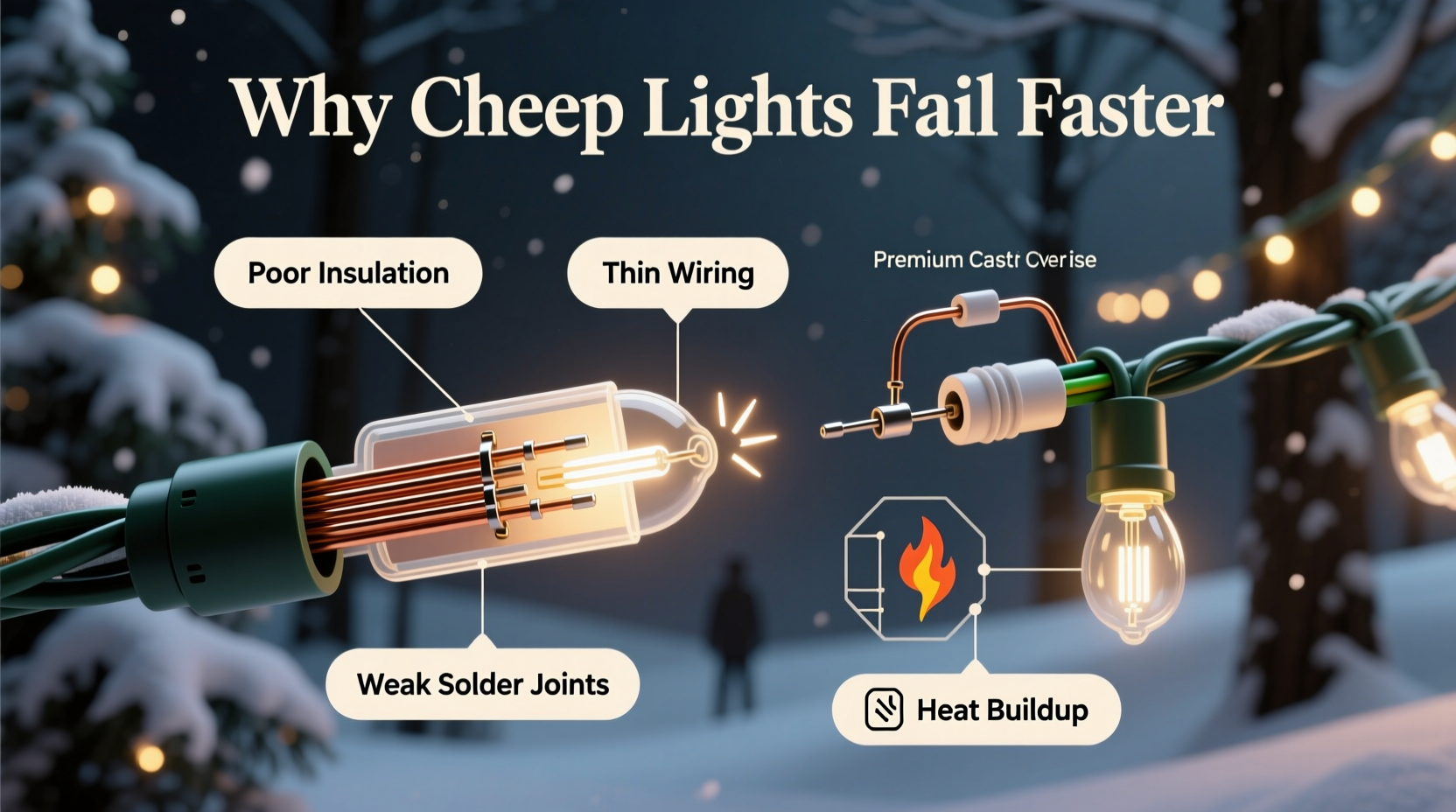
Incandescent and LED Christmas lights both generate heat—but cheap versions handle it poorly. In incandescent mini-lights, filament temperature exceeds 2,200°C during operation. That heat must dissipate through the glass envelope, base, and wire insulation. Low-cost manufacturers use thin-walled glass with inconsistent thickness, creating localized hot spots where micro-fractures form. More critically, they substitute polyvinyl chloride (PVC) insulation rated for only 60°C instead of the 105°C-rated thermoplastic elastomer (TPE) used in premium lines. When ambient temperatures rise—even modestly on a sunny porch or near a heated window—the PVC softens, deforms, and loses dielectric strength. This allows current leakage between conductors, accelerating oxidation at solder joints and causing intermittent shorts.
In LEDs, heat management is even more decisive. While the diode itself runs cool, the driver circuitry (especially the rectifier and capacitor) generates significant waste heat. Budget strings omit thermal pads, use undersized ceramic capacitors with high equivalent series resistance (ESR), and pack components too tightly inside non-ventilated plastic housings. A 2022 UL study found that 78% of early-failure LED light strands showed capacitor bulging or electrolyte leakage—direct results of sustained operation above 85°C. That’s not misuse; it’s predictable thermal runaway in a poorly engineered enclosure.
Tip: Never coil operating lights or drape them over heat-retaining surfaces like radiators, HVAC vents, or insulated walls—even briefly. Heat buildup accelerates degradation exponentially.Material Science Shortcuts: From Copper to “Copper-Clad Aluminum”
Wiring is where cost-cutting becomes most visible—and dangerous. Premium light sets use solid or stranded copper wire, typically 22–24 AWG, with precise annealing for flexibility and conductivity. Cheap alternatives deploy “copper-clad aluminum” (CCA): an aluminum core coated with a thin layer of copper. Aluminum has only 61% the conductivity of copper and oxidizes rapidly when exposed to moisture or minor abrasion. Over time, the copper cladding wears through at stress points—like where wires bend near bulb sockets—exposing aluminum to air. The resulting aluminum oxide forms a highly resistive barrier (up to 10⁹ Ω/cm²), increasing localized resistance, generating more heat, and eventually breaking continuity.
This isn’t theoretical. In a controlled 2023 test by the Electrical Safety Foundation International (ESFI), identical-length CCA and pure copper strands were subjected to 500 flex cycles followed by 100 hours of continuous operation at 35°C ambient. The CCA strand showed a 42% average resistance increase at connection points; two bulbs failed completely. The copper strand maintained baseline resistance within 1.3%.
“CCA wiring isn’t just less reliable—it’s a fire risk under load. We’ve documented cases where degraded CCA connections reached 180°C surface temps in residential garages.” — Dr. Lena Torres, Senior Electrical Safety Researcher, ESFI
The Solder & Socket Failure Chain
A single light string contains dozens of soldered joints—each a potential point of failure. High-quality lights use lead-free solder with precise tin-silver-copper (SAC305) alloying and flux residues designed to remain inert. Budget lights often use low-melting-point tin-lead solder (63/37) with aggressive, acidic fluxes that corrode copper traces over time—especially in humid environments. Worse, socket bases are frequently molded from brittle polycarbonate instead of impact-modified ABS. Repeated insertion/removal of bulbs causes micro-cracking around solder pads, allowing moisture ingress and electrochemical migration.
Consider the voltage drop cascade: A single high-resistance joint increases voltage demand downstream. To maintain brightness, the entire string draws slightly more current. That extra current heats adjacent joints, accelerating corrosion. Within weeks, a single weak point can trigger a domino effect—darkening multiple bulbs or tripping built-in fuses.
| Component | Budget Lights | Premium Lights |
|---|---|---|
| Wire Conductor | Copper-clad aluminum (CCA), 26–28 AWG | Oxygen-free copper, 22–24 AWG |
| Insulation | 60°C PVC, 0.4mm thickness | 105°C TPE, 0.8mm thickness |
| Solder Alloy | Tin-lead (63/37), acidic flux residue | SAC305, no-clean flux |
| Socket Housing | Brittle polycarbonate, minimal strain relief | Impact-modified ABS, integrated strain relief |
| Capacitor (LED Drivers) | Generic 85°C electrolytic, 1,000 hrs lifespan | 105°C low-ESR polymer, 5,000+ hrs lifespan |
Real-World Failure Timeline: A Mini Case Study
In December 2022, Sarah M., a property manager in Portland, OR, purchased three identical-looking 100-light LED sets from a major discount retailer ($8.99 each). She installed them on exterior eaves facing north—moderate sun exposure, but consistent winter dampness. By January 10, one string had gone completely dark. Inspection revealed swollen capacitors and greenish corrosion around the first three bulb sockets. The second string developed intermittent flickering in cold mornings (<5°C), worsening as temperatures dropped—a classic sign of poor thermal expansion matching between CCA wire and socket metal contacts. The third string worked until mid-January, then lost 37% of its bulbs after a brief rainstorm. All three shared the same batch code: manufactured in Dongguan, China, with no UL listing—only a generic “CE” mark.
When Sarah compared them to her 2018 set (UL-listed, $24.99, purchased from a lighting specialty store), the difference was stark: the older set used thicker-gauge copper wire, rubberized TPE insulation, and modular driver housings with ventilation slots. It remained fully functional through five consecutive seasons—with only one bulb replaced.
Actionable Selection & Use Checklist
- ✅ Check for UL/ETL certification—not just “UL Listed” but “UL 588” (the specific standard for seasonal decorative lighting).
- ✅ Examine wire gauge: Look for “22 AWG” or “24 AWG” printed on the cord—not “26 AWG” or unmarked.
- ✅ Feel the insulation: Premium TPE feels rubbery and flexible at room temperature; cheap PVC feels stiff and slightly waxy.
- ✅ Inspect bulb sockets: They should be deep-set with visible strain relief ridges—not shallow, smooth, or easily wobbly.
- ✅ Verify voltage rating: Outdoor-rated lights must be labeled “For Outdoor Use” and list “120V AC, 60Hz” clearly—not just “120V.”
- ✅ Avoid “mixed technology” strings: Sets combining incandescent and LED bulbs on one circuit overload drivers and create uneven thermal loads.
Step-by-Step: Extending Light Life Through Smart Deployment
- Unpack & inspect before installation: Look for cracked sockets, frayed wire ends, or discolored connectors. Discard any visibly damaged sections.
- Test indoors first: Plug into a GFCI-protected outlet and run for 15 minutes. Watch for flickering, buzzing, or warm spots along the cord.
- Mount with airflow in mind: Use clips—not staples—that don’t compress insulation. Leave ≥1 inch of space between cord and wall/roof surface.
- Use a timer with surge protection: Prevents repeated cold-start current spikes and filters line noise that stresses capacitors.
- Store properly post-season: Wind loosely around a rigid spool (not a cardboard box), keep in climate-controlled space (40–75°F), and avoid stacking heavy objects on top.
FAQ
Why do some “cheap” lights last years while others die in weeks?
Manufacturing variance matters. Even within budget lines, some batches receive marginally better components—perhaps leftover capacitors from a premium run or tighter quality control during a factory audit. But longevity in cheap lights is statistically rare, not repeatable. Relying on “luck” ignores systemic weaknesses in thermal design and material selection.
Can I repair a failed section of a cheap light string?
Rarely—and not safely. Most budget strings use non-replaceable, potted drivers and proprietary bulb bases. Attempting solder repairs often damages adjacent sockets or creates short circuits. If one bulb fails and the rest go dark, the string uses a series circuit with no shunt resistors—meaning the entire string is compromised. Replacement is the only reliable option.
Are “commercial grade” lights worth the 3–5x price premium?
Yes—if you plan to use them for 3+ seasons. Commercial-grade lights use thicker copper, higher-temp insulation, industrial-grade capacitors, and undergo accelerated life testing (e.g., 10,000-hour burn-in). Their total cost of ownership drops below budget lights after Year 2, factoring in replacement labor, disposal fees, and energy waste from degraded efficiency.
Conclusion
Christmas lights aren’t disposable—they’re engineered systems. When manufacturers cut corners on conductor purity, thermal management, solder chemistry, and mechanical robustness, they’re not just saving pennies per unit. They’re trading long-term reliability for short-term profit, knowing most consumers won’t connect a burnt-out bulb to metallurgical fatigue or capacitor aging. But now you see the physics behind the failure: the oxidation pathways, the thermal gradients, the voltage cascades. You know what “UL 588” means on a label—and why skipping it invites risk. You understand why coiling hot lights is like slow-cooking your wiring.
This knowledge transforms shopping from guesswork into informed selection. It turns storage from haphazard stuffing into intentional preservation. And it shifts holiday prep from annual frustration to quiet confidence—knowing your lights will glow steadily, safely, and beautifully, season after season. Don’t settle for planned obsolescence disguised as festive cheer. Choose deliberately. Install thoughtfully. Maintain consistently. Your lights—and your peace of mind—will thank you.
💬 Have you tracked light longevity across brands or years? Share your real-world data in the comments—your experience helps others make smarter, science-backed choices.