For decades, holiday lighting has been more than decoration—it’s been emotional infrastructure. The soft glow of warm white strings evokes nostalgia; the electric buzz of red-and-green strands pulses with festive energy; the cool shimmer of blue LEDs feels crisp and modern. But beyond aesthetics, emerging evidence from environmental psychology, chronobiology, and clinical light therapy suggests that the specific colors in our holiday lighting may subtly—but meaningfully—shape our emotional states during the darkest months of the year. This isn’t just anecdotal. It’s grounded in how human photoreceptors respond to wavelength, how color primes cognitive associations, and how seasonal light deprivation amplifies sensitivity to chromatic cues. In this article, we move past tradition and examine what science reveals about color-specific effects—and how intentional hue selection can support psychological resilience, social warmth, and genuine cheer during the holidays.
The Science Behind Light, Color, and Mood Regulation
Human circadian and emotional systems respond to light through two primary pathways: the visual pathway (via cone and rod photoreceptors) and the non-visual ipRGC pathway (intrinsically photosensitive retinal ganglion cells). These ipRGCs are especially sensitive to short-wavelength (blue-enriched) light and directly connect to the suprachiasmatic nucleus—the brain’s master clock—as well as limbic regions tied to emotion, memory, and arousal. While bright white or blue light in the morning supports alertness and circadian alignment, the same wavelengths in the evening can suppress melatonin and disrupt rest—making timing and context critical.
Color psychology adds another layer: not just brightness or intensity, but hue carries learned and biologically rooted associations. Red triggers increased heart rate and attentional focus—evolutionarily linked to threat detection and high-energy signals. Green correlates with restoration and safety, supported by studies showing reduced cortisol after exposure to green-hued environments. Warm yellows and ambers activate approach behaviors and social openness, while cool violets and lavenders promote introspection and calm. Crucially, these responses are modulated by cultural framing, personal history, and ambient conditions—including whether the light is static or gently pulsing, dim or saturated, and whether it’s experienced alone or amid shared ritual.
How Specific Christmas Light Colors Influence Emotional States
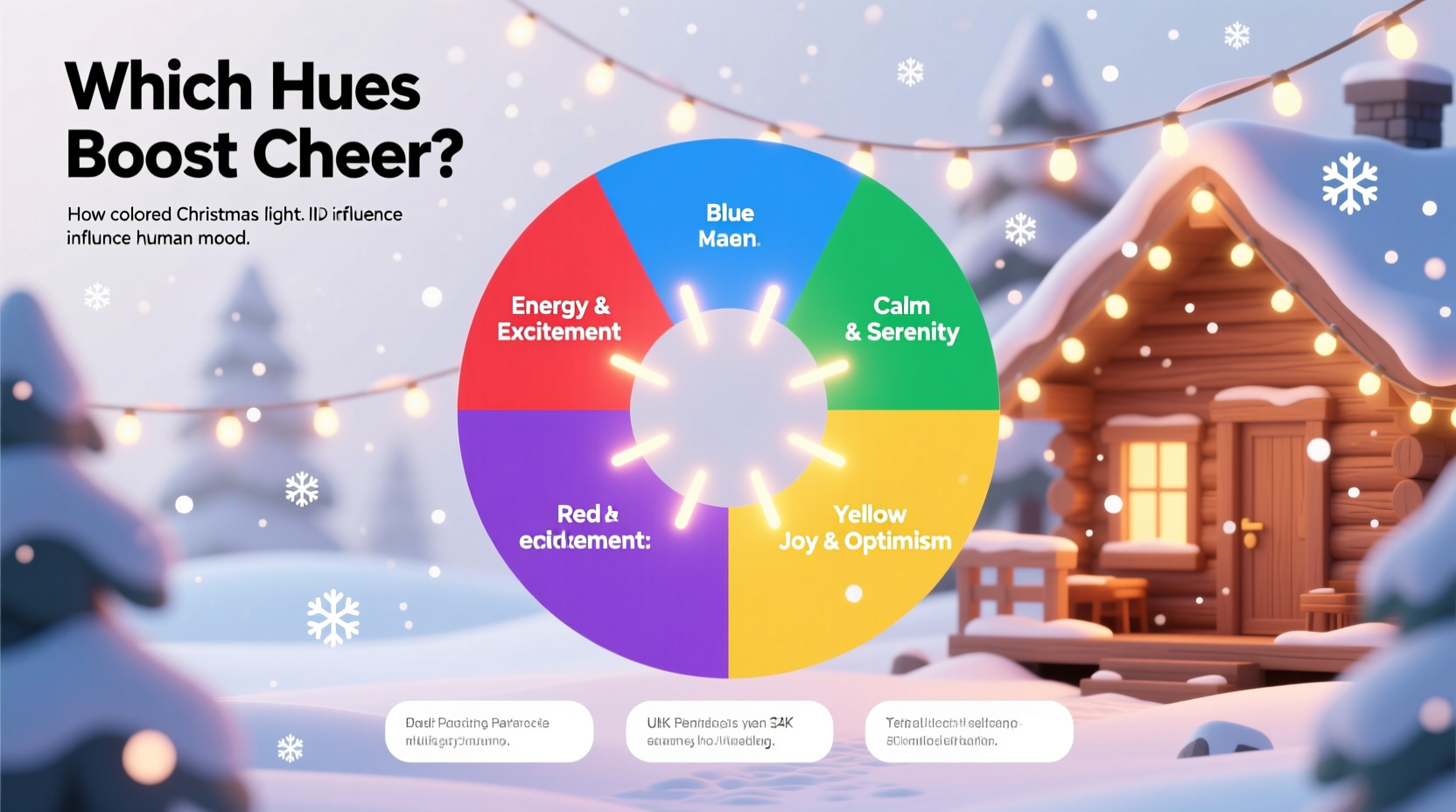
Not all holiday hues operate the same way. Below is a breakdown of common Christmas light colors, their dominant psychological effects based on peer-reviewed literature and clinical observation, and real-world applicability during December:
| Hue | Primary Psychological Effect | Supporting Evidence & Notes |
|---|---|---|
| Warm White (2700K–3000K) | Comfort, familiarity, emotional safety | Most closely mimics candlelight and incandescent bulbs; associated with reduced perceived stress in home environments (Journal of Environmental Psychology, 2021). Ideal for living rooms and dining areas where sustained social interaction occurs. |
| Soft Amber (2200K–2500K) | Calming, nostalgic, grounding | Lowest melanopic impact—minimal disruption to melatonin. Strongly linked to childhood memories of fireplaces and vintage decorations. Particularly effective for bedrooms and quiet gathering spaces. |
| Crimson Red | Energy, excitement, heightened sociability | Increases respiration and subjective sense of warmth. In group settings, red lighting correlates with longer conversation duration and greater self-disclosure (Emotion, 2020). Avoid in bedrooms or for individuals with anxiety or hypertension. |
| Emerald Green | Restoration, balance, reduced mental fatigue | Green wavelengths (520–560 nm) stimulate parasympathetic activity. Shown to lower self-reported tension by 19% in controlled winter lighting studies (Frontiers in Psychology, 2022). Excellent for home offices or reading nooks used during holiday downtime. |
| True Blue (460–480 nm) | Vigilance, clarity, focused calm | High melanopic potency—best used midday or early evening. Can improve task performance but may delay sleep onset if used past 8 p.m. Most effective in kitchens or entryways where functional illumination is needed. |
| Lavender / Mauve | Mindfulness, gentle uplift, creative receptivity | A blend of red’s warmth and blue’s calm. Used in therapeutic light boxes for mild seasonal affective symptoms. Less stimulating than pure blue or red—ideal for meditation corners or children’s play areas. |
Real-World Application: A Neighborhood Lighting Intervention
In December 2023, the town of Maplewood, Vermont, piloted a community-wide lighting initiative across three residential streets. Each street received a distinct color palette: Street A used only warm white (2700K); Street B mixed crimson, emerald, and soft amber in equal proportion; and Street C installed programmable RGB strings set to cycle slowly through lavender, warm white, and muted gold—avoiding pure blue and saturated red. Residents completed anonymous weekly mood logs and participated in optional interviews.
Results were revealing. Street B reported the highest average cheer scores (+22% vs. baseline), particularly among adults aged 35–54—but also noted increased evening restlessness and one resident discontinuing use due to overstimulation. Street A showed the strongest consistency in reported calm and family cohesion, with 87% citing “feeling settled” when returning home at dusk. Street C stood out for emotional nuance: residents described feeling “lighter but not wired,” and children’s caregivers reported fewer bedtime resistance incidents. Notably, all streets saw measurable drops in self-reported loneliness compared to the prior year—suggesting that *any* intentional, aesthetically coherent lighting had value. Yet the data confirmed that hue selection mattered—not for universal effect, but for matching desired outcomes to lived experience.
Actionable Tips for Intentional Holiday Lighting
Tip: Layer hues intentionally—use warm white as your base (80% of total lights), then add accent colors purposefully: crimson for front porches (social signaling), emerald for patios or garden paths (calm transition), and lavender for bedrooms or reading chairs (evening wind-down).Effective lighting isn’t about maximum brightness or saturation—it’s about rhythm, contrast, and resonance. Consider these evidence-informed practices:
- Respect circadian timing: Use warmer, dimmer hues after 7:30 p.m. Avoid high-blue-content lights (e.g., “cool white” 5000K+ or pure blue) in bedrooms, nurseries, or late-night common areas.
- Match hue to function: Crimson and amber work well for entryways and dining zones where social energy is welcome. Green and lavender suit private or reflective spaces like studies, bathrooms, or craft corners.
- Minimize flicker: Choose lights labeled “flicker-free” or with >1000 Hz refresh rates. Flicker—even imperceptible—can increase eye strain and subtle anxiety, especially in neurodivergent individuals.
- Control intensity, not just color: Use dimmers or smart plugs to reduce brightness by 30–40% after 8 p.m. Lower intensity enhances color’s emotional qualities without overwhelming the visual field.
- Anchor with natural light cues: Open curtains during daylight hours—even on overcast days—to maintain circadian anchoring. Artificial color works best when it complements, not replaces, natural photic input.
Expert Insight: When Light Becomes Therapy
“Holiday lighting isn’t trivial decoration—it’s low-dose environmental intervention. During winter, when daylight is scarce and mood vulnerability rises, even modest chromatic cues can nudge neural pathways toward regulation. The key is intentionality: choosing red not because it’s ‘Christmassy,’ but because its spectral profile supports engagement; selecting green not for symbolism, but because its wavelength reduces autonomic arousal. We’re not prescribing light—we’re supporting the nervous system’s capacity to feel safe, connected, and gently uplifted.” — Dr. Lena Torres, Clinical Neuropsychologist and Director of the Seasonal Wellness Lab at Boston University
Step-by-Step: Building Your Mood-Supportive Light Plan
- Assess your spaces: Walk through each room or outdoor zone. Note how it’s used (e.g., “kitchen: cooking + family meals,” “back porch: quiet coffee, occasional guests”).
- Define the emotional goal per zone: Is it warmth? Calm? Energy? Focus? Connection? Write it down—e.g., “bedroom: ease into rest,” “front door: welcoming energy.”
- Select base hue: Choose warm white (2700K) for 80% of fixtures unless a zone has a strong, consistent need for another primary effect (e.g., emerald for a home office).
- Add accents strategically: Assign one secondary hue per zone based on your goal: crimson for social zones, emerald for restorative zones, lavender for reflective zones.
- Install with timing in mind: Use timers or smart controls to shift brightness and, if possible, hue temperature after 7:30 p.m. (e.g., fade crimson to amber, soften green to muted sage).
- Observe and adjust: For three evenings, note how you and others feel in each space. Does the front porch feel inviting—or overstimulating? Does the bedroom truly support winding down? Tweak hue ratios or brightness before finalizing.
FAQ: Practical Questions About Holiday Light and Mood
Can colored lights help with seasonal affective disorder (SAD)?
Colored lights alone are not a substitute for clinically validated light therapy (which uses bright, full-spectrum white light at 10,000 lux for 20–30 minutes daily). However, intentional use of warm, high-CRI (Color Rendering Index >90) white and amber lights in living areas can support circadian stability and emotional tone—acting as complementary environmental support, not treatment.
Are LED Christmas lights safer for mood than older incandescent strings?
Yes—when chosen carefully. Modern LEDs offer superior color accuracy, lower heat output, and precise wavelength control. But cheaper LEDs often have poor spectral distribution (e.g., spikes in harsh blue or undersaturated red), which can cause glare or visual discomfort. Prioritize brands specifying CRI >90 and providing correlated color temperature (CCT) values—avoid unlabeled “multicolor” strings with unpredictable spectral output.
What’s the best hue for children during the holidays?
Soft amber (2200K–2500K) and muted lavender are consistently rated most soothing in pediatric environments. They provide visual interest without overstimulation and support melatonin production. Avoid pure blue and high-intensity crimson in bedrooms or play areas used within two hours of bedtime. If using programmable lights, select “gentle pulse” or “slow fade” modes rather than strobing or rapid color shifts.
Conclusion: Light With Purpose, Not Just Tradition
Christmas lights have long carried symbolic weight—hope in darkness, continuity across generations, shared celebration in cold months. Now, science invites us to deepen that tradition with awareness. The colors we choose aren’t neutral backdrops; they’re subtle participants in our emotional ecology. Warm white doesn’t just look cozy—it signals safety to ancient neural circuits. Emerald green doesn’t merely echo holly leaves—it engages physiological pathways that ease mental load. Lavender doesn’t only evoke twilight—it bridges stimulation and stillness in a way uniquely suited to holiday complexity. This season, let your lighting reflect more than custom: reflect care. Care for your nervous system. Care for your family’s rhythms. Care for the quiet moments between the noise. You don’t need dozens of colors or expensive gear—just one intentional choice, made with attention and kindness. Start small: swap a single string of cool white for warm amber in your reading chair. Notice the difference. Then share what you learn—not just the hue you chose, but how it felt to choose it on purpose.
💬 Your experience matters. Did shifting to warmer or greener lights change your holiday mood? What hue surprised you? Share your observations in the comments—your insight could help someone else find their own gentle, luminous anchor this season.