Applying makeup is as much about precision as it is about creativity. Once the foundation is blended, eyeliner sharpened, and lips lined, the final test often comes down to one question: Does it look right? Many reach for their compact mirror or flip on their phone’s flashlight to inspect their work. But which tool actually reveals the truest representation of your makeup? The answer isn’t as simple as convenience—it hinges on lighting quality, color accuracy, distance, and context.
In professional makeup artistry, lighting conditions are carefully controlled. Natural daylight is considered the gold standard because it renders colors most accurately and minimizes harsh shadows. But in everyday life, people rely on what’s available—usually a small handheld mirror or the bright LED flash on a smartphone. Understanding how each affects your perception can help you avoid over-application, patchy blending, or unnoticed smudging.
The Science of Light and Color Rendering
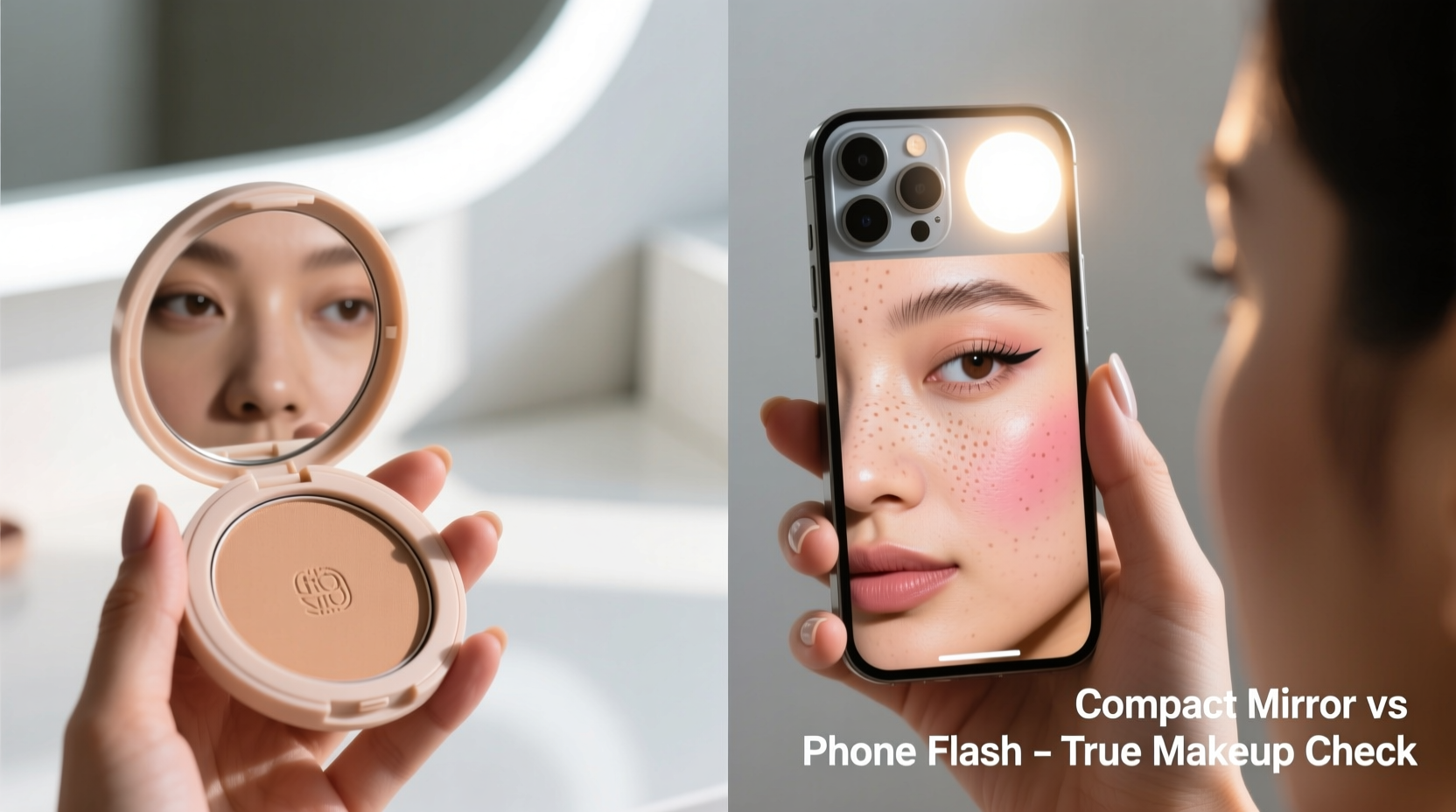
To evaluate whether a compact mirror or phone flash provides a more truthful reflection, we must first understand how light influences our visual perception. Human eyes interpret makeup based on three primary factors: luminance (brightness), color temperature (measured in Kelvin), and the Color Rendering Index (CRI).
CRI measures how accurately a light source reveals the true colors of objects compared to natural sunlight. Sunlight has a CRI of 100—the highest possible score. Most indoor lighting ranges from 80 to 95, while phone flashes typically fall between 70 and 85, depending on the device. Lower CRI values mean colors may appear washed out, distorted, or inconsistent.
Color temperature also plays a crucial role. Warm light (2700K–3500K) adds yellow tones, making skin look softer but potentially hiding blemishes or unevenness. Cool light (5000K–6500K) mimics midday sun and enhances contrast, which can highlight imperfections but offers better clarity for detail work. Many compact mirrors now come with built-in LEDs calibrated around 5000K to simulate daylight—a significant upgrade from older magnifying mirrors with incandescent bulbs.
Tip: When evaluating makeup under artificial light, choose sources labeled “daylight-balanced” (5000K–6500K) and with a CRI above 90 for the most accurate results.How Compact Mirrors Influence Makeup Accuracy
Traditional compacts were once limited to passive reflection—no light source, just glass. Today’s models, however, frequently include ring lights or perimeter LEDs designed specifically for touch-ups. These illuminated mirrors offer several advantages:
- Magnification options: Most feature 5x to 10x zoom, allowing users to examine fine details like lash line gaps or lip exfoliation.
- Controlled lighting: Built-in LEDs provide consistent illumination without relying on ambient room light or unpredictable phone positioning.
- Portability: Designed for purses and travel, they’re ideal for on-the-go checks.
Yet not all compact mirrors are created equal. Lower-end versions may use cheap LEDs with poor color rendering, creating a cool-blue glare that distorts skin tone. Some emit flickering light, which causes eye strain and makes subtle gradients—like contour blending—difficult to judge.
High-quality illuminated compacts, such as those used by professionals, incorporate diffused lighting panels that reduce glare and cast even illumination across the face. Brands like Fancii, Simple Modern, and Glamcore have developed portable mirrors with adjustable brightness and color modes, bringing salon-level accuracy into personal routines.
“Makeup artists always say ‘check it in natural light’—but when that’s not possible, a well-lit mirror with balanced color temperature is the next best thing.” — Lila Chen, Celebrity Makeup Artist
Phone Flash: Convenience at a Cost
The smartphone flashlight is undeniably convenient. It’s always accessible, intensely bright, and requires no extra tools. However, its design wasn’t intended for facial evaluation—it was made to illuminate dark paths or rooms.
When you hold your phone up to your face and activate the flash, several issues arise:
- Harsh, directional lighting: The LED sits at the top or back edge of the phone, casting strong shadows under the nose, chin, and brows. This creates false depth and can exaggerate texture.
- Poor diffusion: Unlike ring lights that surround the face evenly, a single-point flash produces hotspots—overly bright areas that wash out features.
- Inaccurate white balance: Phone cameras automatically adjust color settings based on environment, but the flash often triggers a cooler, bluer tint that alters perceived skin tone.
- Distance distortion: Holding the phone close for detail distorts proportions due to lens curvature (especially wide-angle lenses), making features appear larger or misshapen.
A common mistake is using the front-facing camera with flash enabled. While this seems like a way to “see yourself,” the combination of digital processing, screen reflection, and artificial light leads to a highly unreliable image. The result? You might think your concealer looks perfect under the flash, only to step outside and realize it’s too orange or heavily applied.
Direct Comparison: Mirror vs. Flash
| Feature | Compact Mirror (Illuminated) | Phone Flash |
|---|---|---|
| Light Source Type | Diffused LED panel or ring light | Single-point LED |
| Color Accuracy (Avg. CRI) | 85–95 (higher in premium models) | 70–80 |
| Color Temperature | Adjustable (often 4000K–6500K) | Fixed (~5500K–6000K) |
| Shadow Control | Even, low-shadow illumination | Strong directional shadows |
| Magnification | Yes (5x–10x typical) | No (digital zoom only) |
| Natural Face Proportion | Accurate reflection | Distorted by lens curvature |
| Best Use Case | Detailed application and blending checks | Quick visibility in darkness |
This comparison clearly favors illuminated compact mirrors for accuracy. They are purpose-built for cosmetic evaluation, whereas phone flashes are multipurpose tools repurposed for a task they weren’t designed for.
Real-World Scenario: The Office Touch-Up Dilemma
Sophie, a marketing executive, applies her makeup each morning under bathroom vanity lights. By noon, she notices her lipstick has faded and decides to reapply during a break. In the restroom stall, there’s no window, and the overhead lighting is dim and yellowish. She pulls out her compact mirror with a built-in daylight LED and reapplies her rose-pink lipstick evenly. Before leaving, she double-checks using her phone flash—only to see a stark, bluish cast that makes her lips look gray and overdone.
Confused, she hesitates but trusts the mirror more because she’s used it before. Later that afternoon, a colleague compliments her “perfectly matched lip color.” Relieved, Sophie realizes the phone flash had misrepresented both the hue and saturation due to poor color rendering and harsh lighting.
This scenario illustrates a common pitfall: trusting a quick tech solution over a dedicated beauty tool. The phone gave immediate feedback, but it was misleading. The compact mirror, though slightly less convenient, provided a truer assessment.
Best Practices for an Accurate Makeup Check
Whether you're at home, commuting, or preparing backstage, follow these steps to ensure your makeup looks as intended in real-world conditions.
- Use layered lighting: Combine ambient room light with a daylight-balanced mirror. Avoid relying solely on one source.
- Check in multiple environments: After applying makeup indoors, step near a window or go outside briefly to verify how it appears in natural light.
- Avoid glossy surfaces: Some compacts have overly reflective glass that creates glare. Look for anti-glare or matte-finish coatings.
- Limit phone use for final checks: If you must use your phone, disable the flash and use only the screen light in a well-lit space.
- Calibrate your tools: Invest in a compact mirror with adjustable brightness and color modes so you can simulate different lighting scenarios.
Checklist: Choosing the Right Tool for Makeup Evaluation
- ✅ Does the mirror offer adjustable brightness?
- ✅ Is the LED color temperature close to daylight (5000K–6500K)?
- ✅ Does it have a high CRI (ideally above 90)?
- ✅ Is the lighting diffused, not spotty or glaring?
- ✅ Can you see your full face without distortion?
- ❌ Are you relying only on phone flash in dark or poorly lit areas?
Frequently Asked Questions
Can I trust my phone’s front camera for makeup checks?
Not entirely. While modern front cameras have improved, they still apply digital enhancements like skin smoothing and brightness boosting. These filters alter texture and tone, making makeup appear lighter or more blended than it really is. For accurate assessment, disable beauty filters and avoid using flash.
Is a non-illuminated compact mirror better than a phone flash?
It depends on ambient lighting. In a well-lit room, a plain mirror reflects truer colors than a phone flash, which tends to oversaturate and cast shadows. However, in low light, an unlit mirror is nearly useless, whereas even a flawed phone flash provides visibility. For versatility, choose an illuminated compact.
Do dermatologists recommend any specific method for checking skin after makeup?
Yes. According to Dr. Naomi Patel, a board-certified dermatologist, “Patients often miss clogged pores or uneven coverage because they’re checking under poor light. I recommend using a magnifying mirror with daylight-spectrum LEDs to catch issues early and prevent breakouts or irritation from improper removal.”
Final Verdict: Mirror Wins for Accuracy, Phone for Speed
When it comes to truth in makeup evaluation, the illuminated compact mirror outperforms the phone flash in nearly every category: color accuracy, shadow control, magnification, and realism. It’s engineered for the task, offering consistent, flattering, and revealing light that helps you see exactly how your makeup sits on the skin.
The phone flash, while fast and universally available, sacrifices accuracy for convenience. Its intense, narrow beam distorts color, exaggerates flaws, and fails to represent how makeup will look in natural or social settings. It should be used sparingly—only when no other option exists—and never as the sole judge of a finished look.
For those serious about their makeup routine—whether minimalist or full glam—investing in a quality illuminated compact mirror is a small change with outsized returns. You’ll apply with greater confidence, blend with precision, and avoid the embarrassment of walking into daylight with mismatched foundation or smudged liner.
💬 Have you ever been misled by your phone flash? Share your experience or favorite mirror pick in the comments below—your insight could help others make smarter choices!








