Every December, millions of households plug strings of LED and incandescent lights into power strips—often daisy-chained, hidden behind furniture, or coiled beneath trees. It’s convenient. It looks tidy. But convenience isn’t safety—and the National Fire Protection Association (NFPA) reports that between 2018 and 2022, holiday lighting caused an average of 790 home fires per year in the U.S., resulting in 12 deaths, 54 injuries, and $13 million in property damage annually. Most of those incidents involved overloaded outlets, damaged cords, or improper use of extension cords and power strips.
The short answer is: yes, you can run Christmas lights on a power strip indoors—but only under tightly controlled conditions. The “can” isn’t about permission; it’s about physics, code compliance, and real-world electrical capacity. This article cuts through holiday marketing hype and DIY assumptions. We’ll walk through actual wattage calculations, UL certification requirements, thermal risks most people ignore, and what happens when “just one more string” pushes a circuit past its breaking point.
Why Power Strips Are Not All Created Equal
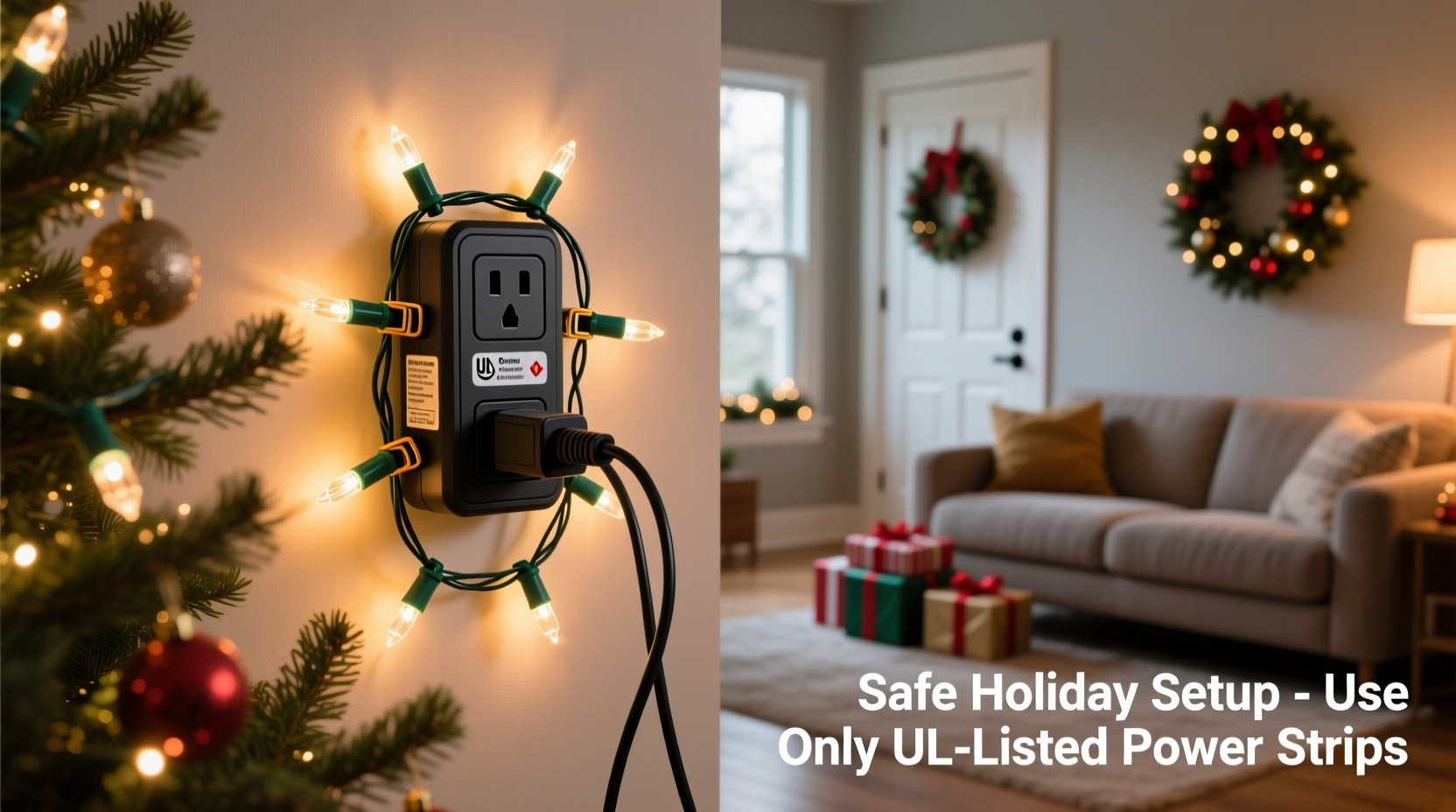
Not every device labeled “power strip” is designed for continuous, high-duty holiday loads. Many consumer-grade models sold at big-box stores are intended for low-wattage electronics like phone chargers, lamps, or desktop computers—not for multiple light strings drawing sustained current over hours or days.
A true “surge-protected power strip” must be certified to UL 1449 (for surge protection) and UL 1363 (for relocatable power taps). Crucially, UL 1363 requires internal thermal cutoffs, robust conductor gauges (minimum 14 AWG for 15-amp models), and clear labeling of maximum load ratings. Yet many inexpensive units omit UL listing entirely—or worse, carry counterfeit marks.
Tip: Flip the power strip over. If there’s no UL, ETL, or CSA mark—and no printed amperage/wattage rating—do not use it for holiday lights. Walk away.UL 1363 also prohibits daisy-chaining (plugging one power strip into another), a practice that increases resistance, heat buildup, and fire risk exponentially—even with “heavy-duty” models. The standard treats each strip as a standalone device, not a modular extension system.
Wattage Math: How Many Strings Can You *Really* Plug In?
Safety starts with numbers—not guesses. Most indoor Christmas light strings draw between 2.4 watts (for 50-LED mini lights) and 21 watts (for 100-bulb incandescent sets). But wattage alone doesn’t tell the full story. You must calculate total load against both the power strip’s rating *and* the circuit breaker’s capacity.
A standard U.S. residential circuit is 15 amps at 120 volts = 1,800 watts maximum. For safety, the NEC (National Electrical Code) recommends loading circuits to no more than 80% of capacity for continuous loads (defined as operating for 3+ hours)—so 1,440 watts is your practical ceiling.
Now consider typical power strip ratings:
| Power Strip Type | Rated Amperage | Max Continuous Load (80% Rule) | Equivalent LED Light Strings (avg. 4.8 W) | Equivalent Incandescent Strings (avg. 21 W) |
|---|---|---|---|---|
| Basic 6-outlet strip (unlisted) | 10 A | 960 W | ~200 strings | ~45 strings |
| UL 1363-certified 15A strip | 15 A | 1,440 W | ~300 strings | ~68 strings |
| UL 1363-certified 12A strip | 12 A | 1,152 W | ~240 strings | ~54 strings |
| “Heavy-duty” 15A strip with 12 AWG cord | 15 A | 1,440 W | ~300 strings | ~68 strings |
Note: These numbers assume ideal conditions—no voltage drop, perfect connections, ambient room temperature, and undamaged cords. Real-world performance is often 10–20% lower due to aging insulation, bent prongs, or warm environments (e.g., near a furnace vent or under a tree skirt).
Here’s what most people miss: LED lights may draw low wattage individually, but their power supplies (especially for C7/C9 or commercial-grade strings) generate harmonic distortion and inrush current spikes. These aren’t reflected in simple wattage labels but stress internal components over time.
Step-by-Step: Safe Indoor Power Strip Setup Checklist
Follow this sequence *every single year*, before plugging in a single bulb:
- Verify UL/ETL certification: Look for the official mark and matching model number on UL’s online database (database.ul.com).
- Check cord condition: Inspect the entire length for cuts, kinks, melted spots, or exposed copper. Discard if any damage is visible—even microscopic cracks in the jacket.
- Calculate total load: Add up wattages of all connected lights using manufacturer labels (not package claims). Use a Kill-A-Watt meter for verification if uncertain.
- Plug directly into a wall outlet: Never daisy-chain, use extension cords, or plug into GFCI-protected bathroom/kitchen outlets (GFCIs may nuisance-trip with capacitive loads from LED drivers).
- Mount securely and ventilate: Mount the strip vertically on a wall stud or heavy furniture leg—not draped over fabric, tucked under rugs, or buried in tree skirts. Allow 2 inches of clearance on all sides.
- Set a timer or smart plug: Limit runtime to 6–8 hours daily. Heat buildup accelerates exponentially after 4 hours of continuous operation.
- Test GFCI/AFCI breakers monthly: Press the “TEST” button on your panel’s arc-fault or ground-fault breakers to ensure they trip within 0.1 seconds.
Real-World Case Study: The Overlooked Thermal Trap
In December 2022, a family in Portland, Oregon, plugged six 100-light LED strings (28.8 W total) and two vintage incandescent garland strands (168 W total) into a UL-listed 15A power strip mounted behind their sofa. They’d used the same setup for five years without issue—until Day 17, when the living room filled with acrid smoke.
Fire investigators found the power strip’s internal bus bar had warped and arced at the neutral connection point. Why? Not overload—the total draw was just 197 W, well below the 1,440 W limit. The culprit was thermal entrapment: the strip was mounted flush against upholstered furniture, blocking airflow. Internal temperatures exceeded 95°C (203°F) during peak operation, degrading solder joints and insulation over weeks. The final failure occurred during a brief voltage surge from a neighbor’s HVAC startup.
This case underscores a critical truth: electrical safety isn’t just about watts—it’s about heat management, installation context, and cumulative wear. A setup that works safely for three hours may fail catastrophically after 12 hours of unattended operation.
Expert Insight: What Electricians and Fire Marshals Actually Say
“The biggest myth I hear is ‘It’s only lights—it’s low power.’ But holiday lighting is among the top three causes of residential electrical fires because people treat it as disposable. A power strip isn’t a magic current multiplier. It’s a point of failure waiting for one overlooked variable—poor ventilation, a nicked wire, or a 5% voltage fluctuation. If you wouldn’t plug a space heater into it, don’t plug 20 light strings.”
— James R. Delaney, CFEI, Senior Fire Investigator, NFPA Public Education Division
“UL 1363 exists for a reason: we’ve tested hundreds of power strips under real holiday conditions—heat cycling, vibration from foot traffic, dust accumulation. Units without thermal cutoffs failed 400% faster in simulated living-room environments. Certification isn’t paperwork—it’s proof the device survived 1,000 hours of abuse.”
— Dr. Lena Cho, Electrical Safety Engineer, Underwriters Laboratories
Do’s and Don’ts: The Non-Negotiable Rules
| Action | Do | Don’t |
|---|---|---|
| Power Strip Selection | Choose UL 1363–certified models with visible amperage rating and thermal cutoff | Use generic “outlet expanders,” hotel-style strips, or power strips older than 5 years |
| Cord Management | Route cords along baseboards; use cord clips rated for 15A loads | Run cords under carpets, across doorways, or through walls without proper grommets |
| Light String Compatibility | Mix only LED strings with identical voltage and driver type (e.g., all 120V AC, non-dimmable) | Connect incandescent and LED strings to the same strip—they create incompatible load profiles |
| Monitoring | Feel the strip’s housing hourly for the first 3 days; if warm to the touch (>40°C / 104°F), unplug immediately | Rely solely on “it hasn’t tripped yet” as proof of safety |
| End-of-Season Protocol | Unplug, unwind fully, inspect for damage, and store in original box at room temperature | Leave lights plugged in year-round or coil tightly while warm |
FAQ: Your Top Safety Questions Answered
Can I use a power strip with a built-in timer for Christmas lights?
Yes—if it’s UL 1363–certified and rated for the total load. Avoid mechanical timers with plastic gears; they degrade under continuous load and may fail mid-cycle. Digital timers with relay outputs (not triac-based) handle lighting loads more reliably. Always verify the timer’s amperage rating matches your strip’s input—not just the outlet’s.
What’s the difference between a power strip and a surge protector?
All UL 1449–certified surge protectors *are* power strips, but fewer than 12% of power strips sold meet UL 1449 standards. A true surge protector includes metal-oxide varistors (MOVs) and clamping voltage specs (e.g., “clamps at 400V”). For holiday lights, surge protection is secondary to thermal safety—but it’s essential if your home has frequent lightning storms or unstable grid voltage.
My power strip feels warm—is that normal?
No. A properly loaded, certified power strip should remain at or near ambient temperature. Slight warmth (up to 30°C / 86°F) is acceptable only at the outlet faceplate during peak load—but the housing, cord, or plug body must never exceed 40°C (104°F). Use an infrared thermometer or the back of your hand: if you instinctively pull away, it’s too hot. Unplug, inspect, and replace.
Conclusion: Safety Is a Habit, Not a Holiday Afterthought
Running Christmas lights on a power strip indoors isn’t inherently dangerous—but treating it as routine convenience is. Every light string is a small appliance drawing real current. Every power strip is a potential thermal bottleneck. Every outlet is part of a circuit engineered to precise tolerances. When we override those tolerances with habit, haste, or hope, physics doesn’t negotiate.
This season, commit to one change: inspect, calculate, and ventilate. Spend five minutes verifying your strip’s certification. Add up the wattages—not the package claims, but the fine-print labels. Mount it where air flows freely. Set a timer so lights turn off before midnight. These aren’t restrictions; they’re acts of care—for your home, your family, and the quiet joy of lights glowing without risk.
Holiday magic shouldn’t depend on luck. It thrives on attention.
💬 Your experience matters. Did you spot a hidden hazard in your setup? Share your tip, correction, or question in the comments—we’ll publish verified insights to help others celebrate safely.








