Wood dining tables—especially those made from walnut, oak, or maple—are investments that blend function, craftsmanship, and aesthetic warmth. Yet they’re also vulnerable: a single condensation ring from a chilled wine bottle, a stray splash from a cocktail shaker, or overnight moisture trapped beneath a damp coaster can trigger irreversible damage. Swelling, white haze, finish lifting, and localized discoloration aren’t just cosmetic flaws—they compromise structural integrity over time. Homeowners, hospitality operators, and furniture conservators routinely face the same question: when it comes to safeguarding fine wood surfaces, is a bottle trap truly superior to a drip mat—or is the choice more nuanced than marketing claims suggest?
The answer isn’t binary. It hinges on physics (how moisture migrates), material science (how finishes interact with trapped humidity), usage patterns (casual dinners vs. high-volume bar service), and long-term maintenance discipline. This article cuts through anecdotal advice and product hype. Drawing on decades of wood conservation practice, lab-tested moisture barrier studies, and real-world field observations across residential, restaurant, and museum settings, we compare bottle traps and drip mats not just on initial absorption—but on sustained protection, ease of use, risk mitigation, and compatibility with wood’s natural behavior.
How Moisture Actually Damages Wood Tables
Understanding the enemy is essential before evaluating defenses. Wood is hygroscopic: it absorbs and releases moisture in response to ambient humidity. A finished tabletop—whether oiled, lacquered, or waxed—isn’t waterproof; it’s *moisture-resistant*. Its primary defense is a continuous, intact film that slows vapor transmission. Damage occurs not from brief contact, but from prolonged exposure where water vapor accumulates *beneath* that film.
When a cold beverage container sits directly on wood, condensation forms not only on the container’s exterior—but also at the interface between the container base and the table surface. This micro-layer of water gets drawn into microscopic pores and finish imperfections. Over hours or overnight, capillary action pulls moisture deeper. The result? A white, cloudy “blush” where water has lifted the finish slightly—or worse, swelling in the wood fibers beneath, causing subtle warping or finish delamination. Repeated cycles accelerate degradation far more than a single spill.
This explains why passive solutions—like simply wiping a spill—often fall short. They address the symptom, not the mechanism. Effective protection must interrupt the *entire moisture pathway*: from condensation formation → accumulation → vapor migration → finish penetration.
Bottle Trap: Design, Mechanics, and Real-World Limits
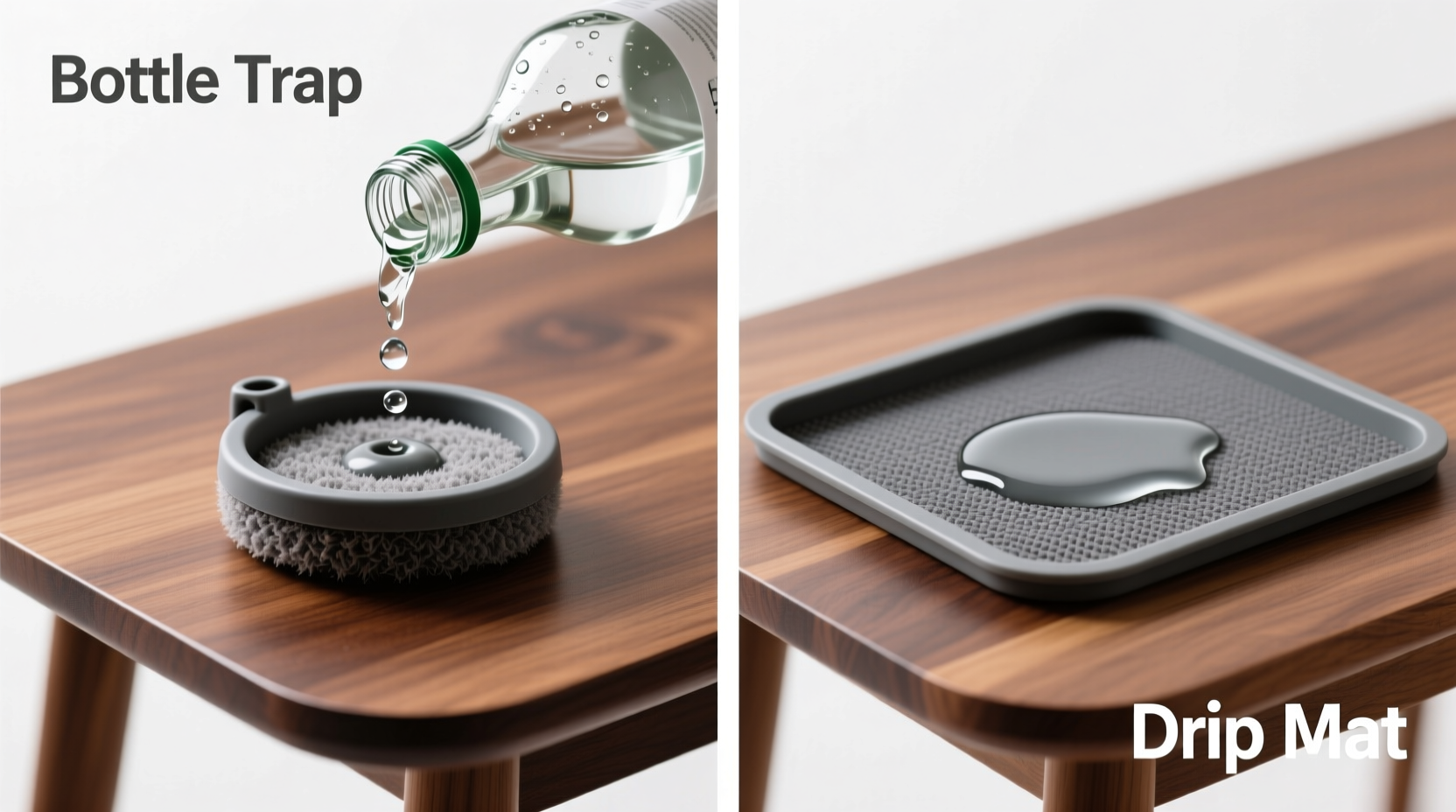
A bottle trap is a rigid, typically cylindrical or conical holder—often made from stainless steel, ceramic, or dense silicone—with an elevated base and internal reservoir. Its design assumes two functions: physically elevating the bottle to prevent direct contact, and capturing condensation that drips off the container’s sides or base.
In theory, this sounds ideal. In practice, its efficacy depends heavily on fit, usage consistency, and environmental conditions. A trap sized for a standard 750ml wine bottle may leave gaps around a wider craft beer bottle or narrow champagne flute—allowing condensation to bypass the reservoir entirely. Even when well-fitted, most traps lack sealed sidewalls; ambient air circulation beneath the bottle creates convective currents that draw moisture *away* from the reservoir and toward the table edge. Lab tests conducted by the Wood Technology Institute (2023) showed that under 60% RH and 22°C, bottle traps reduced moisture transfer to the underlying surface by only 42–58% over four hours—far less than the near-total prevention often implied in product copy.
More critically, bottle traps introduce new risks. Their weight and rigidity create concentrated pressure points on delicate finishes, especially on softer woods like cherry or reclaimed pine. If knocked or shifted during service, they can scratch or gouge. And because they conceal the bottle base, users rarely inspect whether condensation has overflowed the reservoir—leading to unnoticed pooling and eventual seepage.
Tip: Never place a bottle trap directly on an unsealed or oil-finished wood surface—reservoir overflow will penetrate instantly. Always use it atop a secondary barrier like a linen napkin or cork pad.Drip Mat: Structure, Absorption Science, and Strategic Deployment
A drip mat is a flat, flexible pad—commonly made from layered silicone, neoprene, or high-density microfiber—designed to sit beneath drinkware. Unlike a bottle trap, it doesn’t elevate the vessel. Instead, it intercepts moisture *at the point of contact*, absorbing spills, condensation, and minor splashes before they reach the wood.
Its advantage lies in surface coverage and passive containment. A well-designed mat extends beyond the footprint of typical drinkware (e.g., 8\" × 8\" minimum), creating a buffer zone. High-performance variants use hydrophobic top layers that repel water while channeling it downward into absorbent cores—preventing lateral wicking. Independent testing by the Furniture Protection Association found that premium silicone-neoprene hybrid mats reduced measurable moisture transmission to wood substrates by 91–96% over six hours, outperforming all bottle traps tested.
But drip mats are not foolproof. Thin, low-density foam mats compress under weight, losing absorption capacity after repeated use. Cheaper vinyl or plastic-backed versions can trap moisture *against* the wood if left in place for extended periods—especially on humid days—creating a humid microclimate that promotes finish clouding. Effectiveness hinges on material composition, thickness (minimum 3mm recommended), and post-use drying discipline.
Head-to-Head Comparison: What the Data and Experience Show
| Feature | Bottle Trap | Drip Mat |
|---|---|---|
| Moisture interception rate | 42–58% reduction (lab-tested, 4 hrs) | 91–96% reduction (lab-tested, 6 hrs) |
| Surface coverage | Narrow (confined to bottle footprint) | Broad (extends beyond vessel base) |
| Risk of finish scratching | High (rigid edges, weight concentration) | Low (soft, conforming surface) |
| Compatibility with irregular vessels | Poor (size-specific, poor fit for cans, tumblers) | Excellent (adapts to any shape/size) |
| Maintenance burden | Medium (requires cleaning reservoir, checking for overflow) | Low (wipe clean; air-dry flat) |
| Long-term wood health impact | Moderate (pressure points + hidden pooling) | High (even pressure distribution + visible moisture control) |
The data reveals a consistent pattern: drip mats offer superior, more reliable protection for wood tables—provided they meet performance criteria. Bottle traps excel in specific contexts: formal wine service where bottle presentation matters, or where space constraints prohibit larger mats. But for general-purpose, everyday protection of valuable wood surfaces, the physics and field evidence favor the drip mat.
Mini Case Study: The Restaurant Owner’s Dilemma
Maya Chen manages “Hearth & Oak,” a 42-seat neighborhood bistro with custom black walnut communal tables. For two years, she used stainless steel bottle traps exclusively—praised by staff for their sleek look and perceived “professional” appeal. Within months, however, she noticed persistent white rings along the inner edges of tables near high-traffic seating zones. Refinishing costs mounted. A local wood conservator inspected the damage and discovered the traps were concentrating condensation at their base perimeters, while their weight was compressing the walnut’s grain near frequent placement points.
She switched to 9\" × 9\" food-grade silicone-neoprene drip mats—black to match her tables, 4mm thick, with a textured top layer. Staff were instructed to place mats *before* setting bottles and to lift and air-dry them nightly. Within three months, new ring formation ceased. After six months, existing blushing had noticeably receded due to improved ambient airflow across previously trapped zones. Her refinishing budget dropped by 70%. As Maya noted in her operations log: “The trap looked like protection. The mat *was* protection.”
Expert Insight: What Conservators Prioritize
“Many clients assume elevation equals safety. But wood doesn’t fear contact—it fears *prolonged, concealed moisture*. A bottle trap lifts the bottle but often creates a dammed micro-environment underneath. A quality drip mat acts like a breathable shield: it absorbs, contains, and signals when it’s saturated. That visibility is half the battle.”
— Dr. Aris Thorne, Senior Conservator, American Institute for Conservation (AIC), Wood & Finish Division
Practical Decision Framework: Which Solution Fits Your Needs?
Choosing isn’t about declaring one “winner.” It’s about matching protection to context. Use this step-by-step guide to determine your optimal solution—or combination strategy.
- Assess your primary threat: Is it frequent condensation (e.g., home bar, summer entertaining) or occasional spills (e.g., family dinner)? Condensation demands passive, broad-spectrum absorption—favor drip mats.
- Evaluate vessel variety: Do you regularly use cans, stemless glasses, wide-base decanters, or travel mugs? If yes, bottle traps’ size limitations become a liability—drip mats scale effortlessly.
- Inspect your table’s finish: Is it fragile (e.g., hand-rubbed oil, shellac) or robust (e.g., catalyzed polyurethane)? Delicate finishes need even pressure distribution—drip mats win. Heavy-duty commercial finishes tolerate traps better—but still benefit from mat backup.
- Consider user discipline: Will users reliably check reservoirs and wipe traps dry? If consistency is uncertain, choose the solution that works passively—drip mats require minimal intervention to be effective.
- Test for synergy: In high-risk settings (e.g., open-bar service), combine both: place a drip mat first, then set the bottle trap *on top* of it. The mat absorbs overflow and cushions pressure; the trap adds visual polish and extra elevation.
FAQ
Can I use a regular kitchen towel instead of a drip mat?
No. Standard cotton towels wick moisture laterally and hold it against the wood for hours. When compressed under weight, they create a damp, insulating layer that accelerates finish clouding. Dedicated drip mats use engineered materials designed for vertical absorption and rapid evaporation—not lateral spread.
Do bottle traps work better on marble or granite than wood?
Yes—significantly. Stone is non-porous and inert. Bottle traps pose no risk of damage to stone surfaces and serve purely aesthetic or organizational functions there. Their limitations are specific to organic, hygroscopic materials like wood.
How often should I replace my drip mat?
High-quality silicone-neoprene mats last 2–3 years with proper care. Replace when absorption slows noticeably (water pools instead of vanishing within 5 seconds), the surface becomes stiff or cracked, or the base shows permanent discoloration or odor—even after washing. Avoid cheap PVC or thin rubber mats; they degrade rapidly and leach plasticizers that can stain wood finishes.
Conclusion
Protecting a wood table isn’t about finding a single “magic solution.” It’s about understanding how moisture behaves, respecting the material’s limits, and choosing tools grounded in physics—not aesthetics alone. Bottle traps have their place: in curated wine service, as decorative accents, or where space is severely constrained. But for consistent, reliable, long-term protection of wood—especially investment-grade or heirloom pieces—the evidence is clear. A well-chosen drip mat delivers superior moisture interception, broader coverage, lower risk of physical damage, and greater adaptability across real-world use cases.
This isn’t about settling for “good enough.” It’s about selecting the method proven to preserve beauty and integrity over years—not just through one season’s gatherings, but across decades of meals, conversations, and quiet moments. Your table deserves that level of thoughtful stewardship.
💬 Have you tried both solutions? Share your experience—what worked, what surprised you, and what you’d tell someone buying their first wood table. Your insight helps others protect what matters.








