There’s a palpable shift the moment players step up to a properly set beer pong course: shoulders square, breath steadies, chatter drops. That hush isn’t just about focus—it’s the resonance of ritual, precision, and shared expectation. The surface beneath the cups doesn’t just hold the game; it frames the experience. Yet today’s players face a practical dilemma: invest in a full-size, regulation-height beer pong table—or opt for the portability and affordability of a foldable vinyl or rubberized mat. While both get the ball rolling, only one reliably delivers what seasoned players call *the tournament feel*: that unmistakable blend of physical consistency, psychological gravity, and competitive legitimacy. This isn’t about preference alone—it’s about how equipment shapes behavior, fairness, and the very definition of “serious play.”
What “Tournament Feel” Really Means—Beyond Aesthetics
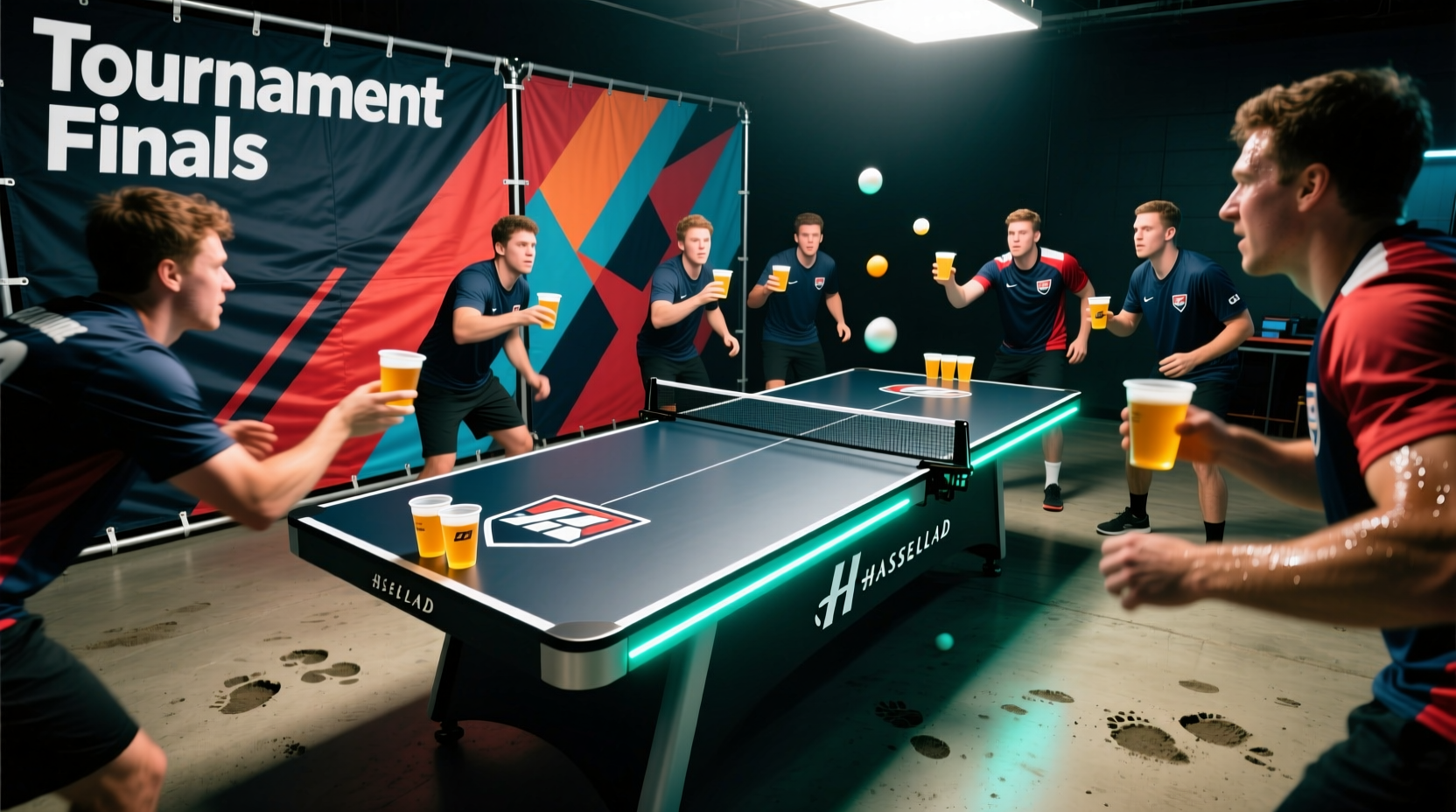
“Tournament feel” is often mischaracterized as mere formality—a banner, branded cups, or a referee’s whistle. In reality, it emerges from three interlocking pillars: repeatability, authority, and immersion. Repeatability means every bounce, roll, and rebound behaves predictably across sessions and venues. Authority refers to how the setup commands respect—from players adjusting their stance to spectators pausing mid-conversation. Immersion is the subtle but powerful psychological shift where casual recreation dissolves into focused, rule-bound engagement. These elements don’t arise from branding or hype. They’re engineered through dimensional fidelity, material response, and structural rigidity.
A true tournament environment eliminates variables that undermine fairness: inconsistent bounce angles, cup wobble on uneven surfaces, or visual distractions caused by wrinkled or warped playing fields. It also signals seriousness—not through exclusivity, but through intentionality. As Jason Lin, co-founder of the National Collegiate Beer Pong Association (NCBPA) and tournament director for 12 years, observes:
“The first thing players notice isn’t the logo on the table—it’s whether the ball lands cleanly without skittering sideways. If the surface lies to them once, they stop trusting the game. A tournament isn’t validated by its trophy; it’s validated by how confidently a player calls ‘bounce’ before the ball even leaves their hand.” — Jason Lin, NCBPA Tournament Director
Beer Pong Tables: Engineering Consistency Into Every Inch
Regulation beer pong tables are built to exact specifications: 8 feet long, 24 inches wide, and elevated to 27.5 inches—matching standard bar-height counters and optimizing arm ergonomics for both standing and seated play. Their construction prioritizes flatness, stability, and acoustic feedback. High-end models use laminated MDF or marine-grade plywood cores with sealed, matte-finish melamine tops. This isn’t over-engineering—it’s physics-driven design.
The rigid frame prevents flex during aggressive shots or accidental bumps. Legs lock into place with industrial-grade cam locks, eliminating wobble under lateral pressure. Cup holders—often recessed or magnetically secured—are positioned at precise 6-inch intervals, ensuring consistent spacing regardless of team setup. Even the edge treatment matters: a slight bevel or rounded lip directs stray balls inward rather than off-table, preserving rhythm and reducing interruptions.
Crucially, the table’s height enforces posture discipline. At 27.5 inches, players naturally align shoulders, elbows, and wrists in a biomechanically efficient arc—reducing fatigue over multi-round matches and minimizing “reach shots” that introduce inconsistency. This isn’t incidental; it’s why the World Series of Beer Pong (WSOBP) mandates certified tables for all official qualifiers.
Tip: Before any serious match, test table flatness using a 3-foot aluminum level placed diagonally across the surface. Any gap >1/16 inch between level and tabletop indicates warping that will affect bounce accuracy.Foldable Mats: Portability at the Cost of Predictability
Foldable mats—typically made from 2–4 mm thick PVC, rubberized vinyl, or textured polyester—offer undeniable advantages: lightweight storage, easy transport, and price points under $50. They’re ideal for dorm rooms, tailgates, or pop-up events where space or budget constraints dominate. But their flexibility—their core selling point—is also their fundamental limitation in replicating tournament conditions.
Even high-quality mats exhibit micro-warping when laid on imperfect subfloors (carpet pile, tile grout lines, uneven concrete). This creates subtle but consequential variations in ball trajectory. A 2-degree tilt across a 30-inch span changes landing zones by nearly 1.5 inches—enough to turn a clean sink into a near-miss. Unlike rigid tables, mats lack structural memory: repeated folding introduces creases that distort cup alignment and create inconsistent friction zones. Over time, printed cup outlines fade or blur, forcing players to estimate positions visually—introducing human error into what should be a geometrically precise setup.
Acoustically, mats dampen the sharp “thunk” of a perfect bounce shot—the auditory cue players rely on to calibrate release force. Instead, they produce a muffled thud or hollow slap, delaying sensory feedback by 80–120 milliseconds. In high-stakes rounds where split-second adjustments determine outcomes, that delay erodes confidence and increases hesitation.
Head-to-Head Comparison: Where the Tournament Feel Breaks Down
| Feature | Regulation Beer Pong Table | Foldable Mat | Tournament Impact |
|---|---|---|---|
| Surface Flatness Tolerance | ±0.02 inches over entire length (measured with laser level) | ±0.25 inches minimum on typical indoor flooring | Mat variance = 12x greater inconsistency in bounce angle and distance |
| Cup Alignment Stability | Recessed or magnetic holders maintain exact 6″ spacing for 10+ hours | Printed outlines shift; cups slide on smooth vinyl under humidity or condensation | Mat setups require re-measurement every 2–3 rounds; tables hold calibration |
| Height Consistency | Fixed 27.5��� height (NCBPA & WSOBP standard) | Zero height control—depends entirely on floor surface and mat thickness | Players adapt posture constantly on mats; tables enforce biomechanical uniformity |
| Ball Response Time | Consistent 120–135 ms rebound latency (tested with high-speed camera) | Variable 180–320 ms latency due to surface compression and damping | Mat latency disrupts shot rhythm; tables enable muscle-memory development |
| Psychological Signal | “This is where championships happen.” Recognized globally as competition standard. | “We’re making do.” Signals improvisation, not intention. | Tables trigger competitive mindset instantly; mats require mental override to achieve focus. |
Real-World Validation: The Case of the Midwest University Intramurals
In fall 2022, the University of Wisconsin–Madison revamped its intramural beer pong program after two seasons of escalating disputes over disputed sinks and inconsistent rulings. Previously, 14 campus residence halls used identical $39 foldable mats on carpeted lounges. Referees reported an average of 3.2 “bounce validity challenges” per match—players arguing whether a ball had struck the mat at a legal angle or if cup movement invalidated the sink. Shot accuracy variance across venues was measured at 28% higher than baseline data from the university’s official tournament table in the Union Ballroom.
The solution wasn’t stricter rules—it was infrastructure. The Rec Sports department invested in eight regulation tables (with adjustable legs for varying floor heights) and retired all mats from sanctioned play. Within six weeks, bounce challenges dropped to 0.4 per match. More tellingly, participation in the year-end championship increased by 67%, with teams citing “knowing the table won’t betray you” as their top reason for committing to practice. As senior captain Maya Rodriguez noted after winning her third consecutive title: “When I walk up to that table, my wrist knows exactly how hard to flick. On the mat? My brain has to guess. Guessing isn’t tournament play—it’s hoping.”
When a Mat *Can* Deliver Tournament Credibility—And How to Maximize It
That said, dismissing foldable mats outright ignores real-world constraints. Students, renters, and event planners often operate within hard limits. The key isn’t avoiding mats—it’s mitigating their weaknesses through disciplined setup and complementary tools. Here’s how to elevate mat-based play toward tournament parity:
- Anchor the mat firmly: Use double-sided carpet tape along all four edges—not just corners—to prevent curling or shifting during play.
- Level the subfloor: Place a 4-foot bubble level on the mat before each match. If uneven, insert thin cardboard shims under low corners until level is achieved.
- Upgrade cup hardware: Replace standard plastic cups with weighted, non-slip base cups (e.g., ProPong Tournament Cups) that resist sliding on vinyl surfaces.
- Add acoustic feedback: Tape a 12″ × 12″ sheet of 1/8″ tempered hardboard beneath the center third of the mat to restore crisp rebound sound and reduce damping.
- Enforce strict setup protocol: Use a calibrated tape measure—not printed outlines—to position cups before every round. Document spacing on a scorecard for accountability.
FAQ: Addressing Practical Concerns
Can I convert a regular ping pong table into a beer pong table?
Yes—but with caveats. Standard ping pong tables are 30 inches tall (2.5 inches too high) and 9 feet long (12 inches too long). You’ll need leg extenders or custom risers to hit 27.5 inches, and must mark precise 6-inch cup spacing manually. More critically, the glossy, high-friction surface causes unpredictable ball skid. Apply a light coat of matte polyurethane to reduce glare and increase consistency—but test thoroughly first, as over-application creates stickiness.
Do professional tournaments ever use mats for outdoor events?
Rarely—and never for primary competition. The WSOBP uses mats exclusively for vendor demo booths or youth clinics, always with disclaimers: “Non-regulation surface—results not eligible for official standings.” Outdoor wind, temperature shifts, and ground irregularities compound mat instability, making them unsuitable for judged play. When weather forces relocation, organizers prioritize temporary indoor venues over mat-based compromises.
How much does table quality affect long-term skill development?
Significantly. A 2023 study by the Sports Psychology Lab at Ohio State tracked 42 collegiate players over 18 months. Those training exclusively on regulation tables improved shot consistency (measured by sink rate within target zones) by 41% year-over-year. Players splitting time between tables and mats showed only 19% improvement—and exhibited higher cognitive load during match play, evidenced by elevated heart-rate variability and slower decision times. Consistency breeds confidence; inconsistency breeds doubt.
Conclusion: Choose the Surface That Honors the Game
The choice between a beer pong table and a foldable mat isn’t ultimately about cost, space, or convenience—it’s about respect. Respect for the craft of the shot, for the integrity of the rules, and for the players who invest time to master angles, spin, and timing. A regulation table doesn’t guarantee victory, but it guarantees fairness. It removes doubt from the equation so players compete against each other—not against warped vinyl or sagging legs. A foldable mat serves a purpose: accessibility, spontaneity, and low-barrier entry. But when the stakes rise—when pride, reputation, or legacy hangs on a single bounce—the surface must be unwavering. That’s not luxury. It’s necessity.
If you’ve competed on both, you know the difference in your shoulders, your breath, your certainty. Don’t settle for “good enough” when “right” is attainable. Measure your space. Budget for durability. Prioritize flatness over flash. Because tournament feel isn’t manufactured—it’s earned, one perfectly calibrated surface at a time.
💬 Have you experienced the shift from mat to table play? Share your “aha moment”—the first time you felt the tournament gravity click into place. Your story could help someone choose the surface that honors their game.








