Whiskey culture has evolved dramatically over the past decade—from craft distillery tours and barrel-proof releases to curated home tasting kits and Instagram-worthy bar carts. Amid this renaissance, one classic gift item persists in quiet confidence: the personalized whiskey decanter. Yet its presence on wedding registries, executive gifting lists, and Father’s Day checkouts invites a fair question: Is it still genuinely stylish—or has it quietly slipped into the realm of dated, dust-collecting tchotchkes? The answer isn’t binary. Personalized whiskey decanters aren’t universally “in” or “out.” Their relevance hinges entirely on intention, execution, and context. When done well, they convey legacy, craftsmanship, and personal resonance. When done poorly, they risk feeling like a relic from a 1990s corporate gift catalog. This article cuts through nostalgia and trend-chasing to examine what makes a personalized decanter feel current—not just customary.
The Enduring Appeal: Why Decanters Still Matter
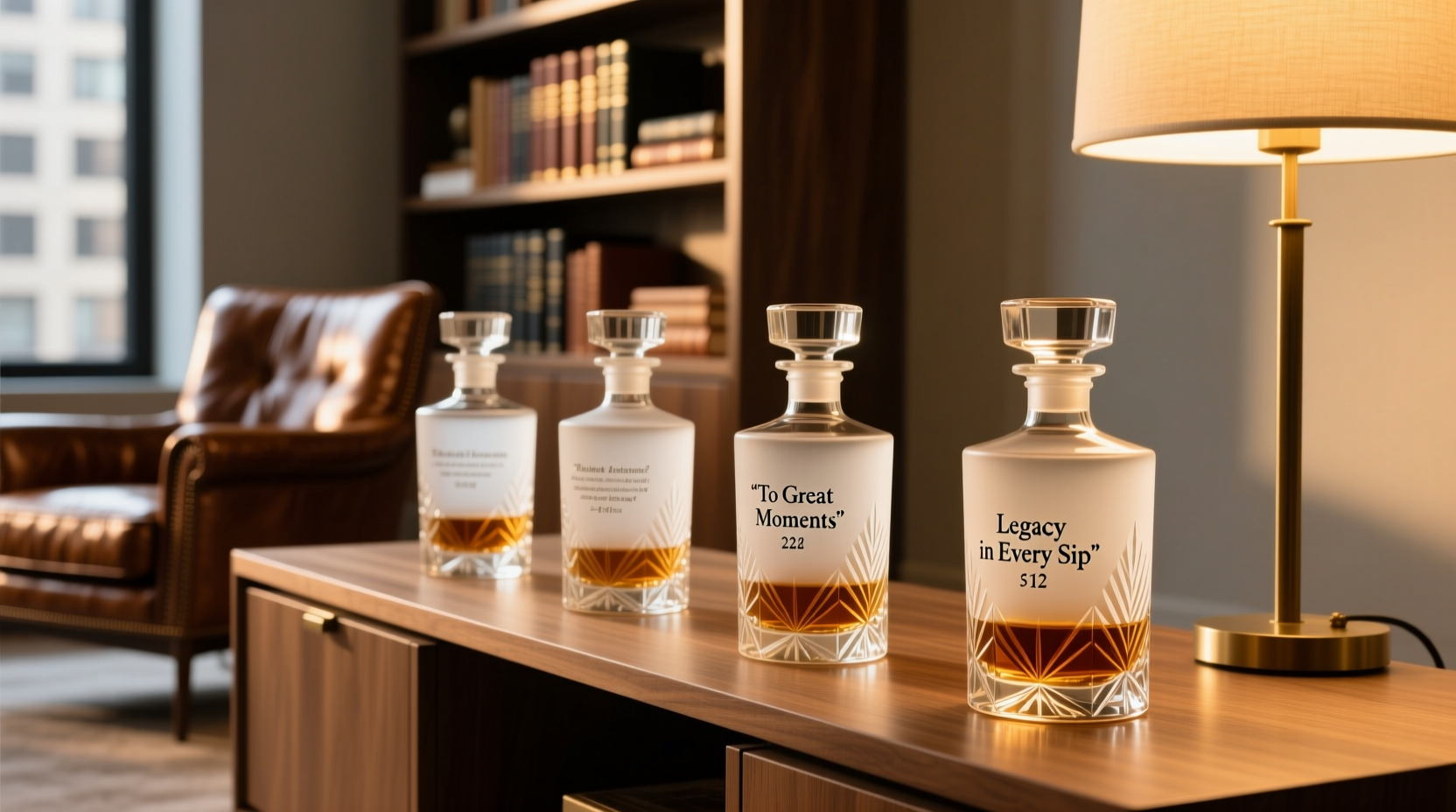
Decanters serve two distinct but complementary functions: practical utility and symbolic weight. Functionally, they aerate whiskey (especially younger, more tannic expressions), soften harsh edges, and allow for controlled pours during tastings or gatherings. Symbolically, they anchor ritual—transforming a pour into a moment of pause, reflection, or shared celebration. Personalization elevates that symbolism further: an engraved monogram, a milestone date, or a bespoke illustration turns the object into a vessel for memory. Unlike mass-produced barware, a well-personalized decanter resists disposability. It’s built to be passed down, referenced, and revisited—not discarded after one holiday season.
This longevity aligns with broader cultural shifts. Consumers increasingly value *meaningful ownership* over novelty acquisition. A 2023 McKinsey Consumer Sentiment Report found that 68% of high-intent luxury buyers prioritize “emotional resonance” over brand name alone—and 54% say they’ll pay up to 22% more for items with personal significance. Whiskey, as a spirit intrinsically tied to time, patience, and provenance, is uniquely positioned to benefit from this mindset. A decanter isn’t merely glass; it’s a frame for narrative—whether honoring a retirement, commemorating a 25th anniversary, or celebrating a first single malt purchase.
What Makes a Personalized Decanter Feel Outdated?
A decanter feels outdated not because it’s old-fashioned, but because it fails to reflect contemporary aesthetics, values, or usage habits. Three common missteps drive this perception:
- Overly ornate or dated styling: Heavy cut-glass patterns reminiscent of 1970s hotel lobbies, excessive gold plating, or florid script engraving clash with today’s preference for minimalist, tactile design.
- Irrelevant personalization: Generic phrases like “World’s Best Dad” or “Est. 1985” without contextual meaning lack authenticity. Modern gifting favors specificity—e.g., “Poured in celebration of your first cask-strength release, June 2024.”
- Ignoring real-world use: Decanters with narrow necks that resist cleaning, non-airtight stoppers that invite oxidation, or bases too wide for standard bar shelves undermine functionality—making them decorative rather than usable.
In short: outdatedness stems from disconnection—not age. A 1940s Lalique decanter displayed on a modern concrete shelf feels intentional and curated. A 2022 laser-engraved decanter with Comic Sans font and a clip-art stag feels jarringly out of step.
Tip: Before ordering, ask yourself: “Will this person actually use it weekly—or will it sit on a shelf as a polite acknowledgment?” If the latter, reconsider the format entirely (e.g., a custom leather-bound tasting journal paired with a bottle).Modern Standards: What Today’s Buyers Expect
Contemporary consumers approach personalized decanters with higher expectations across four dimensions: material integrity, customization depth, functional intelligence, and ethical transparency. Below is a comparison of legacy versus current best practices:
| Feature | Legacy Approach | Modern Standard |
|---|---|---|
| Glass Quality | Standard soda-lime glass, prone to clouding and scratching | Lead-free crystal (e.g., Schott Zwiesel Tritan) or borosilicate glass—scratch-resistant, dishwasher-safe, optically clear |
| Personalization Method | Surface-level sandblasting or foil stamping | Laser etching (deep, permanent, tactile), hand-engraving by master artisans, or ceramic transfer for full-color illustrations |
| Stopper Functionality | Decorative cork or plastic plug with poor seal | Weighted silicone-sealed stoppers, magnetic closures, or ground-glass joints ensuring oxidation resistance for 3+ months |
| Ethical Sourcing | No disclosure of manufacturing origin or labor practices | Transparent supply chain: glass sourced from EU-certified recyclers, engraving done in small-batch US/EU studios, carbon-neutral shipping |
This evolution reflects whiskey drinkers’ growing sophistication. According to the 2024 IWSR Spirits Report, 71% of premium whiskey consumers now research production ethics before purchasing—up from 44% in 2019. A decanter isn’t exempt from that scrutiny. Its creation must mirror the same integrity expected of the liquid it holds.
Real-World Validation: A Case Study in Thoughtful Gifting
When Sarah Chen, a Brooklyn-based sommelier and co-founder of the women-led whiskey collective “Malt & Measure,” gifted her mentor—a retired distiller in Speyside—a personalized decanter last autumn, she avoided every cliché. She commissioned a 750ml, hand-blown borosilicate decanter from a Glasgow glass studio known for sustainable practices. Instead of initials, she had etched the coordinates of the mentor’s first distillery (57.467° N, 3.542° W) alongside the phrase “Where the first cut ran true”—a nod to his legendary precision in spirit separation. The stopper was fitted with food-grade silicone and weighted with reclaimed brass. Inside the box, she included a handwritten note explaining each choice and a vial of water from the distillery’s burn.
The response? Not just gratitude—but immediate integration. Her mentor began using it daily for his morning dram, photographing it beside his tasting notes, and even referencing it during a guest lecture at Heriot-Watt University’s distilling program. “It wasn’t about the glass,” he told her later. “It was about being seen in my work, my history, and my values—all at once.” That decanter didn’t sit unused. It became part of his routine, his story, and his teaching. Its relevance came not from trendiness, but from fidelity to truth.
How to Choose (or Give) a Timeless Personalized Decanter: A 5-Step Guide
- Assess actual usage habits. Does the recipient regularly host tastings? Do they collect rare bottles? Or do they prefer neat pours straight from the bottle? If usage is infrequent, prioritize beauty and symbolism over technical specs. If they’re a serious enthusiast, invest in airtight engineering and lab-grade glass.
- Select personalization with narrative weight. Avoid generic titles (“The Boss”) or vague dates (“2024”). Opt for meaningful markers: a birth year paired with a notable global event (“1978 — The Year Glenmorangie Launched Original”), a distillery name, or a line from a favorite poem about time or patience.
- Verify functional integrity. Check for a ground-glass or silicone-sealed stopper. Ensure the neck opening is ≥2.5cm for easy cleaning. Confirm the base diameter fits standard bar shelving (typically ≤12cm).
- Confirm ethical provenance. Request sourcing details: Where is the glass made? Is it lead-free? Is engraving done locally or outsourced to low-wage regions? Reputable makers provide this transparently.
- Pair intentionally—not extravagantly. A decanter shines when accompanied by context: a small booklet on whiskey maturation, a set of tasting glasses, or a voucher for a virtual distillery tour. Never let the decanter carry the entire emotional weight alone.
“Today’s most cherished decanters aren’t heirlooms waiting to be inherited—they’re active participants in daily ritual. Their power lies in making the ordinary act of pouring feel like an affirmation.” — James MacLeod, Master Distiller, Balvenie Distillery, and author of The Ritual of Whiskey
FAQ: Addressing Common Concerns
Do personalized decanters affect whiskey flavor?
Not inherently—but poor materials can. Low-quality glass may leach minerals over time, especially with high-proof whiskey (≥55% ABV). Lead crystal, while traditional, poses health risks if used daily for long-term storage. Modern lead-free crystal and borosilicate glass are inert and flavor-neutral. Always avoid decanters with painted interiors or metallic linings.
Is engraving safe for long-term whiskey contact?
Yes—if done correctly. Laser etching creates micro-fractures in the glass surface, which are chemically stable and non-porous. Sandblasted or acid-etched surfaces, however, can harbor residue if not polished post-engraving. Reputable artisans polish all etched areas to FDA-compliant smoothness. Ask for certification if uncertain.
Can I personalize a decanter after purchase?
Technically yes—but strongly discouraged. Post-purchase engraving requires removing existing stoppers, precise alignment, and often shipping to a specialist studio. Risk of breakage, misalignment, or inconsistent depth is high. Always order personalization directly from the maker during initial purchase.
Conclusion: Style Isn’t Trend—It’s Intention Made Visible
A personalized whiskey decanter isn’t in style—or out of it—because of fashion cycles. It’s relevant when it honors the drinker’s relationship with time, craft, and meaning. In an era saturated with fleeting digital experiences and disposable goods, a well-chosen decanter offers something increasingly rare: tangible continuity. It asks us to slow down, to mark moments with substance, and to treat ritual as worthy of investment. Whether you’re selecting one for a loved one, curating your own bar, or commissioning a studio piece, remember that the greatest style emerges not from chasing what’s new, but from choosing what endures—with clarity, care, and quiet confidence.
💬 Your turn: Have you received or gifted a personalized decanter that truly resonated? Share what made it special—the engraving, the story behind it, or how it’s used today. Real experiences help others choose with purpose.








