For many city dwellers and apartment residents, the joy of holiday decorating comes with a catch: limited or nonexistent outdoor space. Renters often face strict building rules that prohibit exterior modifications, making traditional outdoor string lights impractical or outright forbidden. In recent years, laser Christmas projectors have emerged as a compelling alternative—offering vibrant, expansive light displays with minimal setup. But are they truly better than classic string lights for those without outdoor access? The answer depends on several factors, including convenience, visual impact, cost, and landlord restrictions.
This article explores the practical realities of using laser projectors versus string lights in rental situations, particularly where balconies, porches, or yards aren’t available. We’ll compare installation, aesthetics, safety, and long-term value to help you decide which option best suits your holiday spirit—and your lease agreement.
Understanding the Rental Decorator’s Dilemma
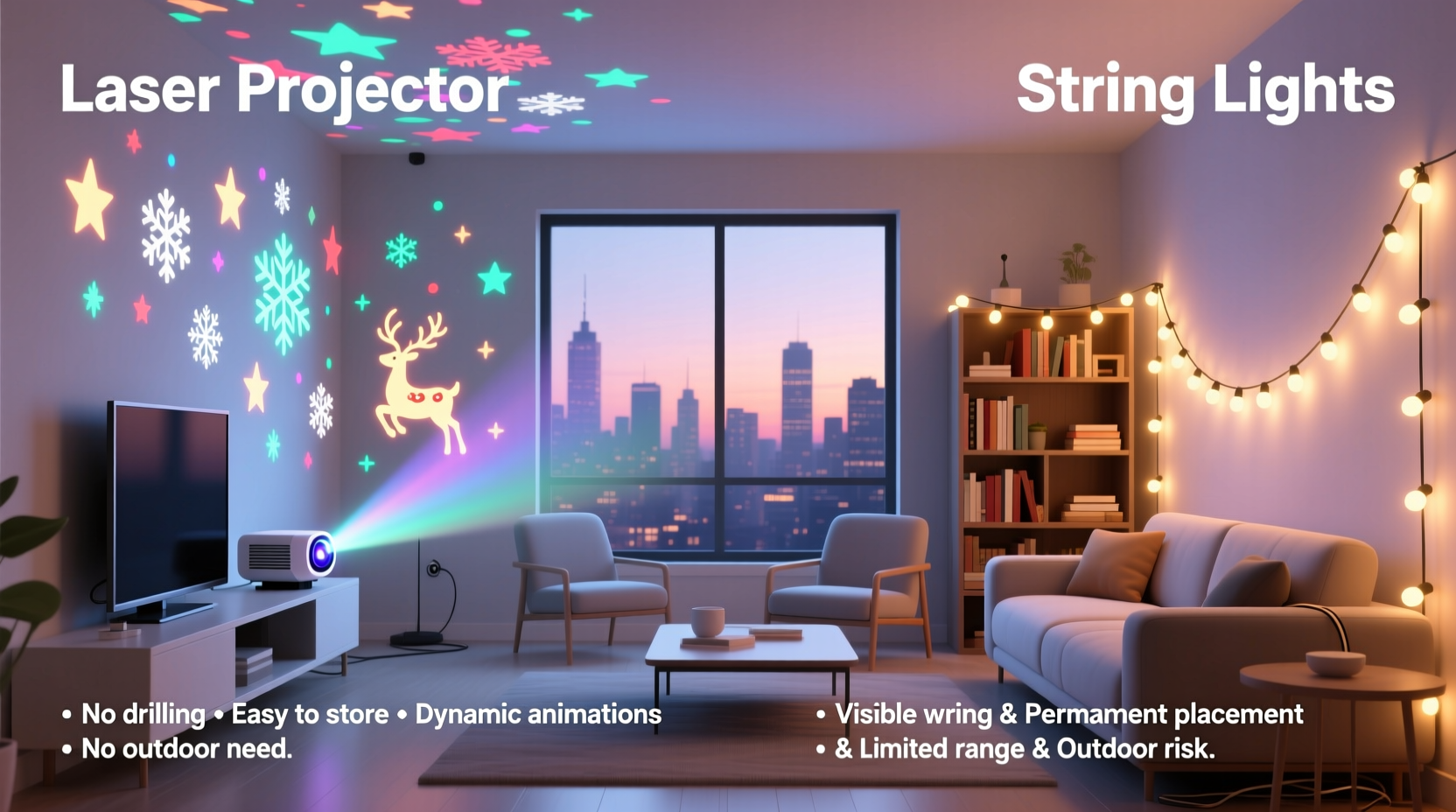
Renters face unique challenges when it comes to holiday decorations. Unlike homeowners, they typically can't drill holes, run extension cords through windows permanently, or install permanent fixtures. Many leases explicitly forbid any alterations to the building’s exterior, including hanging lights from railings or windowsills. Even indoor setups can be constrained by outlet availability, ceiling height, and shared walls where brightness might disturb neighbors.
In this context, the appeal of laser Christmas projectors grows significantly. These devices project animated patterns—such as snowflakes, falling stars, or twinkling trees—onto walls, ceilings, or even across rooms using small, plug-in units. They require no ladders, no tangles of wire, and often just one power source. For someone living in a studio apartment or high-rise condo, this simplicity is transformative.
String lights, while beloved, demand more physical space and planning. Draping them around windows, along walls, or across shelves works well in houses or larger apartments but can feel cramped or underwhelming in tighter quarters. Moreover, managing cords in a rental often means relying on temporary fixes like adhesive hooks or over-door clips, which may not hold up over time or could risk damage deposits if residue or marks are left behind.
Tip: Always review your lease agreement before installing any holiday lights—many landlords allow temporary decor as long as no permanent changes are made.Comparing Laser Projectors and String Lights: A Practical Breakdown
To make an informed decision, it's essential to evaluate both options across key criteria: ease of setup, visual effect, versatility, cost, and safety.
| Feature | Laser Christmas Projectors | String Lights |
|---|---|---|
| Installation Time | Under 5 minutes (plug and aim) | 15–60+ minutes (draping, securing, testing) |
| Space Required | Minimal (fits on shelf or floor) | Moderate to high (needs surface area or vertical space) |
| Visual Coverage | Large (can cover entire wall or ceiling) | Limited (confined to physical placement) |
| Portability | High (lightweight, compact) | Moderate (bulky when stored, prone to tangling) |
| Suitability for Small Spaces | Excellent | Fair to good (depends on layout) |
| Lease-Friendly? | Yes (no attachment needed) | Sometimes (adhesives may leave marks) |
| Average Cost (per unit) | $30–$70 | $10–$50 (but multiple strands often needed) |
| Lifespan | 3–5 years (with proper storage) | 2–4 years (especially if tangled or mishandled) |
The table reveals a clear advantage for laser projectors in terms of speed, footprint, and compliance with rental restrictions. However, string lights still win in certain areas—particularly ambiance and customization. There’s a tactile warmth to real bulbs that projected light can’t fully replicate. Additionally, string lights offer greater flexibility in color schemes, bulb types (warm white, multicolor, vintage), and design integration with other decor like garlands or wreaths.
When Laser Projectors Shine: Scenarios That Favor Projection Lighting
Laser projectors are not just convenient—they can be genuinely transformative in specific living situations. Consider the following realistic example:
Mini Case Study: Maria in Downtown Chicago
Maria rents a 550-square-foot studio apartment on the 18th floor of a high-rise. Her building has strict no-decoration policy on exteriors, and her only window faces a brick wall. Last year, she tried hanging string lights around the window frame, but the effect was barely noticeable beyond her couch. This year, she bought a $45 laser projector and placed it on her bookshelf, aiming it at the opposite wall. Instantly, her entire room transformed—snowflakes danced across the ceiling, and green-and-red dots mimicked a forest scene. Neighbors in the hallway complimented the glow under her door. Best of all, she packed it away in two minutes after the holidays with zero cleanup.
Maria’s experience highlights how laser projectors excel in environments where physical space is limited and visibility is low. Because they use reflection and diffusion, their perceived size far exceeds their actual footprint. Some models even offer rotating heads or multiple projection modes, allowing users to switch themes throughout the season.
Another major benefit is adaptability. A single projector can serve different purposes depending on placement: aimed upward for a “starry sky” effect on the ceiling, angled across a blank wall for a festive backdrop during gatherings, or even used indoors to simulate outdoor lighting by projecting onto curtains or blinds.
Step-by-Step: Setting Up a Lease-Friendly Holiday Display Using a Laser Projector
If you're considering switching from string lights to a laser projector, follow this simple guide to maximize impact while respecting your rental agreement:
- Review your lease terms. Confirm whether decorative lighting is allowed, especially near windows or outlets.
- Measure your space. Identify walls, ceilings, or large surfaces ideal for projection. Avoid placing near flammable materials.
- Choose the right projector. Look for models with adjustable brightness, multiple patterns, and an auto-timer (typically 4–8 hours).
- Position the unit securely. Place on a flat, stable surface like a shelf, TV stand, or floor corner. Avoid wobbly furniture.
- Test the angle and distance. Most projectors work best between 6–15 feet from the target surface. Adjust until the image fills the desired area evenly.
- Plug in and program. Set the timer and choose your favorite mode. Many units remember settings between uses.
- Monitor for heat and safety. Ensure the device isn’t covered or touching fabric. Unplug when leaving the apartment for extended periods.
- Store properly after use. Keep in original box or padded container to protect lenses and buttons.
This streamlined process takes less time than untangling a single strand of traditional lights—and eliminates the frustration of broken bulbs or mismatched colors.
Expert Insight: What Designers and Landlords Say
Interior designers specializing in small-space living increasingly recommend projection lighting for urban renters. According to Dana Reeves, a New York-based apartment stylist, “The psychology of holiday lighting is about perception, not quantity. A well-placed laser effect can create more magic than 200 tiny bulbs crammed into a corner.”
“Projection lighting gives renters agency. They can celebrate boldly without violating rules or risking deposits.” — Dana Reeves, Urban Interior Designer
Even property managers acknowledge the shift. A 2023 survey by the National Multifamily Housing Council found that 68% of leasing offices received fewer decoration-related complaints in buildings where tenants used plug-in projectors instead of wired displays. One regional manager noted, “We don’t get calls about ‘lights shining into my bedroom’ when the source is inside and self-contained.”
Checklist: Choosing the Right Option for Your Rental
Still unsure whether a laser projector or string lights are better for your situation? Use this checklist to decide:
- ✅ Do you lack outdoor space or balcony access? → Favors projector
- ✅ Is your ceiling or a large wall visible and unobstructed? → Favors projector
- ✅ Do you want a dramatic effect with minimal effort? → Favors projector
- ✅ Do you prefer warm, intimate lighting over flashy effects? → Favors string lights
- ✅ Are you keeping lights up for multiple seasons? → String lights may offer better longevity
- ✅ Do you enjoy hands-on decorating and styling? → Favors string lights
- ✅ Are you concerned about damaging paint or trim? → Strongly favors projector
- ✅ Do you move frequently? → Favors projector (easier to pack and reuse)
This tool helps clarify priorities. If most of your answers lean toward the projector, it’s likely the smarter choice for your lifestyle.
Frequently Asked Questions
Can I use a laser Christmas projector outdoors if I have temporary balcony access?
Some models are labeled as weather-resistant or outdoor-safe, but most consumer-grade projectors are designed for indoor use. Check the IP rating—if it lacks water resistance, avoid exposing it to rain or snow. Even on a short-term balcony, moisture and temperature swings can damage internal components.
Do laser projectors use more electricity than string lights?
No—in fact, they often use less. Most laser projectors consume between 5–15 watts, comparable to a single LED bulb. A typical string of 100 mini LED lights uses about 4–8 watts, but decorators often use multiple strands, increasing total draw. Over a month, a projector running 6 hours nightly may cost under $2 in electricity.
Are laser projectors safe for children and pets?
Yes, when used correctly. Modern holiday laser projectors use Class II or Class IIIa lasers, which are low-power and eye-safe under normal conditions. Never stare directly into the beam for prolonged periods, and avoid mounting where beams shine at eye level. Always supervise young children around electronic devices.
Conclusion: Making the Holidays Brighter—Within Your Walls
For renters without outdoor access, the holiday decorating game has changed. Laser Christmas projectors offer a powerful, lease-friendly solution that delivers maximum visual impact with minimal effort. While string lights retain nostalgic charm and tactile appeal, they come with logistical hurdles that can dampen the festive mood—especially in compact or highly regulated living spaces.
The rise of smart, compact projection technology means you no longer need a front porch or garden to spread holiday cheer. With thoughtful placement and a few simple tools, your apartment can glow with seasonal magic while staying fully compliant with rental rules. Whether you’re hosting friends, enjoying quiet nights in, or simply treating yourself to some winter wonder, these devices prove that celebration doesn’t require square footage—it requires creativity.
💬 Have you tried a laser Christmas projector in your rental? Share your setup tips or favorite model in the comments below—your experience could inspire someone else’s brightest holiday yet.








