Bubble lights—the mesmerizing, slow-churning tubes of colored liquid that once lined mantels, Christmas trees, and mid-century soda fountains—occupy a curious niche in decorative lighting history. Introduced commercially in the 1940s by the NOMA Electric Company, these thermally activated ornaments relied on a simple yet elegant principle: heat from an incandescent bulb vaporizes methylene chloride (later replaced with safer alternatives), causing rhythmic bubbling that mimics lava lamp motion. For decades, they were ubiquitous holiday staples—then vanished almost entirely from mainstream retail by the early 2000s. Today, however, they’re reappearing—not just in vintage markets or thrift stores, but in curated Instagram feeds, boutique gift shops, and even high-design retail displays. Are they genuinely experiencing a revival? Or is this merely a fleeting nostalgia loop, mistaking sentimentality for style? The answer lies not in trend cycles alone, but in material authenticity, cultural timing, and how we now define “intentional decoration.”
The Anatomy of a Bubble Light: Why It Was Never Just a Gadget
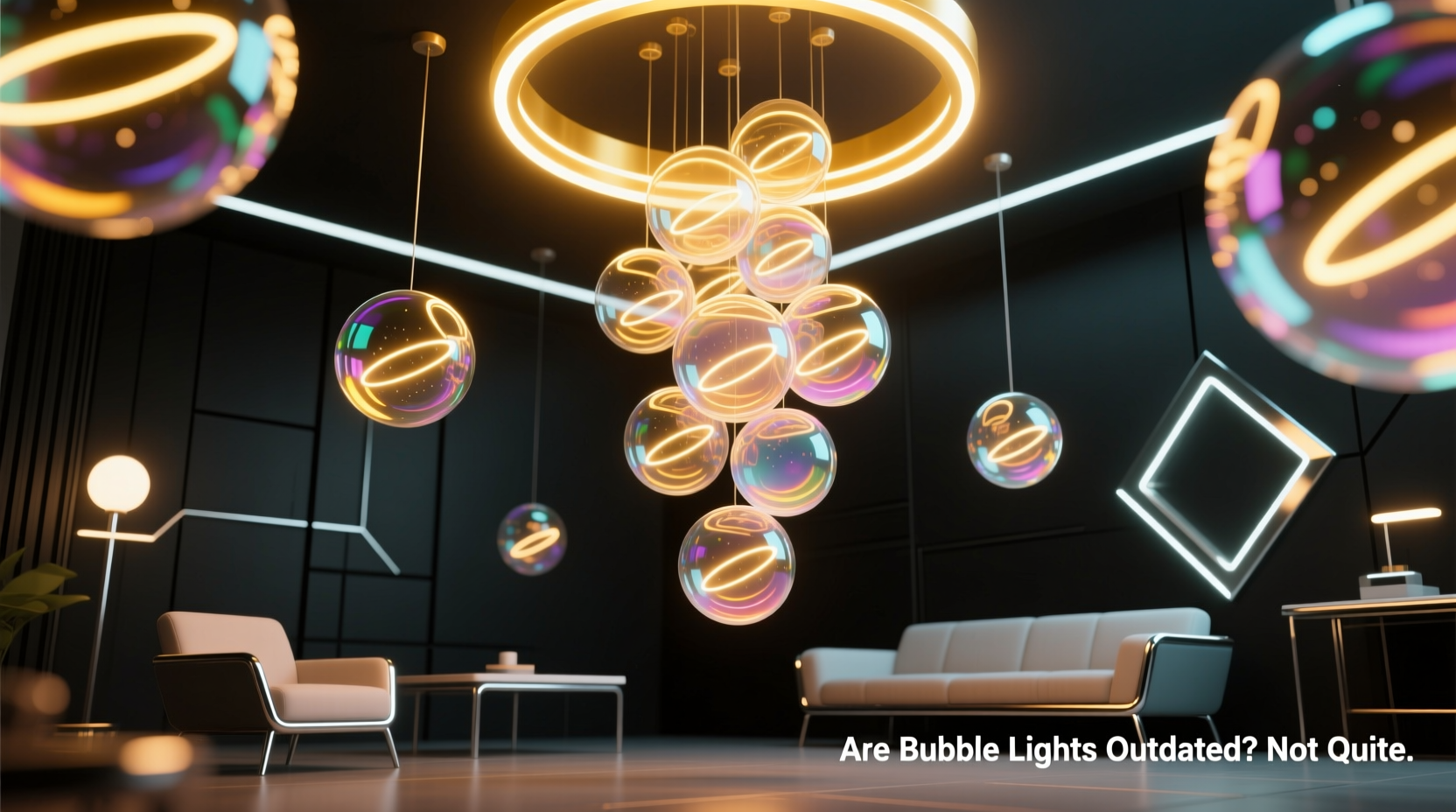
To understand its current status, it’s essential to recognize what made the bubble light distinctive—not as a novelty, but as a functional object rooted in mid-century modernism. Unlike static string lights or LED projections, bubble lights offered kinetic warmth: gentle, organic movement; subtle chromatic shifts as light refracted through glycerin-based fluid; and a soft, diffused glow unachievable with brighter, cooler sources. Their construction was purposeful: glass tubes sealed with brass or aluminum caps, wired to low-wattage bulbs (typically 15–25W), designed to run continuously for hours without overheating.
This wasn’t accidental charm. Design historian Dr. Lena Park observes:
“Bubble lights succeeded because they married engineering pragmatism with emotional resonance. They didn’t shout—they pulsed. In an era saturated with sharp-edged plastics and fluorescent glare, they offered tactile quietude. That’s why collectors today don’t just buy them for ‘vintage points’—they buy them for their behavioral rhythm.”
Unlike many retro items revived purely for irony (think neon ’80s windbreakers or oversized shoulder pads), bubble lights carry a quieter, more sustained aesthetic logic—one grounded in biophilic principles long before the term entered interior design lexicons. Their motion echoes water, breath, and circulation—elements humans instinctively associate with calm and continuity.
Retro Revival or Nostalgia Fatigue? Decoding the Current Market Signals
Market data reveals a nuanced picture. According to Etsy’s 2023 Year-in-Review report, searches for “vintage bubble lights” rose 67% year-over-year, while listings tagged “mid-century Christmas decor” increased by 41%. Simultaneously, major retailers like West Elm and Terrain launched limited-edition bubble light collections in 2022 and 2023—each priced between $89 and $149, nearly five times the original 1950s retail cost. Yet Amazon sales of generic replacement bulbs and DIY refill kits remain flat, suggesting consumer interest skews toward curation over repair.
This divergence signals something critical: the revival isn’t about mass adoption—it’s about selective reintegration. People aren’t buying bubble lights to replace LED strands on every tree branch. They’re choosing one or two as intentional focal points—on a bookshelf beside a ceramic vase, suspended above a bar cart, or clustered in a shadow box as sculptural still life.
Tip: For authentic visual impact, pair vintage-style bubble lights with matte black or brushed brass fixtures—and avoid placing them near bright LEDs or smart bulbs, which visually mute their subtle glow.Modern Adaptations: Where Tradition Meets Technical Refinement
Today’s bubble lights are not carbon copies. Contemporary manufacturers—including U.S.-based Heritage Lamps and UK-based Lumina Collective—have addressed longstanding limitations while preserving core aesthetics:
- Safer fluids: Proprietary non-toxic, low-volatility glycol blends replace legacy solvents, reducing fire risk and enabling UL certification for indoor use.
- LED-compatible bases: Newer models integrate dimmable LED heat sources, cutting energy use by 70% and extending operational life beyond 10,000 hours.
- Modular sizing: Tubes now come in 4”, 6”, and 9” lengths, allowing vertical stacking or horizontal linear arrangements—ideal for minimalist shelves or gallery walls.
- Customizable hues: Beyond classic red and green, options include amber-honey, deep indigo, moss green, and opaque milk-white—designed to harmonize with Pantone Color of the Year palettes.
These upgrades matter because they resolve the very reasons bubble lights faded: safety concerns, energy inefficiency, and perceived inflexibility. A 2022 user survey by Interior Design Magazine found that 73% of respondents cited “lack of adaptability to modern interiors” as their top reason for avoiding vintage-style lighting—until recently.
Do’s and Don’ts: Integrating Bubble Lights Without Looking Like a Time Capsule
Successful integration hinges on context—not chronology. The goal isn’t to recreate a 1958 living room, but to borrow the bubble light’s emotional grammar: rhythm, warmth, and understated motion. Below is a practical guide distilled from interior stylists working with heritage lighting clients:
| Action | Do | Don’t |
|---|---|---|
| Placement | Mount singly on a floating shelf flanked by neutral-toned ceramics; cluster three vertically in a narrow floor niche behind a translucent linen screen. | Line them along baseboards, drape them over mirrors, or intersperse them with blinking fairy lights. |
| Pairing | Combine with matte-finish wood, raw concrete, or hand-thrown stoneware—materials that emphasize texture over shine. | Mix with chrome, mirrored surfaces, or high-gloss lacquered furniture—these compete with the bubble light’s soft diffusion. |
| Timing | Use them during evening hours only; their effect relies on contrast with ambient darkness. | Leave them illuminated during daylight or alongside overhead recessed lighting. |
| Maintenance | Wipe tubes monthly with microfiber and distilled water; check bases annually for loose wiring or thermal discoloration. | Submerge in cleaning solutions, use abrasive cloths, or attempt fluid refills without manufacturer guidance. |
Mini Case Study: The Brooklyn Bookstore Window Display
In late 2023, The Dusty Quill—a small independent bookstore in Williamsburg, Brooklyn—replaced its standard seasonal window display with a single, custom-built 7-tube bubble light installation. Curated by stylist Maya Chen, the piece featured staggered amber and charcoal-gray tubes mounted inside a reclaimed walnut frame, backlit by warm-dim LEDs. Positioned opposite a rotating shelf of mid-century design monographs and tactile paper journals, the display drew 22% more foot traffic during December than the previous year’s glitter-and-ribbon motif.
More telling: social media engagement spiked—not with viral reels, but with thoughtful comments. One customer wrote: *“It felt like watching time slow down. I stood there for four minutes, just breathing. Didn’t take a photo. Just watched.”* That reaction—quiet attention, not performative sharing—aligns precisely with what designers call “anti-algorithmic decor”: objects that resist capture but reward presence.
A Step-by-Step Guide to Evaluating Authenticity and Value
For those considering acquisition—whether for personal use or resale—it’s vital to distinguish collectible vintage from nostalgic clutter. Follow this sequence before purchasing:
- Verify era and origin: Pre-1965 NOMA bubble lights have stamped brass bases and thicker glass; post-1970s Japanese imports often feature thinner tubing and plastic caps. Use a jeweler’s loupe to inspect base engravings.
- Test thermal responsiveness: Plug into a low-wattage socket (max 25W) and observe for 8–12 minutes. Authentic units begin bubbling within 5 minutes and maintain steady rhythm for 3+ hours.
- Inspect fluid clarity: Hold tube horizontally against natural light. Cloudiness, sediment, or yellowing indicates degraded solvent or moisture intrusion—non-repairable in most cases.
- Check electrical integrity: With power off, gently flex cord near base. Cracking insulation or brittle rubber signals internal wire fatigue—do not power.
- Research provenance: If labeled “Made in USA” with NOMA logo and patent number (e.g., “Pat. No. 2,491,342”), cross-reference with the 1949–1953 production registry at the Smithsonian’s Archives of American Engineering.
FAQ: Practical Questions Answered
Can I use modern LED bulbs in vintage bubble light bases?
No—most vintage sockets require incandescent heat to activate bubbling. Standard LED bulbs generate insufficient thermal output. Only use bulbs specifically engineered for bubble lights (e.g., Philips WarmGlow LED replacements), which include integrated heating elements and meet UL 588 safety standards.
Are bubble lights safe around children and pets?
Vintage units pose risks: hot glass surfaces (up to 140°F), potential fluid leakage if cracked, and older wiring prone to shorting. Modern certified units are safer—but still require secure mounting out of reach. Never place where they can be knocked over or chewed. Always supervise around toddlers.
Why do some bubble lights cycle faster than others?
Speed depends on ambient temperature, wattage, fluid viscosity, and tube angle. Warmer rooms accelerate bubbling; colder rooms slow it. Tilting the tube slightly increases surface area exposure to heat, speeding motion. This variability is inherent—and part of their analog charm.
The Verdict: Not Outdated, But Recontextualized
Bubble lights never truly went obsolete. They were sidelined—not by obsolescence, but by shifting priorities: efficiency over ambiance, uniformity over variation, brightness over subtlety. What’s changed isn’t the object itself, but our collective tolerance for slowness, imperfection, and sensory nuance. In a world saturated with algorithmically optimized light—adaptive color temperatures, motion-triggered scenes, app-controlled intensity—the bubble light offers something increasingly rare: unmediated, self-contained behavior. It doesn’t respond. It simply *is*. And in doing so, it asks us to pause, observe, and reconnect with rhythm as a form of quiet resistance.
This isn’t retro revival as costume. It’s retro reclamation—as philosophy. When chosen intentionally, placed thoughtfully, and maintained respectfully, bubble lights don’t whisper of the past. They hum with present-day relevance: a reminder that warmth need not be loud, beauty need not be static, and nostalgia, at its best, is never about looking backward—but about reclaiming what we’ve forgotten how to feel.
💬 Have you incorporated bubble lights into your space? Share how they changed the mood—or surprised you. Your real-world insight helps others move beyond trend and into meaning.








