
For decades, the common explanation for wrinkled fingers after a bath or swim was simple: water absorption. Skin soaks up water like a sponge, swells, and wrinkles. It seemed logical—and it was repeated in textbooks, classrooms, and casual conversations. But recent scientific research has overturned this long-held belief, revealing a far more sophisticated biological mechanism at play. Far from being a passive physical reaction, finger wrinkling is now understood to be an active, nerve-controlled process with evolutionary benefits. This article explores the real reason behind pruney fingers, how the body controls it, and what it means for our understanding of human physiology.
The Old Myth: Osmosis and Swelling
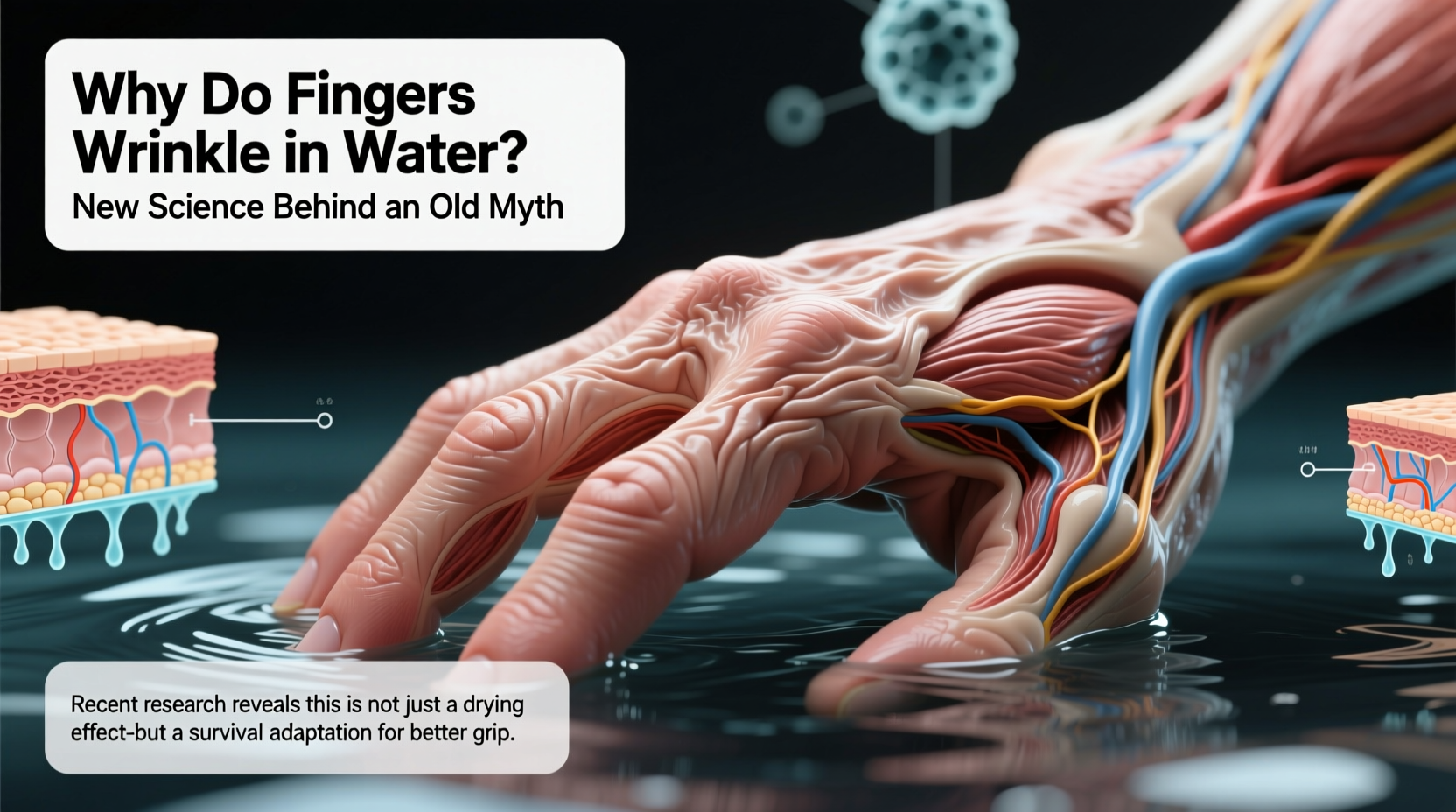
The traditional explanation for wrinkled fingers relied on basic biology. Human skin, particularly on the hands and feet, contains a thick layer of dead keratinized cells in the outermost epidermis. These cells are hydrophilic, meaning they attract and absorb water. When submerged, the theory went, these cells swell unevenly due to osmosis—the movement of water into areas of higher solute concentration. The swelling causes the skin to buckle, forming ridges and wrinkles similar to how paper warps when wet.
This explanation made intuitive sense and was widely accepted. However, it failed to account for several key observations:
- Wrinkling only occurs on the palms and soles, not on other parts of the body exposed to water.
- People with damaged peripheral nerves don’t experience wrinkling—even after prolonged immersion.
- The process takes about 3–5 minutes to begin, which is too slow for simple osmotic swelling.
- Wrinkling stops if blood flow or nerve signals to the fingers are blocked.
These inconsistencies hinted that something more complex was happening beneath the surface.
The New Science: A Neurological Response
In the early 2000s, researchers began re-examining the phenomenon with fresh eyes. A pivotal study published in 2003 by neurologists Einar Wilder-Smith and Adeline Chow demonstrated that finger wrinkling is not a passive process but a controlled physiological response mediated by the nervous system.
They observed that patients with severed median nerves—critical nerves running through the wrist to the hand—did not develop wrinkles when their hands were soaked in water. This proved that intact nerve pathways are essential for the effect. If wrinkling were purely due to water absorption, nerve damage shouldn’t prevent it. The conclusion was clear: wrinkling is an active, autonomic function.
Further research revealed that the process is driven by the sympathetic nervous system, which regulates involuntary bodily functions like heart rate, digestion, and sweat production. When fingers are immersed in water, vasoconstriction—the narrowing of blood vessels beneath the skin—is triggered. As blood volume decreases in the fingertips, the underlying tissue contracts slightly, pulling the overlying skin into folds.
“Finger wrinkling is not a sign of skin damage or saturation—it’s a finely tuned neurological adaptation.” — Dr. Mark Changizi, Cognitive Scientist and Evolutionary Biologist
An Evolutionary Advantage: Better Grip in Wet Conditions
If wrinkling is controlled by the nervous system, it must serve a purpose. In 2011, a team led by neuroscientist Tom Smulders at Newcastle University proposed a compelling hypothesis: pruney fingers act like tire treads, improving grip on wet surfaces.
To test this, they designed an experiment where participants picked up marbles from a water-filled container using either wrinkled or dry fingers. The results were striking: those with wrinkled fingers transferred the marbles 12% faster than those without. The wrinkles formed channels that drained water away from the contact surface, enhancing friction and reducing slippage—much like rain treads on car tires.
This suggests that finger and toe wrinkling evolved as an adaptive trait to help early humans handle wet objects, climb slippery trees, or gather food in rainy environments. Since the effect appears only on hands and feet—our primary tools for manipulation and locomotion—it aligns perfectly with functional evolution.
Tip: Next time you notice your fingers wrinkling in the bath, remember—it’s not a flaw, it’s a feature your body uses to improve wet-surface traction.How the Process Works: A Step-by-Step Timeline
Understanding the sequence of events helps clarify just how dynamic and precise this response is. Here's what happens when your fingers meet water:
- Contact with Water (0–60 seconds): Fingertips are submerged. Water begins interacting with the outer skin layer, but no visible change occurs yet.
- Nerve Signal Activation (1–2 minutes): Sensors in the skin detect prolonged moisture exposure and send signals via the peripheral nerves to the autonomic nervous system.
- Vasoconstriction Initiation (2–3 minutes): The sympathetic nervous system triggers constriction of small blood vessels in the fingertips, reducing blood volume beneath the skin.
- Tissue Shrinkage and Wrinkling (3–5 minutes): As the dermal layer contracts, the relatively inelastic outer skin folds into characteristic ridges.
- Peak Effect (After 5 minutes): Wrinkling stabilizes, forming efficient drainage channels across the fingertip surface.
- Drying Phase (Post-Exposure): Once removed from water, blood flow normalizes, tissues re-expand, and skin smooths out—usually within 20–30 minutes.
This timeline underscores that wrinkling isn't instantaneous or purely chemical—it’s a biologically regulated adaptation with a delay built in, likely to avoid unnecessary responses to brief water contact.
Do’s and Don’ts of Finger Immersion and Skin Health
While finger wrinkling itself is harmless and beneficial, prolonged water exposure can affect skin integrity. Use this guide to maintain healthy hands during frequent washing, swimming, or bathing.
| Do | Don’t |
|---|---|
| Limit soaking time to under 30 minutes when possible | Stay in hot baths or pools for hours without breaks |
| Moisturize hands after drying thoroughly | Use harsh soaps immediately after prolonged immersion |
| Rinse with lukewarm water instead of very hot water | Aggressively rub or peel wrinkled skin |
| Wear waterproof gloves when doing wet chores | Ignore signs of cracking or irritation post-soaking |
| Allow skin time to recover between exposures | Assume all wrinkling indicates dehydration or illness |
Real-World Implications: From Medicine to Design
The discovery that finger wrinkling is functional has implications beyond curiosity. Medical professionals now use the “wrinkle test” as a quick, non-invasive way to assess nerve and circulatory health. Absence of wrinkling may indicate conditions such as peripheral neuropathy, diabetes-related nerve damage, or Raynaud’s disease.
Moreover, engineers and designers have taken inspiration from nature. Some are developing textured gloves or footwear with biomimetic patterns modeled after pruney fingers to enhance grip in wet environments. These could benefit industries ranging from construction and maritime work to sports and robotics.
Mini Case Study: Diagnosing Nerve Damage Through Wrinkling
John, a 58-year-old diabetic patient, visited his neurologist complaining of numbness in his hands. As part of the examination, the doctor performed a simple water immersion test. After five minutes in warm water, John’s fingertips showed no signs of wrinkling—a red flag. Further tests confirmed peripheral neuropathy, a common complication of uncontrolled diabetes affecting nerve signaling. Thanks to this low-tech diagnostic clue, John began targeted treatment earlier, preventing further deterioration.
This case illustrates how a once-dismissed bodily quirk can become a valuable clinical tool.
Expert Insights on the Functionality of Pruney Fingers
Scientists continue to explore the full scope of this phenomenon. While grip enhancement remains the leading theory, some researchers suggest additional roles, such as improved tactile sensitivity in wet conditions or even thermoregulation.
“The fact that evolution preserved this trait across primates suggests it conferred a survival advantage. We’re still uncovering just how refined and useful it really is.” — Dr. Kyriacos Kareklas, Biopsychologist studying hydro-lubrication and skin adaptation
Interestingly, studies show that toes wrinkle too—though less visibly—and likely serve a similar purpose for barefoot walking on wet ground. This bilateral symmetry reinforces the idea of an evolved adaptation rather than a random side effect.
Frequently Asked Questions
Does everyone’s fingers wrinkle in water?
Most people experience finger wrinkling, but the degree and speed vary. Individuals with certain neurological conditions, such as Parkinson’s disease, multiple sclerosis, or diabetic neuropathy, may have delayed or absent wrinkling due to impaired nerve function.
Is it harmful to stay in water until my fingers wrinkle?
No, the wrinkling itself isn’t harmful. However, prolonged exposure to water—especially hot or chlorinated water—can strip natural oils from the skin, leading to dryness or irritation. It’s wise to limit extended soaking and moisturize afterward.
Can I speed up or prevent finger wrinkling?
You cannot easily prevent it if your nervous system is functioning normally. There’s no practical way to block the vasoconstriction response without medical intervention. Conversely, you can’t significantly accelerate it—it follows a natural biological timeline. However, cooler water may slow the process slightly compared to warm water.
Actionable Tips for Everyday Awareness
Tip: If you frequently wash dishes or swim, consider wearing gloves to reduce repeated wet-dry cycles that may lead to skin fatigue—even though wrinkling is protective.- Pay attention to whether your fingers wrinkle consistently—if not, consult a healthcare provider.
- Use the wrinkle response as a reminder to take breaks during prolonged water exposure.
- Teach children that “pruney fingers” are a cool example of how the body adapts—great for science discussions!
- Avoid peeling or scratching softened skin; it’s more vulnerable to microtears and infection.
- Choose moisturizers with ceramides or glycerin to restore the skin barrier after soaking.
Conclusion: Rethinking a Common Experience
What once seemed like a trivial, almost embarrassing side effect of a long bath has turned out to be one of the body’s cleverest adaptations. The wrinkling of fingers in water is not a passive soak-up of moisture but an active, evolutionarily honed response designed to improve grip in wet conditions. Controlled by the nervous system and fine-tuned over millennia, this phenomenon exemplifies how even the smallest bodily quirks can have profound functional significance.
Understanding this shift—from myth to science—doesn’t just satisfy curiosity. It changes how we view our bodies: not as static structures, but as dynamic systems constantly adapting to the environment. Whether you're reaching for a slippery glass, walking barefoot in the rain, or simply enjoying a shower, your body is silently optimizing itself for better performance.
💬 Have you noticed differences in how your fingers wrinkle? Or know someone who doesn’t wrinkle at all? Share your experiences in the comments—your story might help others recognize important health clues hidden in plain sight.