
Recovery from alcohol use disorder is rarely a straight line. Many people assume that once someone stops drinking, their emotional well-being, relationships, and daily functioning will naturally improve. But for some, sobriety arrives without inner transformation—leaving behind the bottle but carrying forward the same resentment, rigidity, defensiveness, and emotional numbness that fueled their drinking. This state is known colloquially—and clinically acknowledged—as “dry drunk syndrome.” It’s not a formal diagnosis in the DSM-5, but it’s a widely observed, deeply real phenomenon in addiction treatment circles, peer support groups, and clinical practice. Understanding dry drunk syndrome isn’t about labeling or pathologizing early recovery—it’s about recognizing warning signs before they erode progress, strain relationships, or increase relapse risk.
What Dry Drunk Syndrome Really Is (and What It Isn’t)
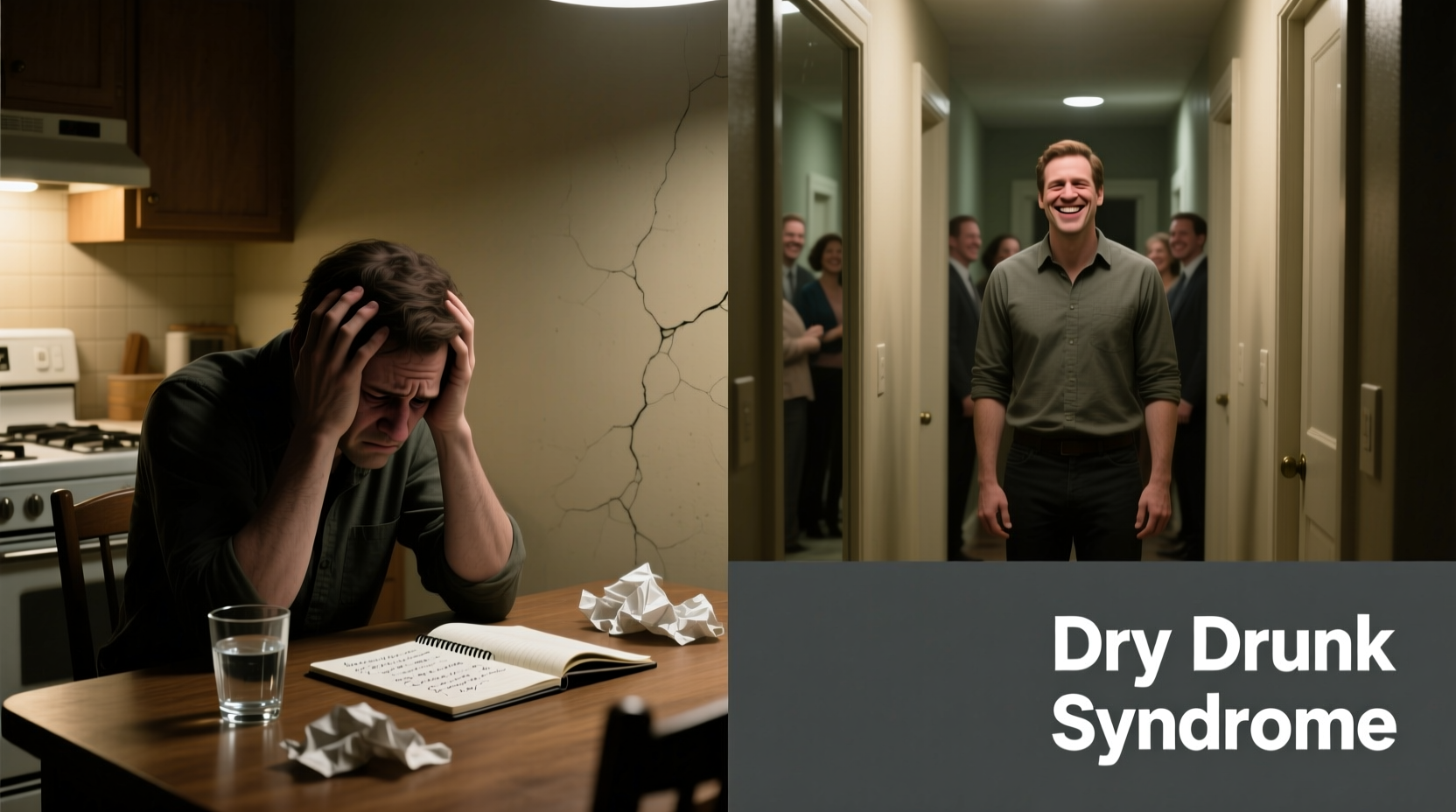
Dry drunk syndrome describes a condition where a person maintains physical abstinence from alcohol but continues to live with the cognitive, emotional, and behavioral patterns characteristic of active addiction. Think of it as sobriety without healing: the body is sober, but the mind and spirit remain stuck in survival mode—reactive, self-centered, emotionally avoidant, and spiritually disconnected. It’s not laziness. It’s not moral failure. It’s often the result of untreated co-occurring conditions (like depression, anxiety, or unresolved trauma), insufficient therapeutic support, or a narrow focus on abstinence alone—without concurrent work on emotional regulation, identity reconstruction, or relational repair.
Crucially, dry drunk syndrome differs from normal recovery discomfort. Early sobriety brings fatigue, mood swings, sleep disturbances, and irritability—many of which are neurobiological adaptations as the brain recalibrates dopamine pathways. Dry drunk syndrome goes beyond that. It reflects entrenched attitudes and habits: chronic complaining, blaming others, rigid black-and-white thinking, spiritual bypassing (“I’m sober—I don’t need therapy”), and an inability to tolerate discomfort without resentment or withdrawal.
What It Feels Like: The Internal Landscape
People experiencing dry drunk syndrome often describe a persistent sense of hollowness—not the acute craving of active addiction, but a low-grade dissatisfaction that colors everything. They may feel:
- Emotionally detached: Watching life unfold like a spectator, unable to access joy, tenderness, or even appropriate grief—even during meaningful moments like a child’s graduation or a friend’s wedding.
- Chronically irritable: Small inconveniences—a delayed text reply, a slow line at the grocery store—trigger disproportionate anger or sarcasm, followed by guilt or shame they quickly suppress.
- Mentally rigid: Believing there’s only one right way to do things (theirs), dismissing feedback as criticism, and resisting new perspectives—even helpful ones offered in therapy or meetings.
- Spiritually stagnant: Attending meetings or saying affirmations mechanically, without internal resonance—using recovery language as armor rather than invitation.
- Relationally brittle: Keeping people at arm’s length, interpreting neutral comments as attacks, or withdrawing instead of communicating needs directly.
This isn’t mere “grumpiness.” It’s the residue of years spent numbing, avoiding, and protecting oneself—now operating on autopilot in sobriety. The absence of alcohol doesn’t automatically install emotional intelligence, humility, or empathy. Those must be practiced.
Tip: If you catch yourself thinking, “I’m sober—why am I still so miserable?” or “Everyone else is the problem,” pause. That’s not weakness—it’s data. It’s your system signaling that deeper work is needed.How to Recognize It: 7 Key Signs (Beyond Just Not Drinking)
Recognition begins with honest self-assessment—not judgment, but curiosity. Below are observable indicators, grouped into behavioral, emotional, and relational categories. Note: One or two signs occasionally don’t indicate dry drunk syndrome. A persistent pattern across multiple areas does.
| Category | Signs | Why It Matters |
|---|---|---|
| Behavioral | • Over-reliance on routine to avoid uncertainty • Using caffeine, sugar, or overwork to replace alcohol’s stimulant effect • Avoiding introspective practices (journaling, meditation, therapy) |
These are substitute coping mechanisms—evidence that emotional regulation skills haven’t yet developed. |
| Emotional | • Persistent cynicism or hopelessness about recovery • Inability to sit with boredom or stillness without agitation • Emotional flatness—rarely laughing deeply or crying authentically |
Sobriety should expand emotional range, not constrict it. Flatness signals suppressed affect. |
| Relational | • Defensiveness when given constructive feedback • Withdrawing during conflict instead of engaging • Talking *about* recovery constantly—but rarely sharing vulnerably *in* recovery |
Healthy recovery deepens connection. Dry drunk patterns isolate. |
A Real Example: Maya’s First 18 Months
Maya, 38, stopped drinking after a DUI and entered a 90-day intensive outpatient program. She completed all requirements, attended AA meetings three times a week, and proudly marked her one-year chip. On paper, she was thriving. In reality, she felt increasingly alienated.
She criticized her partner’s parenting choices daily, citing “my sobriety gives me clarity.” She snapped at her teenage son for leaving dishes in the sink, then justified it as “holding boundaries.” At meetings, she’d recount past drinking stories with dark humor—but shut down when asked how she was feeling *now*. She declined therapy, insisting, “I’m not depressed—I’m just tired of everyone’s drama.”
After a blow-up with her sister over holiday plans—where Maya accused her of “not respecting my sobriety”—her sponsor gently asked, “Are you living *with* your sobriety, or just *next to* it?” That question cracked something open. Maya began seeing a trauma-informed therapist, started somatic practices to reconnect with her body, and learned to name emotions before they erupted. Six months later, she described her shift: “I used to think sobriety meant surviving without alcohol. Now I know it means learning how to be human again—with all the mess and tenderness that requires.”
What to Do Next: A 5-Step Path Out of the Dry Drunk State
Recovering from dry drunk syndrome isn’t about starting over—it’s about deepening recovery. This step-by-step approach integrates clinical insight with lived experience.
- Pause and Name It: Acknowledge without shame: “I’m abstinent, but I’m not thriving emotionally or relationally.” Write down specific examples—what happened, what you felt, how you responded. This builds metacognitive awareness.
- Expand Your Support Ecosystem: Move beyond abstinence-focused groups. Add individual therapy (especially modalities like CBT, DBT, or IFS), trauma-informed care, or mindfulness-based relapse prevention. Sobriety maintenance and emotional healing require different tools.
- Practice Micro-Emotional Experiments: Choose one small daily action to disrupt avoidance: share one authentic feeling with a trusted person; sit quietly for 90 seconds without distraction; notice bodily sensations when irritated (tight jaw? shallow breath?) and breathe into them.
- Interrogate Your Narratives: Challenge automatic thoughts. When you think, “They’re trying to control me,” ask: “What evidence supports this? What might be another explanation? How would I advise a friend in this situation?”
- Cultivate Humility Through Service (Not Performance): Serve without expectation—listen without fixing, help without highlighting your sobriety. Genuine service dissolves self-absorption. As one long-term recovery coach observes: “Humility isn’t thinking less of yourself. It’s thinking of yourself less.”
“Dry drunk syndrome is the body’s SOS signal that sobriety has outpaced self-knowledge. The antidote isn’t more willpower—it’s more presence, more compassion, and more willingness to feel what was once too dangerous to feel.” — Dr. Lena Torres, Clinical Psychologist & Addiction Specialist
FAQ: Addressing Common Questions
Is dry drunk syndrome the same as depression or anxiety?
No—but they frequently overlap. Dry drunk syndrome is a behavioral-emotional pattern rooted in unprocessed addiction-related conditioning. Clinical depression or anxiety are diagnosable conditions requiring specific treatment. However, untreated mood disorders significantly increase the risk of developing dry drunk traits. A skilled clinician can help differentiate and treat both simultaneously.
Can someone be “dry drunk” for years without realizing it?
Yes—and many do. Without external feedback or self-reflective practice, the pattern feels normal. People often mistake resentment for discernment, rigidity for strength, and emotional detachment for peace. It’s commonly identified by loved ones first—or surfaces during major life stressors (job loss, divorce, illness) that overwhelm existing coping mechanisms.
Does experiencing dry drunk syndrome mean recovery has failed?
Quite the opposite. Recognizing it is a sign of growth—not failure. It means awareness has expanded enough to see beyond the surface of abstinence. In recovery communities, this moment is often called “hitting a soft bottom”: not crisis-driven, but insight-driven. It’s where real transformation begins.
Conclusion: Sobriety Is the Beginning, Not the Destination
Dry drunk syndrome reveals a vital truth: stopping alcohol is necessary—but it’s only the first threshold. True recovery asks us to rebuild our relationship with ourselves, with others, and with uncertainty itself. It asks us to grieve the losses addiction caused, to forgive ourselves for the time lost, and to practice kindness toward the parts of us that still flinch at vulnerability. There is no shame in recognizing dry drunk traits in yourself. Shame keeps us stuck; compassionate awareness sets us free.
If this resonates, don’t wait for a crisis to deepen your recovery. Reach out to a therapist trained in addiction and trauma. Revisit your support network—not just to report sobriety milestones, but to share your real, unvarnished experience. Try one micro-experiment this week: name one feeling aloud to someone safe. Notice what arises—not to fix it, but to honor its presence.
💬 Your story matters—and it might be the exact insight someone else needs today. Share one thing you’ve learned about moving beyond abstinence into aliveness. Leave a comment and help turn recognition into collective healing.