
It’s a quiet but widespread observation: the same two glasses of wine that once felt pleasantly relaxing now leave you groggy by 9 p.m. The cocktail that fueled your late-night conversations in your thirties now triggers a headache before dessert. This isn’t just “getting older” — it’s physiology shifting beneath the surface. Alcohol tolerance doesn’t decline because willpower weakens or habits change. It declines because the human body undergoes measurable, well-documented biological transformations after age 35–40 — particularly in how it absorbs, metabolizes, distributes, and responds to ethanol. Understanding these changes isn’t about restricting pleasure; it’s about aligning behavior with biology to preserve health, cognition, sleep quality, and long-term resilience.
Why Tolerance Declines: The Four Core Physiological Shifts
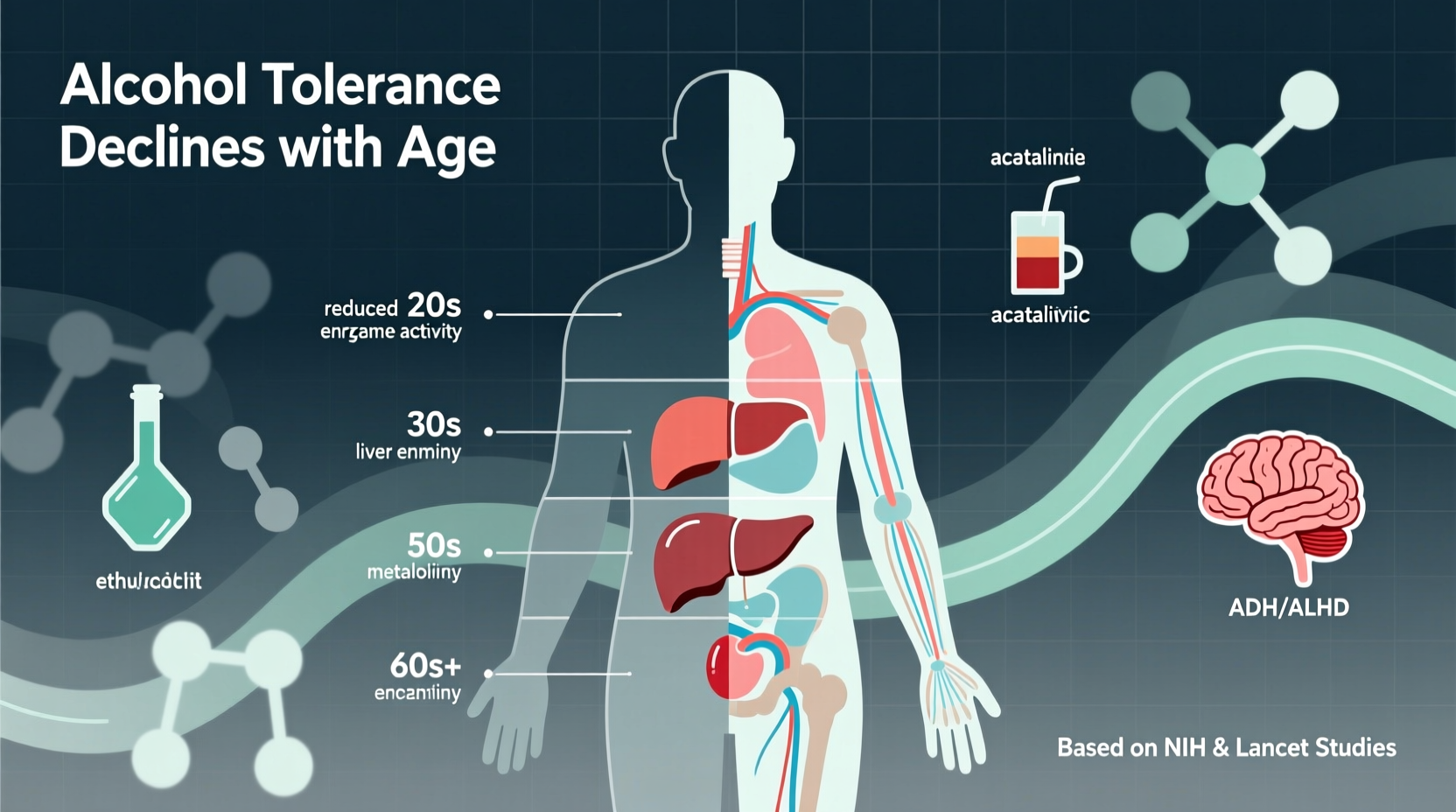
Alcohol tolerance is not a fixed trait — it’s the net result of multiple interdependent systems working in concert. With age, four key mechanisms shift in ways that consistently reduce functional tolerance:
- Reduced Total Body Water (TBW): Muscle mass gradually declines starting in the mid-30s (sarcopenia), while fat mass tends to increase. Because alcohol distributes primarily in water — not fat — older adults have less TBW per kilogram of body weight. This means the same dose of alcohol reaches higher blood concentrations faster. A 160-lb man at age 25 may have ~60% TBW (~96 L); at age 65, that drops to ~50% (~80 L). That 16-liter difference elevates peak BAC by roughly 15–20% for identical intake.
- Slowed Hepatic Metabolism: The liver’s capacity to break down alcohol via alcohol dehydrogenase (ADH) and aldehyde dehydrogenase (ALDH) enzymes diminishes. Studies show ADH activity decreases by up to 30% between ages 30 and 70. More critically, blood flow to the liver declines ~1% per year after age 40 — reducing delivery of alcohol to metabolic sites and slowing clearance rates. Mean alcohol elimination half-life increases from ~4 hours in young adults to ~6–7 hours in those over 65.
- Increased Brain Sensitivity: Aging alters GABA-A and NMDA receptor function, making neural circuits more responsive to alcohol’s sedative and disinhibitory effects. Functional MRI studies confirm heightened amygdala reactivity and reduced prefrontal cortex modulation in older adults after low-dose alcohol — explaining why judgment, reaction time, and emotional regulation deteriorate more rapidly post-drink.
- Medication & Comorbidity Interference: Over 40% of adults aged 60+ take five or more prescription medications. Many — including benzodiazepines, antidepressants, antihypertensives, and NSAIDs — potentiate alcohol’s CNS depression or hepatotoxicity. Even common OTC pain relievers like acetaminophen become significantly more dangerous when combined with regular alcohol use in aging livers.
Evidence from Longitudinal Research: What the Data Shows
Large-scale cohort studies provide consistent, real-world validation of these physiological shifts. The Framingham Heart Study tracked alcohol metabolism across 3,200 participants for over two decades. Researchers found that for every 10-year increase in age beyond 35, average BAC rose 12% higher after standardized drink challenges — independent of weight or sex. Similarly, the Baltimore Longitudinal Study of Aging observed that adults aged 60–75 required 35% less alcohol than their 25–34-year-old counterparts to reach legally impaired BAC levels (0.08%).
A 2023 meta-analysis published in Age and Ageing reviewed 27 peer-reviewed studies on age-related pharmacokinetics of ethanol. It concluded that “the decline in alcohol clearance capacity begins no later than age 40, accelerates after 55, and is clinically significant by age 60 — even in otherwise healthy individuals with normal liver enzyme panels.” Notably, this decline occurs regardless of lifetime drinking history: lifelong abstainers and light drinkers show parallel reductions in metabolic efficiency, confirming it’s driven by aging biology — not cumulative damage.
“Tolerance isn’t lost — it’s recalibrated by biology. When we tell patients ‘you can’t drink like you used to,’ we’re not judging lifestyle. We’re interpreting hard data from their liver enzymes, cerebral blood flow, and body composition. Ignoring it isn’t resilience — it’s risk.” — Dr. Lena Torres, MD, FACP, Geriatric Pharmacologist, National Institute on Aging
Practical Implications: How This Changes Real-Life Drinking
These physiological changes translate directly into tangible, everyday consequences — many of which are misattributed to stress, fatigue, or “just getting old.” Consider the following patterns backed by clinical observation and epidemiological data:
- Sleep disruption intensifies: While alcohol may help initiate sleep, its suppression of REM cycles becomes more pronounced with age. Older adults report 40% more nighttime awakenings and 55% less restorative deep sleep after evening alcohol — even at doses previously considered benign.
- Fall risk rises sharply: Balance and postural control rely on integrated vestibular, visual, and proprioceptive input — all dampened by alcohol. Among adults 65+, alcohol contributes to nearly 22% of fall-related emergency department visits, despite representing only 12% of total beverage consumption in that demographic.
- Medication interactions escalate silently: A daily low-dose aspirin regimen combined with two glasses of wine increases gastric bleeding risk 3.2-fold in adults over 60 — compared to 1.8-fold in younger cohorts — due to age-related mucosal thinning and reduced platelet recovery.
- Cognitive recovery slows: Reaction time and working memory deficits persist for up to 48 hours after moderate intake in adults over 55 — versus 24 hours in those under 40 — reflecting slower neurotransmitter rebalancing and reduced neuroplastic reserve.
Actionable Strategies: Adapting Your Habits Based on Evidence
Knowledge without application has limited value. Below is a step-by-step framework grounded in geriatric pharmacology and behavioral health research — designed not to eliminate choice, but to restore agency through informed adaptation.
Step 1: Recalculate Your “Standard Drink”
Forget volume-based rules (“two glasses”). Use ethanol grams instead. One true standard drink in the U.S. contains 14 g ethanol — but serving sizes vary wildly: • 5 oz wine (12% ABV) = ~14 g • 12 oz beer (5% ABV) = ~14 g • 1.5 oz spirits (40% ABV) = ~14 g Many restaurant pours exceed these by 30–60%. Measure once at home with a jigger to recalibrate your eye.
Step 2: Implement the “3-Hour Rule”
Allow ≥3 hours between drinks — not for “sobering up,” but to let your liver process each dose fully. With age-related clearance slowdown, stacking drinks overwhelms enzymatic capacity, causing acetaldehyde buildup (responsible for nausea, flushing, and inflammation).
Step 3: Prioritize Hydration Timing
Drink one full 8-oz glass of water before your first alcoholic beverage, and another between each drink. This counters age-related thirst dysregulation and reduces BAC elevation by diluting gastric absorption.
Step 4: Audit Medications Quarterly
Bring all prescriptions, OTCs, and supplements to your annual physical — and ask specifically: “Could any of these interact negatively with alcohol, even at low doses?” Flag high-risk combinations (e.g., gabapentin + alcohol, warfarin + wine, metformin + spirits) with your pharmacist.
Step 5: Track Response, Not Just Intake
Maintain a simple log for two weeks: time of first drink, quantity (in grams), food consumed, medications taken, and subjective effects (e.g., “slurred speech by 8:15,” “fell asleep at 8:45,” “woke at 2:30 a.m. unable to return to sleep”). Patterns emerge faster than assumptions.
What’s Safe? A Science-Based Guideline Table
Public health guidelines (e.g., U.S. Dietary Guidelines) recommend ≤1 drink/day for women and ≤2 for men — but these were developed for population-level risk reduction, not individual physiology. The table below reflects evidence-based thresholds tied to measurable outcomes in adults aged 40–75:
| Age Group | Max Daily Ethanol (g) | Corresponding Risk Threshold | Strongly Discouraged If Present |
|---|---|---|---|
| 40–54 | 10–12 g (≈1 standard drink) | BAC rarely exceeds 0.03%; minimal impact on next-day cognition | Hypertension, GERD, regular NSAID use |
| 55–69 | 7–10 g (≈½–1 standard drink) | Preserves sleep architecture >85%; fall risk remains near baseline | Diabetes, atrial fibrillation, statin therapy |
| 70+ | 0–7 g (occasional ½ drink, never daily) | No measurable increase in dementia progression risk over 5 years | Any history of falls, mild cognitive impairment, chronic kidney disease |
Mini Case Study: Maria, 62, Retired Teacher
Maria enjoyed wine with dinner for 30 years — usually two 5-oz glasses of pinot noir. At 60, she began noticing she’d wake exhausted, skip morning yoga, and feel irritable by noon. Her doctor ruled out thyroid issues and sleep apnea. When Maria logged her intake and symptoms, she discovered her restaurant pours averaged 7 oz — delivering ~20 g ethanol nightly. She switched to measured 4-oz servings (11 g), added water before and between, and stopped drinking after 7 p.m. Within three weeks, her energy returned, and her blood pressure dropped 8/4 mmHg. Crucially, she didn’t stop drinking — she optimized it using her body’s new parameters.
FAQ: Addressing Common Concerns
Can I rebuild my tolerance with “practice”?
No — and attempting to do so is medically inadvisable. Unlike muscle adaptation, hepatic enzyme induction (e.g., CYP2E1 upregulation) increases oxidative stress and accelerates liver fibrosis in aging tissue. What feels like “rebuilding tolerance” is often masking early-stage organ strain. True metabolic resilience comes from supporting liver health (adequate protein, B vitamins, antioxidants), not pushing limits.
Does genetics play a bigger role than age?
Genetics influence baseline metabolism — e.g., ALDH2*2 variant causes severe flushing in ~40% of East Asians — but age-related decline affects everyone, regardless of ancestry. A fast-metabolizing 25-year-old still experiences steeper clearance reduction between 50–70 than a slow-metabolizing peer. Age compounds genetic predisposition; it doesn’t override it.
Is “low-alcohol” or “non-alcoholic” wine a safe alternative?
Most non-alcoholic wines contain 0.5% ABV — meaning a 5-oz serving delivers ~0.2 g ethanol. For most adults over 60, this is physiologically negligible. However, check labels: some “alcohol-removed” products retain histamines and sulfites linked to headaches and inflammation — independent of ethanol. Opt for certified NA wines with <0.05% ABV and minimal additives if sensitive.
Conclusion: Aligning Choice With Biology
Alcohol tolerance changes with age not as a limitation — but as vital feedback. It’s your body communicating shifts in hydration balance, enzymatic efficiency, neural responsiveness, and systemic vulnerability. Dismissing these signals risks more than a rough morning: it erodes sleep architecture, accelerates cognitive decline, strains cardiovascular resilience, and amplifies medication hazards — all quietly, cumulatively, and preventably. The science is unequivocal: adaptation isn’t surrender. It’s precision. It’s choosing a 4-ounce pour over a 7-ounce habit. It’s pairing wine with protein instead of sipping on an empty stomach. It’s pausing to ask, “What does my body need *today*?” — not comparing it to who you were at 35. Your relationship with alcohol doesn’t need to end. It needs to evolve — with respect, awareness, and the quiet confidence that comes from honoring your biology, not fighting it.
💬 Your experience matters. Have you noticed shifts in how alcohol affects you after 40? Share one practical adjustment you’ve made — your insight could help someone else navigate this transition with clarity and care.








