Walk into a high-end bar in Portland, Brooklyn, or London today—and you might be handed a glass of house-made rosemary shrub, cold-pressed cucumber water, and activated charcoal–infused bitters before you’ve even seen a bottle of gin. Zero-proof bars—dedicated venues serving no-alcohol beverages with the sophistication, intentionality, and theater of craft cocktail programs—are no longer niche experiments. They’re opening in prime real estate, earning press accolades, and drawing crowds that include sober-curious professionals, recovering individuals, pregnant guests, and health-conscious diners who refuse to settle for flat ginger ale or over-sweetened mocktails.
Yet skepticism remains. Can a beverage without ethanol—without the physiological lift, the subtle numbing warmth, the centuries-old cultural weight of spirits—ever deliver the same depth, complexity, or emotional resonance as a properly balanced Old Fashioned or a smoky Mezcal Negroni? The answer isn’t binary. It’s evolving—and it’s being written not in labs or boardrooms, but behind bars where bartenders are redefining what “craft” means when alcohol is deliberately absent.
The Flavor Gap Is Closing—Fast
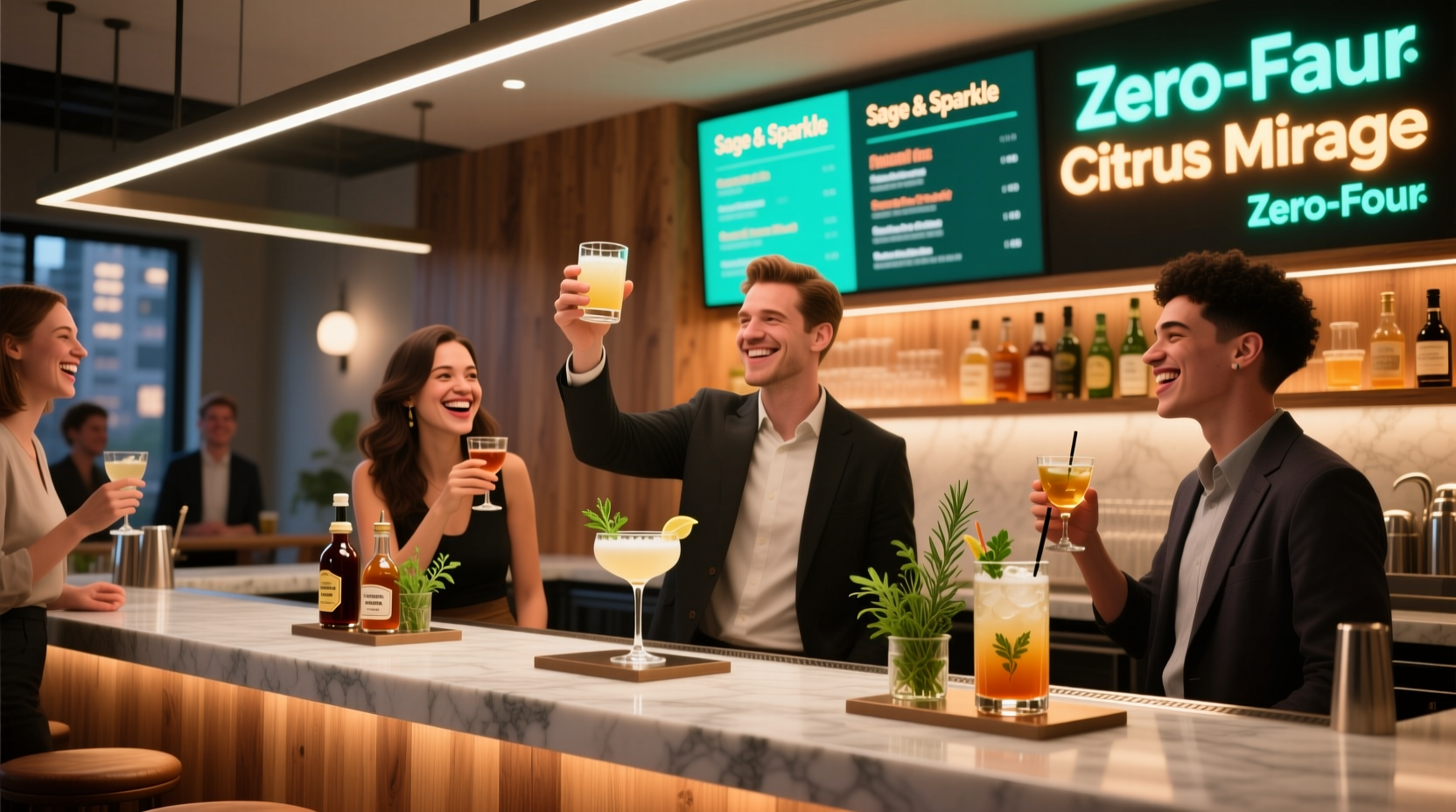
For years, nonalcoholic options suffered from three persistent flaws: cloying sweetness, artificial aftertastes, and one-dimensional profiles. Modern zero-proof bars have moved decisively beyond syrupy “virgin” versions of classic drinks. Instead, they deploy techniques borrowed from fermentation, distillation, and culinary science: house-made shrubs aged for weeks; vacuum-infused botanicals; clarified juices; fat-washed nonalcoholic bases; and precision acid adjustments using citric, malic, and tartaric acids.
Consider the role of ethanol itself—not just as a solvent, but as a flavor carrier and textural enhancer. Without it, bartenders must reconstruct mouthfeel and aromatic diffusion using alternatives: gum arabic for viscosity, xanthan gum for body, cold-brewed tea tannins for grip, and toasted seed oils (like sesame or pumpkin) for umami depth. The result? Drinks that linger, evolve on the palate, and invite contemplation—not just quenching.
Tip: When building zero-proof drinks, treat acidity and bitterness as structural pillars—not afterthoughts. A 0.3% citric acid solution can lift a flat herbal blend more effectively than doubling the sweetener.Consumer Demand Is Structural—Not Seasonal
This isn’t a pandemic-era blip. Data from the International Wine & Spirit Research (IWSR) shows that global no- and low-alcohol beverage volume grew 11.4% between 2021 and 2023—outpacing total alcohol growth by more than 7 percentage points. Crucially, this expansion is driven by demographics with long-term spending power: 34% of U.S. adults aged 25–34 now identify as “sober-curious,” per a 2024 Morning Consult survey—and 68% say they’d pay a premium for thoughtfully crafted nonalcoholic options at restaurants and bars.
What’s shifting isn’t just behavior—it’s expectation. Diners no longer accept “the mocktail special” as an afterthought scribbled on a chalkboard. They expect seasonality, provenance, and narrative: “This blackberry-lavender spritz uses fruit from a regenerative farm 12 miles north, fermented with wild yeast captured in our rooftop garden.” That level of storytelling—and execution—is now table stakes.
Operational Realities: Where Zero-Proof Bars Excel (and Struggle)
Opening a zero-proof bar presents distinct advantages—and unique hurdles—compared to traditional cocktail venues.
| Factor | Traditional Cocktail Bar | Zero-Proof Bar |
|---|---|---|
| Licensing & Compliance | Complex liquor licensing, strict ID checks, insurance premiums 2–3× higher | No liquor license required; lower liability insurance; simplified staff training |
| Ingredient Shelf Life | Spirits last indefinitely; fresh juices require daily prep | No shelf-stable spirits—but many house-made syrups, shrubs, and ferments improve with age (2–8 weeks) |
| Margin Structure | High gross margins on spirits (70–80%), but significant overhead (taxes, security, compliance) | Lower ingredient cost per serve, but higher labor input (fermentation, clarification, infusion); margins stabilize at 65–75% with scale |
| Staff Training Focus | Cocktail technique, spirit knowledge, service speed | Botanical literacy, fermentation science, sensory calibration, nonalcoholic pairing logic |
| Customer Journey | Often centered on intoxication trajectory (“first drink,” “nightcap”) | Centered on intention: digestion, hydration, focus, recovery, or ritual without impairment |
The most successful zero-proof bars don’t position themselves as “alcohol-free alternatives.” They build identity around function and philosophy: The Philadelphia-based *Aether* opens at 4 p.m. for post-work decompression, offering drinks formulated with adaptogens and nervines. In Austin, *Soleil* pairs each zero-proof creation with a specific breathwork prompt printed on the coaster—turning consumption into embodied practice.
A Real-World Case Study: “The Uncommon Ground” in Seattle
When former James Beard-nominated bartender Lena Cho closed her acclaimed rum-focused bar in 2022, industry insiders assumed retirement—or a pivot to consulting. Instead, she launched *The Uncommon Ground*: a 32-seat zero-proof bar in Seattle’s Capitol Hill neighborhood, operating without a single drop of ethanol on premises.
Cho’s model defied early assumptions. She invested $42,000 in a commercial-grade centrifuge for juice clarification and partnered with a local mycologist to develop mushroom-based “umami broths” that mimic the savory depth of aged spirits. Her menu rotates quarterly—and never references alcoholic drinks. Instead of “No-Gin Fizz,” guests choose “Coastal Fog”: seaweed-infused aquafaba, cold-distilled coastal mint, roasted pear vinegar, and a saline mist applied tableside.
Within eight months, *The Uncommon Ground* achieved 92% occupancy on weekends and attracted 40% of its clientele from outside the immediate neighborhood—including regular visits from physicians, therapists, and addiction counselors referring clients seeking safe, dignified social spaces. Revenue per seat exceeds Seattle’s cocktail bar average by 18%, driven by higher average check ($24.70 vs. $20.90) and extended dwell time (82 minutes vs. 58).
“People don’t come here to avoid alcohol,” Cho explains. “They come because they want something *more*—more attention to their physiology, more respect for their choices, more craftsmanship in the glass. Removing ethanol didn’t simplify the work. It deepened it.”
Expert Insight: The Science Behind Satisfaction
“The brain doesn’t crave ‘alcohol’—it craves pattern recognition, novelty, and neurochemical reward. A well-structured zero-proof drink delivers dopamine through anticipation (the ritual of preparation), serotonin via complex aromatics (limonene in citrus peel, linalool in lavender), and GABA modulation through bitter compounds like gentian root. You’re not replacing ethanol—you’re redesigning the entire reward pathway.” — Dr. Aris Thorne, Neurogastronomy Researcher, Stanford Food Lab
This reframing is critical. It moves the conversation away from substitution (“What does this taste *like*?”) toward intention (“What does this help me *feel*?”). Bartenders at leading zero-proof venues now study aroma chemistry, trigeminal nerve stimulation (how carbonation or spice creates “heat” or “tingle”), and the psychology of satiety—understanding that a 12-ounce drink with 3 grams of fiber and 200mg of magnesium may satisfy a guest more durably than a 2-ounce spirit-forward cocktail.
Building a Competitive Zero-Proof Program: A 5-Step Framework
- Define Your Functional Intent: Is your program designed for recovery, focus, digestion, celebration, or social lubrication? Each requires different flavor profiles, textures, and serving formats (e.g., effervescent for energy, viscous and warm for comfort).
- Master Three Foundational Bases: Develop at least one house-made shrub (vinegar + fruit + sweetener), one botanical infusion (cold or hot, strained or suspended), and one texture modulator (gum arabic syrup, clarified coconut water, or fermented grain broth).
- Train Staff in Sensory Literacy: Conduct weekly blind tastings—not of spirits, but of raw ingredients: dried chamomile vs. fresh; roasted vs. raw caraway; different grades of sea salt. Build vocabulary beyond “sweet” and “bitter.”
- Design for Ritual: Incorporate at least one theatrical element per drink—dry ice vapor, hand-peeled citrus zest expressed over the glass, custom glassware chilled to precise temperatures. The absence of alcohol heightens attention to process.
- Integrate with Food & Environment: Collaborate with chefs on shared pantry items (e.g., pickling brines used in both dishes and drinks); use lighting, acoustics, and seating layout to support the intended physiological outcome (calm, energized, grounded).
FAQ
Do zero-proof bars attract enough customers to sustain profitability?
Yes—when positioned intentionally. Leading operators report 65–75% repeat visitation within three months, driven by functional loyalty (e.g., “I come every Tuesday for the Digestif Flight before yoga”). Average spend is often higher than traditional bars because guests order multiple smaller-format drinks across longer visits—and add-ons like house-made snacks or take-home shrub kits boost revenue.
Can zero-proof drinks truly replicate the “buzz” or relaxation of alcohol?
Not physiologically—but they can deliver comparable subjective effects through evidence-based design. Adaptogenic herbs (ashwagandha, rhodiola), magnesium-rich mineral waters, L-theanine from shaded green teas, and gentle carbonation all influence nervous system tone. The key is transparency: ethical zero-proof bars disclose ingredients and avoid unsubstantiated “relaxation” claims.
Is staffing more demanding for zero-proof programs?
Initially, yes—due to the need for fermentation monitoring, pH testing, and botanical sourcing. But once systems are standardized, labor becomes more predictable. There’s no inventory loss from spillage or over-pouring, no late-night security concerns, and significantly lower staff turnover linked to burnout and secondary trauma common in high-alcohol environments.
The Verdict: Competition or Coexistence?
Zero-proof bars aren’t competing with traditional cocktail programs in a zero-sum game. They’re expanding the definition of what a bar can be—and who it serves. The most forward-thinking hospitality groups now operate hybrid models: *The Juniper Room* in Denver dedicates 40% of its menu to zero-proof offerings, with identical pricing, identical glassware, and identical service rigor as its spirit-based counterparts. Their data shows zero-proof orders account for 28% of total beverage revenue—and drive a 33% increase in overall table turnover, as guests feel comfortable ordering multiple rounds without concern for impairment.
What’s emerging isn’t replacement, but recalibration. As consumers grow more discerning about what they ingest—and why—the bar industry faces a choice: continue optimizing for ethanol delivery, or deepen its commitment to holistic human experience. The rise of zero-proof bars signals that the latter path isn’t just viable—it’s increasingly essential.
💬 Your perspective matters. Whether you’ve launched a zero-proof concept, trained staff in nonalcoholic service, or simply noticed a shift in your local bar scene—share your insights in the comments. Let’s build a more inclusive, intentional, and flavorful future for hospitality—together.