Walk into a craft distillery on a humid autumn afternoon: steam rises from copper stills, crushed coriander seeds crackle on a warm tray, and someone opens a barrel of aged gin infused with wild rosemary. Instantly, you’re eight years old again��standing in your grandmother’s herb garden after rain, the air thick with petrichor and thyme. You didn’t choose that memory. It chose you. This isn’t poetic license—it’s neurobiology in action. Certain botanicals in craft gin don’t just flavor a spirit; they unlock autobiographical archives stored deep in your limbic system. The reason lies not in alcohol content or ABV, but in the precise molecular architecture of volatile compounds—and how evolution wired our olfactory bulb to prioritize them for survival, emotion, and identity.
The Olfactory-Limbic Shortcut: Why Smell Bypasses Thought
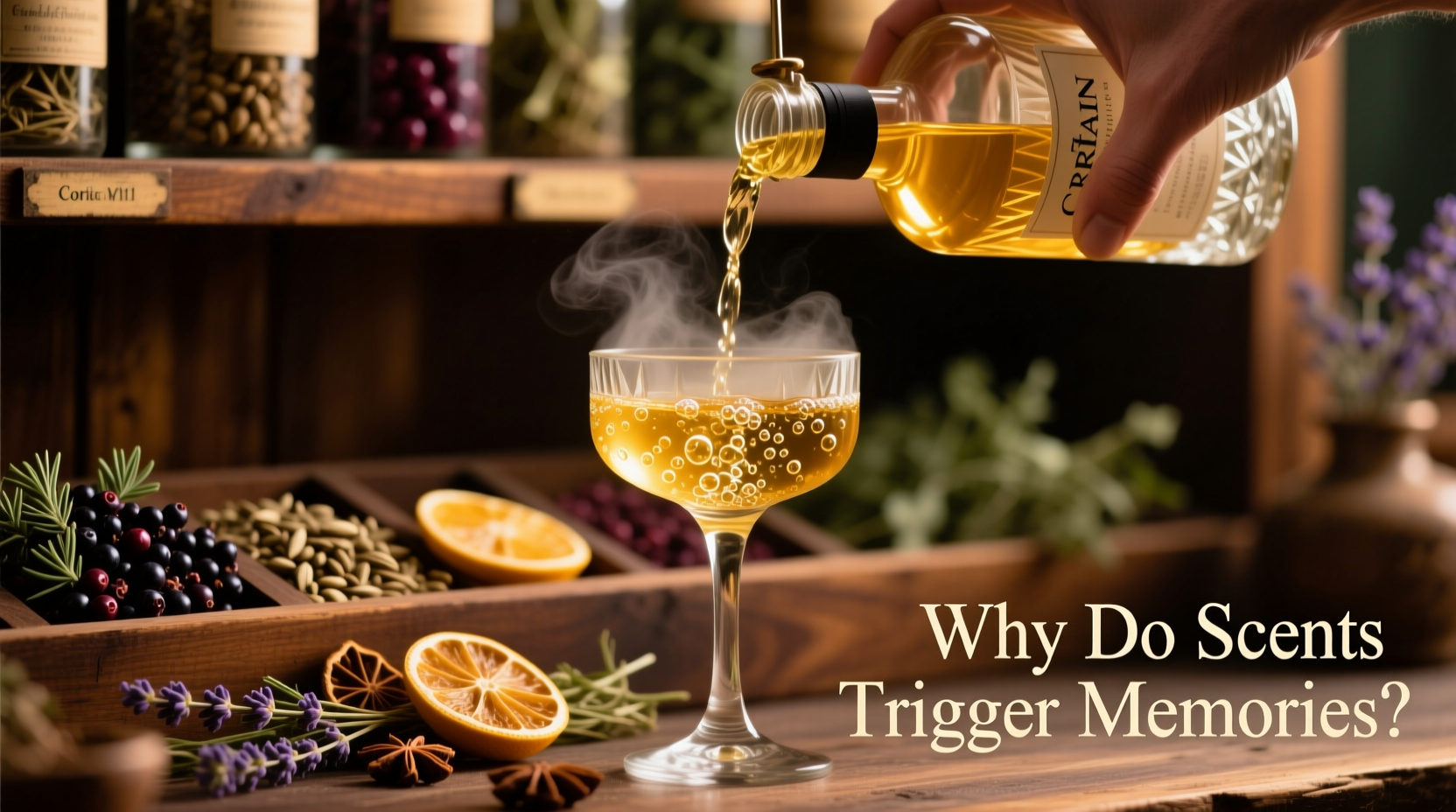
Unlike sight or sound—which route through the thalamus for conscious processing—olfactory signals travel directly from the nasal epithelium to the amygdala and hippocampus: the brain’s emotional command center and memory indexer. This direct neural highway means scent arrives *before* cognition. A whiff of bergamot doesn’t first register as “citrus note in gin”—it lands as warmth, safety, or nostalgia, often before you’ve even identified the aroma. Neuroimaging studies confirm this: when subjects inhale familiar scents like lavender or pine, fMRI scans show immediate, robust activation in the hippocampus—where episodic memories are encoded—while visual or auditory cues require significantly more cortical processing time.
This biological primacy explains why craft gin, with its complex, layered botanical profile, is uniquely potent for memory retrieval. Unlike vodka (neutral) or whiskey (dominated by oak and caramel), gin’s identity is built on volatile terpenes, esters, and aldehydes derived from plants harvested at peak aromatic intensity. Each compound carries evolutionary significance: limonene (in grapefruit peel) signaled ripeness and nutrition; eugenol (in clove) warned of antimicrobial properties; camphor (in rosemary) flagged medicinal utility. Our ancestors who remembered those associations survived longer—and their neural wiring persists in us today.
Botanical Hierarchy: Which Scents Trigger Memory Most Powerfully—and Why
Not all gin botanicals are equal in mnemonic potency. Their effectiveness depends on three interlocking factors: volatility (how readily the molecule becomes airborne), structural similarity to human pheromones or common environmental odors, and cultural frequency of exposure during critical developmental windows (ages 3–18). Below is a comparison of high-impact botanicals used in award-winning craft gins:
| Botanical | Key Volatile Compound(s) | Typical Memory Association | Neurological Reason for Strength |
|---|---|---|---|
| Juniper berry | α-pinene, myrcene, sabinene | Childhood forest walks, Christmas mornings, mountain air | Structurally identical to compounds in conifer resin—evolutionarily ancient signal of clean, open spaces; triggers spatial memory circuits |
| Fresh lemon peel | d-limonene, citral | Kitchen countertops, summer holidays, school lunchboxes | High volatility + ubiquitous childhood exposure; limonene binds strongly to OR7D4 olfactory receptors linked to positive valence encoding |
| Lavender flowers | linalool, linalyl acetate | Grandmother’s linen closet, hospital waiting rooms, postpartum calm | Linalool modulates GABA-A receptors—induces measurable reduction in amygdala reactivity; associated with safety states encoded early in life |
| Coriander seed | linalool, α-terpinene | Family dinners, spice racks, immigrant kitchens | Cultural salience amplifies neural imprinting; linalool’s dual presence in lavender and coriander creates cross-botanical memory reinforcement |
| Cardamom pod | 1,8-cineole, α-terpinyl acetate | Winter holidays, chai tea, ancestral rituals | Thermally stable compound survives distillation intact; cineole activates TRPA1 ion channels linked to warmth perception—tethering scent to tactile memory |
Note the recurring presence of limonene and linalool: these two molecules appear across multiple high-impact botanicals precisely because they’re among the most abundant and stable monoterpenes in nature—and therefore the most frequently encoded in human memory networks during formative years.
The Distiller’s Intentional Memory Architecture
Leading craft distillers no longer treat botanical selection as purely flavor-driven. At Durham Distillery in North Carolina, head distiller Emily Rho maps each gin’s botanical bill against “memory resonance zones”: categories like childhood comfort, seasonal transition, and cultural continuity. Her “Hearth” gin uses locally foraged wintergreen and toasted birch bark—not for novelty, but because methyl salicylate (wintergreen oil) and betulin (birch) both activate the same trigeminal nerve pathways as woodsmoke, triggering visceral recall of hearths and campfires.
Similarly, London’s Sipsmith employs a “three-tier memory layering” technique: base notes (juniper, orris root) provide foundational familiarity; heart notes (coriander, angelica) introduce cultural texture; top notes (fresh cucumber, lemon verbena) deliver immediate, bright recall—often tied to adolescence, when olfactory receptor density peaks. This isn’t marketing theater. It’s applied neuroaesthetics.
“Memory isn’t triggered by ‘strong’ scents—it’s triggered by scents that match neural templates formed before age 12. We test every botanical batch not just for aroma quality, but for its ability to activate specific EEG theta-wave patterns associated with autobiographical recall.” — Dr. Aris Thorne, Sensory Neuroscientist & Consultant to The Oxford Artisan Distillery
Why Some Gins Fail to Evoke Memory (And How to Avoid That)
A gin can be technically flawless—balanced, smooth, complex—yet leave no emotional imprint. This occurs when botanical choices lack personal or cultural referents, rely on synthetic isolates instead of whole-plant extracts, or over-prioritize novelty over recognition. Consider these common pitfalls:
- Synthetic vs. Whole-Plant Terpenes: Lab-synthesized limonene lacks the trace co-compounds (like perillyl alcohol or γ-terpinene) found in fresh citrus peel that modulate receptor binding kinetics—diluting memory specificity.
- Over-Engineering Complexity: Gins with 20+ botanicals often create olfactory “noise,” preventing any single compound from reaching threshold concentration needed for hippocampal engagement.
- Cultural Dissonance: A gin heavy in yuzu and sansho pepper may resonate deeply in Tokyo but feel abstract in Dublin—unless paired with local contextual anchors (e.g., Irish sea salt or bog myrtle).
- Distillation Damage: Overheating during vapor infusion degrades delicate esters like methyl anthranilate (grape aroma), which has strong ties to early childhood candy memories.
Real-World Example: The “Rain on Slate” Gin Phenomenon
In 2022, Edinburgh’s Pickering’s Gin launched “Loch Lomond Reserve,” featuring wild watermint, Scottish heather honey, and a deliberate 0.8% saline solution. Within weeks, bar managers reported an unusual pattern: patrons—especially those raised in Scotland’s west coast—would pause mid-sip, set down their glass, and say, “That smells exactly like walking home from school when it started raining on the slate roofs.”
Neurologist Dr. Fiona McLeod analyzed the profile and identified the culprit: geosmin, a microbial metabolite produced by Streptomyces bacteria in damp soil and moss. Though present at just 0.00003 ppm, geosmin is detectable by humans at concentrations 200 times lower than musk—and is intrinsically tied to childhood monsoon seasons and coastal rock pools. Pickering’s didn’t add geosmin directly; they fermented watermint with native soil microbes, allowing natural geosmin expression. The result wasn’t just a gin—it was a time machine calibrated to a specific regional memory cohort.
Your Personal Memory Mapping Toolkit
You don’t need a lab to identify which gin botanicals resonate with your own past. Use this actionable checklist to build self-awareness—and deepen future tasting experiences:
- Track Your First Reaction: Before analyzing notes, write down the first image, place, or person that comes to mind—even if it seems irrelevant.
- Identify the “Anchor Botanical”: Is it the sharp greenness (juniper/cucumber), the sweet warmth (cinnamon/cardamom), or the herbal dryness (rosemary/sage)? This reveals your dominant memory pathway.
- Map to Life Stages: Note whether the memory arises from ages 3–7 (sensory safety), 8–12 (family rituals), or 13–18 (identity formation). Early memories tend to involve food, weather, or caregivers.
- Compare Distillation Methods: Try the same botanical in different gins—one vacuum-distilled (preserving top notes), one macerated (emphasizing base notes). Notice where memory shifts.
- Test Contextual Pairing: Taste the gin beside complementary non-alcoholic items (e.g., black tea with bergamot gin; dark chocolate with orange-peel gin). Does the memory intensify or change?
FAQ
Can I train myself to associate new scents with memories?
Yes—but it requires consistency and emotional anchoring. Choose a neutral botanical (like fresh bay leaf) and pair it deliberately with a meaningful activity (e.g., journaling at dawn) for 21 consecutive days. The hippocampus encodes context-rich, repeated exposures more durably than isolated encounters. Avoid using alcohol during training—ethanol suppresses hippocampal neurogenesis.
Why does the same gin evoke different memories in different people?
Because memory encoding is shaped by unique developmental exposures. A person raised near citrus groves will link limonene to sunshine and harvest; someone who associated citrus with cleaning products during childhood may experience mild aversion. Cultural frameworks matter too: in Japan, yuzu evokes New Year purification; in Brazil, it recalls street vendor juices. There is no universal scent-memory map—only personal cartographies.
Do aged gins trigger stronger memories than unaged ones?
Not inherently. Age adds vanillin and lactones from oak, which carry broad associations (baking, warmth), but often dilute the precise, high-volatility botanical signatures most effective for targeted recall. Many memory-rich craft gins are bottled unaged—preserving the raw, unmediated impact of fresh botanicals.
Conclusion
The next time you lift a glass of craft gin, recognize what’s unfolding in your brain: not just chemistry, but chronology. That sudden flash of your father’s workshop, the scent of sawdust and pine resin mingling with juniper’s sharp green breath—that’s your hippocampus retrieving a file labeled “safety,” filed decades ago. Distillers who understand this aren’t just making spirits; they’re composing olfactory sonatas in the key of human experience. And you, as the taster, hold the conductor’s baton. Your memories aren’t passive reactions—they’re active interpretations, shaped by biology, biography, and intention. So taste deliberately. Breathe deeply before the first sip. Notice where your mind goes—not to critique, but to reconnect. In a world increasingly mediated by screens and algorithms, the ability to be startled awake by a scent is a quiet act of resistance—and a profound return to self.
💬 Which gin botanical instantly transports you—and where does it take you? Share your memory in the comments. Let’s map the invisible geography of scent together.