
At first glance, a smart bottle opener that logs every twist, counts uncorked bottles, and syncs data to an app feels like a solution in search of a problem. Yet behind the novelty lies a quiet convergence of trends: precision consumption tracking, digital wellness tools, commercial inventory management, and the rise of connected home bar ecosystems. This isn’t just about opening wine—it’s about understanding habits, optimizing operations, and measuring what was once invisible. Unlike Bluetooth-enabled kettles or Wi-Fi scales—devices with clear functional upgrades—smart openers sit at the intersection of behavioral insight and mechanical simplicity. To assess their value, we must move beyond gadget hype and ask: Who benefits meaningfully from knowing *how often* and *when* a bottle was opened? And more importantly—what problems does that data actually solve?
The Core Functionality: Beyond the “Smart” Label
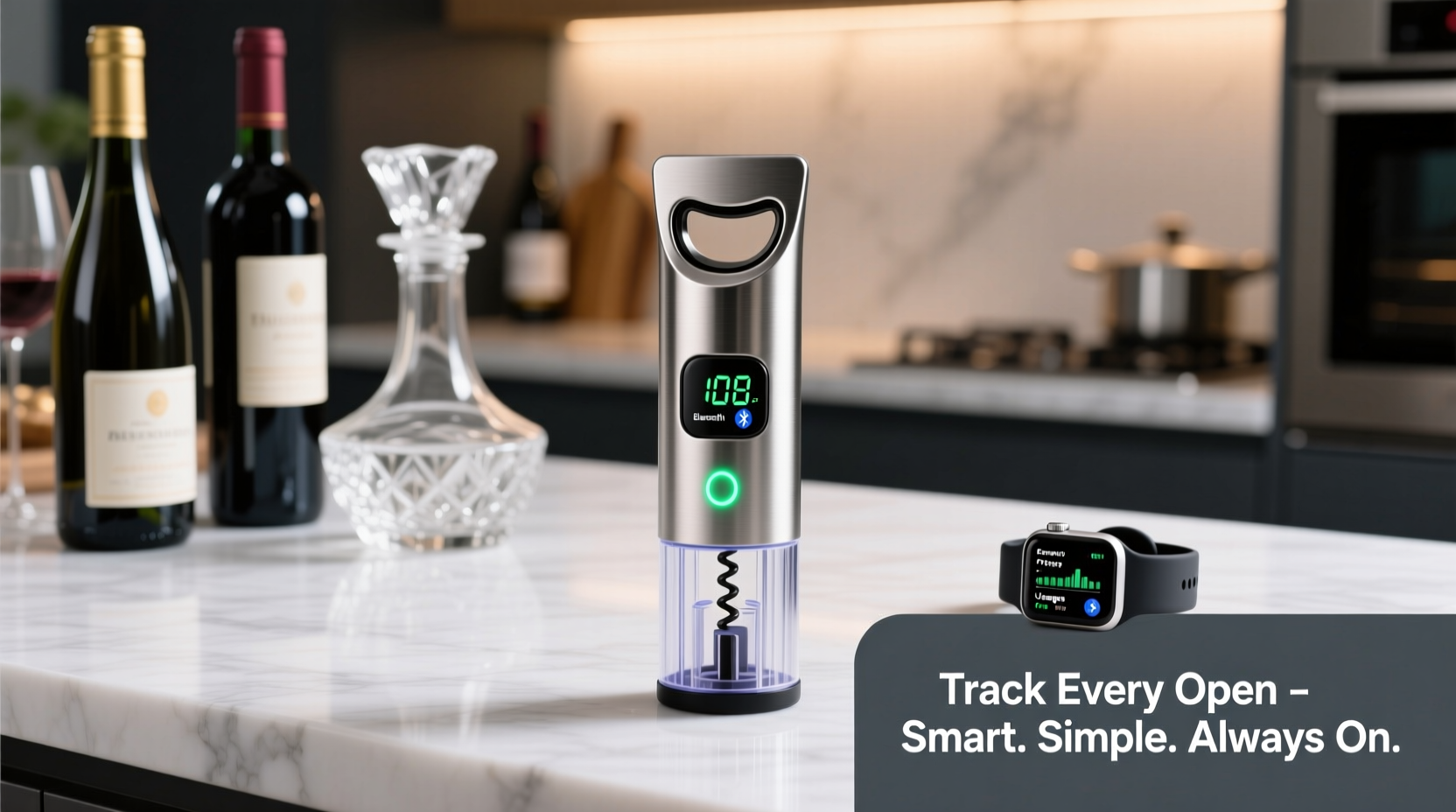
Today’s smart bottle openers—such as the VinoTrack Pro, CorkLog One, and BarMetrics Opener—combine three foundational elements: a high-torque motorized or assisted mechanical system (for corkscrews or cap lifters), embedded motion and pressure sensors, and Bluetooth Low Energy (BLE) connectivity to iOS/Android apps. Most do not require charging after initial setup; many use replaceable CR2032 batteries lasting 12–18 months. The tracking logic is intentionally conservative: a valid “open event” registers only when torque exceeds a calibrated threshold (e.g., 3.2 N·m sustained for >1.4 seconds), followed by a rapid release signal—filtering out accidental taps or misfires.
Data captured includes timestamp, bottle type (manually selected or auto-detected via NFC tags on premium bottles), estimated alcohol volume (based on user-defined bottle size), and optional notes (e.g., “dinner party,” “tasting notes”). Some models integrate with third-party platforms like MyFitnessPal or Habitica, allowing users to log units of alcohol alongside hydration or sleep metrics.
Tip: For reliable tracking, calibrate your opener’s sensitivity setting during the first five uses—especially if switching between natural cork, synthetic stoppers, and screw caps. Overly aggressive thresholds may miss lightweight openings; too low, and shelf vibrations can trigger false positives.Who Actually Benefits? A Reality-Based Use Case Breakdown
Marketing materials often target “wine enthusiasts” or “health-conscious millennials”—broad categories that obscure real utility. Let’s map actual user profiles to tangible outcomes:
- Home mixologists and serious hobbyists: Those maintaining personal tasting journals, building cellars, or preparing for WSET certification. Tracking uncorked bottles helps correlate exposure frequency with palate fatigue, note consistency, and aging observations.
- Small-batch beverage producers: Craft cider makers, natural wine labels, and kombucha brewers using direct-to-consumer fulfillment. Openers placed in sample kits let them verify unboxing and first-use timing—critical for quality control and shelf-life validation.
- Hospitality managers (bars, boutique hotels, B&Bs): Not for guest-facing use—but for back-of-house staff training and inventory reconciliation. When paired with pour spouts and keg trackers, opener logs help flag discrepancies: e.g., 12 bottles logged as opened but only 8 accounted for in sales reports suggests potential diversion or waste.
- Clinical nutrition and recovery support professionals: Registered dietitians working with clients managing alcohol intake as part of metabolic health plans (e.g., NAFLD, hypertension, insulin resistance). Objective opener data—rather than self-reported diaries—provides non-judgmental, time-stamped behavioral baselines.
- Accessibility users: Individuals with arthritis, carpal tunnel, or limited hand strength benefit most from the motorized assistance—not the tracking. But usage logs help occupational therapists quantify functional improvement over weeks: e.g., “reduced grip force required by 37% across 22 sessions.”
“Patients consistently underestimate alcohol consumption by 40–60% in retrospective recall. Device-logged opening events aren’t perfect—but they’re the closest thing we have to objective behavioral anchoring in outpatient settings.” — Dr. Lena Torres, Clinical Nutrition Researcher, Johns Hopkins Medicine
Practical Limitations and What These Devices Don’t Do
Despite compelling applications, smart openers face hard constraints. They track *openings*, not *consumption*. A bottle opened at 7:03 p.m. tells you nothing about whether 50 mL or 500 mL was poured—or whether it sat uncorked for three days. They cannot identify contents (no spectrometry, no RFID scanning of labels), distinguish between a celebratory magnum and a daily 187mL mini—unless manually tagged. And critically: they offer zero integration with smart refrigeration, cellar climate monitors, or UV exposure sensors, meaning context about storage conditions remains siloed.
Privacy is another under-discussed factor. While local BLE transmission is encrypted, cloud-synced logs (required for cross-device access or long-term trend dashboards) reside on vendor servers. Few manufacturers publish transparent data retention policies—some auto-delete logs after 90 days unless users opt into extended storage (often requiring paid subscriptions).
| Feature | Standard Smart Opener | High-End Model (e.g., BarMetrics Opener X3) | What’s Still Missing Industry-Wide |
|---|---|---|---|
| Real-time consumption estimation | No | Basic volume inference (user-selected bottle size × assumed pour count) | No flow sensors, no weight-based measurement, no optical pour detection |
| Content verification | No | NFC tag reading (requires pre-tagged bottles) | No AI label recognition, no barcode scanning, no integration with wine databases (Vivino, Delectable) |
| Battery life | 12–18 months | 24+ months (low-power motion wake) | No solar charging, no USB-C recharge, no battery health monitoring |
| Data export | App-only view, CSV export on request | Automated weekly CSV + JSON API access | No native Apple Health or Google Fit sync, no FHIR-compliant medical data export |
A Real-World Scenario: How One Boutique Hotel Reduced Waste by 22%
The Marlowe House, a 32-room boutique hotel in Portland, Oregon, installed six BarMetrics Opener X3 units across its four guest-floor pantries and two staff break rooms in early 2023. Each pantry stocked curated mini-bar offerings: local craft beer cans, small-batch gin tonics, and 375mL natural wines—all priced individually. Prior to deployment, the hotel relied on manual weekly tallies and observed consistent 30–35% shrinkage (unaccounted-for inventory) attributed to guest consumption, staff sampling, and spoilage.
After three months of opener logging, patterns emerged: 68% of wine openings occurred between 8:00–10:30 p.m.; 41% of opened bottles were consumed fully within 24 hours; but 73% of opened craft sodas remained untouched past 48 hours—suggesting guests preferred immediate consumption over saving. Armed with this, Marlowe House adjusted restocking: shifting from fixed 7-bottle wine sets to rotating 4-bottle selections (reducing spoilage), replacing half the soda SKUs with longer-shelf-life options, and introducing timed “evening welcome drinks” served directly to rooms—cutting pantry traffic by 39%. Shrinkage dropped to 13%, and guest satisfaction scores for pantry freshness rose 2.1 points on a 5-point scale.
This wasn’t about surveillance—it was about aligning supply rhythm with observed human behavior. The opener didn’t change habits; it revealed them.
Step-by-Step: Evaluating Whether a Smart Opener Fits Your Needs
Before purchasing, run this five-step assessment—not as a checklist, but as a diagnostic:
- Define your primary goal. Is it habit awareness (e.g., “I want to know how often I open wine midweek”), operational efficiency (e.g., “I need faster reconciliation for my bar’s nightly inventory”), or clinical support (e.g., “My client needs objective data for their liver health plan”)? If the answer is “just because it’s cool,” pause.
- Map your current workflow. Where do you store bottles? How do you currently log consumption or inventory? If you rely on paper ledgers or mental notes, a smart opener adds structure—but if you already use digital tools like Trello for stock or Notion for tasting journals, evaluate integration friction first.
- Test the data gap. For one week, manually record every bottle opened—including time, type, and estimated volume consumed. Compare your recall accuracy against a simple kitchen timer + notebook. If you miss >3 entries or misremember timing by >90 minutes regularly, device tracking offers measurable value.
- Assess environmental fit. Will the opener live near humidity (a basement cellar), temperature swings (a garage bar), or high-vibration surfaces (next to a dishwasher)? Most models are rated IP54—splash resistant but not condensation-proof. Avoid placing directly on marble or stainless steel counters prone to resonance feedback.
- Review privacy controls. Check if the app allows local-only storage (no cloud sync), if logs can be exported before account deletion, and whether anonymized usage analytics are opt-in or default. If handling sensitive health or business data, demand written confirmation of SOC 2 compliance or equivalent.
FAQ: Addressing Common Questions Head-On
Do smart openers work with all bottle types?
Most handle standard 750mL wine bottles with natural or synthetic corks, as well as beer/soda bottles with crown caps. They struggle with wax-sealed bottles, fused glass stoppers (e.g., some artisanal spirits), and oversized formats (magnums or jeroboams) unless using modular attachments. Screw-cap tracking is reliable only if the opener includes a dedicated cap-lift mode—many consumer models omit this, assuming “smart” implies wine-first design.
Can I use the data for insurance or medical reporting?
Not directly. No FDA-cleared smart opener exists for diagnostic or therapeutic use. While clinicians may accept logs as supplementary behavioral evidence, raw opener data lacks the validation required for formal medical documentation (e.g., DSM-5 substance use criteria). For clinical purposes, pairing opener logs with validated tools like the AUDIT-C questionnaire and biometric markers (liver enzymes, blood pressure trends) creates a far stronger evidentiary picture.
Are there security risks in connecting to my home network?
Minimal—if used as intended. Reputable models use BLE, not Wi-Fi, meaning they don’t join your local network. Data travels only to your phone, not your router. However, avoid models that require a companion hub plugged into your Ethernet port; those introduce unnecessary attack surfaces. Stick to direct phone-to-device architecture unless you need enterprise-grade fleet management (e.g., for 50+ units across venues).
Conclusion: Utility Over Gadgetry
Smart bottle openers with usage tracking aren’t for everyone—and they shouldn’t be. Their value emerges not in isolation, but as precise instruments within defined systems: the clinician’s behavioral toolkit, the bartender’s inventory ledger, the sommelier’s research log, or the accessibility specialist’s functional assessment. They succeed when treated not as lifestyle accessories, but as contextual sensors—quiet observers that convert mechanical action into meaningful insight. The technology itself is modest; what’s significant is the intention behind its use. If you’ve ever stared at an uncorked bottle wondering, “When did I open this?” or reconciled inventory sheets with growing frustration, then yes—this tech serves a real need. But if your goal is simply to open bottles faster, a $12 winged corkscrew remains objectively superior. Choose function over flash. Measure what matters—not just what’s measurable.
💬 Have you deployed smart openers in a professional or health-focused setting? Share your implementation wins, pitfalls, or unexpected insights in the comments—we’ll curate real-world lessons for our next deep-dive update.