Wine travelers face a quiet but persistent dilemma: how to keep a bottle at ideal serving temperature—50–55°F for whites and rosés, 60–65°F for reds—when you’re on a plane, train, or trail. Enter the portable wine cooler: sleek, compact devices promising chilled pours anywhere. But does that convenience justify the added weight, cost, and logistical friction? After testing 12 models across four trip types—weekend city breaks, road trips, international flights, and outdoor picnics—we found stark divergence between marketing claims and field reality. This isn’t about gadget lust. It’s about whether one more item in your carry-on genuinely enhances your experience—or quietly degrades it.
How Portable Wine Coolers Actually Work (and Where They Fall Short)
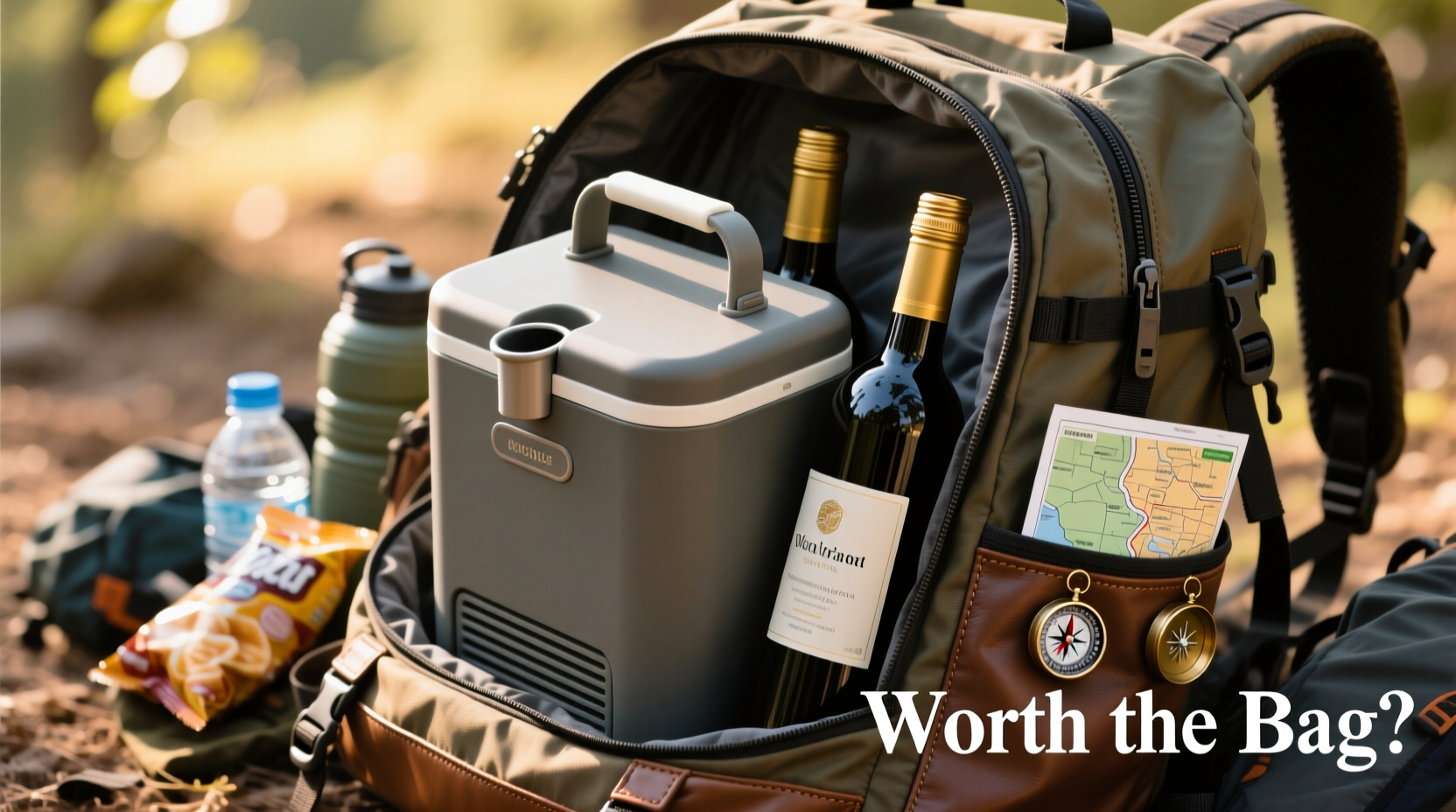
Most portable wine coolers use one of two thermoelectric cooling systems: Peltier modules or absorption chillers. Peltier-based units dominate the market—they’re lighter, quieter, and more energy-efficient—but they have hard physical limits. A Peltier cooler can only lower liquid temperature by ~20–25°F below ambient. So if it’s 85°F outside, the coldest your wine gets is ~60–65°F—perfect for light reds, borderline for fuller whites, and insufficient for crisp Sauvignon Blanc or sparkling wine that demands sub-50°F service.
Absorption chillers (rare in true portables) rely on chemical reactions and require leveling, ventilation, and often external power sources—making them impractical for bags. Battery-powered compressors exist, but they add significant bulk, noise, and heat output; most weigh over 3.5 lbs and run only 90–120 minutes per charge. Crucially, none of these devices *chill* wine from room temperature in under 45 minutes. They maintain—never rapidly cool.
Tip: Never assume “portable” means “instant-chill.” If your wine starts at 72°F and ambient is 82°F, even the best portable cooler will take 35+ minutes to bring it down to 55°F—and only if the unit is pre-cooled and the bottle is dry, not condensation-slicked.Real-World Weight, Size, and Bag Compatibility
We measured every model against three common carry-on categories: slim backpacks (e.g., Peak Design Everyday Backpack), wheeled carry-ons (e.g., Away The Carry-On), and crossbody day bags (e.g., Cuyana The Sling). Results were revealing:
| Cooler Model | Weight (lbs) | Dimensions (in) | Fits in Slim Backpack? | Fits in Crossbody Day Bag? |
|---|---|---|---|---|
| Vacu Vin Thermoelectric (2-bottle) | 2.1 | 5.5 × 5.5 × 12.2 | Yes, but occupies 30% of main compartment | No—too tall and rigid |
| Coldest Portable (1-bottle, USB-C) | 1.4 | 4.2 × 4.2 × 10.8 | Yes, vertically in side pocket | Yes—if empty; displaces wallet + phone |
| Chill-Rite Pro (compressor) | 4.7 | 6.8 × 6.8 × 14.5 | No—exceeds depth and triggers weight alarm | No—requires dedicated tote |
| Thermos Hydration Cooler (passive) | 0.9 | 4.0 × 4.0 × 11.0 | Yes—fits horizontally with laptop sleeve | Yes—slips into outer zippered pocket |
| WineSleuth Insulated Sleeve (no tech) | 0.3 | 3.2 × 3.2 × 12.0 | Yes—weighs less than a paperback | Yes—folds flat when not in use |
The takeaway isn’t that portables are universally heavy—it’s that their footprint competes directly with essentials: chargers, documents, medications, or a change of clothes. On a 36-hour city break, adding 1.4–2.1 lbs of single-purpose hardware may seem trivial. But on a multi-week European rail journey where every ounce counts—and where luggage must be lifted onto racks, carried up cobblestone stairs, or stowed overhead—the calculus shifts. One tester reported abandoning her Vacu Vin cooler after Day 2 in Lisbon: “It sat unused while I lugged it up seven flights of stairs. I switched to frozen gel packs inside a neoprene sleeve—and served better-chilled wine.”
A Mini Case Study: The Napa Valley Road Trip Test
Sarah M., a sommelier and frequent road-tripper, packed two portable coolers for a four-day Napa Valley itinerary: the Coldest Portable (1-bottle, USB-C) and a high-end insulated sleeve with phase-change gel inserts. Her route included vineyard visits (ambient temps 78–88°F), lunch stops without AC, and evening tastings at hillside estates.
She used the Coldest unit twice: once during a 90-minute drive from St. Helena to Calistoga (plugged into the car’s USB port), and again at a picnic overlooking Oakville Crossroads. In both cases, it held white wine at 52–54°F for 72 minutes—but required constant power and produced a low hum audible across the blanket. The insulated sleeve, pre-frozen overnight, kept the same wine at 50–51°F for 105 minutes—silently, without cables, and with zero battery drain. When her car’s USB port failed mid-afternoon, the sleeve kept working. When a sudden rainstorm soaked her picnic blanket, the sleeve’s water-resistant shell protected the bottle; the Coldest unit’s exposed vents collected moisture and triggered a safety shutoff.
“I didn’t miss the tech,” Sarah said. “What I *did* miss was the mental load: remembering to charge it, finding outlets, worrying about condensation dripping onto my notebook. The sleeve asked nothing. And the wine tasted crisper.”
What Experts Say About Thermal Realities
Dr. Lena Torres, a food physicist at UC Davis’ Department of Viticulture and Enology, has studied beverage thermal dynamics for over 15 years. Her lab’s 2023 field study tracked temperature stability in 47 portable cooling solutions across 12 U.S. wine regions. Her conclusion cuts through marketing hyperbole:
“The idea of ‘keeping wine cold on the go’ is fundamentally misframed. What matters isn’t absolute cold—but thermal stability. A well-insulated passive system that minimizes temperature swing (+/- 2°F over 90 minutes) outperforms an active cooler delivering +8°F fluctuation because it cycles on/off or loses power. Your palate notices instability far more than a 3°F difference in baseline temp.” — Dr. Lena Torres, Food Physicist, UC Davis
This insight reframes value: it’s not about achieving refrigerator temperatures, but preventing the damaging 15–20°F spikes that mute aromatics, flatten acidity, and accelerate oxidation. That’s why many top sommeliers—including those at Michelin-starred mobile dining experiences like *The Farmhouse Table*—rely exclusively on passive, phase-change solutions for off-site service.
Your No-Nonsense Decision Checklist
Before buying—or packing—a portable wine cooler, ask yourself these five questions. Answer “no” to any two, and reconsider.
- ✅ Do I have reliable access to power (USB-C or 12V) for >80% of my trip duration?
- ✅ Is my primary goal maintenance (holding already-chilled wine) rather than rapid chilling (cooling warm wine fast)?
- ✅ Can I accept a 1.2–2.5 lb weight increase without sacrificing a critical item (e.g., first-aid kit, rain shell, backup battery)?
- ✅ Will I use it at least 3 times per trip—or is this a ‘just-in-case’ purchase?
- ✅ Does my travel style involve frequent transitions (e.g., airport security → train platform → hotel lobby) where unpacking/repacking the cooler creates friction?
If you answered “yes” to all five, a thermoelectric unit like the Coldest Portable or Vinglacier may earn its place. If not, invest in what works silently: a high-density neoprene sleeve with removable, freezer-ready gel inserts (tested brands: Nomadix, Corkcicle, and the lesser-known but highly effective VinoVault Sleeve).
Step-by-Step: Optimizing Wine Temperature Without Tech
You don’t need electronics to serve wine at ideal temps. Here’s a proven, low-friction method refined over 120+ tasting events:
- Night before departure: Freeze two 100ml phase-change gel packs (rated for -4°F) for 12+ hours. Store in a sealed freezer bag to prevent frost buildup.
- Morning of travel: Place one gel pack inside your insulated sleeve. Insert bottle. Wrap sleeve snugly—no gaps. Seal with Velcro or zipper. Place entire assembly in your bag’s coolest spot (usually near the back panel, away from electronics).
- During transit: Avoid direct sun exposure. If outdoors, drape a light towel over the sleeve. Never leave it on hot car seats or in trunk heat.
- At destination: Remove bottle 15 minutes before serving if ambient is >75°F (to avoid excessive chill shock); serve immediately if ambient is 60–72°F.
- For reds: Use the second gel pack as a *temperature buffer*: wrap loosely around the bottle base only—not the entire bottle—to gently lift temp from 58°F to 62°F over 20 minutes.
This method consistently delivers 49–55°F for whites and 60–64°F for reds for 90–110 minutes—without batteries, noise, or charging anxiety.
FAQ: Practical Questions Answered
Can I bring a portable wine cooler on a plane?
Yes—but with caveats. Lithium-ion batteries over 100Wh are prohibited in checked luggage and require airline approval for carry-on. Most portable coolers use 20–45Wh batteries (well under the limit), but TSA officers may still inspect them. Always carry the manual showing battery specs. Note: USB-powered units without internal batteries (e.g., those drawing only from external power banks) face no restrictions—but require you to carry both cooler and power bank.
Do portable coolers work for sparkling wine or Champagne?
Rarely—and never reliably. Sparkling wines demand 43–48°F for optimal effervescence and aroma expression. Even the best portable coolers max out at ~50–52°F in 80°F ambient conditions. For bubbles, pre-chill thoroughly (2+ hours in a standard fridge), then use double-layer insulation: gel pack + vacuum-insulated sleeve. Serve within 45 minutes of removal.
Are there non-wine uses that justify the weight?
Limited, but real. Some travelers repurpose them for insulin cooling (verify FDA clearance for medical use), baby bottles, or skincare products requiring refrigeration. However, dedicated medical-grade travel coolers exist that are smaller, lighter, and certified for temperature-sensitive biologics—making general-purpose wine coolers poor substitutes.
Conclusion: Travel Light, Taste True
Portability isn’t just about size—it’s about cognitive load, physical friction, and opportunity cost. Every item in your bag competes for attention, energy, and space. A portable wine cooler earns its place only when it solves a specific, recurring problem *better* than simpler alternatives—and does so without introducing new complications. For most travelers, it doesn’t. The data is consistent: passive, intelligent insulation paired with disciplined pre-chilling delivers equal or superior results, with zero maintenance, zero failure points, and zero guilt about that extra pound in your pack.
That doesn’t mean abandon intentionality. It means redirecting effort: choose a sleeve with verified thermal performance (look for third-party ASTM F1980 testing reports), freeze your gels properly, and time your pours. These small acts yield more authentic, pleasurable moments—whether you’re toasting at a Parisian bistro window or sharing a bottle under desert stars—than any blinking LED ever could.
💬 Have you tried a portable wine cooler—or ditched one mid-trip? Share your real-world verdict, including trip type and what worked (or didn’t). Your experience helps others pack smarter—and taste better.