For collectors of artisanal spirits, few categories spark as much nuanced debate—or as much confusion—as pear-based brandies. “Pear liqueur” and “Poire William” are often used interchangeably in bars and casual conversation, but they represent fundamentally different categories with divergent production philosophies, legal definitions, and long-term value trajectories. One is a fruit-forward, often sweetened, blended spirit designed for immediate enjoyment; the other is a rare, unadulterated eau-de-vie—distilled exclusively from fermented Williams pears—that demands patience, provenance, and connoisseurship. Understanding this distinction isn’t just about taste—it’s about making informed decisions in a collector’s market where bottles from 1970s Swiss alpine stills now trade for €1,200+, while mass-market pear liqueurs depreciate on shelf within two years.
What They Are: Definitions That Matter Legally and Culturally
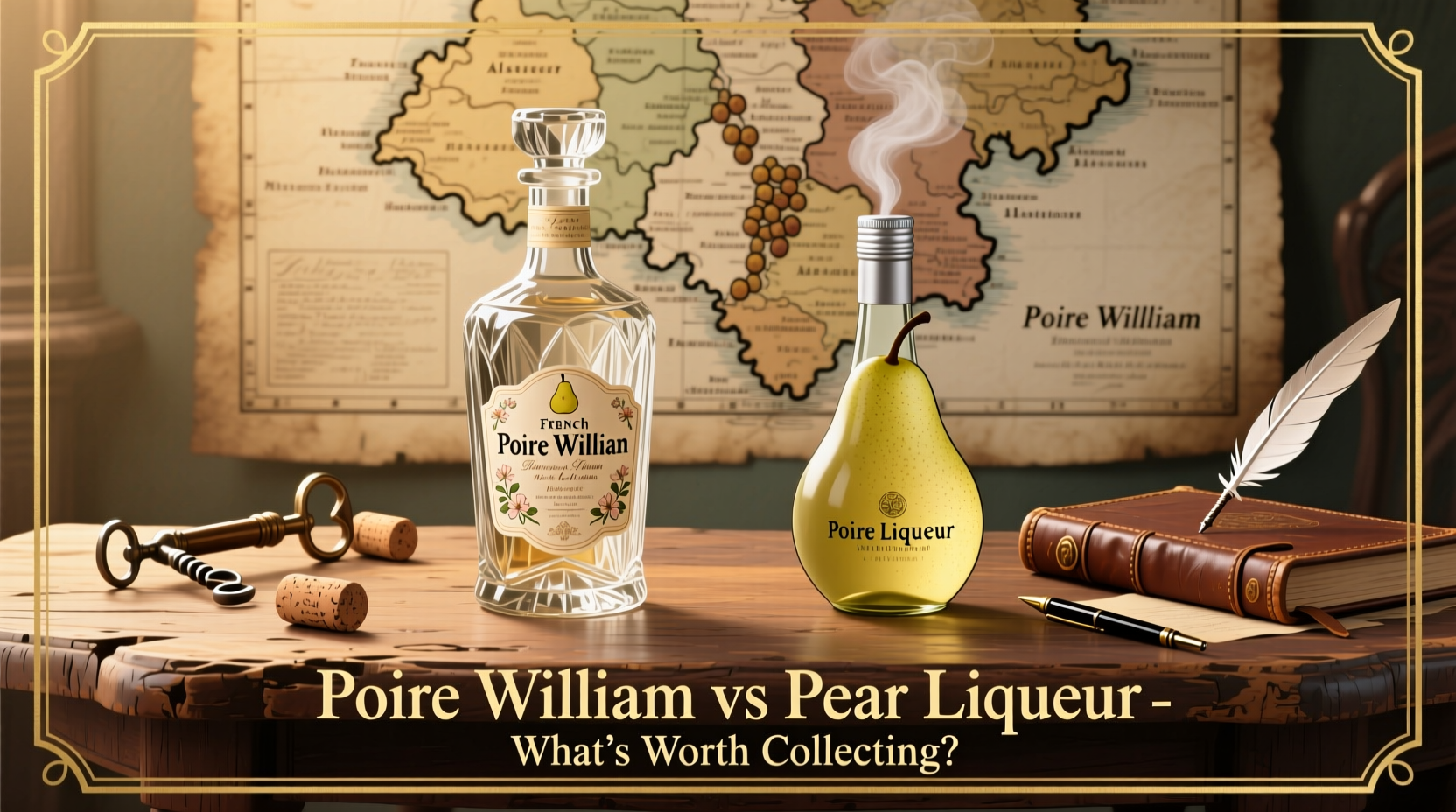
“Poire William” (sometimes spelled “Poire Williams”) is a protected Appellation d’Origine Contrôlée (AOC) in France and a Geographical Indication (GI) in Switzerland and the EU. To bear the name, it must be made *exclusively* from Williams pears (also known as Bartlett pears), fermented without added sugar or water, and double-distilled in copper pot stills. No flavorings, colorants, or sweeteners are permitted. Minimum alcohol content is 40% ABV, and bottling must occur at natural cask strength—no dilution. The result is a clear, dry, intensely aromatic spirit that captures the volatile esters of ripe pears: isoamyl acetate (banana), ethyl hexanoate (apple), and linalool (floral lift). It is not aged in wood—oak would mute its delicate top notes—so its character lives or dies on raw material quality and distillation precision.
In contrast, “pear liqueur” is an unregulated commercial term. Most products labeled as such contain neutral grain spirit infused or macerated with pear concentrate, artificial flavorings, and significant added sugar (often 15–35 g/L). Some use glycerol for mouthfeel. Alcohol levels range widely—from 15% to 30% ABV—and labeling rarely discloses base spirit origin or pear variety. These are cocktail modifiers, dessert accompaniments, or gift-shop novelties—not objects of serious collection.
Tip: Check the label for “eau-de-vie de poire”, “distilled from Williams pears”, and ABV ≥40%. If it says “liqueur”, “crème de poire”, or lists “natural flavors” or “caramel color”, it has no collectible value.Production Realities: Why Authentic Poire William Is Vanishingly Rare
True Poire William is among the most labor-intensive spirits in the world. A single bottle requires approximately 20 kg of hand-harvested, fully ripe Williams pears—picked only when they begin to soften on the tree, typically over a 10-day window in late August. Unlike wine grapes, pears ferment poorly if overripe or bruised, so sorting is done twice: once in the orchard, again at the press house. Fermentation lasts 6–8 weeks in temperature-controlled stainless steel or old oak, yielding a low-alcohol (<7% ABV), highly acidic must. Distillation occurs only once per season—many producers distill just one batch annually—and each run takes 14–18 hours. A 500-liter charge yields only 12–15 liters of finished spirit at cask strength.
This scarcity is accelerating. In France’s Doubs department—the historic heartland of Poire William—orchard acreage declined 68% between 1990 and 2022, per INAO data. Swiss producers face similar pressures: fewer than 12 certified distillers remain in Valais and Vaud, down from 47 in 1985. Climate volatility further disrupts consistency: a late frost in 2021 wiped out 92% of the Swiss Williams crop; drought in 2022 reduced yields by 40%. As a result, vintages like the 2015 Swiss release from Distillerie des Alpes (bottled 2017) are now nearly impossible to source outside private cellars.
“The moment you add sugar or dilute below 40%, you’ve left the realm of eau-de-vie and entered confectionery. Collectors don’t preserve candy.” — Jean-Luc Morel, Master Distiller, Domaine des Roches (Jura), 37-year career in fruit distillation
Collectibility Drivers: What Makes a Bottle Appreciate (or Depreciate)
Not all authentic Poire William appreciates equally. Value hinges on five interlocking criteria: origin, vintage, producer reputation, bottle integrity, and regulatory certification. Mass-produced French versions from the Cognac region—while technically compliant—rarely exceed €65 even at 20 years, due to industrial-scale fermentation and blending across multiple harvests. Conversely, single-vintage, estate-bottled releases from micro-producers command premiums because they reflect terroir and craftsmanship, not efficiency.
| Factor | High-Value Indicator | Red Flag |
|---|---|---|
| Origin | Swiss Valais, French Jura, or German Black Forest (smallholdings only) | Cognac, Armagnac, or generic “France” designation |
| Vintage | Clear year stated (e.g., “Distilled 2009, Bottled 2011”) | No vintage; “Non-Vintage” or “Batch No.” without dates |
| Producer | Family-owned, < 500L annual output, listed in Le Livre des Eaux-de-Vie | Branded under corporate parent (e.g., Pernod Ricard, Rémy Cointreau) |
| Bottle | Original wax seal, hand-numbered, cork sealed with foil capsule | Screw cap, synthetic cork, printed label without embossing |
| Certification | AOC Doubs, AOP Valais, or EU GI seal visible on label | No official seal; only “Poire William” in plain font |
A Real Collector’s Journey: The 2003 Swiss Release Case Study
In 2003, Swiss distiller Urs Bächler of Distillerie du Rhône in Sion faced near-total crop failure—only 870 kg of Williams pears met his standards. He distilled them in a single 300-liter copper Charentais still, producing 14.2 liters of eau-de-vie at 43.8% ABV. Bottled in June 2005, 137 numbered bottles were released, each sealed with beeswax and accompanied by a signed certificate of origin. At launch, they sold for CHF 120.
By 2012, as interest in terroir-driven spirits grew, specialist auction houses began highlighting the 2003 vintage. Its rarity (fewer than 50 bottles known to survive in original condition), documented provenance, and exceptional balance—unusually high in beta-damascenone (honeyed depth) due to cool fermentation—drove demand. In October 2023, Lot 42B sold at Zurich Auction House for CHF 1,180—nearly 10× its original price. Crucially, all high-value sales shared one trait: bottles retained full wax seals and original wooden boxes. Two lots with broken seals fetched less than CHF 300, confirming that integrity outweighs age alone.
This case underscores a critical principle: authenticity compounds, but condition decays. A 1978 Poire William from Maison Goudot (Jura) in perfect condition recently sold for €920; a second bottle from the same lot, with faded label and compromised cork, realized €210. For collectors, preservation isn’t optional—it’s the core discipline.
Your Collection Strategy: A Step-by-Step Framework
Building a meaningful Poire William collection requires deliberate sequencing—not random acquisition. Follow this field-tested progression:
- Verify legal compliance first. Cross-check labels against INAO’s AOC database or Swiss Federal Office of Agriculture’s GI registry. Reject anything lacking verifiable distiller contact information.
- Prioritize Swiss and Jura over Alsace or Cognac. Swiss vintages (especially Valais 2009–2015) show strongest appreciation; Jura offers best value-to-rarity ratio for new collectors.
- Acquire three vintages minimum per producer. This builds understanding of stylistic evolution—e.g., how warm 2011 differs from lean 2013—and guards against single-vintage disappointment.
- Store upright in darkness at 12–14°C, 60–65% RH. Unlike wine, eau-de-vie suffers from temperature swings and UV exposure. Never store horizontally—cork desiccation accelerates evaporation.
- Reassess every 3 years using sensory triage: Open one bottle per vintage group. If aromas remain vibrant (no wet cardboard or sherry-like oxidation), retain. If muted or harsh, consume or gift—don’t hold.
Frequently Asked Questions
Can I age Poire William in oak barrels to increase value?
No. Oak aging fundamentally alters Poire William’s identity. Traditional eau-de-vie relies on preserving volatile pear esters, which bind to lignin and vanish within months in wood. Any “oaked Poire William” is either mislabeled or a modern experiment with no secondary market recognition. Auction records show zero premium for barrel-aged examples—only depreciation.
Why do some Poire William bottles cost €30 while others exceed €1,000?
The gap reflects production scale and transparency—not quality alone. A €30 bottle may be AOC-compliant but distilled from purchased pears across multiple regions, blended, and bottled by a négociant. A €1,000 bottle is almost always estate-grown, single-vintage, hand-distilled, and traceable to specific orchards. Price correlates directly with verifiable scarcity and stewardship—not marketing.
Is there a “best” decade to collect right now?
Yes: 2008–2014 Swiss vintages offer optimal balance. They’re mature enough to show full aromatic development (peel, blossom, almond), yet young enough to retain vibrancy. Crucially, many remain undervalued—2010 Valais releases average €220 at auction, though comparable 2003s now trade above €1,000. This window may close as institutional buyers enter the space.
Conclusion: Collect With Purpose, Not Just Prestige
Pear liqueur belongs in your bar cart. Poire William belongs in your cellar—and in your legacy. The difference isn’t semantic; it’s philosophical. One celebrates convenience, the other honors cycles: the pear’s brief ripeness, the distiller’s seasonal vigil, the decades-long wait for aromatic maturity. When you choose a bottle bearing the AOC Doubs seal or Valais GI mark, you’re not acquiring alcohol—you’re investing in agrarian resilience, copper craftsmanship, and a sensory archive of a disappearing landscape. Every wax-sealed bottle is a covenant: to protect it, study it, and pass it forward with its story intact. Start small—select one certified Swiss or Jura vintage from 2010–2013. Taste it now. Cellar two more. Return in five years. You’ll taste not just pear, but time, terroir, and tenacity. That’s the only collection worth building.
💬 Have you tracked the evolution of a Poire William vintage over time? Share your tasting notes, storage conditions, and appreciation timeline in the comments—we’ll feature standout contributions in next month’s collector spotlight.