
It’s a question that surfaces mid-recipe: “I only have rum cream—can I use it instead of dark rum in my rum cake?” Or the reverse: “My friend brought over a bottle of aged Jamaican rum, but the recipe calls for rum cream.” Swapping these two spirits seems intuitive—they both say ‘rum’—but doing so without understanding their structural differences often leads to split batters, curdled sauces, or drinks that taste cloyingly sweet or strangely thin. Rum and rum cream liqueur are not interchangeable ingredients; they’re fundamentally different categories of liquid, each with distinct roles in cooking and mixology. This isn’t about preference—it’s about chemistry, function, and intention.
What They Are—and Why That Matters
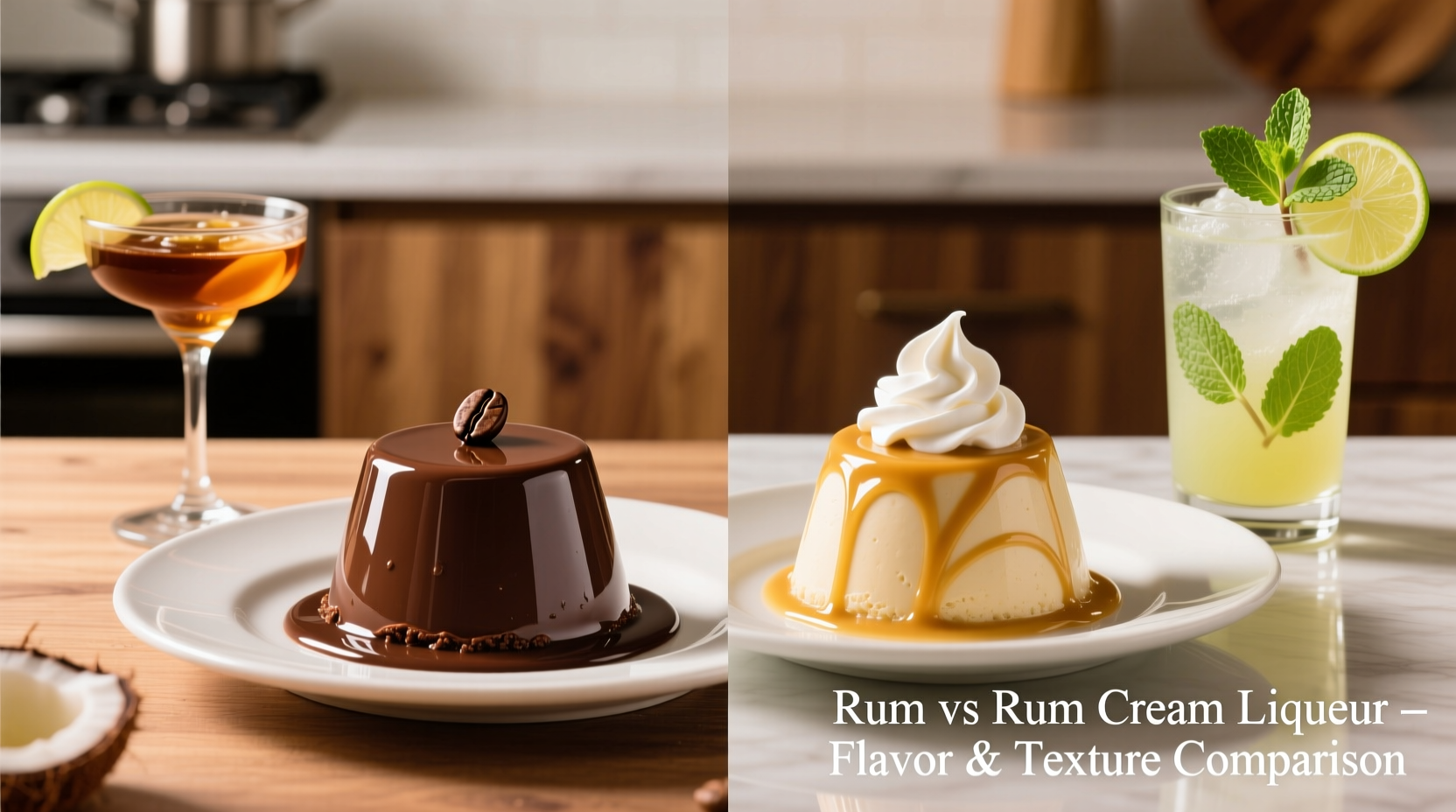
Rum is a distilled spirit made from fermented sugarcane byproducts—molasses or fresh cane juice. It ranges from light and crisp (like Cuban blanco) to rich and funky (like Demerara or Jamaican pot still). Its alcohol content typically falls between 35% and 45% ABV, and its flavor profile hinges on distillation method, aging, and terroir. It contributes heat, depth, aromatic complexity, and—critically—no added sugar beyond trace residual molasses notes.
Rum cream liqueur, by contrast, is a blended, ready-to-drink product. It combines rum (usually a neutral or lightly aged base), dairy cream (or cream substitutes), sugar, stabilizers, and often vanilla or caramel flavoring. Its alcohol content is lower—typically 13% to 17% ABV—and its texture is viscous, creamy, and emulsified. Its purpose is sensory comfort: smoothness, sweetness, and mouthfeel—not structural integrity or volatile aroma.
This distinction explains why substitution fails at the molecular level. Rum delivers ethanol-driven extraction (pulling fat-soluble flavors from spices, chocolate, or citrus zest) and volatility (evaporating during baking to leave behind concentrated essence). Rum cream brings water, fat, sugar, and emulsifiers—ingredients that alter coagulation, interfere with gluten development, and suppress alcohol’s aromatic lift.
When Swaps *Can* Work—With Strict Conditions
Swapping is rarely advisable—but not impossible. Success depends entirely on context: the role the ingredient plays, the volume used, and whether the recipe has built-in flexibility. Below is a reality-tested framework:
Tip: Never substitute rum cream for rum in recipes where alcohol evaporation is essential (e.g., flambéed desserts, baked goods with long oven times, or reductions). The dairy solids will scorch, and the sugar will caramelize prematurely—leading to bitterness or separation.In beverages, limited swaps are possible—but only when the drink is served cold, unheated, and built for richness. A classic Rum & Coke relies on rum’s sharp bite to cut through cola’s sweetness; substituting rum cream yields a dessert-like, syrupy mess. But in a chilled, stirred cocktail like a Rum Cream Old Fashioned (where rum cream replaces simple syrup *and* adds texture), the swap becomes intentional—not accidental.
In desserts, the safest path is functional substitution: replace rum cream with a combination of rum + dairy + sweetener, adjusted proportionally. For example, if a recipe calls for ½ cup rum cream, consider using ¼ cup aged rum + ¼ cup heavy cream + 1–2 tsp brown sugar (depending on desired sweetness). This preserves alcohol content, avoids destabilizing emulsions, and lets you control texture independently.
Practical Swap Guide: What to Use Instead
Blind substitution invites disaster. Instead, match the *function*, not the label. The table below outlines common uses and optimal alternatives—including when to walk away from the swap entirely.
| Recipe Context | Rum Called For → Best Substitute | Rum Cream Called For → Best Substitute |
|---|---|---|
| Baked rum cake (with batter or soak) | Use rum as written—no substitute needed. | Do not substitute rum. Instead: ⅓ cup rum + ⅓ cup full-fat coconut milk + 1 tbsp maple syrup. Adjust flour slightly if batter thins. |
| Flambéed bananas foster | Essential—do not substitute. Rum provides ignition and aromatic lift. | Not suitable. Dairy will sputter and burn unpredictably. |
| Cold dessert sauce (e.g., rum caramel) | Add rum at the end, off heat, to preserve aroma. | Use as written—or enhance with 1 tsp dark rum stirred in last for complexity. |
| Cocktail base (e.g., Daiquiri) | Core ingredient—no viable swap without re-engineering the drink. | Substitute with equal parts coconut cream + ½ part aged rum + ¼ part agave nectar. Shake hard to emulsify. |
| Ice cream swirl or no-churn base | Add rum after churning, mixed with a spoonful of warm simple syrup to prevent ice crystals. | Use as written—but reduce added sugar in base by 15% to offset liqueur’s sweetness. |
Mini Case Study: The Coconut Rum Cake Incident
Last December, pastry chef Lena Rodriguez was catering a holiday dinner for 40 guests. Her signature coconut-rum bundt cake—baked with ½ cup aged Barbados rum and brushed post-bake with a rum-simple syrup—had been a hit for years. That morning, her assistant misread the label and poured in ½ cup of rum cream instead of rum into the batter. The result was immediate: the batter thickened unnaturally, developed faint lumps, and smelled overly sweet, with muted spice notes.
Lena didn’t scrap it. She adapted. She reduced the oven temperature by 25°F, extended bake time by 12 minutes, and brushed the cooled cake with a stronger rum syrup (1:1 rum to demerara syrup) to reintroduce volatile aromatics. She also garnished generously with toasted coconut and flaky sea salt to balance residual sweetness. Guests loved it—but Lena noted the crumb was denser, the rum note less assertive, and the finish longer and creamier than intended. “It worked,” she told us, “but it wasn’t the same cake. It was a different dessert—one that leaned into richness instead of brightness. Knowing *why* it changed let me steer the outcome, rather than just hope.”
Expert Insight: The Role of Alcohol in Flavor Architecture
“Alcohol isn’t just a carrier—it’s an active solvent and volatile transporter. In baking, ethanol carries esters and phenols from rum into the matrix of cake or custard. Remove it, and you lose 60% of the perceived flavor—even if sugar and dairy remain. Rum cream gives sweetness and mouthfeel, but it doesn’t deliver the same aromatic architecture.” — Dr. Aris Thorne, Food Chemist & Beverage Formulation Consultant, formerly with Bacardi Global R&D
Dr. Thorne’s insight underscores a critical principle: flavor perception isn’t additive—it’s synergistic. Rum’s ethanol volatilizes compounds that bind to our olfactory receptors; rum cream’s fat coats the tongue, suppressing those same receptors. You can’t replicate the lift of a well-aged rum with a dairy-based liqueur, any more than you’d substitute heavy cream for white wine in a beurre blanc and expect the same acidity or clarity.
Step-by-Step: How to Rescue a Recipe When You’ve Made the Wrong Swap
If you’ve already added rum cream instead of rum—or vice versa—don’t panic. Follow this sequence to diagnose and correct before it’s too late:
- Pause and assess volume: Is the swap under 2 tablespoons? Often negligible—proceed with minor adjustments. Over ¼ cup? Intervention needed.
- Identify the stage: Is the mixture raw (batter, dough, uncooked sauce)? Or heated (simmering, baking, flambéing)? Raw = easier to adjust. Heated = likely irreversible.
- Neutralize excess sugar: If rum cream was added to a savory or balanced-sweet application, add acid (1 tsp lemon juice or vinegar) and/or fat (1 tsp unsalted butter) to rebalance.
- Reintroduce volatility: Stir in 1–2 tsp high-proof rum (over 50% ABV) at the very end—off heat—to restore aromatic lift without adding more dairy or sugar.
- Adjust texture: If the mixture is too thick or gummy (from rum cream’s stabilizers), thin with a splash of whole milk or coconut milk—not water, which dilutes flavor.
- Taste and calibrate: Salt is your quiet ally. A pinch enhances umami and cuts perceived sweetness without making food salty.
FAQ: Real Questions from Home Bakers and Bartenders
Can I make my own rum cream to control quality and avoid store-bought additives?
Yes—but with caveats. A stable homemade version requires precise emulsification: combine 1 cup aged rum, 1 cup heavy cream (36% fat), ⅓ cup powdered sugar (not granulated—it dissolves cleanly), and ¼ tsp xanthan gum. Blend with an immersion blender for 60 seconds, then chill for 24 hours before use. Without xanthan, separation is inevitable within days. Homemade lacks shelf stability (refrigerate and use within 10 days) but offers superior flavor control and zero artificial preservatives.
Why does rum cream curdle when I add it to hot coffee or hot chocolate?
Curdling occurs because heat denatures the proteins in dairy cream, causing them to clump—especially in acidic environments (coffee’s pH is ~5). Store-bought rum cream contains stabilizers like carrageenan to delay this, but it’s not foolproof. To prevent curdling: warm the rum cream separately (do not boil), then slowly drizzle it into the hot beverage while stirring constantly. Alternatively, add it to the mug *before* pouring hot liquid—letting residual heat gently incorporate it.
Is there a non-dairy rum cream alternative that behaves more like rum in baking?
Coconut cream-based versions (e.g., some Caribbean brands) come closest—but they still lack ethanol and carry significant sugar. For true functional parity, skip the liqueur entirely: use rum + unsweetened coconut milk + a touch of date syrup. This trio replicates richness and tropical nuance without destabilizing batters or masking rum’s backbone.
Conclusion: Respect the Ingredient, Not Just the Name
Rum and rum cream liqueur share a name—but little else. One is a precision tool for building flavor architecture; the other is a finished experience designed for immediate pleasure. Confusing them isn’t a small mistake—it’s a fundamental misreading of culinary language. Yet this confusion is incredibly common, born not of carelessness but of labeling ambiguity and marketing shorthand. The solution isn’t rigidity—it’s literacy. Read labels not for the word “rum,” but for ABV, sugar content, and ingredient order. Taste both side-by-side: notice how rum bites, opens, and evolves on the palate, while rum cream rounds, coats, and soothes. That awareness transforms substitution from guesswork into intention.
Next time you reach for the bottle, pause—not to hesitate, but to clarify purpose. Are you seeking heat or harmony? Extraction or enrichment? Volatility or viscosity? Let the answer guide your hand, not the label. Your desserts will gain clarity. Your drinks will gain balance. And your confidence in the kitchen will deepen—not from memorizing rules, but from understanding why they exist.
💬 Your turn: Have you successfully swapped (or spectacularly failed) with rum or rum cream? Share your story, fix, or favorite rum-forward dessert in the comments—we’re building a real-world swap library, one honest kitchen experiment at a time.








