
For many urban renters and condo owners, wine is more than a beverage—it’s part of daily ritual, social identity, and even culinary infrastructure. Yet in tight quarters where square footage is priced by the inch, dedicating cabinet space, floor area, or counter real estate to a dedicated appliance demands justification. The wine fridge sits at an uncomfortable intersection: it promises precision storage, but delivers minimal utility unless your habits and environment align with its strengths. This isn’t about whether you *like* wine—it’s about whether your lifestyle, climate, collection size, and apartment constraints make a wine fridge a functional tool or an underused status symbol.
Why Apartment Living Makes Wine Storage Uniquely Challenging
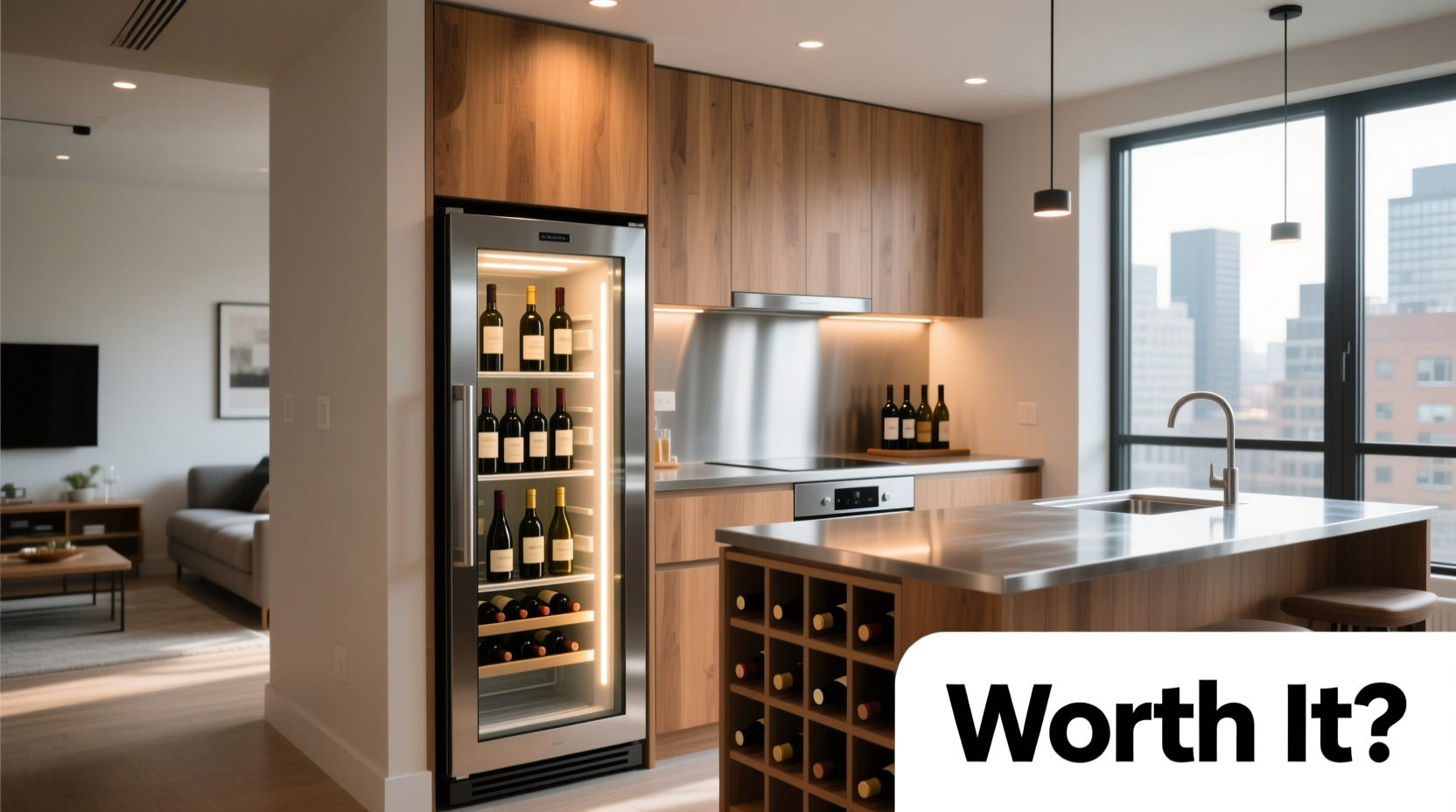
Standard apartment conditions undermine wine preservation in ways most people don’t anticipate. Unlike single-family homes with basements or garages, apartments rarely offer stable, cool, dark, vibration-free environments. Interior temperatures fluctuate dramatically: summer heat radiates through thin walls and west-facing windows; winter heating systems dry out air and raise ambient temps to 22–25°C (72–77°F)—well above the ideal 10–15°C (50–59°F) for long-term storage. Light exposure is constant—LED recessed lighting, open shelving near windows, and even under-cabinet strips emit UV and heat that degrade phenolic compounds. And vibrations? Elevator shafts, shared laundry rooms, and HVAC units transmit low-frequency tremors that disturb sediment and accelerate oxidation.
Refrigerators aren’t the answer either. Their humidity levels hover around 30–40%, far below the 60–70% needed to keep corks plump. Frequent door openings cause temperature swings of up to 8°C in under 30 seconds—enough to stress delicate bottles over time. A standard kitchen fridge also introduces food odors, which can permeate through cork, especially in older or lower-density closures.
Tip: Before buying any appliance, measure your apartment’s actual ambient temperature and humidity for 72 hours using a $15 digital hygrometer placed where you’d store wine. If readings consistently exceed 20°C or dip below 50% RH, passive storage won’t suffice.The Real Value Proposition: When a Wine Fridge Pays Off
A wine fridge isn’t a luxury if it solves a measurable problem—and for certain apartment dwellers, it does. Its value crystallizes across four non-negotiable criteria:
- You regularly hold more than 12 bottles—not just for drinking, but for aging or rotating stock. Below this threshold, temperature-stable cabinets (with insulation, blackout lining, and isolation from heat sources) often outperform entry-level fridges.
- You drink wine within 1–3 months of purchase—but want consistency across varietals. Serving temperature matters: reds served too warm lose structure; whites served too cold mute aromatics. Dual-zone models let you serve a Pinot Noir at 13°C while keeping Sauvignon Blanc at 8°C—no last-minute chilling or warming.
- Your building lacks climate control—especially in cities like Phoenix, Houston, or New York, where summer indoor temps routinely hit 27°C+ without AC running 24/7. In those cases, even a $300 thermoelectric unit maintains 12°C reliably, while ambient storage invites premature aging.
- You own investment-grade or age-worthy bottles—think Burgundy, Barolo, or Napa Cabernet. These require stability, not just coolness. Compressor-based fridges (not thermoelectric) deliver ±0.5°C consistency and adequate humidity retention—critical for preserving cork integrity over 5+ years.
Miss two of these, and the ROI diminishes sharply. Miss three, and the appliance likely becomes a high-efficiency paperweight.
What You’re Really Paying For: A Breakdown of Features vs. Reality
Price tags on wine fridges range from $200 to $3,000—but the difference isn’t just capacity. It’s engineering trade-offs that directly impact apartment viability. The table below compares what matters most in constrained spaces:
| Feature | Entry-Level ($200–$500) | Mid-Tier ($500–$1,200) | Premium ($1,200+) |
|---|---|---|---|
| Cooling Type | Thermoelectric (quiet, vibration-free, but struggles above 25°C ambient) | Compressor + fan (stable down to 5°C, handles heat better) | Compressor + dual evaporators (independent zones, zero cross-contamination) |
| Noise Level | 25–30 dB (near-silent) | 38–42 dB (audible hum in quiet studios) | 35–38 dB (engineered dampening) |
| Humidity Control | None—relies on natural condensation (often drops to 45%) | Passive retention via sealed gaskets & water tray (55–60%) | Active humidification system (60–65% RH) |
| Space Efficiency | Compact (12–24 bottles), fits under counters or in closets | Built-in or freestanding (24–46 bottles), needs 2\" rear/side clearance | Column or integrated (46–120+ bottles), requires professional ventilation |
| Energy Use | 0.5–0.7 kWh/day (cheaper to run) | 0.9–1.3 kWh/day | 1.4–2.1 kWh/day (higher utility cost) |
Crucially, thermoelectric units—the quietest and most compact—fail in hot apartments. They work by moving heat across a semiconductor junction, but their efficiency collapses when ambient air exceeds 25°C. In a Manhattan walk-up on a July afternoon, one may only achieve 16°C internally—not enough for proper storage. Compressor models handle heat better but introduce noise and vibration. There is no perfect solution—only context-appropriate compromises.
A Real-World Apartment Scenario: How One Brooklyn Renter Decided
Maya L., a 32-year-old graphic designer in a 650-square-foot Williamsburg studio, collected wine for five years before installing a wine fridge. Her setup included: a south-facing window with no blackout shades, central AC that cycled off overnight (causing 5°C temperature swings), and a habit of buying 2–3 bottles weekly—mostly mid-tier reds and sparkling wines she drank within 6 weeks.
She tried passive storage first: a vintage wooden cabinet lined with cork and kept in a closet away from the HVAC vent. After six months, two bottles developed “cooked” notes—jammy, flat, with diminished acidity. A third showed seepage around the cork. She logged ambient conditions: closet temps ranged from 18°C (night) to 24°C (afternoon); humidity averaged 42%. She realized her collection wasn’t small enough for passive methods—and her environment was too volatile.
She chose a 24-bottle compressor-based dual-zone unit ($699) with adjustable shelves and rear ventilation. It fit beside her mini-fridge in the galley kitchen, required no installation beyond plugging in, and ran at 40 dB—inaudible over city traffic. Within a month, her whites tasted crisper, her reds showed more nuance, and she stopped replacing spoiled bottles. Her break-even point? 14 months—based on avoiding $22 average bottle losses. Today, she hosts monthly tastings and credits the fridge not with luxury, but with reliability.
“Wine fridges aren’t about hoarding—they’re about intentionality. If you care how your wine tastes *today*, not just whether it’s chilled, then precise, stable storage stops being optional.” — David Chen, Master Sommelier and co-founder of Urban Cellar Co., a NYC-based wine education platform
Your Apartment Wine Storage Decision Checklist
Before purchasing—or dismissing—a wine fridge, work through this objective checklist. Answer honestly. If you check ≥4 boxes, a fridge is likely justified. If ≤2, explore alternatives first.
- ☑ I store more than 15 bottles regularly (not just temporarily)
- ☑ My apartment’s ambient temperature exceeds 22°C for more than 3 months per year
- ☑ I’ve noticed changes in wine quality—flattened bubbles, muted aromas, or premature oxidation—within 2–3 months of purchase
- ☑ I serve multiple wines in one sitting (e.g., appetizer white + main-course red) and want them at ideal temperatures
- ☑ I own at least 3 bottles intended for aging beyond 12 months
- ☑ My current storage location is exposed to light, heat sources, or vibration (e.g., near stove, radiator, or elevator wall)
- ☑ I’m willing to allocate 1.5–2.5 sq ft of permanent floor or cabinet space
Practical Alternatives If a Fridge Isn’t Right—for Now
Not every apartment dweller needs a wine fridge—and that’s fine. Here’s what works *if* your habits and environment allow:
Smart Passive Storage
Line a deep closet or under-bed drawer with closed-cell foam insulation (R-value ≥2). Add a hygrometer and a shallow dish of distilled water to boost humidity. Store bottles horizontally on a vibration-dampening mat (neoprene or cork). Keep the door closed except during access. This achieves ~14°C and 55% RH in moderate climates—sufficient for short-term holding.
The “Chill-and-Serve” Workflow
Buy only what you’ll consume in 10–14 days. Store upright in a dark, cool interior closet (never above the fridge or near windows). Chill whites and rosés in the kitchen fridge 2 hours before serving; decant reds 30 minutes ahead to bring them to 16°C. This eliminates long-term storage needs entirely.
Shared or Off-Site Solutions
In cities like Chicago, Seattle, and Toronto, climate-controlled wine storage lockers start at $35/month for 20 bottles. Some co-ops and condos now include communal wine vaults. For collectors or investors, this beats sacrificing precious square footage.
Frequently Asked Questions
Can I use a regular refrigerator as a temporary wine fridge?
No—not for anything beyond 48 hours. Kitchen fridges operate at 2–4°C, far too cold for both reds and whites. Their low humidity dries corks in under a week, and frequent door openings cause damaging thermal shock. If you must, place bottles in a sealed plastic bin with a damp towel to buffer humidity—and never store for more than 3 days.
Do I need UV-blocking glass on my wine fridge?
Yes—if it’s located anywhere with ambient light exposure (e.g., kitchen, living room, open-concept studio). Standard glass transmits 40% of UV-A rays, which break down anthocyanins and accelerate browning. Look for units with argon-filled, low-E double-glazed doors. If your fridge sits in total darkness (e.g., inside a cabinet), UV shielding is unnecessary.
Will a wine fridge increase my electricity bill noticeably?
For most entry- and mid-tier units: no. A typical 24-bottle compressor model uses ~0.9 kWh/day—about $1.30/month at U.S. average rates. That’s less than running a gaming PC for 2 hours daily. Premium units draw more, but their energy efficiency ratings (look for ENERGY STAR certification) offset cost over time.
Conclusion: It’s Not About Luxury—It’s About Alignment
The question isn’t whether wine fridges are inherently worthwhile. It’s whether yours would solve a real, recurring problem in your specific apartment, with your specific habits, climate, and collection. In a 300-square-foot studio where every inch counts, a $400 fridge that prevents $200 in spoiled wine annually *is* a rational upgrade. In a sun-drenched Miami high-rise where ambient temps hover at 28°C year-round, it’s essential infrastructure—not indulgence. But in a well-insulated Portland apartment with north-facing windows and a 6-bottle rotation? It’s likely over-engineering.
Wine should enhance life—not complicate it with unnecessary appliances. If your current setup delivers consistent, enjoyable results, protect that simplicity. If inconsistency, spoilage, or temperature frustration has become routine, then yes: a thoughtfully chosen wine fridge is worth every inch and watt. Measure first. Test alternatives. Then invest—not in status, but in stewardship of something you genuinely value.
💬 Have you installed a wine fridge in your apartment—or skipped it successfully? Share your setup, challenges, and lessons in the comments. Your experience could help someone else avoid buyer’s remorse—or discover their missing piece.