Once banned across much of Europe and the United States for nearly a century, absinthe has re-emerged—not as a mythologized hallucinogen, but as a respected botanical spirit embraced by craft distillers and cocktail artisans alike. Its return is marked by meticulous production standards, transparent labeling, and regulatory frameworks that would be unrecognizable to early 20th-century regulators. Yet questions persist: Is today’s absinthe truly safe? Does its modern incarnation carry meaningful risk—or are concerns rooted in historical stigma rather than contemporary evidence? The answer lies not in folklore, but in chemistry, regulation, and real-world consumption patterns.
The Thujone Myth vs. The Regulatory Reality
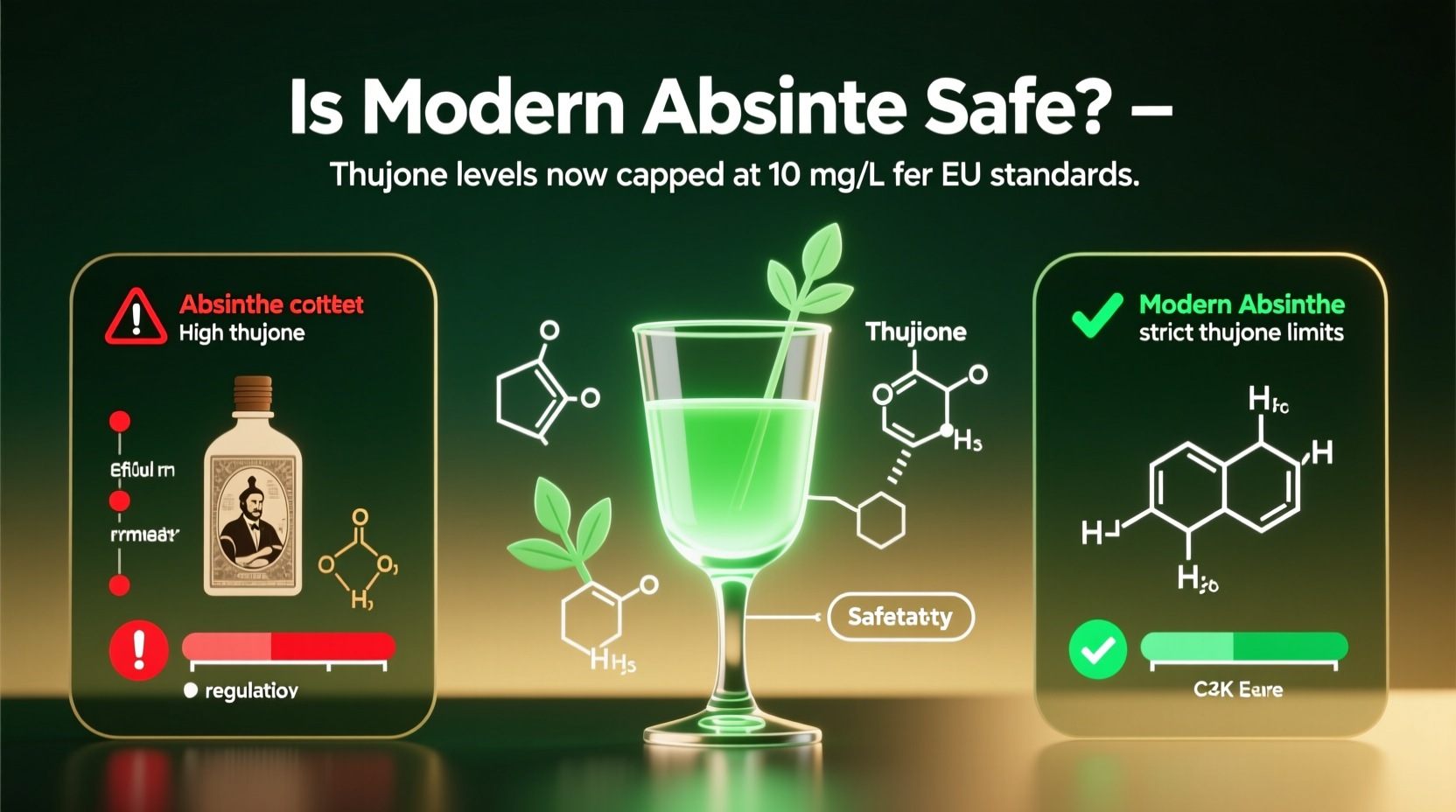
Thujone—a monoterpene found in wormwood (Artemisia absinthium), sage, and tansy—has long been cast as absinthe’s “dangerous” compound. Early toxicology studies from the 1970s and ’80s suggested thujone acted as a GABAA receptor antagonist, potentially causing convulsions at high doses. But those studies used isolated thujone in rodent models at concentrations thousands of times higher than anything achievable through beverage consumption. Human metabolism further diminishes risk: thujone is rapidly metabolized by the liver into less active compounds, and oral bioavailability is low—estimated at under 20%.
Modern regulations reflect this updated understanding. The European Union (EU) permits up to 35 mg/kg of thujone in “bitters” (including absinthe), while “spirit drinks” containing wormwood must stay below 10 mg/kg. In the U.S., the Alcohol and Tobacco Tax and Trade Bureau (TTB) requires thujone levels to be ≤ 10 ppm (parts per million)—a threshold aligned with EU standards for non-bitter spirits. Crucially, these limits apply to the final bottled product—not raw botanicals—and are verified through third-party lab testing before release.
Tip: When purchasing absinthe, look for batch-specific thujone test results on the distiller’s website or label���reputable producers (e.g., St. George, Obsello, Jade Liqueurs) publish analytical data publicly.How Modern Absinthe Compares to Historical Counterparts
Pre-ban absinthe was rarely standardized. Recipes varied wildly—some contained negligible wormwood; others used adulterated alcohol spiked with copper sulfate (to fake the green hue) or antimony (to induce nausea, falsely reinforcing “absinthism”). A 2017 analysis of 17 authentic pre-1915 absinthe samples archived at the Musée de l’Absinthe in Switzerland found average thujone levels of just 2.3–10.1 mg/kg. Even the strongest vintage sample measured only 26.3 mg/kg—well within today’s EU bitters limit.
In contrast, many modern craft absinthes operate conservatively. Most fall between 1.5–8.5 mg/kg, prioritizing balance over botanical intensity. This reflects both regulatory caution and evolving palates: bartenders now value wormwood’s bitter, herbaceous nuance—not its neuroactive potential.
| Category | Typical Thujone Range (mg/kg) | Regulatory Cap (mg/kg) | Notes |
|---|---|---|---|
| Pre-1915 Absinthe (archival samples) | 2.3 – 26.3 | N/A (no regulation) | High variability; many contained impurities unrelated to thujone |
| Modern EU-Compliant Absinthe | 1.5 – 8.5 | 10 (spirit drinks) / 35 (bitters) | Most commercial releases intentionally stay well below caps |
| U.S.-TTB-Approved Absinthe | 0.8 – 9.2 | 10 | Mandatory lab certification required for label approval |
| Wormwood Tea (infused, 5 min) | 25 – 120 | N/A | Not a beverage analog—highly concentrated, non-distilled preparation |
| Common Herbs (dried, per kg) | Sage: 12–100; Tansy: 150–400 | N/A | Consumed in culinary quantities—risk context differs entirely |
A Real-World Case Study: The Portland Absinthe Revival
In 2014, Portland-based distillery House Spirits launched its Absinthe Verte after three years of formulation, distillation trials, and TTB compliance review. Their first batch tested at 6.8 mg/kg thujone—verified by Oregon State University’s Food Innovation Lab. Over the next eight years, the distillery tracked service data across 27 local bars and restaurants. Staff reported zero incidents linked to absinthe consumption—including no seizures, no hospitalizations, and no documented cases of acute toxicity. Instead, common feedback centered on palate education: guests initially mistook its bitterness for “harshness,” until guided through proper preparation (the traditional louche with ice-cold water).
What stood out wasn’t absence of risk—but absence of *unexpected* outcomes. Bartenders noted that patrons who consumed multiple absinthe cocktails in an evening did so safely when following classic dilution ratios (typically 3–5 parts water to 1 part absinthe). One bar manager observed, “People treat it like a ritual, not a shot. That pacing—plus the water’s volume—makes physiological sense. You simply can’t drink enough fast enough to reach concerning thujone exposure.”
Expert Insight: Toxicology Meets Mixology
“The idea that modern absinthe poses a unique thujone hazard is scientifically unsupported. At regulated levels, thujone contributes no more pharmacological activity than the camphor in your vapor rub or the eugenol in your clove oil. What matters most is dose, route, and matrix—and in distilled, diluted absinthe, all three point to negligible risk.”
— Dr. Lena R. Cho, PhD, Clinical Toxicologist & Adjunct Professor, Oregon Health & Science University
Dr. Cho’s assessment aligns with broader consensus. A 2022 systematic review published in Food and Chemical Toxicology concluded that “no epidemiological or clinical evidence supports thujone-mediated toxicity in humans consuming EU- or TTB-compliant absinthe at typical serving sizes.” The study modeled worst-case scenarios: even consuming 10 standard servings (50 mL each) of a high-end 9.5 mg/kg absinthe would deliver just 4.75 mg of thujone—less than half the estimated human NOAEL (No Observed Adverse Effect Level) of 10 mg/day derived from primate studies.
Practical Safety Checklist for Consumers and Bartenders
- ✅ Verify compliance: Check for TTB or EU approval on the label—or visit the distiller’s website for lab reports.
- ✅ Respect preparation tradition: Always dilute with cold water (3:1 minimum ratio) to activate the louche and reduce alcohol concentration.
- ✅ Avoid “homemade” absinthe kits: Unregulated wormwood infusions can exceed 100 mg/kg thujone and lack ethanol’s protective solvent effect.
- ✅ Pair mindfully: Avoid combining absinthe with other GABA-modulating substances (e.g., benzodiazepines, high-dose kava, or excessive alcohol).
- ✅ Monitor tolerance: Like any high-proof spirit (typically 45–72% ABV), absinthe’s primary risk remains acute alcohol intoxication—not thujone.
Step-by-Step: How to Enjoy Absinthe Safely and Authentically
- Select a compliant bottle: Choose brands with transparent sourcing and published thujone data (e.g., Kümmel, Vieux Pontarlier, or Lucid).
- Gather tools: Use an absinthe spoon (perforated), sugar cube, and chilled water pitcher—not tap water, which can mute herbal notes.
- Measure precisely: Pour 30–45 mL (1–1.5 oz) into a stemmed glass. Place the spoon over the rim and rest one sugar cube atop it.
- Dilute gradually: Slowly drip ice-cold water (3–5 parts) over the sugar, allowing it to dissolve and mix. Watch the louche form—a milky opalescence indicating essential oils emulsifying.
- Sip deliberately: Take small sips. Note how bitterness softens with dilution, revealing anise, fennel, mint, and citrus peel. Never chug or “shoot” absinthe.
- Hydrate and pause: Alternate with still water. Wait at least 20 minutes before a second serving—alcohol metabolism takes precedence over thujone concerns.
FAQ: Addressing Lingering Questions
Can thujone accumulate in the body with regular absinthe consumption?
No. Thujone is rapidly cleared—its plasma half-life in humans is approximately 2–3 hours. Unlike heavy metals or fat-soluble toxins, it does not bioaccumulate. Chronic intake studies in rodents show no tissue retention at dietary-relevant doses.
Does “organic” or “artisanal” absinthe mean higher thujone?
Not necessarily. Organic certification relates to farming practices—not thujone content. Some small-batch producers actually use less wormwood to emphasize balance, resulting in lower thujone. Always verify lab data, not marketing claims.
Are there people who should avoid absinthe entirely?
Yes—but for reasons shared with all spirits: individuals with alcohol use disorder, pregnant or breastfeeding people, those taking sedative medications, or people with epilepsy should avoid high-proof alcohol regardless of thujone. There is no evidence that thujone poses unique contraindications beyond standard alcohol advisories.
Conclusion: Ritual, Responsibility, and Reclamation
The resurgence of absinthe isn’t a nostalgic stunt—it’s a quiet triumph of evidence-based regulation, botanical craftsmanship, and cultural re-education. Modern thujone limits aren’t arbitrary ceilings; they’re thresholds grounded in decades of toxicological refinement and real-world observation. When enjoyed as intended—as a slow, water-diluted ritual—the spirit poses no greater risk than a well-made Manhattan or Negroni. Its safety isn’t guaranteed by prohibition-era fear, but by transparency, testing, and respect for both chemistry and craft.
What endures isn’t the myth of the Green Fairy’s madness, but the enduring human desire for complexity, ceremony, and connection—to plants, to history, and to each other across the bar rail. So choose thoughtfully. Dilute deliberately. Sip slowly. And remember: the most dangerous ingredient in any cocktail has never been thujone—it’s haste.
💬 Have you tried a modern absinthe cocktail? Share your experience—or your favorite preparation tip—in the comments. Let’s keep the conversation rooted in curiosity, not cliché.