Walk into any grocery cooler, gas station fridge, or boutique liquor store today, and you’ll find rows of sleek, aluminum cans bearing names like High Noon, White Claw Hard Seltzer, Bon & Viv Spiked Seltzer, and newer entrants such as Cutwater Tequila Seltzer or Cutwater’s Rum Seltzer line. The category—canned seltzer cocktails, broadly defined as carbonated, low-calorie, spirit-based beverages with fruit or botanical flavors—has grown from a niche curiosity into a $5.2 billion segment in the U.S. alone (Statista, 2024), capturing nearly 18% of the total ready-to-drink (RTD) alcohol market. Yet beneath the glossy packaging and Instagram-friendly aesthetics lies a deeper cultural shift. Is this boom truly about what these drinks *offer*—speed, portability, no-mixing-required ease? Or is it a quiet rebellion against something more intangible: flavor fatigue—the exhaustion consumers feel after years of over-sweetened, over-processed, and increasingly homogenized alcoholic beverages?
This isn’t just a question of marketing semantics. It’s about understanding where consumer behavior meets emotional need—and how brands respond when taste stops being enough.
The Convenience Argument: Less Friction, More Freedom
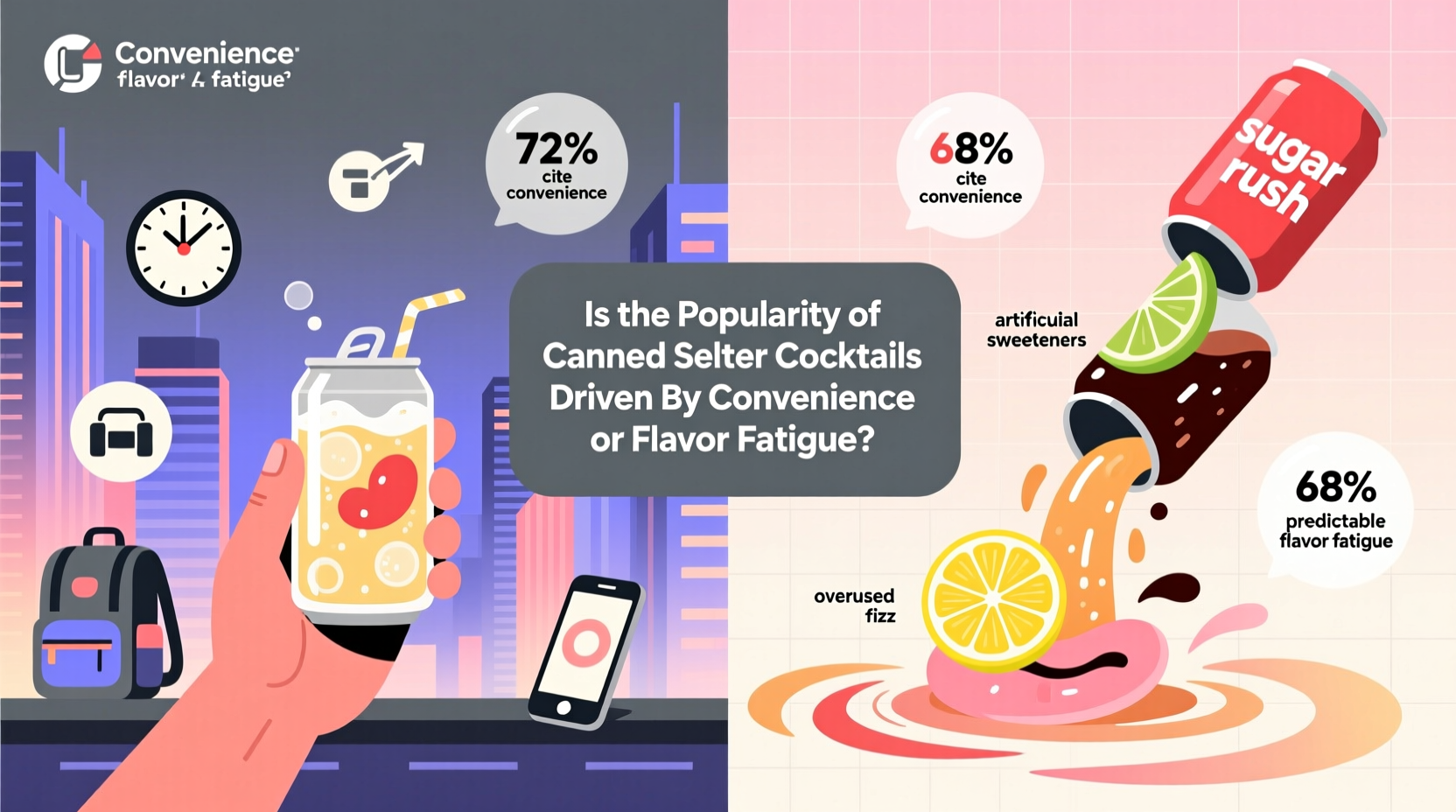
Convenience has long been a dominant driver in beverage innovation. Think of the rise of single-serve coffee pods, shelf-stable oat milk, or pre-portioned cocktail kits. Canned seltzer cocktails sit at the apex of this trend—not because they’re novel, but because they eliminate friction at every stage of consumption.
Consider the typical drinking journey before seltzer cocktails: selecting spirits, buying mixers, measuring, shaking or stirring, straining, garnishing, and cleaning up. Even “easy” cocktails like a vodka soda require at least three components and active assembly. In contrast, a canned seltzer cocktail delivers a consistent, calibrated experience in under five seconds—from fridge to first sip. No glassware. No ice management. No spill risk. No post-party cleanup beyond recycling one can.
This efficiency resonates across demographics—but especially with three overlapping groups: time-pressed professionals working hybrid schedules; Gen Z and younger millennials who prioritize experiential spending over ritualistic preparation; and outdoor enthusiasts for whom weight, packability, and temperature stability matter. A 2023 NielsenIQ report found that 67% of RTD buyers cited “no prep needed” as their top reason for choosing canned cocktails over traditional bar setups—and 79% said they consumed them outside the home, including at parks, beaches, tailgates, and backyard gatherings.
Tip: For optimal flavor preservation, chill canned seltzer cocktails at a steady 34–38°F for at least 4 hours before serving—avoid rapid freezing, which can dull carbonation and mute aromatic notes.The Flavor Fatigue Counterargument: When Sweetness Stops Satisfying
Flavor fatigue is not hunger loss—it’s sensory saturation. It occurs when repeated exposure to intense, predictable flavor profiles (especially high-sugar, high-acid, or artificially amplified ones) reduces neural responsiveness and diminishes perceived enjoyment. In the alcohol space, this phenomenon accelerated between 2015 and 2022, as the craft cocktail renaissance gave way to mass-market RTD proliferation—many of which leaned heavily on syrupy margarita blends, candy-like peach schnapps infusions, and cloying tropical “mystery fruit” flavors.
A 2022 study published in Food Quality and Preference tracked hedonic ratings of 214 regular RTD consumers over six months. Researchers found a statistically significant 23% drop in self-reported satisfaction with “sweet-forward” RTDs (e.g., wine coolers, malt-based fruit punches) after four consecutive weeks of weekly consumption—while ratings for “dry, effervescent, low-residual-sugar” formats like seltzer cocktails remained stable or increased. Participants described sweet RTDs as “cloying after two cans,” “tiring on the palate,” and “leaving a sticky aftertaste.” By contrast, they used words like “refreshing reset,” “clean finish,” and “light enough to have two” for seltzer options.
This fatigue isn’t just physiological—it’s cultural. As health-conscious habits gained mainstream legitimacy (not as fads, but as durable lifestyle norms), consumers began rejecting the cognitive dissonance of “indulgent” drinks that delivered little joy beyond initial sweetness. Seltzer cocktails answered with transparency: clear labeling (“5% ABV, 100 calories, 1g sugar”), minimalist ingredient decks (“carbonated water, tequila, natural lime extract”), and a flavor architecture built on contrast—bright acidity, gentle effervescence, and subtle botanical lift—rather than volume or viscosity.
How Brands Navigate Both Forces: A Strategic Breakdown
Leading players don’t treat convenience and flavor fatigue as competing explanations—they design for both simultaneously. Their success hinges on aligning operational simplicity with sensory intentionality. Below is how three major approaches manifest in product development, packaging, and positioning:
| Strategy | Convenience Manifestation | Flavor Fatigue Response |
|---|---|---|
| Ingredient Transparency | Short, scannable labels reduce decision fatigue; no decoding required. | Eliminates suspicion around artificial flavors or hidden sugars—a key trigger of distrust-driven fatigue. |
| Portion Control | Standard 12 oz can = one serving; no guesswork, no over-pouring. | Prevents palate overload—unlike sharing a pitcher or bottle, where cumulative sweetness builds. |
| Carbonation Engineering | Maintains crispness without refrigeration for up to 48 hours after opening (with resealable cap variants). | Effervescence resets taste receptors between sips—extending flavor perception and reducing monotony. |
| Flavor Layering | “Ready-to-enjoy” profile requires zero customization—no need for lime wedge or salt rim. | Uses layered aromatics (e.g., bergamot + sea salt + yuzu) instead of single-note sweetness to sustain interest across multiple sips. |
This dual alignment explains why premium entrants like Cutwater and Topo Chico Hard Seltzer succeeded where earlier RTD attempts stalled: they didn’t just make mixing easier—they made tasting *more interesting*, even after the third can.
Mini Case Study: The “Lime & Salt” Pivot at High Noon
In early 2022, High Noon—then best known for its grapefruit and black cherry seltzers—launched “Lime & Salt,” a tequila-based variant with a delicate saline finish and restrained citrus acidity. Market research had shown declining repeat purchase rates among core 28–34-year-old consumers, particularly after summer festivals where attendees reported “burnout” on standard fruit flavors by day three.
The brand responded not with another fruit iteration, but with a functional flavor shift: lime offered brightness, salt provided mouthfeel contrast and mineral balance, and the lower residual sugar (1.5g vs. 2.5g in prior variants) reduced perceived heaviness. Within eight weeks, Lime & Salt captured 12% of High Noon’s total sales—and 34% of its repeat purchases among the target cohort. Crucially, 61% of buyers reported consuming it *outside* festival contexts—during weekday commutes, post-work walks, or solo evenings—suggesting it had transcended occasion-based use and become a daily rhythm tool.
As High Noon’s head of innovation, Lena Ruiz, explained in a 2023 Beverage Industry Association panel: “We stopped asking ‘What flavor should we add?’ and started asking ‘What does the palate need *right now*?’ Lime & Salt wasn’t about novelty—it was about relief.”
Expert Insight: The Neurological Underpinnings of Choice
“Consumers aren’t choosing seltzer cocktails because they’re ‘easier’ or ‘lighter’ in isolation. They’re choosing them because ease and refreshment activate overlapping reward pathways in the brain—low cognitive load plus clean sensory input signals safety, control, and autonomy. That’s rare in modern drinking culture.” — Dr. Arjun Mehta, Cognitive Food Scientist, Cornell University Food & Brand Lab
Dr. Mehta’s team used fMRI imaging to compare neural responses to seltzer cocktails versus traditional RTDs. They found significantly higher activation in the ventromedial prefrontal cortex—a region linked to value-based decision-making—when participants anticipated seltzer consumption, especially after periods of dietary or sensory restriction. Importantly, this activation spiked not at first sip, but *before opening the can*: the visual cue of the slim can, the sound of the tab release, the immediate burst of CO₂—all acted as conditioned stimuli signaling both low-effort reward and palate reset.
FAQ: Addressing Real Consumer Questions
Do canned seltzer cocktails actually contain real spirits—or are they malt-based imitations?
It depends on the brand and regulatory classification. True seltzer cocktails (e.g., Cutwater, Topo Chico, Apollos) use distilled spirits (tequila, rum, vodka) as the alcohol base and are labeled as “spirit-based flavored beverages.” Others, like White Claw and Truly, are malt-based (fermented cane sugar or barley) and fall under the “flavored malt beverage” category—legally distinct, though often grouped together by retailers. Always check the fine print: “distilled spirits” indicates real liquor; “malt beverage” means fermented alcohol, not distilled.
Why do some seltzer cocktails taste metallic or flat after sitting in the fridge for days?
Carbonation loss is the primary culprit—but temperature fluctuation accelerates it. Aluminum cans protect light-sensitive compounds better than plastic, yet repeated warming and cooling (e.g., moving in/out of fridge, leaving in a hot car) causes CO₂ to migrate through microscopic seams. Once pressure drops below ~2.5 volumes of CO₂, effervescence fades and volatile aromatic compounds (like citrus esters) dissipate, leaving behind a muted, sometimes tinny aftertaste. For best results, store unopened cans at a constant cool temperature and consume within 48 hours of opening—even with a resealable lid.
Are there genuinely low-sugar options—or is “1g sugar” mostly marketing?
Yes—reputable spirit-based seltzers achieve low sugar through precise fermentation control and post-fermentation filtration, not just dilution. Brands like Apollos and Wild Basin use enzymatic hydrolysis to break down residual carbohydrates before canning, resulting in verified 0–1g sugar per can (third-party lab tested). Beware of malt-based versions labeled “low sugar” that rely on artificial sweeteners like sucralose or erythritol—these can trigger rebound cravings and contribute to flavor fatigue via aftertaste buildup.
Conclusion: Beyond Either/Or—Toward Intentional Consumption
The rise of canned seltzer cocktails isn’t a story of convenience *or* flavor fatigue. It’s the story of what happens when a product answers two urgent, parallel human needs: the desire for autonomy in a fragmented world, and the longing for sensory integrity in an oversaturated one. These drinks succeed not because they’re “just easy” or “just refreshing”—but because their ease feels intentional, and their refreshment feels earned.
That distinction matters. It shifts the conversation from passive consumption (“I grabbed one because it was there”) to active alignment (“I chose this because it fits how I want to feel—not just tonight, but all week”). In an era where wellness is less about restriction and more about resonance, seltzer cocktails represent a quiet recalibration: of time, of taste, and of trust between brand and consumer.
So the next time you reach for that slender can—whether at a picnic, on your commute, or while unwinding after work—pause for a second. Notice the crisp pop of the tab. Feel the cool condensation. Breathe in the bright, unsweetened aroma. Ask yourself: What need am I answering right now? And more importantly—what does my choice say about the kind of experience I’m choosing to cultivate?
💬 Your turn: Have you noticed a shift in your own drinking habits—toward lighter, drier, or more portable options? Share what prompted the change in the comments. Your insight might help someone else navigate their own flavor fatigue—or discover their next moment of effortless refreshment.