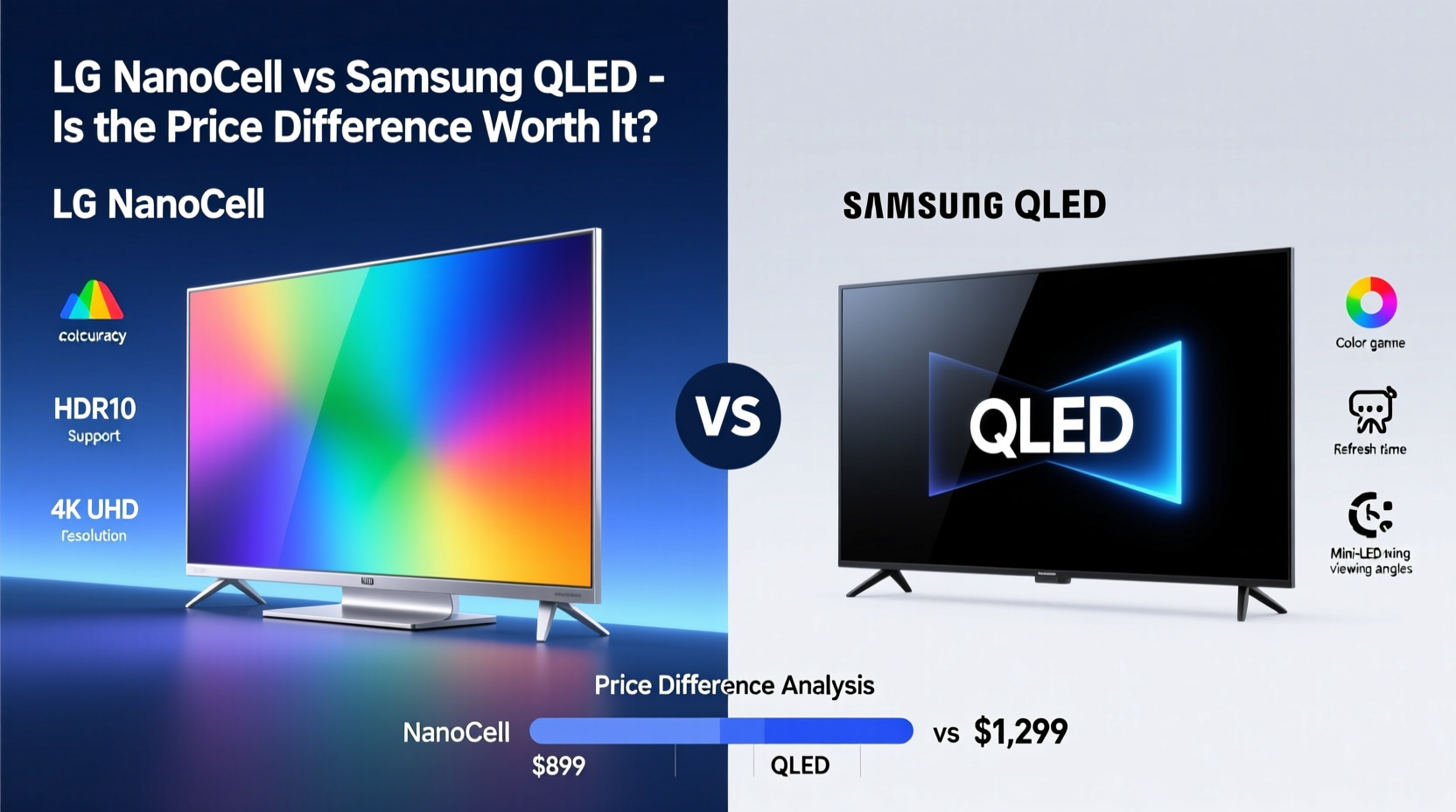
When shopping for a high-end 4K TV, two names consistently rise to the top: LG’s NanoCell and Samsung’s QLED. Both promise vibrant colors, deep contrasts, and smart features that elevate home entertainment. But with Samsung’s QLED models often priced significantly higher than LG’s NanoCell lineup, a pressing question emerges: is the premium truly justified? To answer this, we need to look beyond marketing claims and examine real-world performance, panel technology, viewing conditions, and long-term value.
Understanding the Core Technologies
The fundamental difference between LG NanoCell and Samsung QLED lies in their display technologies and how they manipulate light and color.
NanoCell is LG’s proprietary enhancement of standard LED/LCD panels. It uses a layer of nano-sized particles that filter out unwanted wavelengths of light—particularly impure reds and greens—to deliver more accurate and consistent colors across wide viewing angles. Unlike OLED, NanoCell TVs are still LCD-based, meaning they rely on a backlight and liquid crystals to produce images. This affects contrast and black levels, especially in dark rooms.
QLED (Quantum-dot Light Emitting Diode), Samsung’s flagship LCD technology, uses quantum dots—nanocrystals that emit precise colors when hit by light. These dots enhance brightness and color volume, allowing QLED TVs to achieve higher peak brightness than most NanoCell models. Samsung pairs QLED with full-array local dimming (FALD) in higher-end models, improving contrast by selectively dimming zones behind the screen.
“QLED excels in bright environments due to its superior peak brightness, while NanoCell offers better off-axis color consistency—key for larger living rooms.” — David Lin, AV Testing Lab Director at HomeScreen Review
Picture Quality: Brightness, Color, and Contrast Compared
Picture quality remains the deciding factor for most buyers. Let’s break down the key metrics:
Brightness and HDR Performance
Samsung QLED TVs, particularly the Q80B and QN90B series, regularly achieve peak brightness levels above 1,500 nits. This makes them ideal for HDR (High Dynamic Range) content in well-lit rooms. Sunlit scenes in movies like *Dune* or sports broadcasts retain detail in highlights without washing out.
In contrast, most LG NanoCell models (such as the NANO75 or NANO80) max out around 600–800 nits. While sufficient for moderate lighting, they struggle to match QLED’s punch in daylight or brightly lit spaces. However, NanoCell’s anti-reflective coating helps reduce glare, offering a balanced experience even if raw brightness falls short.
Color Accuracy and Viewing Angles
This is where LG gains ground. NanoCell’s nano-particle filter ensures colors remain stable even when viewed from the side—critical in wider seating arrangements. In a family living room where viewers sit at angles, NanoCell maintains color fidelity far better than standard QLED panels.
Samsung has improved viewing angles in recent years with \"Wide Viewing Angle\" filters, but side-viewers still notice a drop in color saturation and contrast. For dedicated home theaters with centered seating, this may not matter. But for open-concept homes, NanoCell holds a practical edge.
Contrast and Black Levels
Neither technology matches OLED’s per-pixel illumination, but differences exist. High-end QLED models with FALD can produce convincing local contrast, minimizing haloing around bright objects. However, blooming (light bleeding into dark areas) is still common in lower-tier QLEDs.
NanoCell relies on edge-lit or basic FALD systems in mid-range models, resulting in less precise contrast control. Blacks appear more grayish in dark scenes, especially noticeable during night-time sequences in shows like *Stranger Things*. LG compensates somewhat with advanced processing via its α (Alpha) processor, which enhances depth perception through software.
Tip: If your room has large windows or ambient light, prioritize brightness—Samsung QLED may be worth the extra cost. For darker rooms or angled seating, LG NanoCell delivers excellent value.Real-World Example: The Martinez Family Living Room
The Martinez family upgraded their 55-inch plasma to a new 65-inch TV. Their living room has a south-facing window, making afternoons bright. They initially considered the LG Nano90 ($1,199) but opted for the Samsung QN90B ($1,799) after testing both in-store.
At first, the decision seemed excessive. But over time, they appreciated the QN90B’s ability to handle daytime sports without squinting. Skin tones stayed natural, and fast-motion scenes in football games remained smooth thanks to Samsung’s 120Hz panel and Motion Xcelerator Turbo+. When watching movies at night, the deeper contrast made space scenes in *Interstellar* more immersive.
However, their teenage daughter, who often watches TikTok videos from the couch corner, complained that her phone-captured videos looked oversaturated on the Samsung. Meanwhile, their visiting parents praised the LG demo unit at the store for looking “natural” from every seat.
The takeaway: context matters. The Martinezes gained in brightness and motion clarity but sacrificed some color neutrality and off-angle performance.
Feature Comparison: Smart Platforms, Gaming, and Sound
| Feature | LG NanoCell (webOS) | Samsung QLED (Tizen) |
|---|---|---|
| Smart Platform | webOS – intuitive, app-rich, Magic Remote support | Tizen – fast, clean interface, universal search |
| Gaming Features | HDMI 2.1 on select models, VRR, ALLM, 4K@120Hz | Full HDMI 2.1 suite, Game Bar overlay, Auto Low Latency Mode |
| Sound Quality | Average built-in speakers; benefits from soundbar pairing | Slightly better up-firing audio in high-end models |
| Voice Assistants | Google Assistant, Alexa built-in | Bixby, Alexa, Google Assistant supported |
| Energy Efficiency | Moderate power draw | Higher consumption due to brighter backlight |
For gamers, both brands offer strong support for next-gen consoles. However, Samsung’s Game Monitor feature and faster input lag (as low as 9.5ms on QN90B) give it a slight competitive edge. LG’s webOS remains one of the most user-friendly platforms, with swipe-based navigation and excellent app selection.
Is the Price Difference Worth It? A Value Breakdown
The average price gap between comparable-sized NanoCell and QLED models ranges from $300 to $600. So, what do you actually get for that extra investment?
- Higher peak brightness – Better for sunny rooms and HDR impact.
- Better contrast control – Especially on FALD-equipped QLEDs.
- Smoother motion handling – Beneficial for sports and action films.
- More premium design
But consider this: if your viewing environment is moderately lit or you primarily watch content at night, many of these advantages diminish. LG’s NanoCell delivers 80–90% of the visual quality at a significantly lower price point. Plus, LG often includes features like Filmmaker Mode and AI Sound Pro that rival Samsung’s offerings.
Checklist: Choosing Between NanoCell and QLED
- Assess your room lighting: Bright room? Lean toward QLED.
- Evaluate seating layout: Wide-angle viewers? NanoCell wins.
- Determine primary use: Gaming/sports? QLED’s motion clarity helps.
- Set a firm budget: Can you justify a $500+ premium?
- Test in person: View demo units with real content, not just test patterns.
Frequently Asked Questions
Can NanoCell compete with QLED for gaming?
Yes, on paper. Mid-to-high-end NanoCell models support HDMI 2.1, 4K@120Hz, VRR, and ALLM. However, Samsung’s QLED generally offers lower input lag and smoother motion interpolation, making it slightly better for competitive gaming.
Do QLED TVs last longer than NanoCell?
Both use similar LCD lifespans (around 60,000 hours). Neither suffers from burn-in like OLED. Longevity depends more on usage habits than technology type. With normal use, both should last 7–10 years without significant degradation.
Is NanoCell just rebranded LED?
Not exactly. While based on LCD, the nano-particle filter differentiates it from standard LED TVs by improving color purity and viewing angles. It’s a meaningful upgrade over basic LCD, though not revolutionary like OLED.
Final Verdict: When to Pay More—and When Not To
The price difference between LG NanoCell and Samsung QLED isn’t arbitrary—it reflects tangible improvements in brightness, contrast engineering, and build quality. But “worth it” depends entirely on your priorities.
If you watch mostly at night, have controlled lighting, or value consistent color from multiple seats, LG NanoCell offers exceptional performance per dollar. You’re likely paying $400 extra for benefits you won’t fully utilize.
Conversely, if you crave cinematic HDR pop, play games in daylight, or want the latest hardware features, Samsung QLED justifies its premium. The added brightness and refined processing deliver a noticeably more dynamic image under ideal conditions.
💬 Ready to make your choice? Revisit your viewing habits, measure your room’s light, and prioritize real needs over specs. Share your experience below—what mattered most when choosing between LG and Samsung?