
Freshness in beer isn’t a single attribute—it’s the delicate convergence of volatile aroma compounds, stable carbonation, enzymatic activity, hop oil integrity, and microbial stability. When drinkers ask whether cask ale is “better” than kegged beer for freshness, they’re often conflating tradition with quality, nostalgia with science, or sensory memory with objective shelf performance. The truth is more nuanced: cask ale can deliver an unmatched immediacy of flavour *at its peak*, but that peak is narrow, fleeting, and highly dependent on execution. Kegged beer, by contrast, offers tightly controlled consistency and extended freshness windows—but at the cost of some aromatic volatility and textural nuance. Understanding this trade-off requires looking past romanticism and into cellars, tap lines, and lab data.
What “Freshness” Really Means in Beer Science
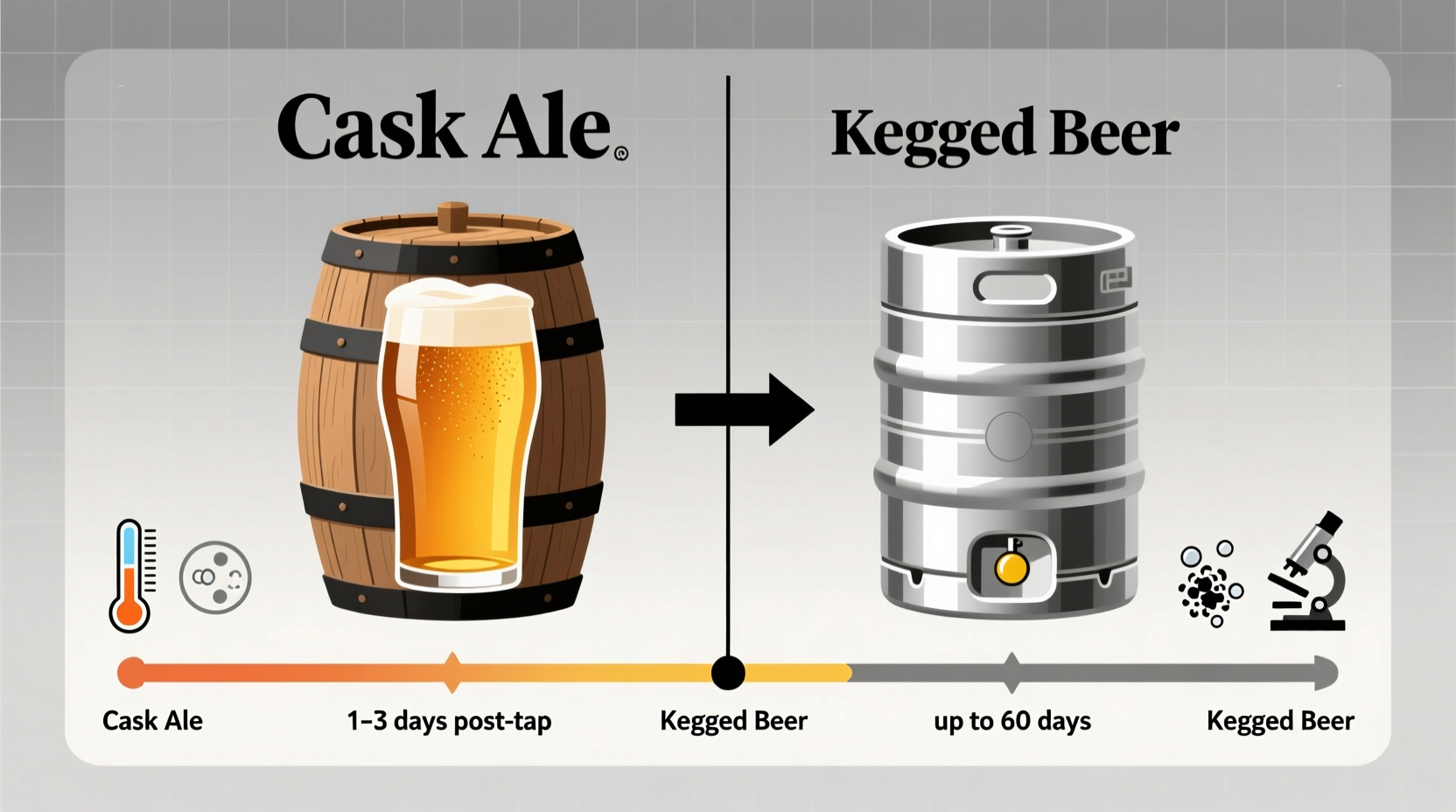
In brewing science, freshness is measured across three interdependent dimensions: flavour stability, aromatic vitality, and physical condition. Flavour stability refers to resistance against oxidation (stale cardboard, sherry-like notes), light-struck reactions (skunky thiols), and microbial spoilage (diacetyl, acetaldehyde, lactic souring). Aromatic vitality captures the retention of volatile hop oils (myrcene, humulene), esters (fruity banana or pear), and sulfur compounds (freshly cracked pepper, grapefruit zest)—all of which degrade rapidly when exposed to oxygen, heat, or time. Physical condition encompasses carbonation level, mouthfeel texture, and clarity—factors heavily influenced by serving temperature, pressure, and filtration.
Cask ale—unfiltered, unpasteurised, naturally conditioned with live yeast, served without external CO₂ pressure—is engineered for aromatic vitality and textural authenticity. Its low carbonation (0.5–1.0 volumes CO₂) and cellar temperature (11–13°C) preserve delicate esters and allow subtle yeast-derived complexity to shine. But that same lack of preservative barriers makes it profoundly vulnerable: oxygen ingress through the spile, temperature fluctuations, and poor line hygiene can trigger rapid staling within 48 hours of tapping.
Kegged beer—typically filtered, often pasteurised or sterile-filtered, and served under precise CO₂ or nitrogen pressure—prioritises flavour stability and physical consistency. Its higher carbonation (2.2–2.7 volumes CO₂), cold storage (1–4°C), and sealed system drastically slow oxidative degradation. A well-handled keg of IPA can retain bright citrus and pine notes for 3–4 weeks post-tap; a cask of the same beer may lose 60% of its volatile hop compounds within 36 hours.
The Cask Freshness Window: Narrow, Demanding, and Rewarding
Cask ale’s freshness is not linear—it follows a steep, symmetrical curve. It begins with “still” (the day after racking, when yeast is dormant), peaks at “conditioned” (usually Day 2–3 post-racking), and declines rapidly after “flat” sets in (Day 4–5, depending on cellar conditions). This window is dictated by two biological realities: yeast metabolism and oxygen diffusion.
During conditioning, yeast consumes residual sugars and reabsorbs diacetyl and acetaldehyde—cleaning up off-flavours while producing subtle fruity esters. Once conditioning completes, yeast begins autolysis if left too long, releasing bitter, meaty, or sulphury notes. Simultaneously, each time the spile is changed—from hard to soft to wrought iron—the cask breathes. Oxygen enters, reacting instantly with iso-alpha acids and hop oils to form trans-2-nonenal (cardboard), hexanal (green apple), and other stale aldehydes. Research from the Brewing Industry Research Foundation shows dissolved oxygen levels in a cask rise from <0.05 ppm pre-tap to >0.8 ppm within 72 hours of first pour—well above the 0.1 ppm threshold where sensory taint becomes detectable.
Tip: A cask should be tapped no earlier than 24 hours after racking—and only once it has reached full condition. If the beer tastes green or yeasty on Day 1, wait. If it tastes thin or oxidised on Day 4, it’s past its prime. Trust your palate, not the calendar.Kegged Beer: Engineering Consistency Over Volatility
Kegged beer trades aromatic volatility for reproducible freshness. Its sealed stainless-steel vessel eliminates oxygen ingress during service. Precise CO₂ pressure maintains consistent carbonation, preventing foaming or flatness. And cold-chain logistics—maintained at ≤4°C from brewery to bar—slow all chemical degradation pathways. Oxidation rates drop by over 70% for every 10°C reduction in temperature; a keg stored at 2°C degrades five times slower than one held at 12°C.
Modern keg systems also incorporate advanced safeguards: double-sanitised, food-grade vinyl or EPDM lines; regularly purged couplers; and automated line-cleaning schedules verified by ATP swab testing. In contrast, many traditional pubs still use unlined copper or poorly maintained plastic lines for cask—introducing metallic off-notes, biofilm contamination, and inconsistent flow. A 2022 survey by the British Beer & Pub Association found that 41% of cask complaints stemmed not from the beer itself, but from dirty lines or warm cellars.
This doesn’t mean keg lacks nuance. Modern craft brewers now use “bright tank conditioning”—holding beer under pressure with fresh yeast for 5–7 days before kegging—to retain ester complexity. Others employ hop-backs or dry-hopping in pressurised brite tanks to lock in volatile oils. These techniques produce kegged beers with remarkable aromatic depth—just less ephemeral than cask.
Real-World Performance: A Case Study from Sheffield
In early 2023, The Rutland Arms—a Sheffield pub known for both cask and keg excellence—ran a controlled side-by-side trial with Thornbridge Brewery’s Jaipur IPA (a 5.9% ABV, 70 IBU West Coast-style IPA). Two identical batches were produced: one destined for cask (unfiltered, unpasteurised, natural conditioning), the other for keg (centrifuged, sterile-filtered, CO₂-carbonated to 2.5 volumes).
The cask was racked on Monday, conditioned Tuesday–Wednesday, and tapped Thursday at noon. By Friday evening, trained staff noted a 32% reduction in perceived citrus aroma intensity (measured via GC-MS headspace analysis) and a slight increase in papery notes. By Sunday, 68% of customers described the beer as “less vibrant” than Thursday’s pour.
The keg was connected Wednesday evening and served at 2.5°C. Over 12 days, GC-MS tracked only a 9% decline in myrcene and limonene concentrations. Staff reported no perceptible change in aroma or bitterness until Day 11—when a faint honeyed oxidation note emerged. Crucially, the keg maintained perfect foam stability and mouthfeel throughout; the cask lost 40% of its lacing retention by Day 3.
The takeaway wasn’t that keg “won.” It was that freshness manifested differently: cask offered a singular, luminous peak on Thursday—unrepeatable, unforgettable, and gone by Sunday. Keg delivered reliably excellent pints for nearly two weeks. Which is “better” depends entirely on whether you value intensity or endurance.
Comparative Freshness Factors: A Technical Breakdown
| Factor | Cask Ale | Kegged Beer |
|---|---|---|
| Oxygen Exposure During Service | High: Spile allows continuous O₂ ingress; typical DO rise from 0.05 → 0.8+ ppm in 72h | Negligible: Sealed system; DO remains <0.03 ppm if lines are purged and couplers clean |
| Temperature Control | Variable: Cellar temps often fluctuate ±2°C; warming accelerates staling 3× | Precise: Chilled glycol systems hold ±0.3°C; cold chain preserved from brewery to tap |
| Microbial Stability | Low: Live yeast + no preservatives = vulnerability to wild yeast, lactobacillus, pediococcus | High: Pasteurisation or sterile filtration eliminates spoilage organisms; CO₂ pressure inhibits growth |
| Volatile Aroma Retention | Exceptional at peak (Days 2–3), then rapid decline; esters and hop oils highly oxygen-sensitive | Good to very good; lower initial volatility but slower decay; pressurised storage protects terpenes |
| Shelf Life Post-Tap | Optimal: 48–72 hours; acceptable: up to 96 hours with perfect handling; risky beyond | Optimal: 14–21 days; acceptable: up to 28 days with rigorous line hygiene and cold storage |
Expert Insight: What Brewers and Cellarmen Say
“People think ‘cask = fresh’ because it’s served without gas. But freshness isn’t about absence—it’s about control. A cask is a living, breathing system. You don’t just open it—you steward it. One warm day, one dirty line, one over-spiled cask, and that freshness evaporates. Keg gives you control. That’s why our best-selling IPA sells faster on keg: customers get the same brilliant pint every time—not just on Thursday.” — Sarah Hughes, Head Brewer, Thornbridge Brewery
“I’ve pulled pints from the same cask on Monday and Friday and tasted completely different beers. Not better or worse—just different stages of the same organism. If you want to taste what the brewer intended, drink it on Day 2 or 3, in a cool cellar, from a spotless line. Anything else is compromise.” — Michael Doherty, CAMRA National Cellarman of the Year 2022
Your Freshness Checklist: How to Maximise Quality, Whichever Format You Choose
- For Cask Ale: Verify the beer is conditioned (ask for the racking date); confirm cellar temperature is 11–13°C; check that the handpull is clean and the spile is appropriate (soft for active conditioning, hard for resting); avoid pints poured more than 4 days after tapping.
- For Kegged Beer: Ensure the tap is chilled (no condensation on the faucet); ask if lines are cleaned weekly; verify the beer is served at correct pressure (30–12 psi, depending on style); avoid kegs stored near heat sources or in direct sunlight.
- For Both: Smell the pour before drinking—oxidised, buttery (diacetyl), or vinegar-like (acetic acid) notes indicate staleness; look for persistent lacing and creamy foam (signs of healthy proteins and proper carbonation); trust your palate over branding or reputation.
FAQ: Addressing Common Misconceptions
Does “real ale” always mean fresher?
No. “Real ale” is a protected term defined by CAMRA: it means beer that undergoes secondary fermentation in the container from which it’s dispensed. While this process *can* yield exceptional freshness at peak, it does not guarantee it. A poorly stored, over-conditioned, or line-contaminated cask is far less fresh than a well-handled keg of the same beer—even if the keg is filtered and pasteurised.
Is kegged beer “dead” compared to cask?
Not biologically—but sensorially, yes, in a specific way. Kegged beer lacks the subtle, evolving yeast character of cask (bready, vinous, or peppery notes from active Saccharomyces). However, modern craft keg often includes late yeast additions, hop infusions, or mixed-culture fermentations that reintroduce complexity. “Dead” confuses sterility with sensory poverty—a misconception unsupported by blind tasting trials.
Can cask ale ever be as stable as keg?
Only with radical intervention—like adding small doses of antioxidants (ascorbic acid), using oxygen-scavenging spiles, or installing inert-gas blanket systems (nitrogen or argon) in the cask. These exist experimentally but contradict traditional cask philosophy and are rarely used commercially. Stability and tradition remain fundamentally at odds in cask.
Conclusion: Freshness Is Contextual—Choose Intentionally
There is no universal answer to whether cask ale is “better” than kegged beer in terms of freshness—because freshness is not absolute. It is contextual, temporal, and deeply tied to intention. If your goal is to experience a beer at its most vivid, textured, and alive—where yeast, hops, and malt converse in real time—then cask ale, served at its precise, narrow peak, remains unmatched. But if your priority is reliability, longevity, and consistent delivery of intended flavours across multiple visits, then kegged beer represents a triumph of engineering and discipline.
The real issue isn’t format—it’s execution. A brilliantly kept cask in a meticulous cellar outshines a neglected keg in a warm, dirty bar. Equally, a cutting-edge keg system pouring perfectly carbonated, cold, clean IPA delivers a freshness cask cannot replicate over time. Rather than debating superiority, we should advocate for higher standards across both: stricter line hygiene protocols for cask, wider adoption of cold-chain verification for keg, and greater transparency from pubs about racking dates, cleaning logs, and cellar temperatures.
💬 Your experience matters. Have you tasted the same beer on cask and keg within 48 hours? Did one feel noticeably fresher—or just different? Share your observations in the comments. Real-world data from drinkers like you helps refine how we define, measure, and protect beer freshness.