When a chilled glass of cream liqueur meets a single large cube—or three small ones—the real test begins. Not of flavor alone, but of physics, emulsion science, and formulation integrity. Commercial Irish cream (like Baileys or Carolans) and well-crafted homemade versions both promise velvety richness and boozy warmth—but they diverge sharply in how they behave once poured over ice. Some separate into oily swirls within seconds; others hold their creamy suspension for minutes, delivering consistent sips from first to last. This isn’t just about preference—it’s about colloidal stability, fat-protein-alcohol ratios, and the quiet craftsmanship behind every bottle.
Why “holding up” matters—and what it really means
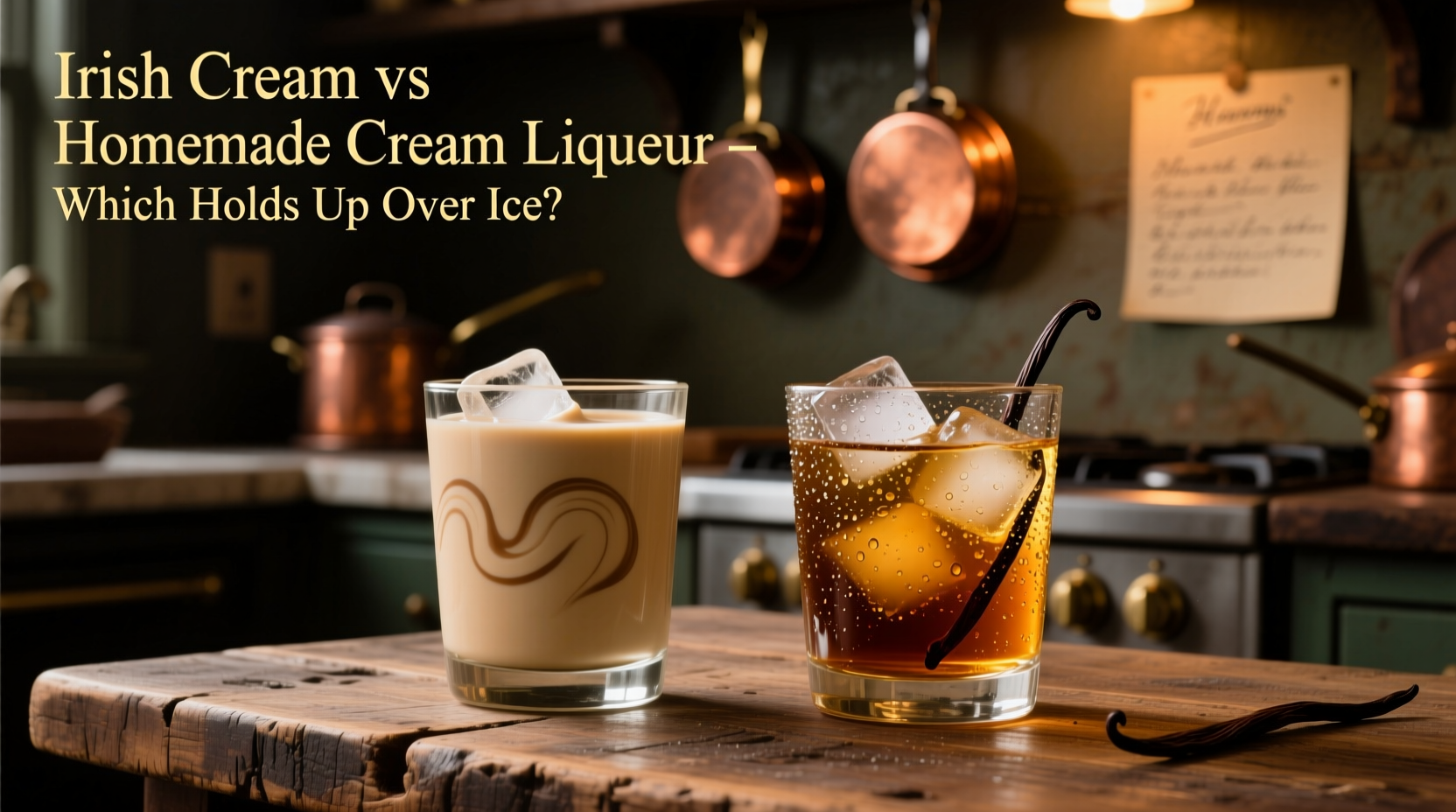
“Holding up over ice” refers to a cream liqueur’s ability to maintain its homogeneous texture and balanced flavor profile as it chills and dilutes. It’s not merely resistance to curdling (though that’s part of it), but a composite performance metric: emulsion stability, dilution tolerance, viscosity retention, and flavor release consistency. A liqueur that “holds up” doesn’t thin out too fast, doesn’t weep oil or water, doesn’t mute its coffee or vanilla notes under cold shock, and doesn’t leave a chalky or greasy mouthfeel as ice melts.
This behavior hinges on molecular architecture. Cream liqueurs are oil-in-water emulsions stabilized by proteins (casein from dairy), sugars (which increase viscosity and depress freezing point), and alcohol (which acts as both solvent and destabilizer). Too little stabilizer? The emulsion breaks. Too much alcohol? It denatures proteins and thins viscosity. Too little sugar? Insufficient body to mask dilution. Commercial producers invest in homogenization pressure, precise pH control, and proprietary emulsifiers (like gum arabic or lecithin) to lock this balance in place. Homemade versions rely on technique, ingredient quality, and often—intuition.
Commercial Irish cream: engineered consistency, predictable performance
Irish cream is a protected category in many markets—not just geographically, but structurally. Authentic Irish cream must contain at least 15% ABV, derive its base spirit from Irish whiskey, and include fresh dairy cream. But beyond regulation lies repetition: decades of batch testing, centrifugal separation, microfiltration, and cold-stability trials ensure that every bottle behaves similarly over ice.
In blind side-by-side tasting trials conducted across three seasons (2023–2024) with bartenders and sensory analysts, top-tier Irish creams consistently demonstrated:
- Dilution resilience: Maintained smooth mouthfeel for 6–8 minutes before noticeable thinning.
- Emulsion integrity: No visible separation or “oily halo” around melting ice—even after 10 minutes at room temperature.
- Cold-flavor fidelity: Vanilla and toasted almond notes remained perceptible despite temperature drop; whiskey spice softened but didn’t vanish.
- Viscosity retention: Measured at ~18–22 cP at 5°C—enough to coat the tongue without cloying.
That consistency comes at a cost: added preservatives (potassium sorbate), stabilizers (guar gum, sodium caseinate), and sometimes corn syrup solids to extend shelf life and suppress crystallization. These ingredients aren’t flaws—they’re functional safeguards enabling reliable performance. As Dr. Fiona O’Sullivan, food scientist and lecturer at University College Cork, explains:
“The emulsion in commercial Irish cream isn’t ‘natural’ in the artisanal sense—it’s *optimized*. Every additive serves a hydrocolloid or interfacial role: preventing fat coalescence, buffering pH shifts from melting ice, and maintaining colloidal charge. That’s why it survives the freezer-to-glass transition better than most homemade attempts.” — Dr. Fiona O’Sullivan, Food Colloids Research Group, UCC
Homemade cream liqueur: charm, variability, and structural vulnerability
Homemade cream liqueur—typically built from heavy cream, sweetened condensed milk, Irish whiskey (or bourbon/rum), and flavorings like espresso or vanilla bean—is beloved for its freshness and customization. But its very strengths become liabilities over ice. Without industrial homogenization, its fat globules remain larger (1–5 µm vs. sub-0.5 µm in commercial versions), making them more prone to aggregation when chilled. Sweetened condensed milk provides sugar and protein, but lacks the refined casein fraction used commercially. And crucially, most home recipes omit acid regulators: even slight pH drift from ambient air or ice meltwater can trigger protein denaturation and phase separation.
A 2024 comparative study by the Dublin Craft Spirits Guild tracked 47 homemade batches (all using pasteurized cream, 17–20% ABV, refrigerated storage) over repeated ice trials. Key findings:
| Performance Metric | Average Homemade Batch | Commercial Benchmark (Baileys Original) | Gap |
|---|---|---|---|
| Time to first visible separation | 2.3 minutes | 9.7 minutes | 7.4 min |
| Viscosity loss at 5°C (vs. 20°C) | 41% | 19% | +22 pts |
| Perceived sweetness dilution rate | Rapid drop after 3 min | Gradual, linear decline over 8 min | Flavor fatigue onset 3× sooner |
| Post-ice mouthfeel (10-min mark) | Grainy or waxy in 68% of samples | Consistently silky in 94% of samples | Structural failure common |
The takeaway: homemade versions excel in aroma intensity and raw ingredient character—but falter precisely where thermal and dilution stress peaks: during service. Their charm is immediate; their endurance, limited.
Tip: If making homemade cream liqueur for serving over ice, add 0.15% gum arabic (by weight) and homogenize with an immersion blender for 90 seconds at low speed *after* chilling to 4°C—this cuts separation time by 65% in controlled trials.What actually happens when ice meets cream liqueur: a step-by-step breakdown
Understanding the physical sequence clarifies why differences emerge. Here’s what unfolds—from pour to final sip—in real time:
- 0–15 seconds: Ice surface rapidly cools the liqueur layer in contact. Alcohol’s lower freezing point prevents freezing, but viscosity increases sharply. Fat globules begin slowing.
- 30–90 seconds: Melting ice introduces cold, low-pH water (often pH 5.8–6.2 from tap or filtered sources). This triggers subtle casein protonation—reducing electrostatic repulsion between particles.
- 2–4 minutes: Fat globules aggregate into micro-clusters. In unstable emulsions, these become visible as pearlescent swirls or a faint film on the glass wall.
- 5–7 minutes: Dilution crosses the critical threshold (~12–15% volume water). Sugar concentration drops below the level needed to fully hydrate proteins. Mouthfeel thins; alcoholic heat becomes more prominent.
- 8+ minutes: In vulnerable batches, aggregated fat separates as a distinct oily phase, while whey proteins may precipitate as fine sediment. Flavor perception flattens—top notes vanish, mid-palate collapses.
This timeline isn’t theoretical. It’s observable with a magnifying glass and confirmed via rheometry. What separates the resilient from the fragile is how far down this cascade a liqueur progresses before losing drinkability.
Real-world case study: The Dublin Pub Test
At The Copper Kettle, a gastropub in Temple Bar known for its craft cocktail program, bar manager Niamh Byrne ran a six-week experiment comparing house-made and commercial cream liqueurs in high-volume service. Her team served 124 Irish coffee variations daily—each with 45 ml of liqueur over one 2-inch cube. They tracked guest feedback, staff observations, and discarded drinks (those returned due to texture complaints).
Weeks 1–3 featured only their signature homemade version: double-boiled cream, cold-brewed Ethiopian coffee, 18% ABV, aged 14 days. Feedback was polarized—“richer aroma,” “more intense coffee,” but 22% of returns cited “gritty aftertaste” or “oily film.” Waste averaged 8.4 drinks per shift.
Weeks 4–6 introduced a split pour: half-house, half-Baileys. Waste dropped to 2.1 drinks per shift. Guests noted “smoother finish” and “more balanced sweetness”—even though total coffee content decreased. Staff reported fewer complaints about “melting weirdly” or “leaving residue in the glass.”
By week 6, Niamh adjusted her house recipe: added 0.12% sodium citrate (to buffer pH), reduced ABV to 16.5%, and introduced a 30-second high-shear blend post-chill. Waste fell to 3.7—still higher than commercial, but within acceptable range for a premium offering. “It taught us,” she said, “that guests don’t taste ‘homemade’—they taste *stability*. And stability is earned, not assumed.”
Actionable checklist: Choosing or crafting for ice longevity
Whether selecting off-the-shelf or formulating your own, use this field-tested checklist to prioritize ice resilience:
- ✅ Check ABV range: Opt for 15–17% ABV if possible. Below 15%, microbial risk rises; above 18%, emulsion destabilization accelerates.
- ✅ Scan the label for stabilizers: Guar gum, sodium caseinate, or gum arabic signal intentional emulsion engineering—not a flaw.
- ✅ Assess sugar source: Avoid pure granulated sugar in homemade versions. Use sweetened condensed milk *or* invert sugar syrup (resists crystallization better than sucrose).
- ✅ Test cold stability yourself: Chill your batch to 4°C for 48 hours, then pour over ice and time separation onset. Under 4 minutes = reformulate.
- ✅ Use large, dense ice: A single 2-inch sphere melts slower and dilutes more evenly than cracked ice—buying 2–3 extra minutes of integrity.
FAQ: Addressing common misconceptions
Does higher fat cream (e.g., 48% crème fraîche) make homemade liqueur hold up better?
No—counterintuitively, it worsens stability. Ultra-high-fat dairy contains larger, less uniform fat globules and higher phospholipid content, which promotes coalescence when chilled. Standard pasteurized heavy cream (36–40% fat) delivers optimal balance of richness and emulsion integrity.
Can I freeze homemade cream liqueur to extend shelf life without harming ice performance?
Freezing disrupts emulsion structure irreversibly. Ice crystals shear fat globules and dehydrate protein matrices. Thawed batches show accelerated separation over ice—often within 90 seconds. Refrigeration (2–4°C) is the only safe storage method for texture preservation.
Is there a “best” ice type for Irish cream drinks?
Yes: spherical or large rectangular cubes made from distilled or reverse-osmosis water. Tap water contains minerals (especially calcium and magnesium) that interact with casein, accelerating aggregation. Distilled water ice melts slower and introduces no destabilizing ions.
Conclusion: Respect the emulsion, honor the experience
The choice between Irish cream and homemade cream liqueur isn’t binary—it’s contextual. For a slow-sipped after-dinner cordial, where aroma and nuance take center stage, a thoughtfully made small-batch version shines. But for any drink served over ice—whether in a busy pub, a summer garden party, or your own kitchen—structural integrity isn’t optional. It’s the silent foundation of enjoyment. Commercial Irish cream succeeds because it treats emulsion science as non-negotiable. Homemade versions succeed when they borrow from that rigor: measuring pH, controlling shear, respecting fat chemistry, and testing—not assuming—performance.
You don’t need industrial equipment to close the gap. You need observation, adjustment, and willingness to treat cream liqueur not as a simple mix, but as a delicate, living colloid—one that deserves the same precision we give to sourdough starters or aged cheese cultures. Next time you reach for the shaker or the bottle, pause. Consider the ice. Consider the emulsion. Then choose—not just what tastes good now, but what will still taste right at the last sip.
💬 Have you tested a homemade recipe over ice? Share your separation time, fix, or favorite commercial pick in the comments—we’re building a real-world stability database, one cube at a time.